
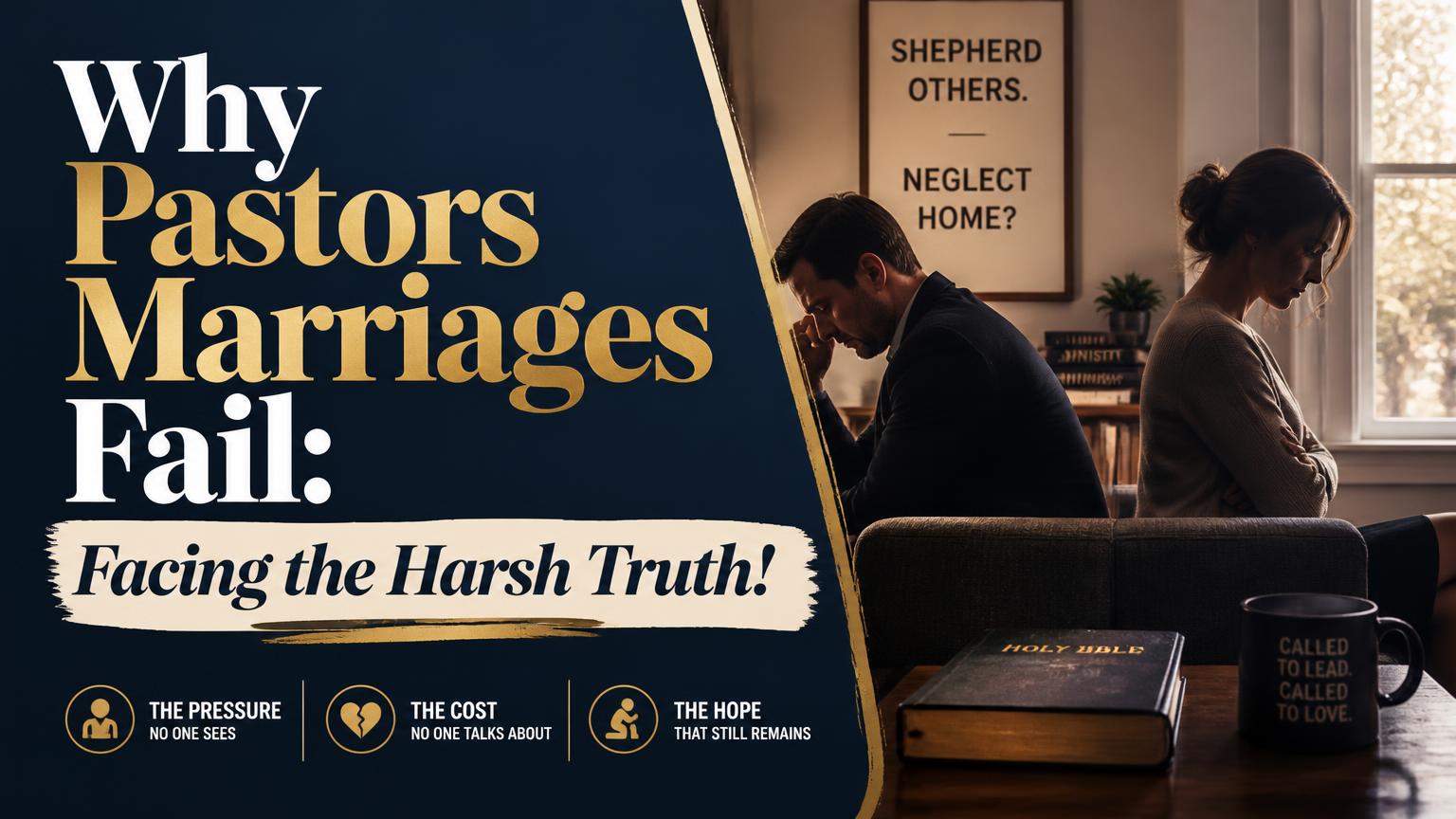
A pastor’s marriage can fail for many of the same reasons as any other marriage—neglected communication, unresolved conflict, betrayal, financial strain, or emotional disconnection. Ministry, however, can intensify those pressures because the couple’s home is often affected by public expectations, irregular schedules, spiritual authority, church conflict, and constant access to other people’s needs.
The harsh truth is that visible ministry success does not prove private marital health. A pastor may preach faithfully while avoiding difficult conversations at home. A church may celebrate sacrifice while quietly rewarding patterns that leave a spouse lonely, overburdened, or unheard. Understanding why pastors’ marriages fail requires looking beyond personal weakness to the interaction between character, relationships, boundaries, and church culture.
Why Pastors’ Marriages Fail
Pastoral marriage failure rarely has one isolated cause. More often, several pressures reinforce one another until emotional distance, secrecy, resentment, or betrayal becomes difficult to reverse.
Ministry Pressure Replaces Marital Presence
Pastoral ministry often includes evening meetings, counseling appointments, emergencies, preaching preparation, hospital visits, administration, and weekend responsibilities. A pastor may be physically present at home but mentally occupied by the congregation.
The problem is not simply having a demanding schedule. The deeper problem arises when ministry consistently receives a pastor’s best attention while the marriage receives whatever energy remains. Over time, a spouse may feel less like a cherished partner and more like an interruption to ministry.
This can happen gradually. A missed date becomes a regular pattern. A serious conversation is postponed because someone from the church needs help. Family plans are repeatedly canceled, while church commitments are treated as immovable. The pastor may believe the sacrifice is necessary, but the spouse experiences it as abandonment.
Christian service does not require neglecting one’s marriage. Ephesians 5:25 commands husbands to love their wives sacrificially, but biblical sacrifice is not a license to sacrifice the spouse for public ministry. Love includes presence, attention, protection, and a willingness to make costly changes.
Role Expectations Blur Personal Boundaries
A pastor’s spouse may be expected to teach, attend every event, host people, lead women’s ministries, manage hospitality, or project constant enthusiasm about the church. Some congregations do this explicitly; others communicate the expectation through criticism, comparison, or disappointment.
When the spouse’s voluntary support becomes an unofficial job, resentment can develop. The spouse may feel unable to say no without appearing disloyal to God or unsupportive of the pastor. The pastor may also feel caught between defending the marriage and satisfying church expectations.
Healthy boundaries clarify that a pastor’s calling is not automatically the spouse’s calling. Marriage involves mutual support, but it does not erase individual gifts, limits, privacy, or consent. A spouse should not be forced to perform a public religious role in order to validate the pastor’s ministry.
Isolation and Emotional Loneliness Go Unaddressed
Pastors and their spouses often carry information that cannot be discussed casually. A pastor may know about marital problems, financial crises, abuse, addiction, or confidential counseling situations within the congregation. The spouse may see the effects of that burden without being able to understand its details.
At the same time, pastors may hesitate to admit personal struggles because they fear losing credibility. Their spouses may also avoid honest conversations because they believe the pastor is already overwhelmed. This creates a form of loneliness inside the marriage: both people are carrying pain, but neither feels free to bring it into the relationship.
Isolation becomes especially dangerous when a couple has no trusted, mature support outside the immediate church. Confidential pastoral supervision, professional counseling, and relationships with wise Christian peers can provide perspective before frustration becomes crisis. Privacy is necessary; secrecy that prevents help is not.
Conflict Avoidance Turns into Secrecy
Some pastoral couples avoid conflict because they believe disagreement looks spiritually immature. Others fear that honest marital tension will damage the pastor’s reputation. Instead of resolving problems, they maintain a peaceful public image.
Unresolved conflict does not disappear because a couple prays, preaches, or avoids visible arguments. It often reappears as emotional withdrawal, sarcasm, defensiveness, chronic criticism, or separate lives. A pastor may use spiritual language to end a conversation rather than engage the actual issue. For example, “We need to trust God” may be true, but it does not replace an apology, a financial discussion, or a concrete change in behavior.
Secrecy can also develop around spending, private messages, counseling relationships, pornography, alcohol, or contact with a former romantic partner. Trust is damaged not only by the behavior itself but by concealment and the discovery that one spouse has been managing a second private reality.
Emotional Affairs and Sexual Boundaries Are Not Protected
Pastors regularly interact with people during moments of grief, fear, marital distress, and spiritual vulnerability. That access can create intense emotional connections. A counseling relationship may become unusually personal, or frequent private communication may gradually move beyond appropriate pastoral care.
Emotional affairs often begin without an explicit decision to betray a spouse. A pastor feels admired, understood, or needed by someone outside the marriage. Private conversations increase, transparency decreases, and the outside relationship receives emotional energy that belongs within the marriage.
Clear boundaries reduce this risk. They may include meeting in visible settings, limiting private messaging, using appropriate technology policies, involving another counselor when needed, and making ministry communication transparent to the spouse or a supervising structure. Boundaries are not an admission that every relationship is immoral. They recognize that power differences, emotional vulnerability, and repeated private access can create risks that good intentions do not eliminate.
When sexual misconduct or coercion occurs, it should not be described merely as a “marriage problem.” The pastor bears responsibility for violating trust or abusing power. The affected spouse and any congregant who was harmed need protection, truthful information, and appropriate professional and legal support.
Churches Can Reward Image over Health
A church may unintentionally create conditions that damage a pastor’s marriage. It may celebrate constant availability, treat rest as lack of commitment, expect the family to absorb ministry costs, or respond to weakness with shame rather than responsible support.
Some churches also prefer a polished pastoral family image. That pressure can make couples hide serious problems until the situation becomes explosive. A congregation that asks a pastor to appear invulnerable may receive less honesty, not greater holiness.
Church governance matters. Reasonable workloads, vacation, sabbaticals, financial clarity, pastoral supervision, counseling access, and defined emergency procedures can protect both the pastor and the congregation. A church should not make the pastor’s spouse responsible for monitoring the pastor, repairing the pastor’s character, or preserving the church’s reputation.
What Pastoral Marriage Failure Does—and Does Not—Mean
A failed or troubled pastoral marriage does not automatically prove that every sermon was false, that the pastor never loved God, or that the spouse caused the problem. Marriages involve two people, but responsibility is not always equal. Infidelity, abuse, addiction, coercive control, and financial deception require moral clarity rather than vague statements about “both sides.”
Nor does ministry pressure excuse destructive conduct. A busy schedule may explain why a couple became disconnected; it does not justify adultery. Church criticism may explain a pastor’s exhaustion; it does not justify intimidation at home. A difficult season can reveal vulnerability, but each person remains responsible for how that vulnerability is handled.
Church leaders should also distinguish marital difficulty from disqualification questions. First Timothy 3:2–5 connects Christian leadership with character and household responsibility, but applying those principles requires careful pastoral and congregational judgment. A marriage in distress is not automatically proof of hypocrisy, and public repentance is not automatically proof that trust and leadership capacity have been restored.
Restoration should be evaluated through sustained truthfulness, accountability, changed behavior, protection of anyone harmed, and appropriate counsel—not through a quick apology or pressure to resume ministry.
How Pastors and Churches Can Protect the Marriage
Protection begins before a crisis. A pastor and spouse can discuss what the calling will require, what it will not require, and which limits are nonnegotiable.
Useful practices include:
- Establishing protected time for the marriage and family, treating it as a real commitment rather than leftover time.
- Agreeing on boundaries for counseling, texting, travel, social media, and private meetings.
- Reviewing the church calendar together so ministry demands are visible rather than constantly surprising.
- Creating a process for handling congregational emergencies instead of making the pastor permanently available.
- Maintaining friendships and mentoring relationships outside the church.
- Seeking counseling early, before resentment hardens into contempt or secrecy.
- Discussing money, compensation, debt, housing, and expectations openly.
- Giving the pastor’s spouse freedom to define their own level of public involvement.
- Building a leadership structure in which the pastor is accountable to qualified peers or elders.
Scripture presents marriage as a relationship that deserves honor, not as an obstacle to spiritual usefulness. Hebrews 13:4 calls marriage honorable, and 1 Corinthians 13 describes love through patience, truthfulness, humility, and perseverance. Those qualities must be practiced privately, not merely preached publicly.
The church also has responsibilities. It should provide realistic workload expectations, protect time off, avoid gossip, take complaints seriously, and refuse to make the spouse a symbol of the church’s success. Support should not mean covering misconduct. Genuine care combines compassion with accountability.
When a Pastoral Marriage Is Already in Crisis
A couple in crisis needs an accurate diagnosis before deciding what repair should look like. Some marriages suffer from mutual disconnection and can benefit from structured counseling, honest confession, and sustained behavioral change. Others involve abuse, coercion, addiction, or serious betrayal, where immediate safety and specialized support must come first.
A spouse should not be told to remain in danger to demonstrate forgiveness. Forgiveness, reconciliation, and restoration to ministry are related but different matters. Forgiveness may be a spiritual process; reconciliation requires rebuilt trust; restoration to public leadership requires additional evaluation because other people may be placed at risk.
Professional marriage counseling can help when both spouses are willing to participate honestly. Individual counseling may be necessary when trauma, addiction, compulsive sexual behavior, depression, or abuse is present. In situations involving violence, threats, coercive control, child abuse, or sexual misconduct, safety planning and appropriate authorities take priority over preserving appearances.
A marriage can recover from serious damage, but recovery is not measured by how quickly the couple returns to public ministry. It is measured by truth replacing concealment, responsibility replacing blame, consistent change replacing promises, and safety replacing fear.
The Central Truth About Pastoral Marriages
Pastors’ marriages do not fail simply because ministry is demanding. They fail when ministry demands are allowed to override covenant responsibilities, when boundaries are treated as unnecessary, when loneliness remains hidden, or when church image becomes more important than truth.
A healthy pastoral marriage does not require perfection or constant public performance. It requires ordinary faithfulness: honest communication, protected time, accountable leadership, appropriate limits, repentance when wrong, and support strong enough to prevent the couple from carrying ministry alone. The church best honors a pastor’s calling when it refuses to treat the marriage as a ministry accessory—and helps protect the people behind the pulpit.