
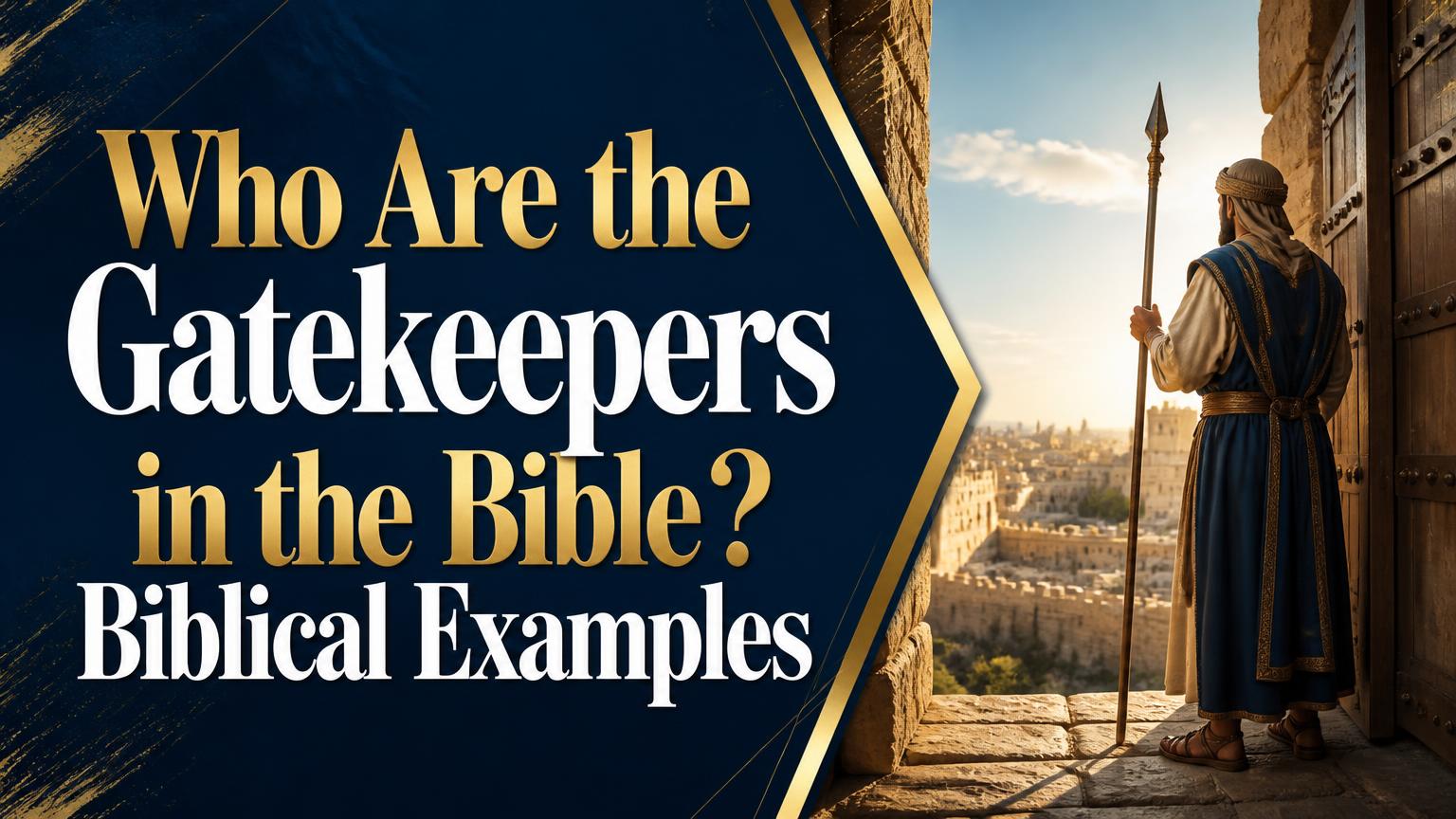
Gatekeepers in the Bible were people assigned to guard entrances, regulate access, protect sacred spaces, and oversee certain supplies. The most prominent gatekeepers were Levites who served at the tabernacle and temple. They were not merely doorkeepers in a modern sense; their responsibilities included security, maintaining worship order, guarding treasuries, and ensuring that unauthorized or ceremonially unclean people did not enter restricted areas. The Bible also uses related terms for guards at city gates, royal palaces, private homes, and symbolic sheepfolds.
Who Are the Gatekeepers in the Bible?
Temple Gatekeepers Were Levites Assigned to Sacred Access
The primary biblical gatekeepers were Levites appointed to serve at the house of God. First Chronicles 9:17–27 identifies gatekeeping families connected with Shallum, a descendant of Korah, and describes their responsibility for guarding the entrances to the temple. First Chronicles 26 gives a larger organizational account, including the families of Meshelemiah, Obed-edom, and Hosah.
These gatekeepers belonged to the tribe of Levi but were distinct from the priests who offered sacrifices. Their service was part of the wider Levitical ministry that supported Israel’s worship. David’s organization of temple duties included thousands of gatekeepers among the Levites (1 Chronicles 23:5), showing that this was an established office rather than an occasional assignment.
The position could involve both ordinary Levites and appointed leaders. Some supervised specific groups, while others served according to scheduled divisions. Their work was therefore organized, inherited through recognized families, and integrated into the administration of the sanctuary.
Their Duties Included Security, Treasuries, and Order
Gatekeepers controlled access to the temple courts and entrances. In a holy place where different areas had different levels of access, this responsibility helped preserve order and protect the sanctity of worship. During the reforms of Jehoiada, gatekeepers were stationed at the entrances of the temple so that no ceremonially unclean person could enter (2 Chronicles 23:4–8, 19).
Their duties also extended beyond watching doors. First Chronicles 9:26–27 says that leading gatekeepers were entrusted with rooms and treasuries in the house of God. They guarded vessels, offerings, and dedicated articles used in worship. Some were responsible for the chambers near the temple gates and for opening the temple each morning.
Under Hezekiah’s reforms, Kore the Levite served as the gatekeeper at the eastern gate and supervised freewill offerings brought to the temple (2 Chronicles 31:14). This example shows that gatekeepers could handle financial and material responsibilities requiring trustworthiness, not simply monitor who entered.
Named Gatekeeper Families Appear in Chronicles
First Chronicles 26 presents the gatekeepers as organized by family and assigned by lot to different locations. Meshelemiah and his sons are associated with one division, Obed-edom with another, and Hosah with another. The text also describes assignments to the east, west, north, and south sides of the temple, as well as to storehouses and other service areas.
Obed-edom is especially notable because he is often remembered for hosting the ark of the covenant in his home after its removal from the house of Abinadab (2 Samuel 6:10–12). In the temple organization, members of his family served as gatekeepers. The text does not present this as proof that every gatekeeper had the same personal history, but it does demonstrate that particular Levitical households became associated with trusted sanctuary service.
The lists in Chronicles emphasize that temple gatekeeping was a recognized ministry requiring structure and accountability. Families were not simply standing wherever they chose; they served according to assigned responsibilities within a larger system of worship administration.
Gatekeepers Continued Through Reform and Restoration
The role of gatekeepers continued through several important periods of Israel’s history. During the reforms of Jehoiada, they helped protect the temple and supported the lawful coronation of Joash (2 Chronicles 23). During Hezekiah’s reforms, gatekeepers supervised offerings and temple resources (2 Chronicles 31). These examples show that their work became especially visible when worship was being restored after neglect or corruption.
After the exile, families of gatekeepers returned with Zerubbabel. Ezra 2:42 records groups descended from Shallum, Ater, Talmon, Akkub, Hatita, and Shobai. Nehemiah also names gatekeepers serving in Jerusalem and describes them guarding the gates and storehouses (Nehemiah 11:19; 12:25).
Their continued presence in the postexilic community indicates that gatekeeping was considered necessary for the restored temple and city. Rebuilding the worship system required more than reconstructing a building; it also required restoring the personnel and responsibilities that maintained proper order.
Where Else Does the Bible Mention Gatekeepers?
City and Palace Gatekeepers
Not every biblical gatekeeper was a temple Levite. City gates were important places of defense, commerce, legal decisions, and public information. In 2 Kings 7:10, the gatekeepers of Samaria discovered that the Aramean army had abandoned its camp. Their position allowed them to monitor movement around the city and report unusual events.
Royal palaces also had people assigned to guard entrances. In the book of Esther, Bigthan and Teresh are described as officials who guarded the king’s threshold or door (Esther 2:21–23). Mordecai learned of their conspiracy, and Esther reported it to the king. These men were palace guards, not temple gatekeepers, so the same general concept applied in a different setting.
The basic function was similar: watch an entrance, control access, and protect the people or property within. The religious meaning, however, belonged especially to the Levitical gatekeepers serving at the sanctuary.
Household and Sheepfold Doorkeepers
The New Testament uses related language in ordinary and illustrative settings. In John 18:16–17, a servant girl who kept the door of the high priest’s courtyard admitted Peter. This was a household or compound entrance, not a formal temple office.
Jesus also refers to a doorkeeper in two illustrations. In John 10:3, the gatekeeper opens the sheepfold for the shepherd, while in Mark 13:34 a doorkeeper is instructed to stay awake while the master is away. These passages use a familiar occupation to communicate truths about recognition, vigilance, readiness, and rightful authority.
The gatekeeper in John 10 should not automatically be identified with a specific biblical office or interpreted as a direct reference to temple Levites. It functions within Jesus’ shepherd imagery. The image helps explain the relationship between the shepherd, the sheep, and the one responsible for the entrance.
Psalm 84 and the Desire to Serve at God’s House
Psalm 84:10 says, “I would rather be a doorkeeper in the house of my God than dwell in the tents of wickedness.” Some translations use “doorkeeper,” while others render the phrase as standing at the threshold or serving at the entrance.
The verse is poetic rather than a personnel record. It does not necessarily mean that the psalmist literally held the office of temple gatekeeper. Nevertheless, it uses the position to express humility and devotion: even the lowest or least prestigious place in God’s house is better than comfort or status among the wicked.
Because Psalm 84 is associated in its superscription with the sons of Korah, and Korahite families appear among the temple gatekeepers, the imagery has a meaningful connection with Levitical worship. Its central point, however, is the value of nearness to God, not the pursuit of an official title.
What Do Biblical Gatekeepers Teach About Service?
Faithful Service Does Not Require Public Recognition
Gatekeepers often worked at entrances, storage rooms, and service areas rather than in the most visible parts of worship. Yet Scripture records their names, families, assignments, and faithfulness. Their example shows that work can be essential even when it receives little public attention.
This principle applies beyond the temple. A community depends on people who protect, organize, prepare, maintain, and quietly carry responsibilities others may overlook. Biblical gatekeeping therefore illustrates the dignity of dependable service. The value of a task is not determined by how prominent it appears, but by whether it faithfully supports what God has entrusted to the community.
Guarding Sacred Things Required Trustworthiness
Gatekeepers were entrusted with access, offerings, vessels, and temple rooms. Their role required more than physical strength. It required judgment, reliability, and respect for what was holy. They had to distinguish appropriate access from inappropriate access and handle communal resources responsibly.
That pattern provides a useful biblical principle for leadership and service: responsibility should be joined to character. People entrusted with buildings, finances, teaching, pastoral care, or vulnerable individuals must act as stewards rather than owners. The gatekeeper’s authority was limited and accountable; the temple belonged to God, not to the person guarding it.
Gatekeepers Are Not a Named New Testament Church Office
The Bible does not establish “gatekeeper” as a standard office in the New Testament church. The temple role belonged to Israel’s Levitical worship system, while the New Testament describes church responsibilities using terms such as elders, overseers, deacons, teachers, and shepherds.
Christians may appropriately use “gatekeeping” as a metaphor for wise protection, discernment, or stewardship, but that metaphor should not be confused with a direct biblical office. In John 10, Jesus identifies himself as the door or gate for the sheep, emphasizing that access to salvation and safety is centered in him. Human leaders may serve and protect, but they do not replace Christ as the true mediator and shepherd.
Gatekeepers, Priests, and Watchmen: Important Distinctions
Gatekeepers, priests, and watchmen sometimes worked in related environments, but they were not identical roles. Priests performed sacrifices and other duties connected with the altar and sanctuary worship. Levitical gatekeepers guarded entrances, supervised access, and handled certain temple resources. Watchmen generally monitored danger, reported threats, or guarded a city, wall, or important location. Prophetic references to watchmen, such as Ezekiel 3:17, also use the term symbolically for spiritual responsibility.
There could be cooperation between these groups. During Jehoiada’s actions in 2 Chronicles 23, priests, Levites, and gatekeepers worked together to protect the temple and establish the rightful king. Cooperation, however, does not erase the distinctions among their assignments. Understanding those differences prevents the common mistake of treating every person near a gate as a temple gatekeeper or assuming that every biblical reference to a doorkeeper describes a Levite.
Conclusion
The Bible’s main gatekeepers were Levites appointed to guard the entrances, rooms, treasuries, and sacred order of the tabernacle and temple. Families such as those connected with Shallum, Meshelemiah, Obed-edom, and Hosah appear in the biblical records, while later gatekeepers served during temple reforms and after the return from exile. Other gatekeepers guarded cities, palaces, homes, and sheepfolds, so the context determines the exact meaning.
Their work demonstrates that faithful service includes protection, accountability, readiness, and care for what belongs to God. Although gatekeeping is not a formal New Testament church office, the biblical role still offers a clear principle: entrusted responsibilities should be carried out with vigilance, humility, and integrity.