
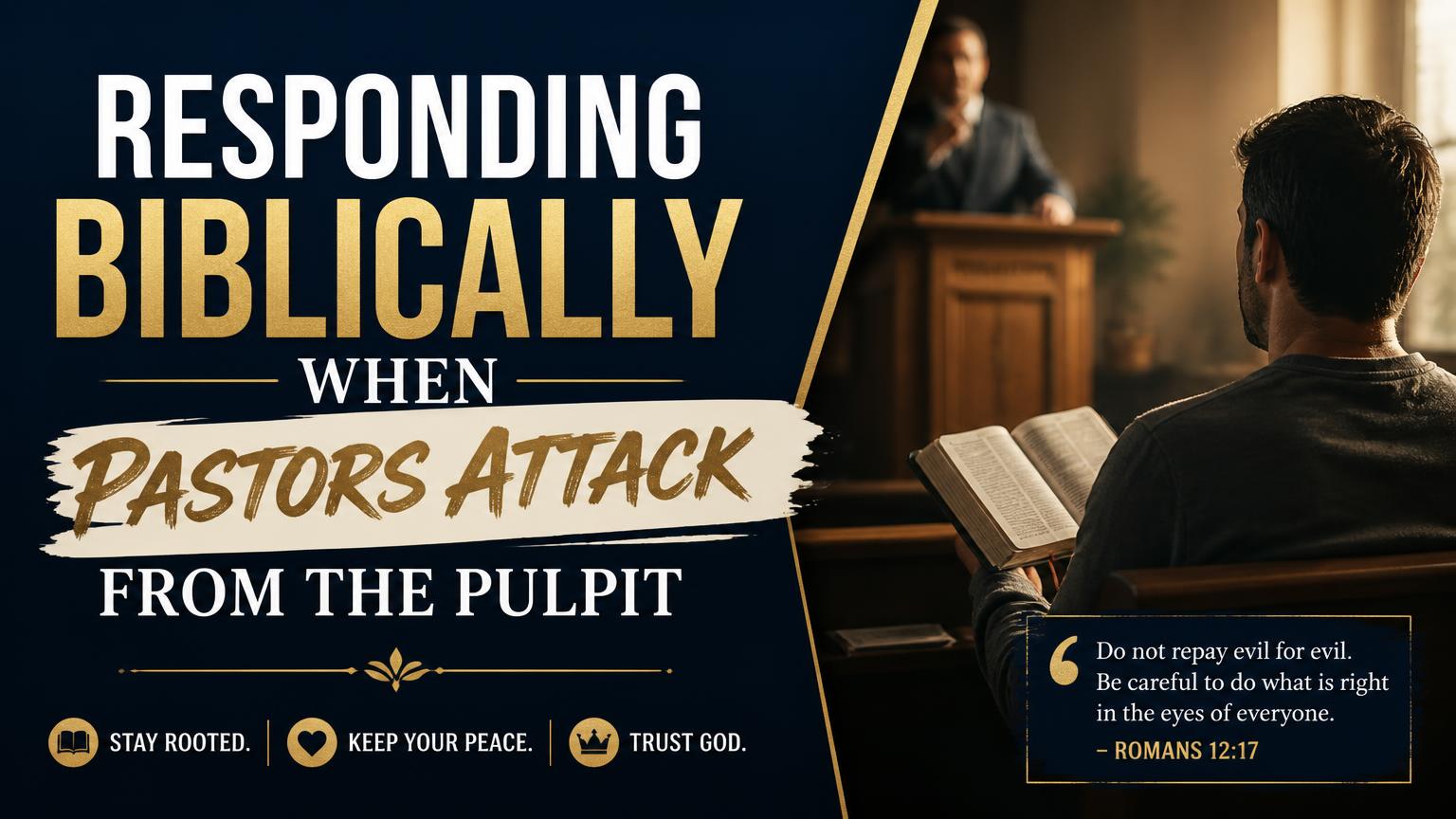
A pastor’s responsibility is to proclaim God’s truth, correct error, and shepherd people toward spiritual maturity. That responsibility does not permit public humiliation, intimidation, retaliation, or the use of sermons to settle personal disputes. When pastors attack from the pulpit, Christians need both biblical discernment and practical wisdom: distinguish faithful correction from abuse, address the matter appropriately, establish boundaries, and seek help when church leadership refuses accountability.
When Pastors Attack From the Pulpit
A difficult sermon is not automatically a personal attack. Biblical preaching can expose sin, challenge comfortable assumptions, and call a congregation to repentance. The issue is not whether a message feels uncomfortable but whether the pastor is handling Scripture faithfully and treating people with truth, justice, and love.
Correction Is Not Automatically an Attack
Faithful correction focuses on conduct, beliefs, or spiritual patterns that Scripture addresses. It does not need to identify or embarrass a particular person. Its purpose is restoration rather than domination.
Paul instructed Timothy to correct, rebuke, and encourage “with great patience and careful instruction” (2 Timothy 4:2). That combination matters. Biblical correction may be direct, but it should be patient, accurate, and aimed at spiritual good.
Jesus Himself sometimes confronted people publicly, especially when they were teaching error or harming others. Yet His public rebukes were not examples of a leader using the pulpit to vent irritation, punish disagreement, or retaliate against a critic. A pastor’s strong words should therefore be evaluated by their biblical purpose, accuracy, and manner—not merely by their intensity.
Signs a Sermon Has Become a Personal Attack
A pulpit message may cross into personal attack when it repeatedly does things such as:
- Identifies or unmistakably describes a private individual to embarrass that person before the congregation
- Reveals confidential information without a legitimate pastoral or legal reason
- Attributes evil motives without evidence
- Uses Scripture to threaten people who ask reasonable questions or raise concerns
- Mocks, belittles, or humiliates members
- Suggests that disagreement with the pastor is rebellion against God
- Uses sermons to retaliate after a conflict, resignation, complaint, or criticism
- Makes accusations that the person has no meaningful opportunity to answer
- Encourages the congregation to avoid, condemn, or pressure someone based on the pastor’s one-sided account
- Repeatedly singles out a person or group through coded references and insinuations
A single poorly chosen comment may reflect bad judgment rather than a settled pattern of abuse. Repeated behavior, refusal to acknowledge harm, coordinated retaliation, and misuse of authority provide stronger evidence that the problem is systemic.
A sermon that seems directed at you can still be misinterpreted. Before concluding that an attack occurred, consider what was actually said, whether others independently understood the message the same way, and whether the pastor has a known pattern of similar behavior. Discernment requires evidence, not only emotional reaction.
Why Public Attacks Are Spiritually Harmful
Public attacks are especially damaging because the pulpit carries spiritual authority. A pastor can make a personal opinion sound like divine judgment, and a congregation may assume that the pastor’s version of events is complete simply because it was delivered in a sermon.
This can produce shame, fear, isolation, and confusion. It can also distort a person’s view of God if pastoral hostility is presented as God’s displeasure. Scripture condemns shepherds who use their position to dominate rather than serve. Jesus taught that Gentile rulers “lord it over” others, but His followers must lead through service rather than control (Mark 10:42–45). Peter likewise instructed elders to shepherd willingly and avoid domineering over those entrusted to them (1 Peter 5:2–3).
The harm affects the congregation as well as the targeted person. Members may learn that silence is safer than honesty, that loyalty to a leader matters more than truth, or that spiritual language can be used to escape accountability. That is not healthy pastoral authority; it is a corruption of it.
How Should Christians Respond to a Pastor’s Public Attack?
The wisest response is neither immediate retaliation nor passive acceptance. Respond in stages, increasing the level of involvement as the seriousness and persistence of the conduct become clearer.
Record What Happened Without Exaggeration
Write down the date, setting, relevant wording, and people who heard the message. Preserve a recording only if doing so is lawful and consistent with church policy. Separate direct quotations from your interpretation of what the pastor meant.
This record serves two purposes. It prevents memory from being reshaped by distress, and it allows mature advisers to evaluate the situation objectively. Do not circulate edited clips or inflammatory summaries before you understand the full context.
Examine Your Own Conduct Honestly
Ask whether you contributed to the conflict, misunderstood the message, or are resisting a legitimate biblical correction. This is not an instruction to accept false guilt. It is an application of Jesus’ teaching to examine the log in your own eye before addressing the speck in another’s (Matthew 7:3–5).
Repentance and self-examination protect the response from becoming a counterattack. If you did wrong, acknowledge it plainly. If the pastor still treated you unjustly, your own imperfect conduct does not authorize public humiliation.
Seek a Private Conversation When It Is Safe
Jesus gave a pattern of addressing personal offenses directly before involving others (Matthew 18:15). If the situation is not threatening, request a calm private conversation. Describe the specific words or conduct, explain the impact, and ask for clarification.
Use language that focuses on observable facts:
“In the sermon on Sunday, you referred to a member who questioned the leadership and said that person was spiritually dangerous. I understood that description to refer to me. Was that your intention?”
A private conversation may reveal a misunderstanding, or it may show whether the pastor is willing to accept correction. A healthy leader can listen, clarify, acknowledge mistakes, and pursue reconciliation. A defensive response does not automatically prove wrongdoing, but contempt, threats, denial of obvious facts, or retaliation are serious warning signs.
Do not insist on a private meeting if the pastor has threatened you, has a history of intimidation, has disclosed private information, or controls the setting in a way that makes honest conversation unsafe. Bring a trusted person, use written communication, or seek outside assistance instead.
Involve Mature and Independent Witnesses
If the conversation fails, involve people who are spiritually mature and sufficiently independent to assess the matter. Depending on the church’s structure, this may include elders, denominational leaders, a governing board, or respected pastors outside the congregation.
Matthew 18:16 emphasizes the value of witnesses, while 1 Timothy 5:19–20 addresses accusations involving elders. The principle is not to protect leaders from all scrutiny. It is to prevent rumor and careless accusations while ensuring that persistent, substantiated wrongdoing is addressed openly.
Choose advisers who can ask hard questions of everyone involved. Friends who automatically affirm your interpretation may provide emotional support but not reliable discernment. Likewise, church officers who are financially or relationally dependent on the pastor may lack practical independence.
Correct the Record Without Creating a Second Attack
If the pastor publicly made a false statement about you, you may need a measured public clarification. Keep it factual and limited. State what was false, provide the relevant correction, and avoid speculating about the pastor’s character.
Do not use social media, another sermon, or private conversations throughout the congregation to punish the pastor. Proverbs 15:1 commends a gentle answer, and Romans 12:17–21 warns Christians not to repay evil with evil. Refusing retaliation does not require surrendering the truth; it means pursuing correction without adopting the same destructive methods.
Biblical Standards for Pastoral Authority
Pastoral authority is real, but it is delegated authority. A pastor serves under Christ and remains accountable to Scripture, the church, and other leaders.
Shepherds Must Serve Rather Than Dominate
The New Testament describes pastors as shepherds, teachers, and servants—not as rulers whose preferences are beyond question. Jesus identified servant leadership as the pattern for His followers (Mark 10:43–45). Peter warned elders not to be domineering (1 Peter 5:3).
Therefore, “submit to your leaders” in Hebrews 13:17 cannot reasonably mean obey every personal demand or remain silent about misconduct. Christian submission is not blind loyalty to a personality. It is a willingness to receive faithful spiritual guidance while recognizing that leaders themselves must obey Christ.
Leaders Must Handle Truth and People Carefully
James warns that teachers will be judged more strictly (James 3:1). Pastors handle both Scripture and the reputations of people, so careless accusations have serious consequences.
A pastor may not transform private information into public ammunition simply because the information is technically true. Truth must be used justly, proportionately, and with regard for confidentiality. Even when a person has sinned, public disclosure should serve a legitimate purpose rather than satisfy anger or strengthen a leader’s control.
Discipline and Accountability Must Be Fair
The Bible does not require churches to ignore serious pastoral misconduct. It requires allegations to be handled carefully, evidence to be considered, and persistent sin to be confronted. A pastor should neither be condemned by rumor nor shielded by position.
If church leaders dismiss every concern as rebellion, invoke spiritual authority to avoid questions, or punish those who report misconduct, the congregation is no longer practicing biblical accountability. The problem may involve the wider leadership culture rather than only one sermon.
When a Church Should Escalate the Matter
Some situations require more than a private conversation. Escalate the matter when the pastor:
- Makes repeated public attacks
- Spreads knowingly false allegations
- Retaliates against people who raise concerns
- Threatens employment, housing, family relationships, or spiritual standing
- Exposes confidential counseling or personal information
- Targets vulnerable people
- Encourages harassment or exclusion
- Refuses review by other qualified leaders
- Engages in sexual misconduct, financial abuse, coercive control, or criminal behavior
If the church has a denomination, board, or formal complaint process, follow it carefully and keep copies of relevant communication. If there is abuse, a credible threat, exploitation of a minor, sexual assault, or another possible crime, contact appropriate civil authorities and qualified professionals. Church processes should not replace emergency services, legal protection, or safeguarding obligations.
It may also be wise to seek counseling from someone who understands spiritual abuse. A pastor’s attack can produce anxiety, shame, and self-doubt even when the targeted person did nothing wrong. Support can help a person distinguish conviction from manipulation and make decisions without panic.
When Leaving the Church Is Wise
Leaving is not always the first or only response, but it can be a faithful decision when leadership is persistently abusive, unrepentant, or unwilling to accept accountability. Christians are not required to remain under destructive leadership to prove loyalty or forgiveness.
Before leaving, consider practical matters such as housing, employment, children’s safety, financial dependence, and the availability of a healthier congregation. If the environment is unsafe, leave promptly and explain details only to people who need to know. You do not need the abusive leader’s permission to establish distance.
Forgiveness does not mean restored trust without repentance. Reconciliation requires truth, responsibility, and changed behavior. A person may release personal vengeance before God while still maintaining firm boundaries and declining to return to an unsafe leadership environment.
A Faithful Way Forward
When pastors attack from the pulpit, the right response combines truth, humility, courage, and restraint. First distinguish biblical correction from personal retaliation. Then document the facts, examine your own conduct, seek a safe private conversation when possible, and involve independent leaders if the problem persists. Serious abuse, threats, and criminal conduct require appropriate outside help.
Pastoral authority exists to protect and build up Christ’s people, not to shield leaders from scrutiny or give them control over consciences. Faithfulness may involve reconciliation, formal accountability, or leaving a harmful church. In every case, the goal is not to win a personal battle but to honor truth, protect people, and pursue the kind of shepherding Scripture requires.