
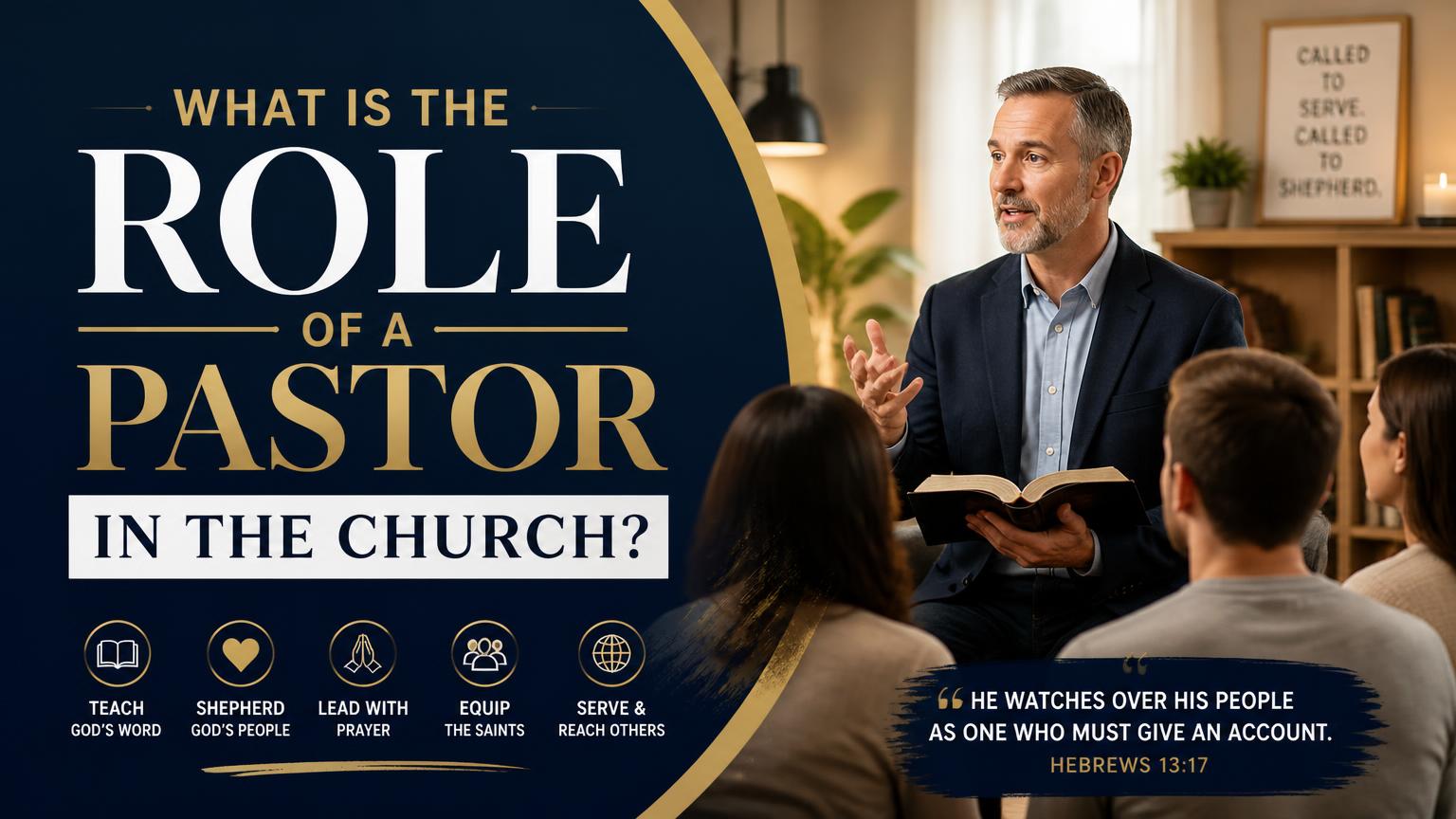
A pastor’s role in the church is to shepherd God’s people by teaching Scripture, caring for members, leading the congregation, guarding sound doctrine, and equipping believers for ministry. The pastor serves under the authority of Jesus Christ rather than replacing Christ as the church’s head. Although specific responsibilities differ among denominations and congregations, biblical pastoral ministry combines spiritual oversight, faithful teaching, personal care, and servant leadership.
What Is the Role of a Pastor in the Church?
The word pastor comes from a term meaning “shepherd.” This image describes the pastor’s central responsibility: guiding, feeding, protecting, and caring for a congregation as it follows Christ. Jesus is the “Chief Shepherd” (1 Peter 5:4), so pastors exercise delegated responsibility rather than independent authority.
The New Testament also connects the work of pastors with the ministries of elders and overseers. These terms can overlap, although different denominations organize church leadership in different ways. In every case, the pastor’s authority is meant to serve the spiritual well-being of the church, not personal status or control.
Shepherd God’s People
Pastors provide spiritual direction and care for the congregation. Like a shepherd who watches over a flock, a pastor helps believers understand God’s Word, recognize spiritual dangers, grow in faith, and remain connected to the life of the church.
Peter instructed church elders to shepherd God’s flock willingly and eagerly, “not lording it over those entrusted to you, but being examples to the flock” (1 Peter 5:2–3). This establishes an important boundary: pastoral leadership is accountable, humble, and exemplary. A pastor does not own the congregation. The church belongs to Christ.
Shepherding may include:
- Praying with and for church members
- Visiting people who are sick, grieving, elderly, or isolated
- Offering biblical counsel during difficult decisions
- Helping reconcile conflict
- Encouraging spiritual growth
- Supporting families and marriages
- Responding to crises and serious pastoral needs
- Helping new believers become established in the faith
Pastoral care is more than kindness or emotional support. It applies the truth and hope of the gospel to real circumstances while respecting the limits of the pastor’s training. Serious mental-health, medical, legal, or safety concerns may require qualified professionals or emergency services in addition to pastoral support.
Teach and Guard the Faith
Teaching Scripture is one of the pastor’s most important responsibilities. A pastor normally preaches, explains biblical doctrine, leads Bible studies, and helps the congregation apply Christian truth to daily life.
Paul told Timothy to “preach the word” and to correct, rebuke, and encourage with patience and careful instruction (2 Timothy 4:2). This means pastoral teaching should do more than provide inspiration. It should explain what the Bible says, how its message fits together, what it reveals about God and salvation, and how it shapes Christian conduct.
Pastors also help protect the church from false teaching. This requires knowing Christian doctrine, recognizing distortions of the gospel, and addressing error without treating every disagreement as equally serious. Sound teaching should produce maturity, wisdom, holiness, and love rather than pride or dependence on the teacher.
Because pastors teach publicly and influence others, Scripture treats the role as a serious responsibility. James 3:1 warns that teachers will be judged more strictly. The warning emphasizes that pastoral ministry requires integrity, careful interpretation, and humility.
Lead Worship, Prayer, and Christian Practices
Depending on the church tradition, pastors lead or participate in worship services, prayer gatherings, baptisms, and the Lord’s Supper. They may also officiate at weddings, funerals, child dedications, confirmations, or other services.
These responsibilities are not merely ceremonial. Worship gathers the church around God’s character and saving work. Baptism publicly identifies a believer with Christ, while the Lord’s Supper directs the church toward Christ’s death, covenant, and continuing fellowship with his people. Pastors help ensure that these practices are understood and carried out faithfully.
Pastors also model a life of prayer. In Acts 6:4, the apostles described their priorities as prayer and ministry of the Word. While this passage does not create a rigid job description for every modern pastor, it illustrates a lasting principle: public leadership should arise from dependence on God rather than from organizational skill alone.
Equip Believers for Ministry
A pastor is not meant to perform every ministry in the church. Ephesians 4:11–12 describes pastors and teachers as gifts Christ gives to equip the saints for the work of ministry and to build up the body of Christ.
This means the pastor’s success cannot be measured only by how many tasks the pastor personally completes. Healthy pastoral leadership helps members discover their gifts, grow in maturity, serve one another, and participate in the church’s mission.
In practice, this may involve:
- Training teachers, small-group leaders, and ministry volunteers
- Mentoring emerging leaders
- Encouraging evangelism and discipleship
- Organizing ministries around genuine needs
- Delegating responsibilities wisely
- Creating structures that allow members to serve safely and effectively
A congregation can become unhealthy when every decision and ministry depends on one person. Equipping others distributes responsibility, develops mature believers, and reflects the New Testament picture of the church as a body with many members and gifts (1 Corinthians 12:12–27).
Lead the Church With Wisdom and Accountability
Pastors often provide leadership in decisions about worship, discipleship, staffing, finances, missions, facilities, and community involvement. Yet biblical leadership is not identical to corporate control. Pastors should lead in cooperation with appropriate elders, deacons, ministry leaders, and the congregation’s governing structure.
The New Testament presents church leaders as servants and examples. Jesus rejected the model of authority that seeks status over others, teaching that greatness among his followers is expressed through service (Mark 10:42–45). A pastor therefore makes decisions with truth, prayer, transparency, consultation, and concern for people rather than personal influence.
Accountability is essential. A pastor should not be placed beyond correction or scrutiny. Depending on the denomination, accountability may involve elders, denominational bodies, congregational votes, supervisory boards, financial controls, safeguarding procedures, or other forms of oversight. These structures protect both the congregation and the pastor.
What Qualifications Should a Pastor Have?
The central qualifications for pastoral leadership concern character, doctrine, relationships, and spiritual maturity—not charisma, popularity, wealth, or platform size.
In 1 Timothy 3:1–7 and Titus 1:5–9, Paul emphasizes qualities such as:
- Integrity and self-control
- Faithfulness in marriage and family life
- Hospitality
- Humility rather than arrogance
- The ability to teach
- A good reputation in the wider community
- Emotional and relational maturity
- Freedom from greed and abusive behavior
- Commitment to sound doctrine
- The ability to encourage believers and correct error appropriately
These passages do not imply that a pastor must be flawless. They describe a recognizable pattern of mature Christian character. A person may preach well and still be unfit for pastoral leadership if that person is manipulative, dishonest, abusive, financially reckless, or unwilling to receive correction.
The qualifications also show that pastoral ability is not merely professional competence. Education, communication skills, and administrative ability can be valuable, but the biblical test reaches deeper: does the person’s life support the message being taught?
How Is a Pastor Different From Other Church Leaders?
Church leadership structures differ, so titles cannot always be compared precisely across traditions. Still, several broad distinctions are useful.
An elder usually refers to a spiritually mature leader responsible for oversight, teaching, and care. In some churches, “pastor” is the title of a vocational or paid elder who leads a congregation. In others, pastors and elders have distinct roles.
A bishop or overseer emphasizes responsibility for supervision. Some traditions use the term for a regional leader over multiple churches; others understand it as closely related to the local pastor or elder.
A deacon generally serves the practical and congregational needs of the church. Acts 6 connects servant leadership with ensuring that important needs are not neglected, although the exact role of deacons varies across denominations.
A priest is a title used in traditions with a sacramental and episcopal understanding of ordained ministry. Some churches use “pastor,” “priest,” and “minister” in different ways, while others use them almost interchangeably. The terminology should therefore be interpreted within the church’s theological tradition.
Regardless of the title, no pastor replaces the unique mediating work of Jesus Christ. First Timothy 2:5 identifies Christ as the one mediator between God and humanity. Pastoral ministry points people to Christ rather than making the pastor the necessary gateway to God.
What Does a Pastor Do During a Typical Week?
A pastor’s visible work may center on Sunday worship, but the role usually includes extensive preparation and less visible service. A typical week might include:
- Studying and preparing sermons or lessons
- Praying for the congregation
- Meeting with individuals, couples, or families
- Visiting hospitals, care facilities, or homes
- Planning worship services and ministry programs
- Training leaders and volunteers
- Attending staff or elder meetings
- Counseling and making referrals when appropriate
- Conducting weddings, funerals, baptisms, or communion
- Responding to emergencies
- Managing or reviewing administrative responsibilities
- Engaging in evangelism and community ministry
The balance varies. A small-church pastor may handle administration, visitation, preaching, and facility work personally. A pastor in a larger church may lead a staff and concentrate more on preaching, leadership development, and oversight. Some pastors serve bivocationally while working another job, and their responsibilities must be understood in light of the time and resources available.
A church should not judge pastoral faithfulness only by public visibility. Much of pastoral ministry consists of patient, repeated work: listening carefully, teaching consistently, praying persistently, and helping people remain faithful through ordinary seasons.
What Is the Congregation’s Responsibility?
The pastor has a particular leadership role, but ministry belongs to the whole church. Every Christian is called to follow Christ, love fellow believers, use spiritual gifts, make disciples, and serve others.
Hebrews 13:17 calls believers to respect godly leaders, while other passages command mutual encouragement, bearing one another’s burdens, and speaking truth in love. These responsibilities work together. The congregation should support faithful leadership, pray for its pastors, offer appropriate correction, and refuse to treat the pastor as either a celebrity or a servant who exists to meet every demand.
Pastors also need rest, boundaries, family care, and meaningful accountability. Expecting one person to provide every form of counseling, visit every member, lead every program, solve every conflict, and remain constantly available is neither realistic nor biblically necessary. Shared ministry is healthier for the pastor and the congregation.
Common Misunderstandings About Pastoral Ministry
A Pastor Is Not the Church’s Sole Minister
The pastor has a distinct office or calling, but the church is not meant to be a performance centered on one professional. Christ gives gifts throughout the body, and members share responsibility for ministry.
A Pastor Is Not a Spiritual Autocrat
Pastoral authority is real, but it is limited by Scripture, the church’s accountability structures, and the servant-shaped example of Jesus. Leadership that relies on intimidation, secrecy, manipulation, or unquestioned personal loyalty contradicts biblical shepherding.
Pastoral Care Is Not the Same as Professional Therapy
Pastors can provide prayer, spiritual guidance, biblical counsel, and relational support. They should also recognize when a situation requires licensed clinical care, medical attention, legal help, or protection from abuse. Referring someone to another qualified professional is responsible care, not pastoral failure.
Success Is Not Measured Only by Attendance or Visibility
Large crowds, polished communication, and online influence do not by themselves demonstrate faithful ministry. Biblical evaluation also considers doctrine, character, love, spiritual maturity, justice, humility, and whether believers are being equipped to follow Christ.
A pastor’s role in the church is to serve as a faithful shepherd under Jesus Christ. Pastors teach and protect the faith, care for people, lead worship and prayer, equip believers for ministry, and guide the congregation with humility and accountability. The role is neither personal domination nor spiritual celebrity; it is entrusted service. Healthy pastoral ministry helps the church depend more deeply on Christ, grow in truth and love, and participate together in God’s mission.