
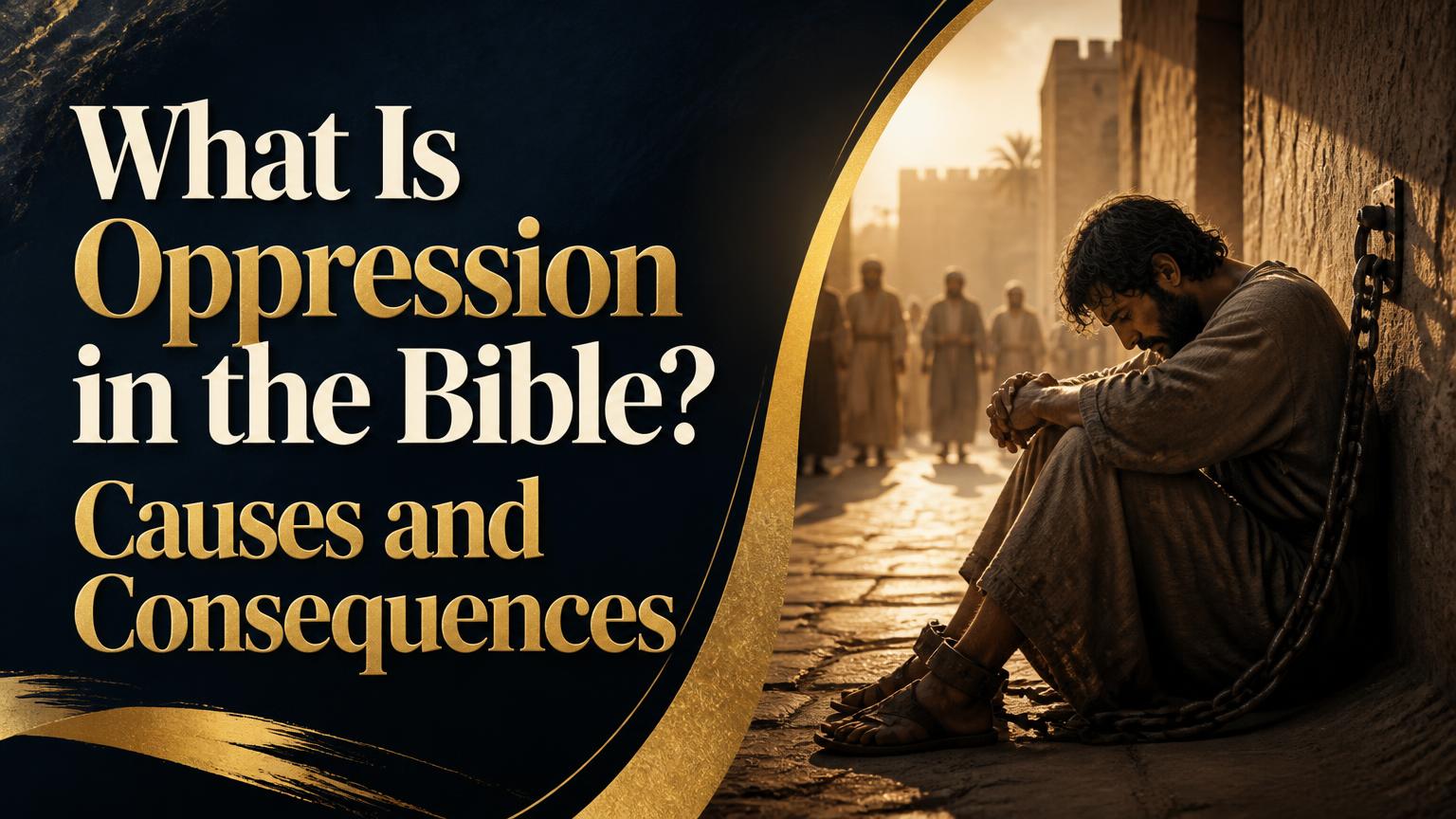
Oppression in the Bible refers to the unjust use of power to burden, exploit, silence, or deprive other people. It can involve slavery, forced labor, dishonest courts, withheld wages, land theft, predatory debt, political abuse, or discrimination against vulnerable groups. Scripture treats oppression as both a personal sin and a social evil. It repeatedly shows God hearing the cry of the oppressed, judging those who exploit them, and commanding his people to practice justice, defend the vulnerable, and reject partiality.
What Is Oppression in the Bible?
Biblical Meaning of Oppression
Biblical oppression is more than ordinary hardship or an unequal outcome. It occurs when a person or institution uses power, wealth, authority, violence, or social advantage to crush another person unjustly. The oppressor may take what belongs to someone else, deny a legitimate right, manipulate legal processes, withhold fair compensation, or make escape from exploitation difficult.
The Bible frequently connects oppression with words and images such as crushing, extorting, defrauding, robbing, trampling, and placing heavy burdens on others. Exodus 3:7–9 describes Israel’s suffering under forced labor in Egypt as oppression that God sees and hears. Deuteronomy 24:14–15 warns employers not to exploit poor laborers by withholding their wages. These passages show that oppression may occur through both obvious violence and ordinary economic practices that take advantage of vulnerability.
Oppression is therefore defined by injustice and abuse, not merely by the existence of authority or difficulty. Parents, governments, employers, church leaders, and other authorities may exercise legitimate responsibility without oppressing anyone. Authority becomes oppressive when it serves the powerful at the expense of the weak or treats people as tools rather than as human beings made in God’s image.
Who Is Commonly Oppressed in Scripture?
The Bible repeatedly mentions groups whose limited social or economic power made them vulnerable: the poor, widows, orphans, foreigners, servants, debtors, laborers, and people without influential advocates. This does not mean that only members of these groups can experience oppression. It means that Scripture recognizes how dependence and disadvantage can make exploitation easier.
The repeated concern for these groups also reveals a biblical principle: justice must account for unequal power. Treating everyone identically is not always just if one person can easily defend personal interests while another has no meaningful access to protection. Psalm 82:3–4 calls God’s people to defend the weak and needy, rescue the poor, and deliver them from the hand of the wicked.
Why Does Oppression Happen?
The Bible identifies several connected causes of oppression. Greed turns another person’s need into an opportunity for profit. The desire for control leads rulers, employers, and individuals to treat people as possessions. Partiality causes courts and communities to favor the rich or influential. Fear and indifference allow injustice to continue because those with power choose not to intervene.
Prophetic passages often expose the relationship between private sin and public injustice. Isaiah 10:1–2 condemns those who make unjust laws and deprive the poor of their rights. Amos 2:6–7 and 5:11–12 describe the exploitation of the poor, bribery, dishonest trade, and abuse of legal power. Oppression can therefore be personal, institutional, or both. A corrupt system is sustained by individual choices, while individual choices become especially destructive when laws and customs protect them.
How Does God Respond to Oppression?
God’s response to oppression includes compassion, attention, judgment, and deliverance. Exodus 3 portrays God as one who sees Israel’s suffering, hears their cries, knows their pain, and acts against the power that enslaves them. This language rejects the idea that God is indifferent to social injustice or concerned only with private religious devotion.
The prophets also announce judgment on oppressors. James 5:4 declares that the unpaid wages of exploited workers cry out to God. Psalm 12:5 presents God as rising to protect the poor because they are plundered and the needy groan. Divine patience should not be mistaken for approval. Scripture may describe a delay before judgment, but it consistently treats oppression as accountable before God.
God’s concern does not mean that every oppressed person receives immediate earthly relief. The Bible includes faithful people who suffer for long periods without visible rescue. Its teaching is instead that injustice is never morally invisible to God, and final judgment belongs to him even when human courts fail. This gives hope to victims while also warning communities not to normalize exploitation.
Biblical Examples of Oppression
Israel’s Oppression in Egypt
Israel’s slavery in Egypt is one of Scripture’s clearest examples of oppression. Pharaoh imposed forced labor, appointed taskmasters, and treated an entire people as a threat to be controlled. The suffering involved physical labor, political domination, family separation, and an attempt to destroy Israel’s future through the killing of male infants.
God’s deliverance of Israel does not present freedom as merely personal escape. He confronts Pharaoh’s system, forms Israel into a covenant people, and later commands them to remember their own experience as oppressed foreigners. Because Israel knew what oppression felt like, they were forbidden to exploit foreigners, widows, or the poor. Their memory of suffering was meant to produce justice rather than a new cycle of domination.
Oppression Condemned by the Prophets
The prophets frequently challenged oppression within Israel itself. Amos condemned wealthy people who lived comfortably while poor people were exploited. Micah 2:1–2 describes people who planned to seize fields and houses because they had the power to do so. Isaiah criticized rulers who created laws that deprived the poor of justice.
These passages show that biblical oppression is not limited to slavery or military conquest. It can occur through property fraud, unfair taxation, corrupt courts, exploitative commerce, and legal systems designed to protect privilege. The prophets judged worship as hypocritical when religious activity existed alongside cruelty. Amos 5:21–24 makes clear that God rejects public worship when justice is absent from public life.
Jesus and the Oppressed
Jesus announced good news to the poor, liberty to captives, recovery of sight to the blind, and freedom for the oppressed in Luke 4:18–19. His ministry included healing, restoration, table fellowship with excluded people, and direct challenges to religious and social practices that burdened others. He also warned against leaders who placed heavy burdens on people while refusing to help carry them.
Jesus himself experienced unjust treatment through betrayal, manipulated testimony, political expediency, and execution by crucifixion. His suffering does not make oppression acceptable; it reveals the seriousness of human injustice and God’s ability to bring redemption through the suffering of the innocent. The resurrection declares that oppressive power does not have the final word.
What Are the Consequences of Oppression?
Harm to the Oppressed
Oppression produces physical, economic, emotional, and spiritual harm. It can deprive people of food, wages, housing, safety, family stability, education, or legal protection. It may also create fear and humiliation because victims learn that those with authority can violate their rights without consequence.
The Bible takes these effects seriously rather than treating them as incidental inconveniences. The cries of the oppressed appear repeatedly in the Psalms because injustice affects a person’s relationship with community, security, and hope. Scripture gives victims permission to lament, appeal to God, seek justice, and name wrongdoing truthfully.
Corruption of Communities
Oppression damages more than its immediate victims. It corrupts courts, economies, families, churches, and governments by rewarding dishonesty and teaching people that power matters more than truth. When exploitation becomes normal, bystanders may lose their moral sensitivity, while victims may become trapped in poverty or excluded from meaningful participation.
This is why biblical commands about justice address the whole community. Deuteronomy required honest weights, fair treatment of laborers, and protection for vulnerable people. These practices were intended to prevent prosperity from becoming a license to exploit. Justice protects relationships by placing limits on what the powerful may do.
Judgment on Oppressors
Oppression also brings moral and spiritual danger to the oppressor. Repeatedly using power against others can harden the conscience and create the illusion that success proves righteousness. Scripture rejects that illusion. Wealth, office, legal authority, or social respect cannot shield a person from God’s judgment.
The Bible does not suggest that every oppressor suffers immediate consequences. Some appear to prosper for a time, which is why biblical writers sometimes ask why the wicked succeed. Yet the consistent message is that God judges hidden motives and public actions. Repentance requires more than regret; it involves stopping exploitation, making restitution where possible, and pursuing changed conduct.
How Should Christians Respond to Oppression?
Defend Those Without Power
Christians are commanded to speak for people whose voices are ignored. Proverbs 31:8–9 urges readers to speak up for those who cannot speak for themselves and to defend the rights of the poor and needy. This may involve reporting abuse, supporting fair treatment, challenging discriminatory practices, accompanying vulnerable people in legal or institutional settings, or helping them obtain practical protection.
Biblical advocacy should not be reduced to angry speech. It seeks truth, protects victims, and aims at just action. It also requires listening carefully because people experiencing oppression may understand dangers that outsiders do not see.
Practice Justice and Mercy Together
Micah 6:8 summarizes the believer’s calling as doing justice, loving mercy, and walking humbly with God. Justice addresses wrongdoing and restores what has been denied. Mercy refuses to treat people as disposable. Humility recognizes that even those who oppose oppression can misuse power or assume they understand every situation.
James 1:27 connects faithful religion with caring for orphans and widows in distress. This does not mean that compassion replaces structural change. Direct help may relieve immediate suffering, while wise advocacy addresses the conditions that caused it. Both forms of service can be necessary.
Reject Partiality and Exploitation
James 2:1–9 warns Christians not to honor the rich while humiliating the poor. The church must not reproduce the same status systems that biblical prophets condemned. This applies to financial decisions, leadership, employment, discipline, hospitality, and the treatment of outsiders.
Christians should also examine less visible forms of exploitation: unpaid or unfair labor, manipulation of dependent people, dishonest business practices, coercive leadership, and the misuse of confidential information. Biblical justice begins with concrete conduct, not only public declarations.
Pursue Justice Without Becoming Oppressive
Opposition to oppression does not authorize hatred, false accusations, revenge, or the abuse of new power. Romans 12:19 tells believers to leave vengeance to God, while Romans 12:21 calls them to overcome evil with good. This does not prohibit lawful protection or appropriate consequences for wrongdoing. It means that the pursuit of justice must not become a pretext for cruelty.
Christian action should protect the vulnerable, tell the truth, hold offenders accountable, and seek restoration where genuine repentance makes it possible. Forgiveness, when appropriate, does not require denying harm, abandoning boundaries, or removing necessary safeguards.
How Is Oppression Different From Suffering and Persecution?
Oppression Is Not Identical to Every Hardship
The Bible uses language of affliction broadly, but not every painful experience is oppression. Illness, bereavement, natural disaster, personal failure, and the ordinary difficulties of life may cause real suffering without being caused by an oppressor. Calling every hardship oppression can obscure the specific responsibility involved in injustice.
Oppression requires an element of wrongful domination, exploitation, deprivation, or abuse. A person may suffer without being oppressed, and a person may be oppressed even when outsiders do not recognize the harm. Careful discernment asks what happened, who had power, whether rights or duties were violated, and whether the harm was intentional, negligent, or embedded in a system.
Oppression Can Include Persecution, but the Terms Differ
Persecution is hostility directed at someone because of identity, belief, or allegiance, particularly religious faith. Oppression is broader and includes economic, legal, social, political, and physical exploitation. Christians may experience both at once. For example, a believer could be denied employment because of faith and then threatened by authorities for practicing that faith.
The distinction matters because different forms of injustice may require different responses. Persecution may call for endurance and faithful witness, while economic exploitation may require restitution, labor protections, or legal intervention. In both cases, Scripture calls for courage, truthfulness, prayer, and concern for those who suffer.
Conclusion
Oppression in the Bible is the unjust misuse of power that exploits, silences, burdens, or deprives vulnerable people. Scripture describes it in slavery, corrupt courts, withheld wages, land theft, partiality, abusive leadership, and social exclusion. God sees the suffering of the oppressed, condemns those who profit from injustice, and commands his people to defend the weak and practice fair dealing.
The biblical response joins compassion with accountability. Christians should distinguish oppression from suffering in general, protect victims without seeking revenge, and pursue justice without copying the domination they oppose. Biblical faith therefore treats justice as a concrete obligation expressed through truthful speech, responsible authority, practical mercy, and resistance to exploitation.