
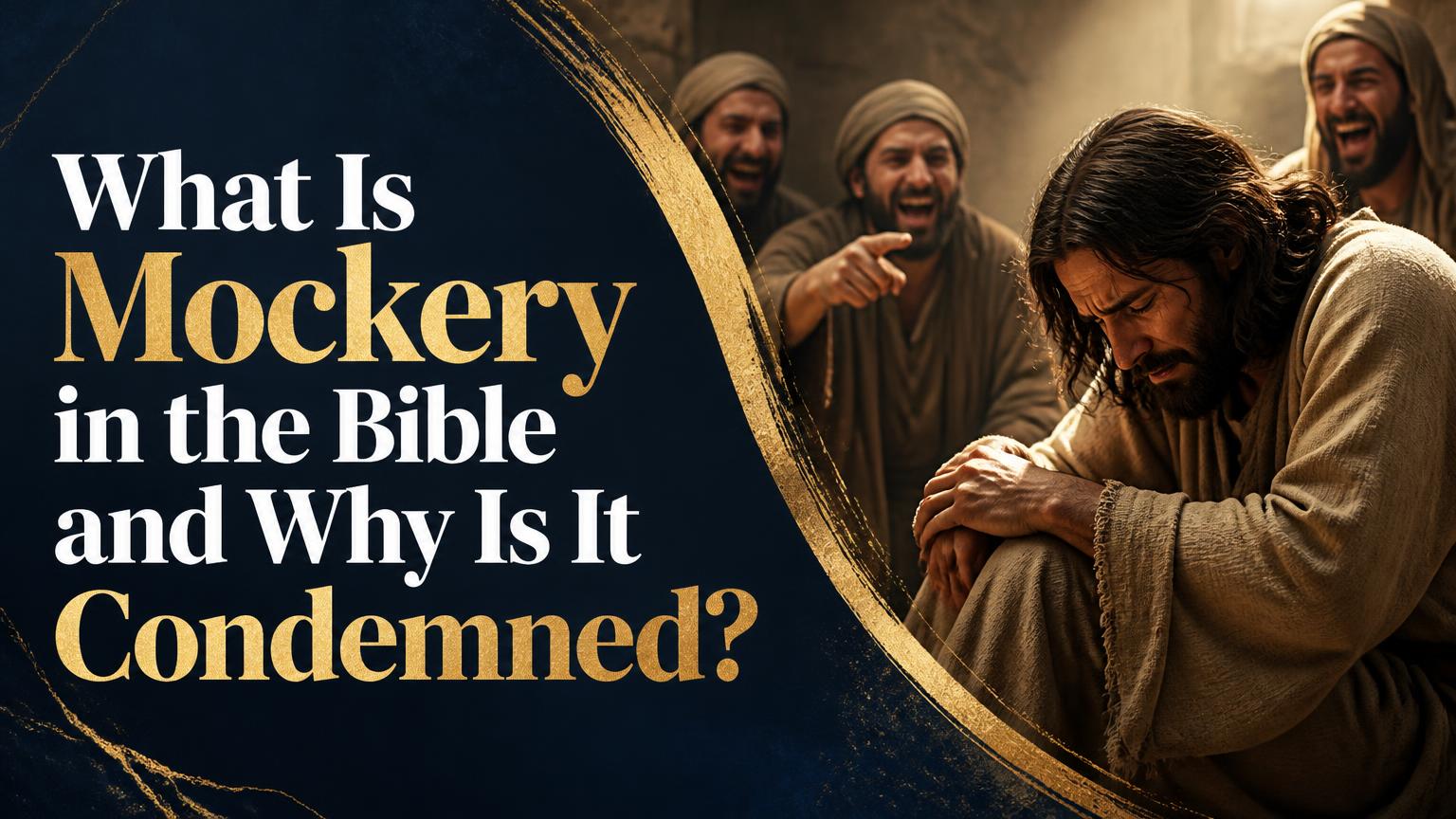
Mockery in the Bible is more than playful teasing or disagreement. It is contemptuous speech or behavior that ridicules God, rejects truth, humiliates another person, or treats what is holy as foolish. Scripture repeatedly condemns this posture because mockery is rooted in pride and often seeks to shame rather than correct. At the same time, the Bible distinguishes sinful derision from wise rebuke, prophetic exposure of falsehood, and appropriate moral criticism. Understanding that distinction is essential for interpreting biblical examples accurately.
What Is Mockery in the Bible?
Biblical mockery is an expression of scorn, derision, or contempt. It may appear through insulting words, sarcastic taunts, humiliating actions, dismissive laughter, or public challenges intended to shame someone. The Bible’s English translations use several related ideas, including scoffing, jeering, taunting, despising, and treating someone with contempt.
Mockery can be directed toward God, God’s Word, God’s people, moral truth, or vulnerable individuals. Its defining feature is not simply that the speech is sharp or humorous. The central issue is the attitude behind it and the harm it seeks to produce.
Mockery Expresses Contempt Rather Than Mere Disagreement
A person can disagree with a belief, criticize an action, or expose an error without mocking anyone. Mockery goes further by communicating that the target is beneath respect or unworthy of serious consideration. Proverbs often contrasts the wise person, who accepts correction, with the “scoffer,” who responds to truth with arrogance and hostility (Proverbs 9:7–8).
This distinction matters because biblical faith does not require silence in the face of falsehood or injustice. Jesus confronted hypocrisy, Paul corrected serious doctrinal errors, and the prophets openly challenged idolatry. Their words could be severe, but their purpose was truth, repentance, protection, or judgment—not cruelty for entertainment or social dominance.
Mockery Can Be Directed Against God and His Truth
Scripture treats mockery of God as a serious form of rebellion. Galatians 6:7 says, “God is not mocked,” meaning that no one can treat God with contempt and ultimately escape the consequences of doing so. The verse does not suggest that human insults can injure God’s dignity. Rather, it teaches that God cannot be deceived, manipulated, or defied without accountability.
Mocking God may involve openly ridiculing him, but it can also appear in a person’s life. Someone may profess faith while deliberately treating God’s commands as irrelevant. In that sense, hypocrisy can become a practical form of mockery: a person claims to honor God while knowingly sowing conduct that contradicts his professed beliefs.
Mockery Humiliates People Made in God’s Image
The Bible also condemns mockery directed at human beings. Since people are made in God’s image, degrading them is not morally insignificant (Genesis 1:26–27). Proverbs warns against rejoicing when an enemy falls (Proverbs 24:17–18), and Paul instructs believers not to repay evil with evil or insult with insult (1 Peter 3:9).
Mockery becomes especially harmful when it targets weakness, poverty, disability, grief, social status, ethnicity, or sincere faith. Public ridicule can damage a person’s reputation, isolate the vulnerable, and encourage others to join in humiliation. Biblical concern for speech therefore includes both what words communicate and what they do to the person who hears them.
Scoffing, Derision, and Taunting Are Related Forms
The Bible uses several overlapping descriptions rather than one technical definition of mockery. A scoffer rejects wisdom with arrogant laughter. Derision treats a person or belief as ridiculous. Taunting attempts to provoke fear, shame, or anger, often before an audience. Jeering at Jesus during his trial and crucifixion combined insult, humiliation, and rejection of his identity.
These terms should not be treated as perfectly interchangeable in every passage. Their common thread is contempt. The biblical question is not merely whether someone used sarcasm or humor, but whether the speech dishonored truth, degraded a person, encouraged sin, or displayed proud resistance to God.
Why Is Mockery Condemned in Scripture?
Mockery is condemned because it corrupts the purposes of speech. According to Scripture, words should communicate truth, give grace, correct wisely, encourage others, and defend those who need protection. Mockery reverses those purposes by using language to elevate the speaker and diminish the target. It often replaces honest reasoning with humiliation, making it harder for people to receive correction or pursue reconciliation.
The Bible also connects mockery with pride. Proverbs 21:24 describes the proud and arrogant person as a “scoffer,” showing that contempt is not merely a communication style but a character issue. Mockery assumes that the speaker occupies a superior position and that another person deserves ridicule rather than patient engagement. That attitude can make repentance difficult because anyone who laughs at correction is less likely to examine his own conduct.
Mockery can also produce consequences beyond the immediate insult. It normalizes cruelty, encourages group hostility, and may lead people to reject wisdom simply because it has become socially embarrassing to accept it. Scripture’s warnings about scoffers therefore address both personal character and the influence such people can have within a community.
Biblical Examples of Mockery
The Bible contains many examples of mockery, usually to reveal the arrogance of the mocker, the suffering of the faithful, or the seriousness of rejecting God. These accounts do not all function in exactly the same way. Some describe sinful behavior, while others show how God’s servants endure ridicule or expose false worship.
Goliath Mocked Israel and Israel’s God
In 1 Samuel 17, Goliath taunted the Israelite army and treated Israel’s God with contempt. His confidence rested on physical strength and military intimidation, so he assumed that Israel’s weakness proved the weakness of Israel’s God. David’s response directly challenged that assumption: the battle would demonstrate that the Lord saves, not merely that human weapons prevail.
Goliath’s mockery illustrates how contempt often grows from misplaced confidence. He judged reality by visible power and ridiculed faith as weakness. The narrative does not praise David because he won an argument through insult; it presents him as trusting God’s name and defending the honor of God’s covenant people.
Assyria Mocked Jerusalem’s Trust in God
In 2 Kings 18, the Assyrian spokesman mocked Jerusalem’s confidence in the Lord and attempted to frighten its inhabitants into surrender. His speech used propaganda, intimidation, and religious comparison. He portrayed Judah’s faith as irrational and suggested that no god could rescue Jerusalem from Assyria’s power.
This example shows that mockery can be a political weapon. It is sometimes used to weaken courage before physical conflict begins. The passage also warns that confident religious language does not make a mocker correct. Assyria’s representative spoke as though he understood God’s power, yet his claims revealed arrogance and ignorance.
Jesus Was Mocked During His Suffering
The Gospels repeatedly describe Jesus being mocked before and during the crucifixion. Soldiers dressed him in royal clothing, struck him, and pretended to honor him as a king (Matthew 27:27–31). Religious leaders and others challenged him to save himself, using his suffering as supposed evidence that his claims were false.
This mockery is especially significant because it targeted the truth while appearing to expose it. Jesus truly is King, but his kingship was expressed through obedient suffering rather than the political power his mockers expected. The cross therefore reveals both the evil of contempt and Christ’s refusal to answer humiliation with sinful retaliation (1 Peter 2:23).
“God Is Not Mocked” Describes Moral Accountability
Galatians 6:7 places the statement “God is not mocked” within a discussion of sowing and reaping. Paul’s point is that people cannot live contrary to God’s order and assume that consequences will never follow. A person who sows to the flesh should not expect the harvest associated with life in the Spirit.
This passage is not a promise that every wrongdoer will experience immediate visible punishment. Scripture itself shows that the wicked may prosper temporarily and that faithful people may suffer unjustly. The principle is deeper: God sees truly, judges justly, and cannot be deceived by religious claims or outward appearances.
Is All Ridicule or Sarcasm Mockery?
No. The Bible does not classify every sharp statement, joke, or use of irony as sinful mockery. Prophets sometimes used vivid ridicule to expose the absurdity of idolatry, and Elijah challenged the prophets of Baal in a deliberately provocative exchange (1 Kings 18:27). Jesus also used forceful language against hypocritical religious leaders. These examples addressed public deception and false worship rather than making cruelty a normal form of personal entertainment.
The difference lies in purpose, truthfulness, proportionality, and love. A rebuke aims to correct wrongdoing or protect others; mockery aims to degrade. Satire can expose hypocrisy, but it can also become an excuse for arrogance. Even when a criticism is factually correct, a believer must consider whether the manner of delivery serves truth and restoration or merely displays superiority.
A useful test is to ask what the speech seeks to produce. Does it invite repentance, clarify a serious error, defend the vulnerable, or restrain harm? Or does it seek laughter, humiliation, revenge, or social approval at another person’s expense? Biblical wisdom does not demand bland speech, but it does reject contempt disguised as courage.
How Should Christians Respond to Mockery?
Do Not Answer Contempt With Contempt
Christians are instructed to bless those who insult or persecute them rather than returning the same treatment (Romans 12:14; 1 Peter 3:9). This does not mean pretending that abuse is harmless or refusing to establish boundaries. It means refusing to let another person’s contempt dictate one’s own character.
Jesus’ response to mockery was not passive approval of injustice. He entrusted himself to the Father, spoke truth when necessary, and endured suffering without retaliatory abuse. In practical terms, a wise response may include calmly correcting misinformation, ending an abusive conversation, seeking help, or reporting serious harassment without using humiliation as a weapon.
Speak Truth Without Seeking Humiliation
Ephesians 4:15 describes Christian communication as “speaking the truth in love.” Truth and love must remain together. Love without truth becomes evasive, while truth without love can become a performance of superiority. When correction is necessary, the goal should be understanding, repentance, protection, or restoration rather than winning an audience.
This principle applies in families, churches, workplaces, and online discussions. A person may reject a Christian belief, commit a serious wrong, or spread harmful teaching without becoming an object of personal ridicule. Christians can name error clearly while remembering that the person being corrected remains accountable to God and bears human dignity.
Defend People Who Are Being Ridiculed
Biblical ethics do not focus only on avoiding mockery personally. Proverbs 31:8–9 calls God’s people to speak for those who cannot speak for themselves and to defend the rights of the vulnerable. When ridicule becomes bullying or public humiliation, silence can allow the harm to continue.
A constructive response may involve interrupting the joke, refusing to share humiliating content, supporting the person being targeted, or confronting the group’s behavior privately and wisely. The goal is not to create a second spectacle but to protect dignity and restore justice.
Examine and Repent of Personal Mockery
Because mockery can be socially rewarded, people may overlook it in their own speech. Sarcastic comments, memes, nicknames, gossip, and “jokes” can become sinful when they depend on another person’s shame. James 3 warns that the tongue can cause disproportionate harm, even when its words seem small.
Repentance requires more than feeling embarrassed after being exposed. It may involve acknowledging the wrong without excuses, apologizing to the person harmed, removing public content, repairing reputational damage, and developing habits of truthful and gracious speech. The Christian response to mockery begins with receiving God’s correction rather than assuming that only other people are scoffers.
Conclusion
Mockery in the Bible is contempt expressed through ridicule, taunting, humiliation, or dismissive treatment of God, truth, or people made in God’s image. Scripture condemns it because it grows from pride, damages others, resists correction, and cannot ultimately deceive God. Yet the Bible does not forbid every sharp statement or use of irony; wise rebuke and prophetic exposure can serve truth when they are directed toward correction and protection rather than personal humiliation. Christians are therefore called to reject contempt, endure ridicule without retaliation, defend the vulnerable, and speak truth with humility and love.