
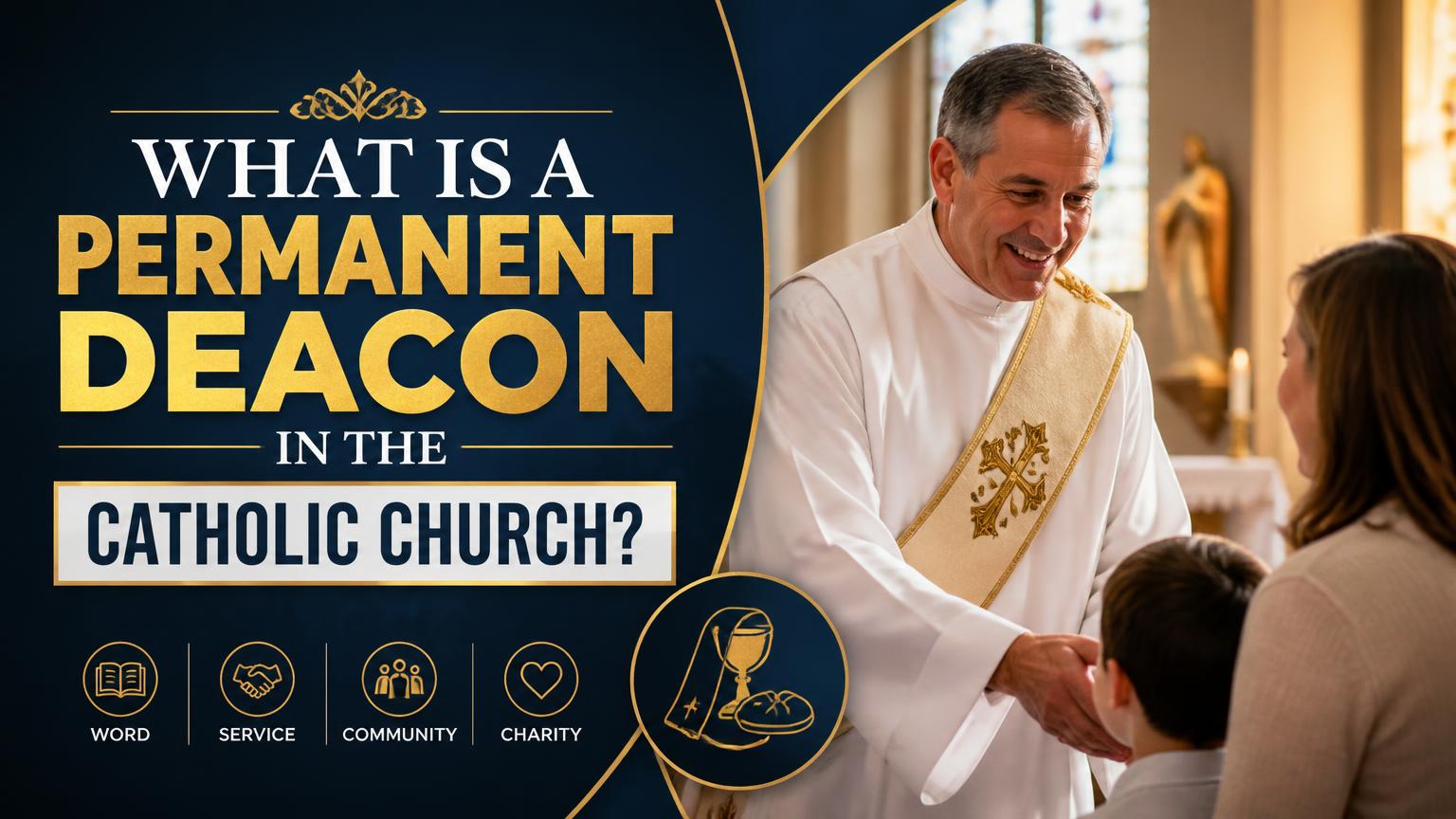
A permanent deacon is an ordained Catholic minister who receives the Sacrament of Holy Orders and serves the Church through the ministries of the Word, liturgy, and charity. He is not a priest preparing automatically for priestly ordination. “Permanent” means he intends to remain a deacon rather than proceed to the priesthood, although some permanent deacons may later seek priestly ordination under particular circumstances and Church law.
Permanent deacons proclaim the Gospel, preach when permitted, baptize, assist at the altar, witness marriages on behalf of the Church, preside at certain funeral and prayer services, and organize works of charity. They cannot celebrate Mass, consecrate the Eucharist, hear sacramental confessions, or administer the Anointing of the Sick as a priest does.
What Is a Permanent Deacon in the Catholic Church?
A permanent deacon is a man ordained to the first degree of the Sacrament of Holy Orders. The three degrees are bishop, priest, and deacon. Deacons therefore belong to the Catholic hierarchy, but their ministry differs from that of priests and bishops.
The word deacon is related to the Greek term diakonos, commonly associated with service or ministry. A deacon’s service is not merely charitable volunteering. Through ordination, he is configured to Christ in a specific public ministry within the Church.
The Three Areas of Diaconal Ministry
The Catholic Church traditionally describes the deacon’s ministry in three connected areas:
- The Ministry of the Word: proclaiming the Gospel, preaching when authorized, teaching the faith, and helping with evangelization and catechesis.
- The Ministry of the Liturgy: assisting the priest and bishop at Mass, baptizing, witnessing marriages, and leading certain liturgical or prayer services.
- The Ministry of Charity: serving the poor, visiting the sick and imprisoned, supporting vulnerable families, and coordinating the Church’s practical response to human need.
These areas are not separate careers. A deacon is expected to connect proclamation, worship, and service. For example, a deacon who assists a food pantry may also help recipients encounter the Church’s pastoral care, while a deacon who preaches about Christian charity should embody that message through concrete service.
What Does a Permanent Deacon Do at Mass?
At Mass, the deacon has a distinct liturgical role. He may:
- Proclaim the Gospel
- Preach the homily when permitted
- Announce the intentions of the Universal Prayer
- Prepare the altar and sacred vessels
- Assist the priest or bishop
- Invite the congregation to exchange the sign of peace
- Distribute Holy Communion, especially as an ordinary minister
- Dismiss the congregation
The deacon does not preside over the Eucharistic Prayer or consecrate the bread and wine. Those actions belong to a validly ordained priest or bishop. The deacon’s role at Mass is therefore more than ceremonial assistance but different from priestly presidency.
What Sacraments Can a Permanent Deacon Celebrate?
A permanent deacon can validly baptize, especially through the solemn celebration of Baptism. He may also ordinarily assist at and bless marriages when he has the required delegation from the Church. In many places, deacons also preside at funeral rites outside Mass.
A deacon cannot:
- Celebrate Mass
- Consecrate the Eucharist
- Hear sacramental confessions or grant absolution
- Administer the Sacrament of the Anointing of the Sick
- Ordain other ministers
A deacon may lead prayers, Scripture services, Communion services outside Mass, and certain rites of Christian burial. The precise responsibilities depend on the rite being celebrated, the law of the Church, and the permission or delegation granted by the bishop.
How Is a Permanent Deacon Different From a Priest?
Both deacons and priests are ordained ministers, but their authority and sacramental functions are not the same.
| Permanent Deacon | Priest |
|---|---|
| Receives the first degree of Holy Orders | Receives the second degree of Holy Orders |
| Proclaims the Gospel and may preach | Proclaims the Gospel and preaches |
| Assists at Mass | Presides at Mass |
| May baptize and witness marriages with authorization | May baptize, witness marriages, and celebrate the Eucharist |
| Cannot consecrate the Eucharist | Consecrates the Eucharist |
| Cannot hear confessions | May hear confessions with faculties |
| Cannot administer Anointing of the Sick | May administer Anointing of the Sick |
| Is ordained for permanent diaconal service | May serve as a priest or bishop’s collaborator in pastoral and sacramental ministry |
A permanent deacon is not a “part-time priest.” The diaconate has its own vocation and identity. Its emphasis is service, especially service that links the Church’s worship with its mission to the wider community.
Why Are Some Deacons Called “Permanent”?
The diaconate has always been an ordained ministry, but for many centuries in the Latin Church it was commonly received only briefly by men preparing for priesthood. This is called the transitional diaconate.
The Second Vatican Council supported the restoration of the permanent diaconate in the Latin Church. Since then, dioceses have developed formation programs for men who intend to remain deacons. The permanent diaconate also has a long-standing place in the Eastern Catholic Churches, where married men may be ordained to the diaconate according to their particular traditions.
The distinction is therefore about a man’s intended vocation:
- A transitional deacon is preparing for priestly ordination.
- A permanent deacon intends to remain in the diaconate.
Both receive the same degree of Holy Orders as deacons. The difference is not that one is “more ordained” than the other, but that their expected paths of service differ.
Who Can Become a Permanent Deacon?
The requirements vary by country and diocese, but the Catholic Church generally requires a candidate to be a baptized Catholic man of suitable character, faith, maturity, and service. He must complete theological, spiritual, pastoral, and human formation before ordination.
Formation commonly includes:
- Scripture and Catholic theology
- The sacraments and liturgy
- Church history and canon law
- Spiritual direction and prayer
- Pastoral care and preaching
- Ministry with the poor, sick, elderly, and marginalized
- Supervised parish and community service
- Personal and family discernment
The formation period often lasts several years. A diocese evaluates whether a candidate possesses the stability, faith, emotional maturity, communication skills, and practical readiness required for public ministry.
Can a Married Man Become a Permanent Deacon?
Yes. In the Latin Catholic Church, married men may be ordained permanent deacons if they satisfy the Church’s requirements. The candidate’s wife must ordinarily give her consent, because ordination affects the entire household. The family’s stability and ability to support the demands of ministry are considered during discernment.
A married man who is ordained a deacon remains married and continues his family responsibilities. His ordination does not make him a celibate priest. However, if his wife dies, Church discipline generally does not permit him to marry again after ordination, except in particular circumstances with the necessary permission.
Unmarried permanent deacons ordinarily accept the obligation of celibacy. A deacon cannot marry after ordination.
Is a Permanent Deacon a Full-Time Minister?
Not necessarily. Many permanent deacons have secular employment and serve the Church in addition to their family and professional responsibilities. Others work for a parish, diocese, Catholic school, hospital, prison ministry, or charitable organization.
The word “permanent” refers to the deacon’s vocation, not necessarily to a full-time job. A deacon’s ministry may be substantial even when it is not salaried or his primary occupation. His responsibilities should be arranged with appropriate regard for marriage, family life, employment, and health.
A deacon’s wife and family are not ordained with him, and they do not become responsible for carrying out his ministry. Nevertheless, the family’s circumstances matter because diaconal service can require evening and weekend commitments, pastoral availability, study, and participation in parish life.
What Does the Bible Say About Deacons?
The New Testament provides evidence for recognized ministers called deacons, although the development of the later sacramental diaconate cannot be reduced to one isolated passage.
Acts 6:1–6 describes the appointment of men to help address the needs of widows in the early Christian community. The passage is often viewed as an important biblical precedent for a ministry combining service, responsibility, and spiritual leadership. It does not provide a complete description of the later Catholic order of deacons, but it illustrates why practical care for people in need belongs within the Church’s ministry.
Paul also refers to deacons in Philippians 1:1 and gives qualifications for them in 1 Timothy 3:8–13. These qualifications emphasize dignity, integrity, faithfulness, self-control, and a well-ordered household. They show that Christian ministry requires more than public ability; it requires a life capable of bearing credible witness to the Gospel.
How Does a Deacon Serve Beyond the Church Building?
The diaconate is especially associated with bringing the Church’s concern for human dignity into ordinary places and difficult situations. A deacon may serve in ministries such as:
- Visiting patients in hospitals and nursing homes
- Accompanying families during bereavement
- Helping people access food, housing, or other assistance
- Supporting prison and reentry ministry
- Teaching the faith in parish programs
- Preparing couples for marriage
- Working with immigrants, refugees, or people experiencing poverty
- Coordinating parish outreach and charitable projects
This service is not intended to replace professional social work, medical care, or government assistance. A responsible deacon recognizes when people need qualified specialists and helps connect them with appropriate resources. Christian charity includes compassion, but it also requires prudence, respect for dignity, confidentiality, and practical wisdom.
Common Misconceptions About Permanent Deacons
A permanent deacon is not simply a senior altar server. He is ordained and has sacramental and liturgical responsibilities that a layperson does not receive through ordinary parish service.
He is also not an independent religious authority. A deacon serves under the authority of the diocesan bishop and within the pastoral direction of the parish or ministry to which he is assigned.
Finally, the diaconate is not merely an administrative position. Although deacons may coordinate programs or manage charitable work, their ministry is rooted in ordination, prayer, proclamation of the Gospel, liturgical service, and care for people.
Conclusion
A permanent deacon is an ordained Catholic minister who remains in the diaconate as a lifelong vocation rather than treating it as a temporary step toward priesthood. His ministry unites the Word, the liturgy, and charity: he proclaims the Gospel, assists at Mass, baptizes, witnesses marriages with authorization, leads certain rites, and serves people in need. He cannot celebrate the Eucharist, hear confessions, or administer the Anointing of the Sick. The permanent diaconate is therefore a distinct vocation of ordained service within the Catholic Church, often lived alongside marriage, family life, and secular work.