
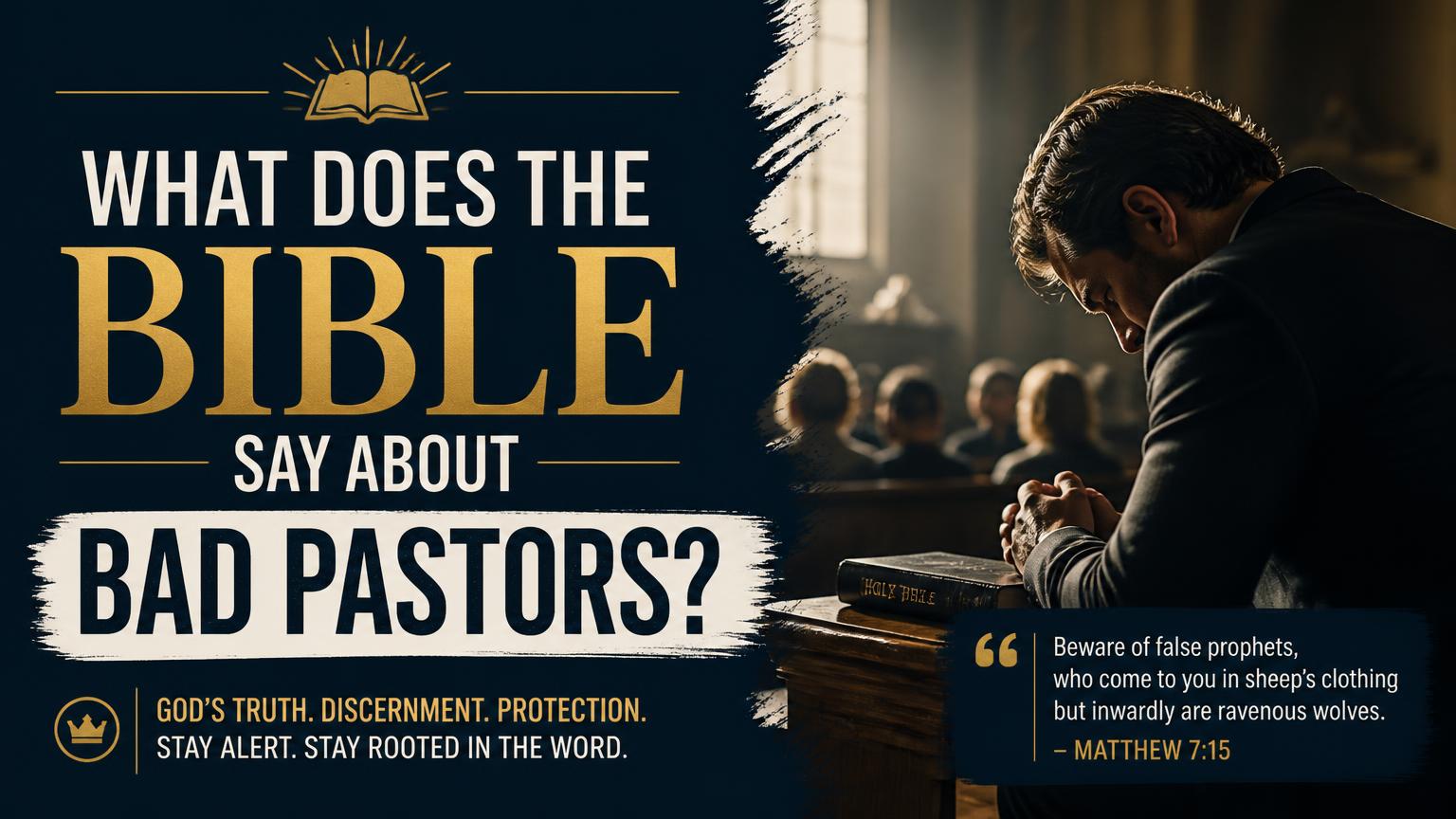
The Bible treats pastoral leadership as a sacred responsibility, not a position of personal privilege. Pastors, elders, and overseers are called to teach sound doctrine, model godly character, protect the church, and serve willingly. Leaders who exploit people, distort truth, pursue money or status, abuse authority, or persist in serious unrepentant sin are condemned as unfaithful shepherds.
Scripture also gives believers a careful response: test teaching, examine character and conduct, establish fair accountability, protect the vulnerable, and refuse to give unquestioning loyalty to a corrupt leader.
What Does the Bible Say About Bad Pastors?
The Bible does not use “bad pastor” as a single technical category. It speaks instead about false teachers, corrupt shepherds, domineering leaders, disqualified elders, and shepherds who neglect or harm God’s people. These passages establish both the standards pastors must meet and the consequences of violating them.
Faithful Pastors Must Meet Character Standards
The New Testament presents pastoral leadership primarily through the terms elder, overseer, and shepherd. These roles overlap in the early church and describe leaders responsible for teaching, guiding, and caring for believers.
In 1 Timothy 3:1–7 and Titus 1:5–9, Paul lists qualifications for overseers and elders. A leader must be above reproach, self-controlled, respectable, faithful, able to teach, and known for managing his household well. He must not be violent, quarrelsome, arrogant, greedy, or controlled by alcohol. Titus also emphasizes that an elder must hold firmly to sound doctrine so that he can encourage believers and correct those who contradict the truth.
These qualifications show that pastoral ability is not merely a matter of charisma, communication skill, or ministry success. A person may attract large crowds and still lack the character required for spiritual leadership. Biblical leadership joins sound teaching with a credible life.
Bad Pastors Abuse Authority and Exploit People
One of the Bible’s strongest condemnations of corrupt leaders appears in Ezekiel 34. God rebukes Israel’s shepherds because they fed themselves instead of the flock. They took advantage of the sheep, failed to strengthen the weak, did not heal the sick, and did not search for the lost. The result was scattered, vulnerable people.
The passage identifies a central failure of bad pastoral leadership: using people to serve the leader rather than using leadership to serve people.
Jesus made a similar criticism of religious leaders who loved public honor, imposed heavy burdens on others, and used spiritual positions for status (Matthew 23:1–12). Their problem was not simply that they were imperfect. They separated public religious authority from humility, mercy, justice, and integrity.
Peter gives the opposite model. Elders are to shepherd God’s people willingly, eagerly, and by example—not by domineering over those entrusted to them (1 Peter 5:1–4). Pastoral authority is therefore real, but it is limited. It belongs under Christ’s authority and must be exercised for the good of the flock.
Exploitation can take several forms:
- pressuring people for money while treating giving as proof of faith
- demanding personal loyalty that belongs to Christ
- manipulating members through fear, shame, or spiritual threats
- using confidential information to control people
- excusing immoral behavior because of ministry influence
- isolating members from family, other churches, or outside counsel
- intimidating anyone who asks reasonable questions
These patterns are not biblical shepherding. They are forms of spiritual abuse.
Bad Pastors Distort Truth and Produce Harmful Fruit
The Bible takes false teaching seriously because leaders shape what people believe about God, salvation, holiness, and Christian life. Paul warns the Ephesian elders that some people would arise within the church and distort the truth to draw disciples after themselves (Acts 20:28–30). He tells them to remain watchful because false teaching often enters through persuasive personalities rather than obvious hostility.
Jesus instructs believers to recognize false prophets by their fruits (Matthew 7:15–20). “Fruit” includes both teaching and conduct. A leader’s theology cannot be separated permanently from the way that theology affects people and the leader’s own life.
Warning signs may include:
- denying or radically altering the gospel
- using Scripture selectively to support personal power
- making predictions or claims that contradict biblical teaching
- treating questions as rebellion
- promoting greed, sexual misconduct, pride, or favoritism
- creating dependence on the leader instead of maturity in Christ
- repeatedly causing division for personal advantage
Romans 16:17–18 warns believers to watch for people who create divisions and deceive others through smooth speech. Yet not every theological disagreement makes a pastor a false teacher. The biblical test involves the substance of the gospel, the consistency of teaching, the leader’s character, and the practical fruit produced over time.
God Holds Unfaithful Shepherds Accountable
Pastoral leadership brings greater accountability. James 3:1 warns that teachers will be judged more strictly because their instruction influences others. Hebrews 13:17 also speaks of leaders who keep watch over souls and will give an account for that responsibility.
This accountability is both a warning and a comfort. A pastor may avoid consequences temporarily through influence, wealth, or institutional protection, but Scripture denies that spiritual status places anyone beyond God’s judgment. Ezekiel 34 promises that God himself will confront shepherds who have neglected and scattered his sheep.
Paul gives instructions for addressing accusations against elders in 1 Timothy 5:19–20. An accusation should not be accepted casually, but credible and established wrongdoing must not be concealed. Persistent sin among leaders requires public accountability because leaders’ conduct affects the whole church.
The passage balances two necessary principles: leaders deserve protection from reckless accusations, and leaders must not receive immunity from truthful correction.
How Should Christians Respond to a Bad Pastor?
The Bible does not tell believers to remain passive under corrupt spiritual leadership. It calls them to respond with truth, wisdom, courage, and appropriate order.
Test Teaching, Character, and Fruit
Believers are instructed to examine what they hear rather than accept every religious claim automatically. The Bereans were commended for testing Paul’s teaching against Scripture (Acts 17:11). John likewise says to test the spirits because many false prophets have gone into the world (1 John 4:1).
That testing should include more than isolated Bible verses. Consider:
- What does the pastor teach about Christ and the gospel?
- Does the pastor submit to Scripture or manipulate it?
- Is the leader’s private conduct consistent with public preaching?
- Can concerns be raised without retaliation?
- Are other qualified leaders involved in accountability?
- Are people becoming more mature and free in Christ, or more fearful and dependent on the pastor?
A single poor sermon, mistake, or moment of impatience does not establish a pattern of corruption. Serious concerns should be evaluated carefully, with attention to evidence and repeated conduct.
Use Fair Accountability and Correction
When the problem is serious but does not involve immediate danger, concerns should ordinarily be addressed through an appropriate process. Matthew 18:15–17 describes direct confrontation followed by additional witnesses and broader church involvement when necessary. First Timothy 5:19–20 gives specific guidance for accusations involving elders.
The purpose of this process is not institutional self-protection. It is to establish truth, give the accused a fair opportunity to respond, protect the church from gossip, and ensure that genuine wrongdoing is not hidden.
A healthy church should have more than one person capable of evaluating the pastor. Shared leadership, transparent finances, clear policies, and independent safeguarding processes make it harder for one leader to control the entire community.
Protect People From Abuse
Biblical peacemaking must not be confused with concealing abuse. If a pastor threatens, sexually exploits, physically harms, financially defrauds, or coercively controls people, protecting victims takes priority over preserving the leader’s reputation.
Someone facing danger should seek safety and contact appropriate civil authorities, safeguarding professionals, or trusted support. Allegations involving crimes should not be handled only as an internal church matter. Forgiveness does not eliminate the need for protection, truth-telling, restitution, or legal accountability.
A church that pressures victims into silence, discourages reporting, destroys evidence, or treats the pastor’s reputation as more important than the harmed person is acting contrary to the shepherding principles of Scripture.
Leave a Church When Continued Presence Is Harmful
Remaining in a church under a faithful but imperfect pastor is different from remaining under a leader who is persistently abusive, deceptive, or unrepentant. Scripture warns believers to avoid those who corrupt the faith and use religion for selfish ends (Romans 16:17–18; 2 Timothy 3:1–5).
Leaving a dangerous church is not automatically rebellion, unforgiveness, or rejection of biblical authority. In some circumstances it is a wise act of protection. A person may seek counsel from mature Christians, evaluate another congregation carefully, and continue pursuing Christ apart from a harmful leader.
How Is a Bad Pastor Different From an Imperfect Pastor?
Every pastor is a sinner who can make mistakes, misjudge situations, teach poorly, or need correction. Scripture does not require pastors to be flawless. “Above reproach” does not mean sinless; it means that a leader’s life is not characterized by disqualifying, scandalous, or unresolved patterns.
The more significant distinction is often between weakness that is acknowledged and corrected and sin that is defended, repeated, and used to harm others.
An imperfect pastor may:
- admit mistakes
- receive correction
- apologize without shifting blame
- seek help and accountability
- make changes over time
- distinguish personal preference from biblical command
A disqualified or dangerous pastor may:
- deny obvious wrongdoing
- attack those who raise concerns
- demand unquestioning loyalty
- weaponize Scripture
- conceal financial or sexual misconduct
- punish people who leave
- repeat the same abuse while claiming special spiritual authority
This distinction prevents two opposite errors. Churches should not destroy a faithful leader over every human weakness, but neither should they excuse persistent serious sin simply because the leader is gifted or popular.
What Should Churches Expect From Pastoral Leaders?
First Peter 5:4 identifies Christ as the “Chief Shepherd.” Pastors are therefore under-shepherds, not owners of the church. Their authority is delegated, accountable, and directed toward the care of God’s people.
A healthy church should expect pastors to teach faithfully, live transparently, welcome appropriate questions, share leadership, care for the weak, and accept correction. It should also establish practical safeguards: financial oversight, procedures for handling complaints, protection for minors and vulnerable adults, meaningful membership freedom, and accountability outside the pastor’s immediate circle.
The church’s goal is not suspicion of every leader. It is faithful stewardship. Trust should be earned through truth, character, humility, and consistent care rather than demanded through titles or spiritual intimidation.
The Bible says that bad pastors are not harmless religious personalities; they are unfaithful shepherds who may mislead, exploit, and injure God’s people. Scripture condemns that conduct, promises accountability, and gives believers permission to test leaders and reject corruption. At the same time, it distinguishes deliberate, unrepentant abuse from ordinary pastoral weakness. The right response is neither blind loyalty nor careless accusation, but truth, due process, protection for the vulnerable, and allegiance to Christ above any pastor.