
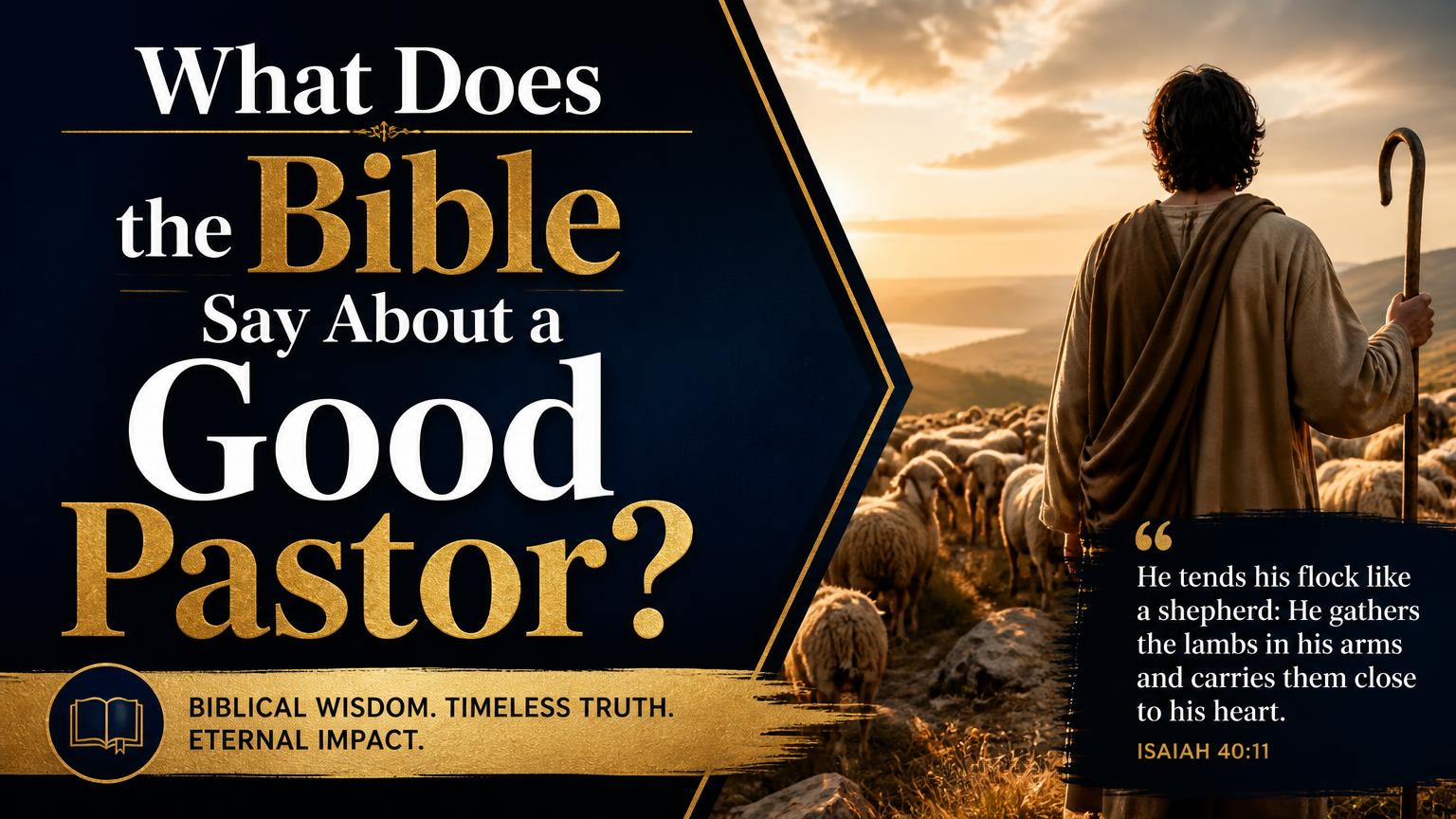
A good pastor, according to the Bible, is not defined primarily by charisma, popularity, church size, or speaking ability. He is a faithful shepherd who serves under Jesus Christ, teaches Scripture accurately, protects the church, demonstrates mature character, and cares for people with humility and perseverance. The New Testament also makes clear that pastors are accountable to God and must lead without exploiting or controlling those entrusted to them.
What Does the Bible Say About a Good Pastor?
The Bible presents pastoral ministry as shepherding God’s people. Jesus is the ultimate Shepherd, and every human pastor serves under His authority. The word pastor means “shepherd,” and the New Testament connects pastoral leadership with teaching, oversight, spiritual care, and protection.
The central biblical standard is faithfulness to Christ rather than visible success. A pastor may lead a large or small church, have a prominent ministry or a quiet one, but Scripture measures him by his doctrine, character, conduct, and care for the flock.
A Pastor Must Shepherd Under Christ
Jesus described Himself as “the good shepherd” who lays down His life for the sheep (John 10:11). This establishes the pattern for Christian pastoral ministry: a pastor does not own the church or replace Christ. He serves the people who belong to Jesus.
Peter instructed elders to “shepherd the flock of God” and to serve as examples rather than domineering over those in their care (1 Peter 5:1–4). The church is God’s flock, not the pastor’s personal possession. This distinction affects how a pastor handles authority, money, decisions, correction, and disagreement.
A biblical pastor therefore asks, “What is faithful to Christ and beneficial to His people?” rather than, “What will increase my influence?” His leadership should direct people toward Jesus, Scripture, holiness, and spiritual maturity—not toward dependence on his personality.
A Pastor Must Have Proven Character
The qualifications in 1 Timothy 3:1–7 and Titus 1:5–9 emphasize character before achievement. A pastor should be above reproach, self-controlled, respectable, hospitable, faithful, and able to manage his household responsibly. He must not be violent, quarrelsome, greedy, arrogant, or controlled by alcohol.
These qualifications do not describe a sinless man. Every pastor remains dependent on God’s grace and must repent when he fails. “Above reproach” means that his life should not display an established pattern of hypocrisy, scandal, irresponsibility, or moral compromise that undermines his profession of faith.
Character matters because pastoral leadership is influential. A gifted communicator who lacks integrity can damage people while appearing successful. By contrast, a pastor with mature character gives credibility to the message he teaches. His private life, family relationships, financial conduct, speech, and treatment of difficult people should be consistent with his public ministry.
A Pastor Must Teach and Protect the Church
Paul required an overseer to be able to teach and to hold firmly to the trustworthy word so that he could encourage believers and refute error (1 Timothy 3:2; Titus 1:9). Teaching is therefore not an optional feature of pastoral ministry. A pastor must explain the Bible accurately, apply it wisely, and resist ideas that distort the gospel.
This includes more than delivering sermons. A teaching pastor helps people understand the whole counsel of God, connects biblical truth to ordinary life, and equips believers to read and obey Scripture for themselves. Ephesians 4:11–12 describes pastors and teachers as gifts given to equip the saints for ministry, not to perform every ministry on the church’s behalf.
Protection is closely related to teaching. Paul warned the Ephesian elders that false teachers would arise and urged them to remain watchful (Acts 20:28–31). A pastor should therefore be willing to address serious error, destructive behavior, and teachings that lead people away from Christ. Protection should be grounded in truth and love, not in suspicion or a desire to control every opinion.
A Pastor Must Lead Through Service, Not Control
Jesus rejected self-serving models of authority. He taught that greatness among His followers is expressed through service, and He demonstrated this by washing His disciples’ feet (Mark 10:42–45; John 13:1–17).
A pastor may have real responsibility and authority, but biblical authority is ministerial: it exists to serve God’s purposes and strengthen the church. First Peter 5:3 specifically warns leaders not to domineer over the flock but to be examples.
This does not mean that a pastor must avoid making decisions, confronting sin, or exercising leadership. It means he cannot treat members as personal followers, silence legitimate concerns, demand unquestioning loyalty, or use spiritual language to protect his position. A pastor leads people toward maturity, which includes helping them grow in discernment rather than making them permanently dependent on him.
A Pastor Must Care for People Personally
Biblical shepherding includes personal care. Jesus was moved with compassion for people who were “harassed and helpless, like sheep without a shepherd” (Matthew 9:36). He knew His sheep, called them by name, sought the lost, and cared for the vulnerable (John 10:3–4; Luke 15:3–7).
A good pastor does not view people merely as attendance figures, donors, volunteers, or ministry results. He notices suffering, visits the sick, strengthens the discouraged, welcomes outsiders, corrects gently, and helps restore those who have wandered. His care may be expressed through preaching, prayer, counseling, visitation, practical assistance, or directing people to qualified help when a need exceeds his abilities.
Personal care does not require a pastor to meet every need alone. Moses became overwhelmed when he tried to carry the entire burden of the people, and wise leadership required shared responsibility (Exodus 18:17–23). A faithful pastor cares deeply while also building a healthy body in which members serve one another.
A Pastor Must Be Humble, Prayerful, and Accountable
Pastoral work requires spiritual dependence. In Acts 6:4, the apostles prioritized prayer and the ministry of the Word. A pastor who teaches others to trust God but neglects prayer is relying on technique rather than the Lord.
Humility also means recognizing limitations, receiving correction, confessing sin, and sharing leadership appropriately. The New Testament frequently speaks of elders in the plural, and passages such as Acts 20:17, 28 and 1 Peter 5:1–3 show leaders serving within a community of accountability. Local church structures differ among Christian traditions, but the underlying principle remains valuable: pastoral authority should not be isolated from wise oversight.
A pastor should also handle money transparently and avoid using ministry for personal enrichment. Scripture repeatedly condemns greedy or dishonest leadership, while 1 Timothy 3:3 and Titus 1:7 require financial self-control. Trust grows when a pastor’s practices are open, responsible, and free from manipulation.
The Biblical Role of a Pastor Includes More Than Preaching
Preaching is central, but pastoral ministry is broader than standing behind a pulpit. In the New Testament, shepherding includes several connected responsibilities:
- Teaching: explaining Scripture and applying it faithfully.
- Equipping: helping believers mature and serve according to their gifts.
- Protecting: confronting false teaching and destructive conduct.
- Caring: supporting people through grief, temptation, illness, conflict, and spiritual weakness.
- Leading: guiding the congregation toward worship, mission, unity, and holiness.
- Restoring: helping repentant people return to faithful fellowship.
- Modeling: showing through personal conduct what Christian obedience looks like.
These responsibilities must remain connected. Teaching without compassion can become harsh. Compassion without truth can become permissive. Leadership without humility can become authoritarian. A good pastor brings truth, love, courage, patience, and wisdom together under Christ’s direction.
What the Bible Does Not Require of a Good Pastor
The Bible does not require a pastor to be flawless, universally admired, highly entertaining, or able to solve every problem. It does not measure faithfulness by church attendance, social-media visibility, wealth, or rapid numerical growth.
Nor does Scripture suggest that a pastor’s success excuses moral failure. Talent cannot compensate for disqualifying conduct, and a large ministry is not proof that a leader meets biblical qualifications. At the same time, an ordinary pastor who faithfully teaches, prays, serves, repents, and cares for people should not be dismissed simply because his ministry lacks public prominence.
A biblical evaluation must distinguish weakness from persistent unrepentant misconduct. Every pastor has limitations and will sometimes make poor decisions. Those failures call for humility, correction, and sometimes restoration. Patterns of abuse, deception, sexual immorality, financial exploitation, or coercive control require serious action and cannot be hidden behind a claim of spiritual authority.
How Should a Church Recognize a Good Pastor?
A church evaluating a pastor should look beyond communication skill and ask whether his life and ministry correspond to Scripture:
- Does he remain faithful to the gospel and the authority of Scripture?
- Does his character support his public teaching?
- Does he treat people as members of Christ’s flock rather than as personal assets?
- Does he welcome appropriate accountability and correction?
- Does he equip others or insist on controlling every ministry?
- Does he handle money, power, and disagreement with integrity?
- Does his ministry produce spiritual maturity, love, truth, repentance, and service?
These questions should be considered over time. A single impressive sermon or emotional ministry moment cannot reveal the full quality of a pastor’s leadership. Patterns of conduct, relationships, doctrine, and response to correction provide a more reliable picture.
The Congregation Also Has Responsibilities
The Bible places duties on church members as well as pastors. Believers are instructed to respect faithful leaders, support them, pray for them, and respond to their biblical teaching (1 Thessalonians 5:12–13; Hebrews 13:17–18). Members should not expect a pastor to function as a flawless substitute for Christ or as the only person responsible for ministry.
At the same time, respect does not mean ignoring serious wrongdoing. Church leaders remain accountable to God and should be held to the standards Scripture gives them. A healthy congregation supports faithful shepherding while maintaining truth, wisdom, proper boundaries, and concern for those who may be harmed.
A good pastor, then, is neither an untouchable authority nor merely a religious public speaker. He is a servant-leader who answers to the Chief Shepherd, Jesus Christ.
Conclusion
The Bible says that a good pastor is a faithful shepherd under Jesus Christ. He teaches Scripture, protects the church from error, cares for people personally, leads by example, exercises authority humbly, and demonstrates proven character. He will not be perfect, but his life should show repentance, integrity, and steady faithfulness. Biblical pastoral ministry is ultimately measured less by popularity or visible success than by whether the pastor faithfully serves Christ and helps God’s people grow in truth, holiness, love, and maturity.