
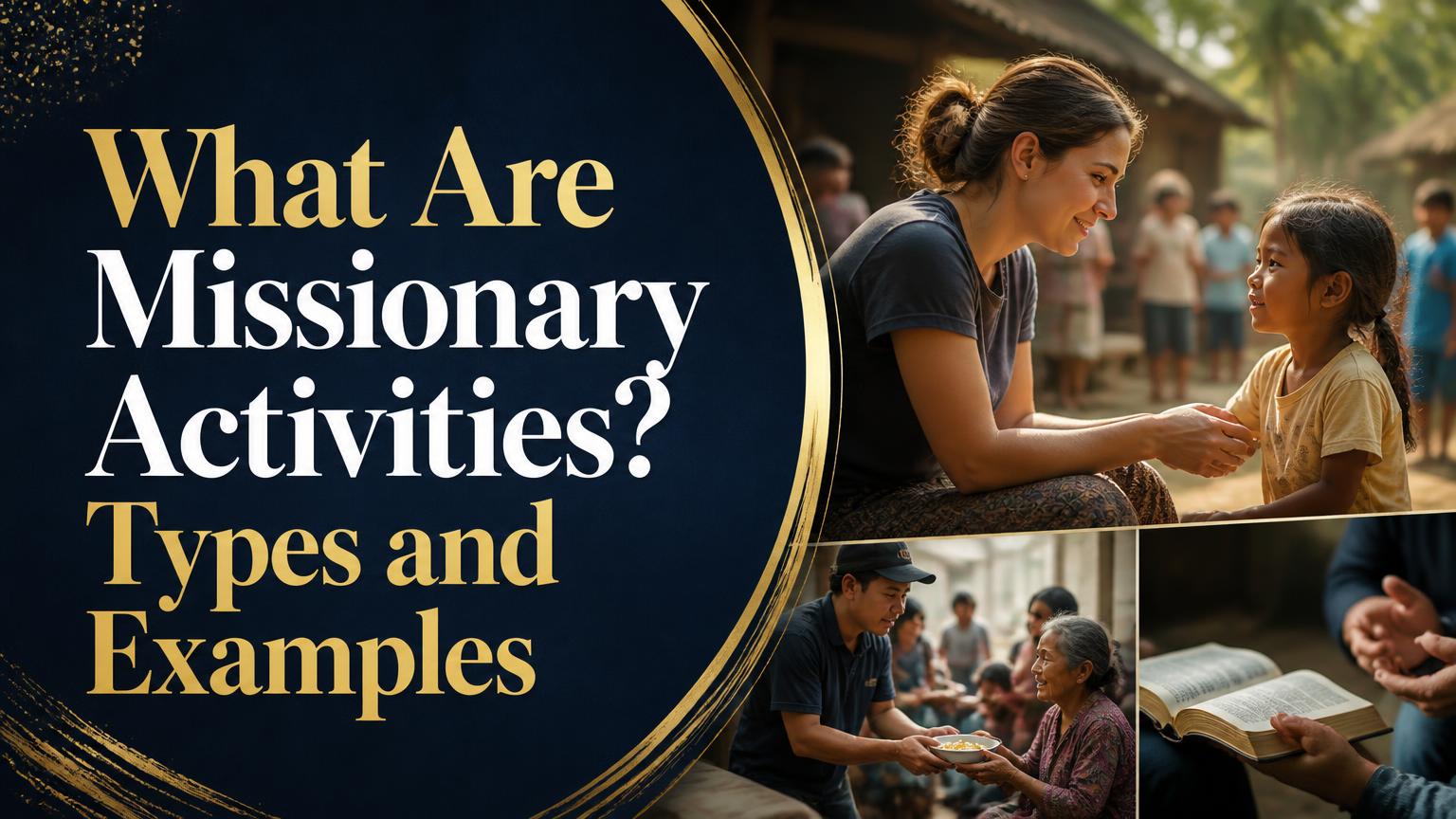
Missionary activities are organized or personal efforts to communicate the Christian faith, make disciples, establish or strengthen churches, and serve communities in practical ways. They may take place across national and cultural boundaries, but missionary work is not limited to overseas travel. Local evangelism, Bible translation, leadership training, education, medical care, disaster relief, poverty alleviation, and community development can all be missionary activities when they are connected to Christian witness and service. Their methods differ among churches and traditions, but effective missionary work seeks to respect people, address genuine needs, and communicate the gospel without coercion.
What Are Missionary Activities?
Missionary activities are actions carried out by Christians, churches, or mission organizations to participate in Christian mission. Their purposes commonly include sharing the gospel, helping people grow as disciples of Jesus, forming Christian communities, training local leaders, and demonstrating Christian compassion.
Missionary work combines proclamation and service in different proportions. Some activities focus directly on evangelism and teaching, while others address education, health, poverty, displacement, or social development. Christian traditions disagree at times about methods and priorities, but missionary activity generally involves both communicating Christian beliefs and serving people in ways that reflect those beliefs.
The Meaning and Purpose of Missionary Activities
The word missionary refers to someone sent with a mission. In Christianity, a missionary is typically a person who is sent by a church or Christian organization—or who works independently—to bear witness to Jesus Christ and serve a particular community. The work may be short-term or lifelong, local or international, formally organized or carried out through ordinary relationships.
The purpose is broader than persuading people to attend a religious service. Missionary activities may involve explaining the Christian message, answering questions about faith, translating Scripture, teaching the Bible, discipling new believers, supporting families, or helping establish a self-sustaining local church. The intended relationship is one of service and partnership rather than control.
Common Missionary Activities
Missionary activities vary according to the needs of a community, the gifts of the workers, and the goals of the sending church. Common examples include:
- Evangelism: Sharing the Christian message through conversations, preaching, public meetings, literature, media, or personal relationships.
- Discipleship: Teaching new or growing Christians how to understand Scripture, pray, worship, make ethical decisions, and participate in church life.
- Church planting: Helping form new Christian congregations and developing local leadership so that the congregation does not depend permanently on outside workers.
- Bible translation and distribution: Making Scripture available in languages and formats that people can understand and use.
- Education: Operating schools, literacy programs, vocational training, theological education, or after-school programs.
- Medical and community service: Providing clinics, health education, clean-water initiatives, agricultural training, housing support, or assistance during disasters.
- Leadership development: Training pastors, teachers, evangelists, counselors, and other local servants.
- Advocacy and reconciliation: Supporting peacebuilding, opposing exploitation, assisting marginalized people, or helping divided communities pursue reconciliation.
These activities are not automatically missionary simply because a Christian performs them. Their classification depends on purpose, context, and connection to the church’s mission. For example, a Christian doctor working overseas may be participating in medical missions if the work is part of a Christian service effort, while ordinary professional employment is not necessarily missionary activity.
Where Missionary Activities Take Place
Missionary activities can occur in a person’s own neighborhood, among immigrant communities, in rural areas, on university campuses, in prisons, online, or in another country. Cross-cultural missions receive much public attention, but Christian mission also takes place within cultures where churches already exist and among groups that have limited access to Christian teaching or community support.
Location affects method. A missionary working among people who speak another language must learn how communication, family structures, authority, religion, and social customs operate in that community. A local missionary may already understand those factors but still need wisdom when serving people from different socioeconomic or cultural backgrounds. In both settings, listening and relationship-building are essential because effective service cannot be separated from an understanding of the people being served.
The Biblical Foundation of Missionary Work
Christians commonly connect missionary activities to Jesus’ command in Matthew 28:19–20 to make disciples of all nations, baptize them, and teach them to obey his commands. Acts 1:8 describes witness extending from Jerusalem outward to the ends of the earth. These passages provide the foundation for evangelism, discipleship, church formation, and cross-cultural Christian witness.
The New Testament also connects mission with practical love. Jesus’ ministry included teaching, healing, compassion, and attention to people who were socially or economically vulnerable. James 2:14–17 warns against claiming faith while ignoring a person’s material needs, and Galatians 6:10 encourages believers to do good. These passages do not reduce mission to social service, nor do they permit service to be used as a disguised method of manipulation. They present Christian witness as a life in which spoken faith and tangible love should support rather than contradict each other.
Types of Missionary Activities
Missionary work is not one uniform profession. Some missionaries concentrate on direct religious teaching, while others serve through education, medicine, relief work, administration, translation, or specialized training. The categories below often overlap in practice.
Evangelism and Gospel Communication
Evangelism involves explaining the Christian message and inviting people to consider faith in Jesus Christ. It may occur through personal conversations, preaching, small groups, radio, film, digital media, literature, or public events. Good evangelism allows people to ask questions and make decisions freely; it does not depend on threats, deception, or pressure.
Communication must also be understandable in the local context. A missionary may need to explain unfamiliar Christian terms, distinguish biblical teaching from cultural habits, and recognize that an audience may associate Christianity with colonialism or political power. Faithful communication therefore requires both clarity about the gospel and humility about the messenger’s own culture.
Discipleship and Church Planting
Missionaries often help new believers develop habits of prayer, Bible reading, worship, ethical conduct, and service. This process is called discipleship. It is more extensive than gaining initial converts because it concerns long-term spiritual maturity and participation in a Christian community.
Church planting involves helping establish a congregation that can worship, teach, care for members, evangelize, and appoint qualified local leaders. Healthy church planting aims for local ownership rather than permanent dependence on foreign money or outside decision-makers. Missionaries may initially provide training and resources, but the long-term goal is usually a stable local church shaped by Scripture and able to serve its own context.
Education, Literacy, and Theological Training
Educational missions may include primary schools, language instruction, literacy classes, vocational programs, scholarships, or seminaries. These efforts can expand opportunity and help communities develop local capacity. In some settings, education also creates a trusted environment in which Christian teaching can be offered, although participation should not be conditioned on religious conversion.
Theological training prepares pastors and other leaders to interpret Scripture, teach accurately, care for congregations, and respond to local questions. Training local leaders is particularly significant because imported models may not address the language, customs, economic realities, and pastoral concerns of the community. Education is most constructive when it equips people rather than treating them as permanent recipients of outside expertise.
Medical Missions and Community Development
Medical missionaries may provide clinical care, maternal health services, disease prevention, rehabilitation, mental-health support, or health-worker training. Community development may address clean water, sanitation, farming, housing, employment, or disaster preparedness. These activities can reduce suffering directly and strengthen a community’s ability to solve problems over time.
Medical and development work requires clear ethical boundaries. Patients should not feel that treatment depends on attending worship or professing faith. Likewise, development projects should involve local residents in identifying needs and making decisions. A project designed entirely by outsiders may provide short-term benefits while creating dependence, overlooking local knowledge, or failing after outside funding ends.
Relief, Reconciliation, and Advocacy
Missionary activities may respond to war, famine, natural disasters, trafficking, persecution, homelessness, or forced displacement. Relief work provides immediate assistance such as food, shelter, medical supplies, and protection. Longer-term work may help families rebuild livelihoods, reunite communities, or obtain legal and social support.
Some missionaries also support reconciliation between ethnic, religious, or political groups. Christian teaching about forgiveness does not remove the need for justice, accountability, or protection from abuse. Responsible mission work therefore avoids using reconciliation language to silence victims. It seeks truth, safety, restoration, and fair treatment while encouraging peace where genuine peace is possible.
What Makes Missionary Activities Effective and Ethical?
Effective missionary work depends less on dramatic projects than on trust, competence, humility, and continuity. Missionaries need to listen before proposing solutions, learn the local language where possible, and recognize the difference between biblical convictions and personal cultural preferences. They should cooperate with local churches and community leaders instead of assuming that outside workers understand every problem best.
Ethical practice also requires informed consent, financial transparency, safeguarding, and respect for religious freedom. People should not be pressured through threats, false promises, manipulation of poverty, or control of essential services. Children and vulnerable adults require particular protection from exploitation and abuse. Missionaries should also evaluate whether their projects produce lasting benefit, strengthen local leadership, and use resources responsibly.
Short-term mission trips can encourage cross-cultural learning and provide useful labor, but they can also create unintended harm when untrained visitors replace local workers, perform tasks they are not qualified to do, or treat poverty as a brief educational experience. A responsible short-term effort follows local direction, prepares participants carefully, and supports long-term relationships rather than measuring success by photographs or the number of projects completed.
How Missionary Activities Differ From Related Christian Practices
Missionary activities overlap with evangelism, outreach, ministry, charity, and humanitarian work, but the terms are not identical. Evangelism specifically emphasizes communicating the gospel. Christian service is broader and may include caring for church members or neighbors without a direct evangelistic objective. Humanitarian work focuses on relieving suffering and protecting human dignity, whether or not it is religiously motivated.
Missionary activity can include all of these practices, but it usually has an explicit connection to Christian mission. That connection should not be understood as permission to make aid conditional on conversion. A food distribution, school, or clinic can be operated by a Christian organization while serving people regardless of their beliefs. The distinction matters because it protects both the integrity of Christian witness and the freedom of the people receiving assistance.
Missionary activity also differs from colonialism, even though Christian missions have sometimes been entangled with colonial power and have sometimes imposed foreign cultural practices. Modern missionary ethics must acknowledge that history, separate the gospel from cultural domination, and encourage local leadership. Sharing Christian faith does not require treating one culture’s clothing, music, political system, or social customs as universally Christian.
Conclusion
Missionary activities are Christian efforts to communicate the gospel, make disciples, build and strengthen churches, and serve human needs. They include evangelism, Bible teaching, church planting, translation, education, medical care, community development, disaster relief, leadership training, reconciliation, and advocacy. The work may occur locally or internationally and may be carried out by ordained workers, trained professionals, churches, or ordinary believers.
The strongest missionary activity joins clear Christian witness with genuine respect and practical love. It does not measure success only by public decisions or the number of projects completed. It seeks trustworthy relationships, protects human dignity, develops local leadership, and leaves communities stronger rather than dependent. Understanding these principles makes it easier to distinguish faithful missionary service from cultural pressure, poorly designed charity, or religious activity that lacks meaningful care for people.