
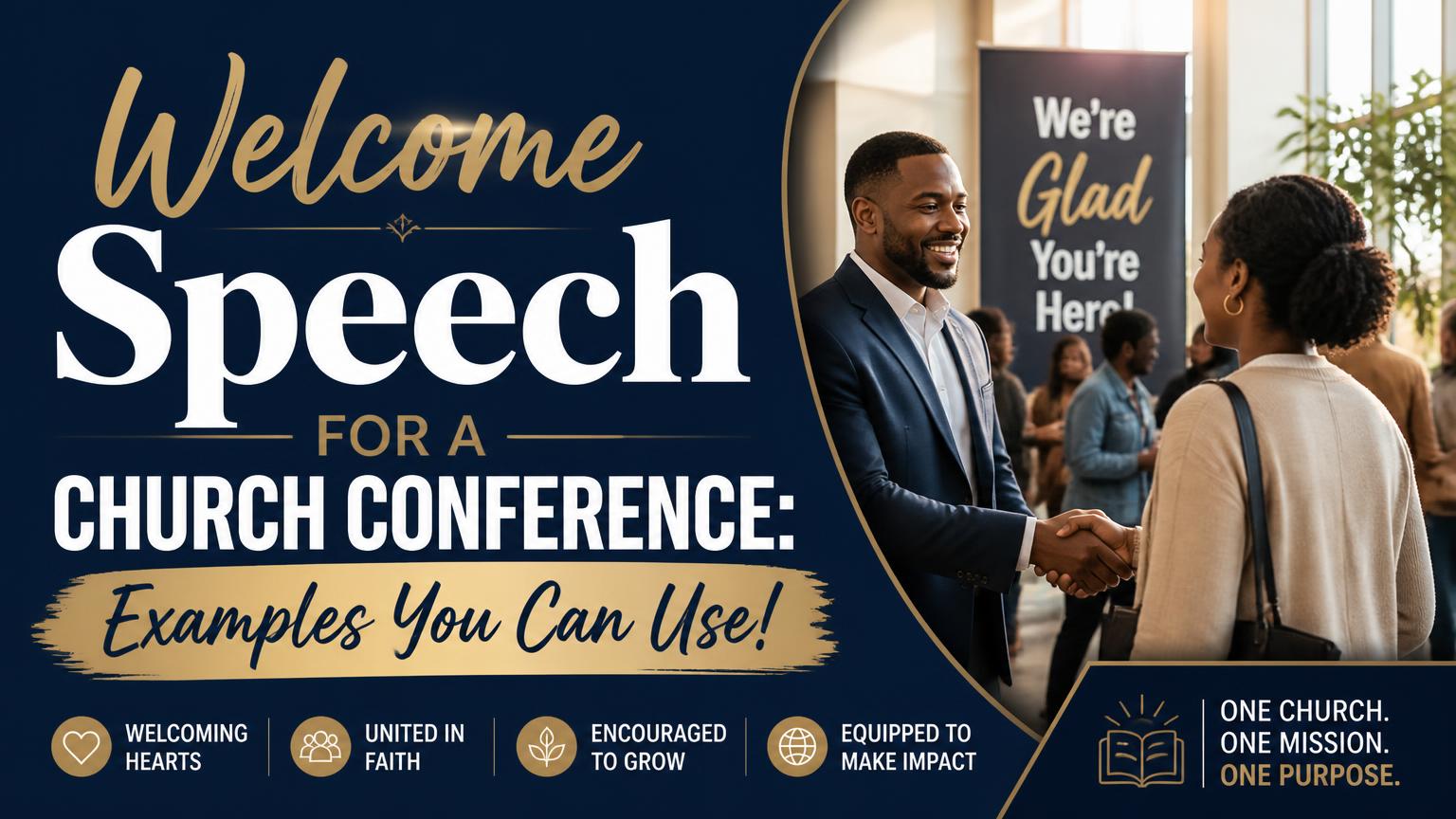
A welcome speech for a church conference should make people feel received, remind them why they have gathered, and direct attention toward God rather than the speaker. The best speeches are usually brief—about two to five minutes—while still acknowledging guests, introducing the conference theme, and explaining what attendees can expect.
The examples below can be adapted for a ministry conference, leadership gathering, annual church conference, women’s or men’s conference, youth event, or virtual meeting.
Welcome Speech for a Church Conference: Examples You Can Use
Short and Formal Welcome Speech
Good morning, everyone, and welcome to our church conference.
We are grateful to God for bringing us together and thankful for the opportunity to worship, learn, fellowship, and grow. We extend a special welcome to our guest speakers, ministry leaders, visitors, and everyone joining us for the first time.
Our theme for this conference is “[Conference Theme].” We pray that each session will strengthen our faith, renew our commitment to Christ, and equip us to serve others more faithfully.
As Hebrews 10:24–25 reminds us, we gather to encourage one another and to consider how we can live out our faith through love and good works. May this conference be a time of meaningful teaching, sincere worship, prayer, and Christian fellowship.
Thank you for being here. Please participate fully, welcome those around you, and come with an open heart. May God bless this conference and use it for His glory.
Warm and Personal Welcome Speech
Good morning, church family, and welcome.
It is a joy to see so many people gathered for this special conference. Some of you have been part of this church for many years, while others may be attending for the first time. Wherever you are in your journey, we want you to know that you are welcome here.
We have not gathered merely to attend another event. We have gathered to seek God, encourage one another, and receive wisdom for the work He has given us. The relationships we build and the truths we discuss may continue to influence our homes, churches, and communities long after this conference ends.
Our prayer is that no one will leave unchanged. May God speak through the preaching, conversations, worship, and prayers. May He give us humility to listen, courage to respond, and love to serve.
Thank you for joining us. Please take time to introduce yourself to someone new, encourage another attendee, and make the most of this opportunity to grow together. Welcome, and may the Lord richly bless you.
Theme-Focused Welcome Speech
Welcome to “[Conference Name].” We are thankful that you have joined us for this year’s conference, centered on the theme “[Conference Theme].”
A theme is more than a phrase printed on a program. It gives us a shared direction for our conversations, prayers, and decisions. During this conference, we will consider what this theme means for our personal discipleship, our church ministries, and our responsibility to the wider community.
Colossians 3:16 teaches believers to teach and encourage one another with wisdom, gratitude, and the word of Christ. That is our hope for these sessions. We want to listen carefully, think honestly, and encourage one another in ways that produce faithful action.
We welcome our speakers, presenters, volunteers, church leaders, and every participant. Each person contributes to the life of this gathering. Please engage respectfully, ask thoughtful questions, and remain attentive to what God may be teaching us.
Thank you for being here. May this conference help us understand our calling more clearly and follow Christ more faithfully.
Welcome Speech for a Church Leadership Conference
Good morning, pastors, ministry leaders, delegates, volunteers, and friends. Welcome to our church leadership conference.
Leadership in the church is not primarily a position of status; it is a responsibility to serve God and His people. Jesus demonstrated this when He connected greatness with humble service in Mark 10:42–45. That principle should shape the way we approach every discussion and decision during this conference.
We have gathered to evaluate, plan, learn, and seek wisdom for the future of our church. Some conversations may involve difficult questions, but our goal is not simply to defend personal preferences. Our goal is to honor Christ, listen to one another, care for the congregation, and pursue what strengthens the church’s witness.
We welcome every voice and ask everyone to participate with patience, honesty, and humility. May our discussions be guided by prayer, biblical conviction, and genuine concern for people.
Thank you for the time and energy you have given to this gathering. May God grant us wisdom, unity, and courage as we serve.
Welcome Speech for a Church Conference With Visitors
Good morning, and welcome to our church conference.
We are especially glad to welcome our visitors, first-time guests, partner churches, guest ministers, and those joining us from other communities. Your presence enriches this gathering, and we hope you feel received from the moment you arrive.
This conference gives us an opportunity to worship together, learn from one another, and consider how the Christian faith should shape our daily lives. Although we come from different congregations and backgrounds, we share a common desire to honor Jesus Christ and encourage His people.
Psalm 133:1 celebrates the goodness of God’s people dwelling together in unity. Unity does not require that we have identical experiences or opinions. It calls us to treat one another with love, respect, and patience as we pursue what is true and helpful.
Please feel free to ask questions, join conversations, and introduce yourself to others. We are grateful you are here, and we pray that this conference will be a blessing to you.
How to Write an Effective Church Conference Welcome
Begin With a Clear Greeting
Open by welcoming the audience directly. “Good morning, church family,” “Welcome, everyone,” or “We are grateful to have you with us” is usually enough. Avoid beginning with a long explanation of the event or an apology for speaking.
If the setting includes both members and guests, greet both groups. Mentioning visitors, speakers, volunteers, leaders, and online participants can help people feel recognized without requiring a lengthy list of names.
State Why the Gathering Matters
After the greeting, explain the purpose of the conference in one or two sentences. A ministry conference may focus on spiritual growth, a leadership conference on service and responsibility, and an annual church conference on prayerful evaluation and planning.
This explanation gives the welcome substance. It tells attendees that the conference is not simply a schedule of meetings but an opportunity connected to the church’s mission.
Introduce the Theme or Central Focus
Name the conference theme and briefly explain what it means. Do not merely repeat the theme as a slogan. Show how it relates to Christian life, ministry, discipleship, leadership, worship, or service.
For example:
“Our theme, ‘Faithful in Every Season,’ reminds us that Christian faithfulness includes both visible success and seasons of difficulty, waiting, and change.”
A brief explanation helps the audience listen for the theme throughout the sessions.
Set a Spiritual Tone Without Preaching a Sermon
A welcome speech can include prayer, Scripture, or a short spiritual reflection, but it should not become the opening sermon. Its purpose is to prepare people for the conference, not to provide a complete teaching message.
Choose one passage that supports the gathering’s purpose. For example:
- Hebrews 10:24–25 supports encouragement and meeting together.
- Philippians 2:1–4 supports humility and concern for others.
- Colossians 3:16 supports teaching, wisdom, gratitude, and mutual encouragement.
- Mark 10:42–45 is appropriate for servant leadership.
- Romans 12:4–8 can support teaching about different gifts and responsibilities.
Explain the connection briefly. A Scripture reference is more useful when attendees understand why it applies to the conference.
Tell People What to Expect
A short practical orientation can make the event more comfortable. Mention the major sessions, worship, discussion groups, meals, question-and-answer periods, or opportunities for fellowship. Give only information that attendees need at the beginning; detailed announcements can come later.
If the conference is online, explain how participants can submit questions, use the chat, access materials, or receive technical assistance. Clear instructions reduce confusion and allow people to focus on the content.
A Simple Structure for Your Own Speech
A reliable welcome speech can follow this six-part structure:
- Greeting: Welcome the congregation, guests, speakers, and participants.
- Appreciation: Thank people who organized, served, traveled, or contributed.
- Purpose: Explain why the church has gathered.
- Theme: Introduce the central subject and its spiritual relevance.
- Expectation: Encourage participation, openness, prayer, and fellowship.
- Transition: Introduce the first speaker, worship leader, prayer, or session.
For a two-minute speech, one or two sentences for each part are usually sufficient. If the event is formal, use the official name of the conference and the correct titles of leaders. If it is a small church gathering, a warmer and more personal tone may be appropriate.
Common Mistakes to Avoid
A welcome speech becomes less effective when it tries to do too much. Avoid these problems:
- Making it too long: A welcome should prepare the event, not compete with the main program.
- Listing too many names: Recognize key contributors, but do not make attendees wait through an exhaustive roll call.
- Using vague spiritual language: Explain what the conference is intended to accomplish.
- Turning the speech into a sermon: Keep the focus on welcome, purpose, and preparation.
- Ignoring visitors: Guests should understand that they are genuinely included.
- Making unverified promises: Do not guarantee that every attendee will receive a specific result or experience.
- Reading every announcement: Move detailed logistics to the appropriate part of the program.
- Using humor that may exclude people: Humor can help, but jokes about visitors, denominations, age, culture, or personal circumstances can create discomfort.
- Failing to rehearse names and transitions: Mispronouncing a speaker’s name or not knowing what follows can undermine an otherwise strong opening.
The speaker should also be audible, composed, and familiar with the microphone or online platform. A sincere delivery matters more than dramatic performance.
How to Adapt the Speech to Different Audiences
A church conference welcome should reflect the people attending it. For a youth conference, use accessible language and emphasize belonging, spiritual growth, and participation. For a women’s or men’s conference, connect the welcome to the specific fellowship and ministry goals without suggesting that every attendee has the same life experience. For a leadership conference, emphasize stewardship, humility, accountability, and service. For an interchurch gathering, use language that welcomes different congregations and avoids unnecessary assumptions about local customs.
A multicultural or international conference may require special care with names, translations, cultural references, and the amount of background information provided. In every setting, make the welcome specific enough to feel genuine while leaving room for people with different experiences.
A strong welcome speech does not need elaborate language. It needs a clear purpose, a gracious tone, a meaningful connection to Christian faith, and a smooth transition into the conference.
The most effective examples welcome people personally, explain why the church has gathered, connect the event to Scripture and Christian service, and prepare attendees to participate. Keep the speech focused and sincere: the goal is to open the conference with hospitality, spiritual direction, and a shared sense of purpose.