
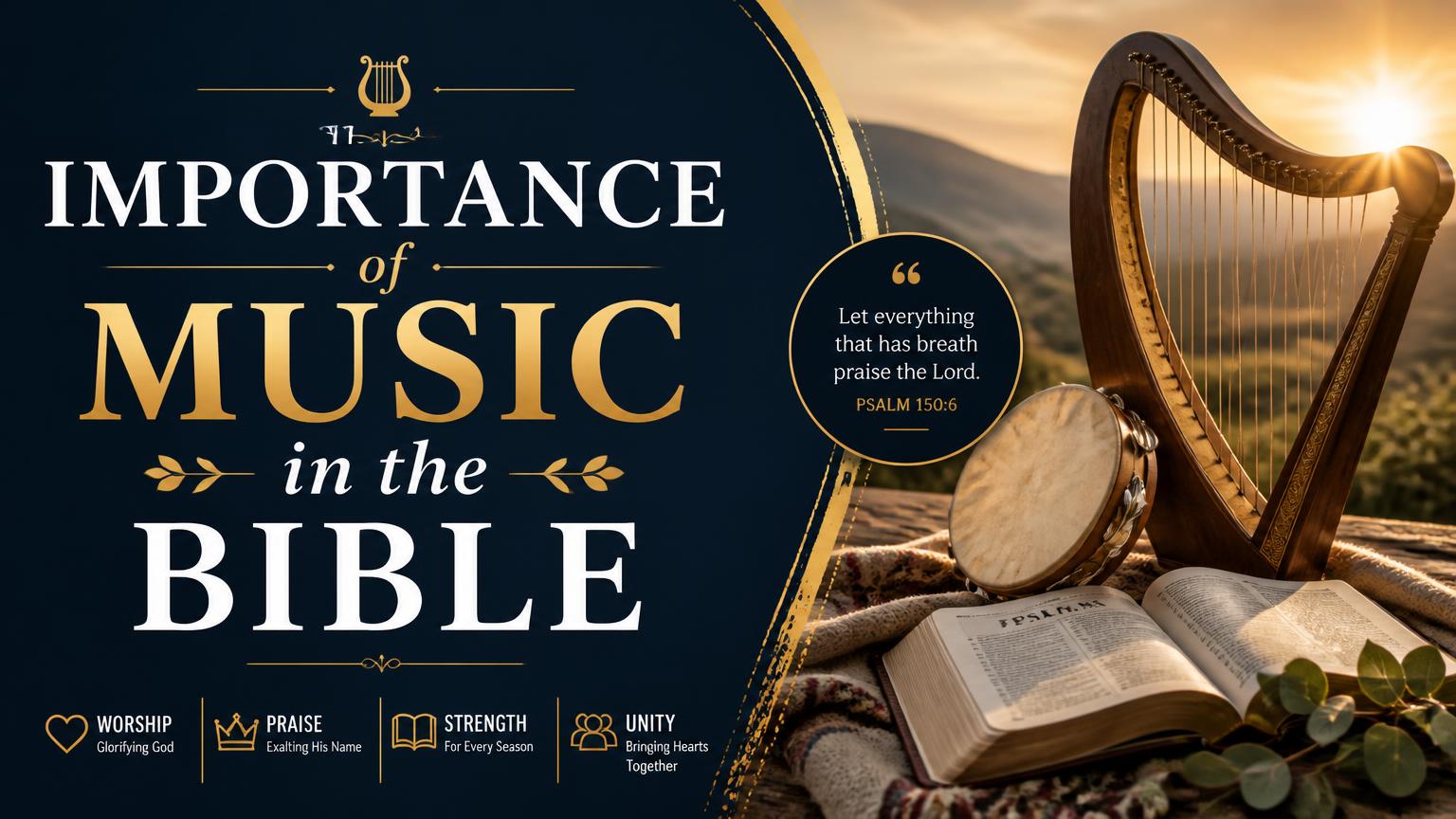
Music in the Bible is far more than a decorative part of religious ceremony. It expresses praise, grief, faith, repentance, thanksgiving, spiritual longing, communal identity, and hope. Scripture presents singing and instrumental music in private devotion, public worship, royal courts, warfare, prophecy, teaching, and the life of the early church. Its importance lies in the way it joins truth with memory, emotion, community, and action.
The Importance of Music in the Bible
Music Expresses Praise and Worship
The Bible most frequently associates music with worshiping God. The Psalms repeatedly call God’s people to sing, play instruments, and declare his works. Psalm 96:1 says, “Sing to the Lord a new song,” while Psalm 150 gathers together a range of instruments—trumpet, harp, lyre, tambourine, strings, pipe, and cymbals—in praise.
Music gives worshippers a form through which they can respond to God’s character and actions. Israel sang after God delivered them from Egypt. Exodus 15 records the song of Moses and Miriam, transforming national rescue into a communal confession of God’s power and faithfulness. The song did more than celebrate an event; it interpreted the event as God’s saving work.
Music also helped Israel worship together. During the dedication of Solomon’s temple, singers and instrumentalists joined in declaring God’s goodness and enduring mercy (2 Chronicles 5:11–14). The biblical pattern is therefore not limited to individual musical expression. Singing gathered the community around a shared understanding of who God is and what he has done.
Music Gives Voice to Lament and Sorrow
Biblical music is not restricted to joyful praise. A large portion of the Psalms consists of lament—songs that express fear, grief, injustice, loneliness, guilt, or apparent abandonment by God.
This matters because the Bible does not require worshippers to hide painful emotions. Psalm 13 begins with the repeated question, “How long?” and Psalm 42 describes a soul cast down and disturbed. Yet these songs bring distress into relationship with God rather than treating sorrow as evidence that faith has failed.
Lament often moves through a pattern of complaint, petition, remembrance, and renewed trust, although not every lament resolves neatly. Music gives suffering a structured language. It allows individuals and communities to name what is wrong while continuing to address God. In this sense, biblical worship includes honest grief as well as celebration.
The book of Lamentations and songs connected with national disaster show that music can preserve memory after tragedy. It helps a community mourn, confess, and seek mercy instead of denying its wounds.
Music Teaches and Preserves Faith
In an largely oral culture, songs helped people remember theological truths and historical events. A melody, repeated line, or poetic structure can make words easier to recall and pass on. Deuteronomy 31:19–21 describes a song given to Israel as a witness that would remain in the nation’s memory.
The Psalms taught worshippers about creation, covenant, wisdom, sin, forgiveness, kingship, suffering, and hope. Psalm 1 presents the contrast between the righteous and the wicked; Psalm 78 recounts God’s dealings with Israel; Psalm 119 celebrates God’s instruction. These are not merely emotional compositions. They are sung theology.
The New Testament continues this teaching function. Ephesians 5:18–19 instructs believers to address one another with “psalms and hymns and spiritual songs,” and Colossians 3:16 connects singing with allowing “the word of Christ” to dwell richly among believers. Music therefore teaches both vertically—directing praise to God—and horizontally, strengthening the understanding of the congregation.
Music Supports Prophecy and Spiritual Ministry
Several biblical passages connect music with prophetic activity. In 1 Samuel 10:5–6, a group of prophets is associated with musical instruments and prophetic speech. In 2 Kings 3:15, a musician plays before the prophet Elisha, after which the prophet delivers the word of the Lord.
These passages should not be used to claim that music automatically produces prophecy or guarantees a particular spiritual experience. Instead, they show that music could form part of a prophetic setting in ancient Israel. Music helped establish an atmosphere of attention, ordered participation, and spiritual reflection, while the authority of prophecy remained with God’s revealed word—not with the emotional intensity of the performance.
The Levites appointed for temple service also included trained musicians and singers (1 Chronicles 25:1–7). Their ministry was organized, skilled, and communal. Scripture thus leaves room for both spontaneous expression and disciplined preparation.
Music Strengthens People in Conflict and Crisis
Music often appears at moments of danger or transition. Israel sang after the Red Sea crossing, Deborah and Barak sang after victory over Sisera (Judges 5), and Jehoshaphat’s army went into battle with singers praising God (2 Chronicles 20:21–22).
These accounts do not present music as a magical weapon. In the story of Jehoshaphat, the singers’ praise expresses trust in God while the battle belongs to him. The music shapes the people’s posture: they act from confidence in divine faithfulness rather than from panic or self-reliance.
David’s harp also had a practical role in Saul’s court. David played for Saul when the king was tormented, and the music brought relief (1 Samuel 16:14–23). This account does not establish a universal medical claim about music, but it does recognize music’s capacity to affect a person’s emotional state and provide comfort.
Music Unites the Church and Points to Future Hope
Jesus and his disciples sang a hymn after the Last Supper (Matthew 26:30), showing that singing belonged within the practice of Jesus’ followers. Paul and Silas sang hymns while imprisoned in Philippi (Acts 16:25). Their song did not depend on favorable circumstances; it became an act of faith in suffering.
The early church used music to teach, encourage, and express shared allegiance to Christ. Several passages in the New Testament may preserve early Christian hymns or poetic confessions, including Philippians 2:5–11 and 1 Timothy 3:16. Whether or not every passage was originally sung, each demonstrates the importance of memorable, communal language for expressing Christian belief.
Revelation also portrays music as part of the worship of heaven. The redeemed sing to the Lamb in Revelation 5:9–10, and later visions include a great multitude praising God. Biblical music therefore has an eschatological dimension: it anticipates the final gathering of people from every nation in worship.
Major Forms and Uses of Music in Scripture
The Bible does not present one single musical purpose. Its examples include:
- Songs of praise: celebrating God’s character, creation, mercy, and saving acts.
- Songs of thanksgiving: responding to deliverance, provision, healing, or victory.
- Laments: expressing suffering, repentance, confusion, and the longing for justice.
- Wisdom songs: teaching how to live faithfully and discern good from evil.
- Royal and victory songs: marking the rule of a king or the deliverance of God’s people.
- Processional and temple music: accompanying public worship and sacred festivals.
- Personal songs: giving individuals language for prayer and reflection.
- Songs of love: as in the Song of Solomon, which celebrates marital love through poetic imagery.
- New covenant songs: expressing faith in Jesus Christ and the hope of resurrection.
The variety is significant. Biblical music is not confined to one mood, location, social group, or musical style. It serves the whole range of life before God.
Music, Instruments, and Skilled Service
Scripture mentions many instruments, including lyres, harps, trumpets, flutes, tambourines, cymbals, and stringed instruments. Different instruments served different functions. Trumpets could announce assemblies, festivals, or royal events; percussion supported celebration; stringed instruments accompanied singing and reflection.
The Bible also affirms musical skill. The temple musicians were appointed, trained, and organized into groups. David is described as a skilled player, and Psalm 33:3 encourages worshippers to play skillfully. This suggests that preparation and excellence can serve worship rather than contradict sincerity.
At the same time, technical quality is not presented as a substitute for obedience. In Amos 5:21–24, God rejects Israel’s songs and instruments because the nation practices injustice. The problem is not music itself; it is the contradiction between religious performance and unrighteous living. Worship that sounds impressive but ignores justice, mercy, and faithfulness is unacceptable to God.
What Music Does Not Mean in the Bible
The Bible does not teach that music manipulates God, guarantees spiritual power, or replaces truth and obedience. Music can intensify emotion, create unity, and help people remember words, but those effects do not prove that God approves of everything expressed through a song.
Biblical worship holds together several elements:
- Truth: the words should reflect what is faithful and sound.
- Sincerity: worship should come from genuine devotion rather than performance alone.
- Community: singing should build up the people who participate.
- Moral consistency: worship should be joined to obedience and justice.
- Appropriate order: spiritual expression should strengthen rather than confuse or harm the congregation.
Jesus also warned against outward religious behavior divorced from inward devotion. The principle applies to music: a song can be beautifully performed while the worshipper’s heart remains distant from God. Conversely, simple singing can be genuine worship when it expresses faith and truth.
Why Music Remains Important for Christians
Music remains important because it engages the mind, emotions, memory, body, and community at the same time. A sung confession may stay with a person long after a spoken statement has been forgotten. A lament can help believers pray when ordinary speech feels inadequate. A congregational hymn can teach doctrine while joining many voices in one confession.
Its value, however, depends on what it communicates and how it is used. Christian music should not merely produce an emotional response; it should direct people toward God, form truthful beliefs, encourage faithful living, and make room for both joy and sorrow. The biblical model includes artistic skill, but it places skill beneath worship and worship beneath a life of faithfulness.
Conclusion
The importance of music in the Bible lies in its ability to unite belief and experience. Scripture uses music to praise God, mourn suffering, remember salvation, teach truth, strengthen communities, accompany spiritual ministry, and anticipate the worship of the redeemed. It is powerful, but not magical; emotional, but not merely sentimental; artistic, but never detached from truth and obedience. Biblical music gives God’s people a faithful language for responding to him in every season of life.