
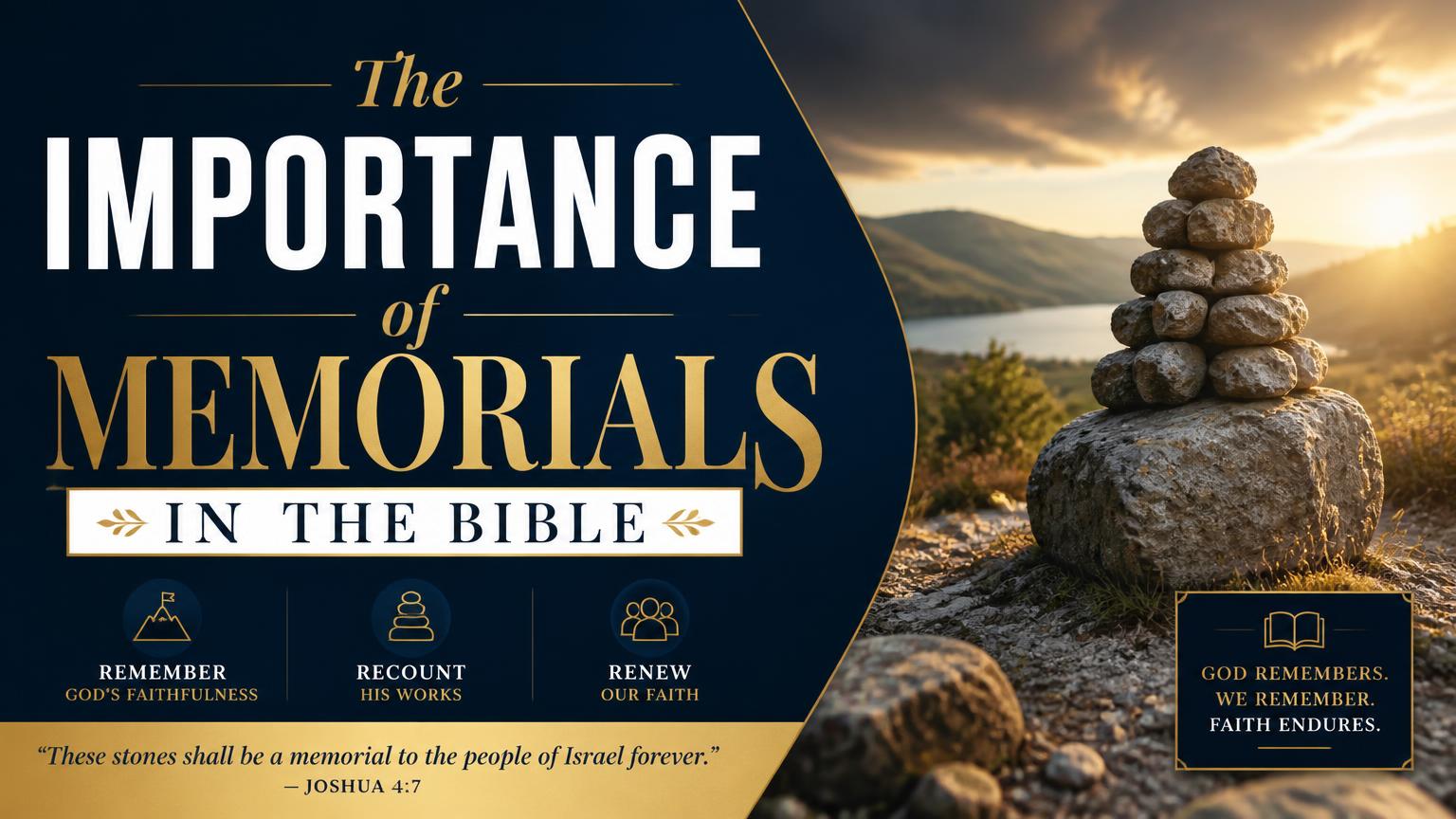
Memorials in the Bible are more than monuments to the past. They are God-given reminders that preserve His acts, strengthen faith, teach future generations, and call His people to renewed obedience. Biblical memorials may take the form of rituals, stones, written records, meals, names, offerings, or spoken testimony. Their purpose is not to give an object magical power, but to direct attention to God’s faithfulness and the meaning of His works.
The Importance of Memorials in the Bible
Memorials Preserve God’s Acts in History
A central purpose of biblical memorials is to prevent God’s mighty acts from being forgotten. After Israel crossed the Jordan River, God commanded Joshua to take twelve stones from the riverbed and set them up at Gilgal. When future children asked what the stones meant, parents were to explain that God had stopped the Jordan so Israel could cross on dry ground (Joshua 4:1–24).
The stones functioned as a visible teaching tool. They connected a present generation with an event it had not personally witnessed. The memorial did not possess power in itself; its value lay in the story it preserved. Whenever people saw it, they had an opportunity to remember that God had acted faithfully on behalf of His people.
This pattern appears throughout Scripture. The Passover was established as a continuing memorial of Israel’s deliverance from Egypt:
“This day shall be for you a memorial day, and you shall keep it as a feast to the LORD” (Exodus 12:14).
The annual meal made redemption part of Israel’s worship and family instruction. The exodus was not allowed to become a distant historical fact. It remained a living foundation for Israel’s identity.
Memorials Teach Children and Future Generations
Biblical memorials are deliberately intergenerational. They answer a recurring concern in Scripture: How will faith be transmitted when the original witnesses are gone?
The Passover instructions anticipated children asking, “What do you mean by this service?” Parents were to explain the Lord’s deliverance (Exodus 12:26–27). The stones from the Jordan served the same purpose. A memorial creates a natural opportunity for questions, and those questions open the way for testimony.
Psalm 78:4 expresses this responsibility:
“We will not hide them from their children, but tell to the coming generation the glorious deeds of the LORD.”
A memorial therefore has educational significance. It helps families and communities explain not merely what happened, but what the event reveals about God: His power, judgment, mercy, covenant faithfulness, and willingness to save.
This principle also applies beyond formal monuments. A family’s practice of giving thanks, a church’s retelling of God’s provision, or a congregation’s observance of the Lord’s Supper can preserve a testimony for people who were not present when the original event occurred.
Memorials Call God’s People to Faith and Obedience
Remembering in the Bible is not merely recalling information. Biblical remembrance involves bringing a truth to mind in a way that shapes present conduct.
When Israel remembered the exodus, it was expected to live as a redeemed people. The Passover memorial therefore carried ethical implications. Israel was to worship the Lord alone, reject Egypt’s former gods, and obey the covenant through which God had ordered their life.
Likewise, the stones at the Jordan were not intended simply to create historical interest. They reminded Israel that the God who had brought them into the promised land could be trusted to guide and sustain them. The memorial strengthened confidence for future obedience.
Deuteronomy repeatedly commands Israel to “remember” what God had done, especially when prosperity might lead the people to pride or self-reliance (Deuteronomy 8:2, 11–18). Forgetfulness in Scripture often means more than a mental lapse. It describes living as though God’s past faithfulness no longer matters. Memorials confront that form of spiritual forgetfulness.
Memorials Proclaim God’s Faithfulness Publicly
Some memorials served as public witnesses. When the tribes east of the Jordan built an altar near the Jordan River, the other tribes initially feared that it represented rebellion or false worship. The eastern tribes explained that the altar was intended as a witness between them and future generations: they belonged to the Lord and shared in Israel’s worship (Joshua 22:24–29).
The altar was called a witness because it testified to a relationship and a shared identity. In this case, the memorial addressed a potential future misunderstanding. It reminded later generations that geographical separation did not necessarily mean spiritual separation.
Memorials can therefore preserve public testimony. They declare what a people believes, what God has done, or what covenant relationship it claims. Their meaning is strongest when they point beyond themselves to truth that must continue to shape the community.
Biblical Forms of Memorial
The Bible uses several different forms of remembrance. These forms differ in appearance, but they serve related purposes.
Physical Memorials
Stones, altars, engraved names, and other visible objects helped people remember events and relationships. The twelve stones at the Jordan are the clearest example. The names of Israel’s tribes engraved on the high priest’s garments were also described as a “memorial” before the Lord (Exodus 28:12, 29). They represented the people in worship and emphasized that they were held before God.
Physical memorials are useful because human beings often need visible reminders. A tangible object can preserve a story in a specific place and make memory communal rather than merely private.
Ritual Memorials
Passover was a recurring ritual memorial. Its annual repetition ensured that the exodus remained central to Israel’s worship. The ritual involved food, questions, narration, and participation. It did not merely tell people to remember; it gave them a structured way to remember together.
For Christians, the Lord’s Supper fulfills a related memorial function. Jesus commanded His disciples to eat the bread and drink the cup “in remembrance of me” (Luke 22:19; 1 Corinthians 11:24–26). The Supper remembers Christ’s death, proclaims its significance, and points toward His future return. It is therefore both remembrance and proclamation.
Written and Communal Memorials
The Bible also presents written records and shared testimony as means of remembrance. Malachi 3:16 describes those who feared the Lord speaking with one another, after which “a book of remembrance” was written before Him. The image communicates God’s attentive recognition of faithful people, especially when their obedience appeared unnoticed.
Esther 9:28 established Purim as a lasting observance so that the deliverance of the Jewish people would be remembered from generation to generation. The community’s annual celebration transformed historical rescue into continuing communal memory.
Memorials of Faithful Actions
In Mark 14:9, Jesus said that the woman who anointed Him at Bethany would be remembered wherever the gospel was proclaimed. Her act became a memorial because it expressed costly devotion to Christ.
This does not mean that her deed earned salvation or that human praise was its ultimate reward. Rather, Jesus ensured that her faith would continue to instruct others. Her example demonstrates that sacrificial love offered to Christ is not lost, even when it is misunderstood by people at the time.
Similarly, when an angel told Cornelius that his prayers and almsgiving had “ascended as a memorial before God” (Acts 10:4), the statement did not mean that Cornelius purchased God’s favor. It showed that God had seen his sincere response to the light he had received and was now bringing him into fuller knowledge of the gospel.
What Does It Mean That God “Remembers”?
When Scripture says that God remembers Noah, His covenant, or His people, it does not suggest that God had previously forgotten them. God’s remembrance means that He turns His covenant attention toward them and acts according to His promises.
For example, Genesis 8:1 says that God remembered Noah, and the floodwaters began to recede. Exodus 2:24 says that God heard Israel’s groaning and remembered His covenant with Abraham, Isaac, and Jacob. In both cases, “remembering” describes faithful action, not the recovery of lost information.
This distinction matters. Human memorials help people remember because human memory is limited and vulnerable to distortion. God does not need memorials to refresh His knowledge. He establishes memorials for His people so that they will remember Him, interpret their lives correctly, and respond in faith.
The direction is therefore important: biblical memorials do not force God to act. They remind people of the God who has already promised and acted faithfully.
Memorials Are Not Meant to Become Idols
The Bible values memorials but also warns against confusing a reminder with the reality to which it points. A sacred object can be misused when people begin to trust in the object rather than in God.
A striking example is the bronze serpent Moses made in the wilderness. God originally used it as a means through which repentant Israelites could look and live (Numbers 21:4–9). Centuries later, however, the Israelites treated it as an object of worship. King Hezekiah destroyed it because the people were burning incense to it (2 Kings 18:4).
The lesson is not that physical reminders are inherently wrong. The lesson is that even something originally connected with God’s work can become spiritually harmful when it receives the devotion that belongs to God alone.
A biblical memorial should direct attention away from itself. If it becomes an object of superstition, pride, manipulation, or worship, it has lost its proper function.
Memorials, Mourning, and Christian Hope
The Bible does not reduce memorials to monuments for the dead, although remembering faithful people and grieving loss can be appropriate. Biblical remembrance remains connected to God’s purposes. A memorial can honor a person’s life while also bearing witness to God’s grace, the person’s faith, or the hope of resurrection.
Christian remembrance of the dead must therefore hold sorrow and hope together. Scripture permits genuine grief, but it rejects hopeless grief as the final perspective for those who trust in Christ (1 Thessalonians 4:13–14). A Christian memorial is most faithful when it tells the truth about loss while also pointing to God’s promises.
The emphasis should not be on preserving a person’s reputation at any cost or treating the dead as spiritually accessible through an object. Instead, remembrance can give thanks for a life, acknowledge its influence, comfort the living, and direct attention to God’s mercy.
How Biblical Memorials Should Shape Life Today
Biblical memorials remain useful when they produce faithful action rather than passive nostalgia. Their proper use includes:
- Remembering specific acts of God: Vague gratitude is strengthened by recalling concrete answers to prayer, deliverance, provision, or spiritual growth.
- Telling the story to children: Personal and congregational history can teach younger believers how God has worked across time.
- Practicing regular worship: Communion, prayer, Scripture reading, and testimony keep central truths from becoming abstract.
- Connecting memory with obedience: Remembering God’s mercy should influence how people worship, treat others, use possessions, and endure difficulty.
- Guarding against self-glory: A memorial should celebrate God’s grace rather than turn past achievements into a monument to human importance.
- Rejecting superstition: No object, place, or ceremony replaces repentance, faith, love, and obedience.
The strongest memorial is not one that merely survives physically. It is one that continues to produce truthful worship and faithful living.
Memorials in the Bible preserve the memory of God’s saving acts, teach successive generations, strengthen trust, and publicly testify to covenant faithfulness. They are reminders rather than sources of power. Their purpose is fulfilled when people look beyond the stone, meal, written record, or ceremony to the God who acted in the past and remains faithful in the present.