
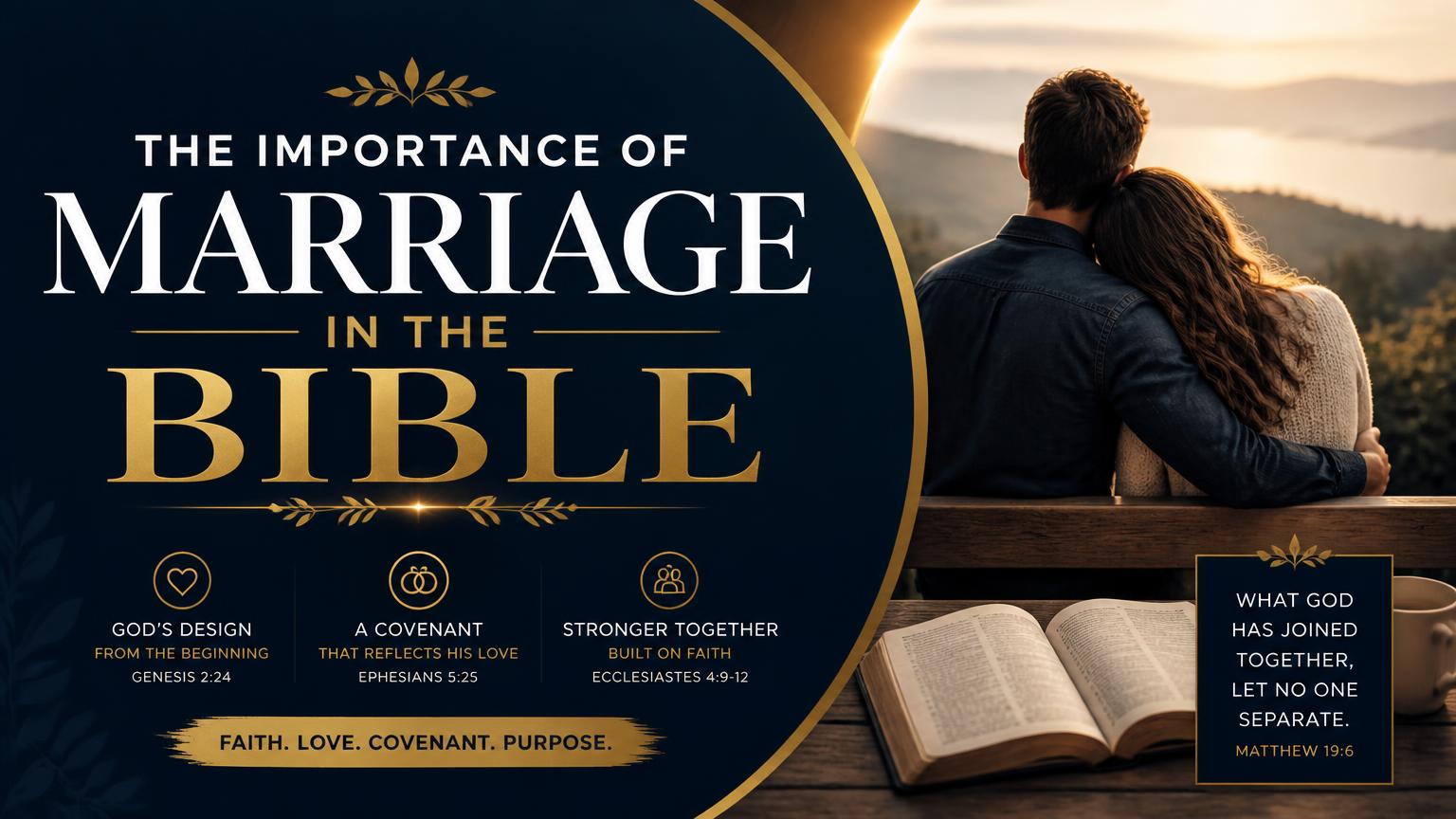
Marriage holds an important place in the Bible because it is presented as God’s creation, a covenant of faithful companionship, the foundation of family life, and a living picture of Christ’s relationship with the church. At the same time, Scripture does not treat marriage as necessary for spiritual completeness or as a higher status than faithful singleness. Its importance must be understood alongside God’s purposes for both marriage and celibate devotion.
The Importance of Marriage in the Bible
The Bible’s teaching about marriage begins in creation rather than in later social customs. Genesis presents marriage as part of God’s good design for human life, while later passages explain its covenantal, moral, familial, and spiritual significance.
Marriage Is Part of God’s Created Design
Genesis 2:18 records God’s declaration that it is not good for the man to be alone. God then creates the woman and brings her to the man, establishing marriage as a relationship of companionship, mutual belonging, and shared vocation.
Genesis 2:24 describes the resulting union: a man leaves his parents, holds fast to his wife, and the two become “one flesh.” This language indicates more than affection or legal partnership. It describes a comprehensive union involving bodily intimacy, emotional commitment, shared life, and covenant loyalty.
Jesus refers back to this creation account in Matthew 19:4–6. His teaching shows that marriage is not merely a human arrangement that can be redefined according to convenience. It is a union established by God, and therefore it should be treated with seriousness, faithfulness, and permanence.
Marriage Is a Covenant, Not Merely a Contract
A contract is generally an exchange of obligations that continues while both parties fulfill specified terms. Biblical marriage is better understood as a covenant: a solemn commitment made before God that calls husband and wife to faithful love.
Malachi 2:14 calls a wife a man’s “companion” and “wife by covenant.” This description emphasizes that marriage involves personal loyalty, not simply shared finances, sexual access, social respectability, or legal status.
The covenant character of marriage explains why the Bible repeatedly condemns adultery and treachery. Sexual unfaithfulness violates the exclusive promise at the heart of the relationship. Proverbs presents marital faithfulness as a source of joy, while Hebrews 13:4 calls believers to honor marriage and preserve sexual integrity.
A covenant does not mean that a person must remain in danger or tolerate violence. Biblical faithfulness never authorizes abuse, coercion, or oppression. Marriage involves responsibility before God, and that responsibility includes protecting the dignity and well-being of one’s spouse.
Marriage Provides Companionship and Mutual Help
Marriage answers the problem of human isolation identified in Genesis 2. The husband and wife are created to share life, work, burdens, decisions, and joy. This companionship is not based on the idea that one spouse is inherently more valuable than the other. Both are created in God’s image (Genesis 1:27).
The biblical picture is therefore stronger than a division in which one person commands and the other merely serves. Ephesians 5:21 begins its teaching on Christian relationships with a call to mutual submission. Husbands are commanded to love sacrificially, following Christ’s self-giving example, while wives are called to respond within a relationship shaped by honor and devotion.
The purpose is not domination but self-giving love. A Christian marriage should make forgiveness, truthfulness, service, and faithfulness visible in ordinary life. Companionship becomes meaningful when both spouses seek the good of the other rather than treating marriage as a means of personal control or fulfillment.
Marriage Supports Family Life and the Nurture of Children
From the beginning, God blesses humanity with the command to be fruitful and multiply (Genesis 1:28). Marriage provides the covenant setting in which sexual union, childbearing, and the formation of a household can be ordered and nurtured.
The Bible describes parents as responsible for teaching children God’s works and ways. Deuteronomy 6:6–7 instructs parents to speak about God’s commands throughout daily life. Psalm 78:5–7 likewise presents the transmission of faith from one generation to the next as a serious responsibility.
This does not mean that every marriage must produce children to be considered valid or valuable. Scripture honors marriage as a covenant even when children are not present, and it recognizes that fertility is not fully controlled by human choice. Nor does having children automatically make a marriage faithful. Biblical family life depends on love, instruction, protection, discipline, and a household oriented toward God.
Marriage and parenthood are related but not identical callings. A childless marriage can still fulfill the biblical purposes of companionship, covenant faithfulness, sexual integrity, service, and spiritual partnership.
Marriage Teaches Faithfulness, Sacrifice, and Holiness
Marriage is important in the Bible partly because it exposes selfishness and calls people to grow in love. A spouse cannot sustain a healthy covenant through temporary feelings alone. Marriage requires patience, repentance, honesty, forgiveness, sexual faithfulness, and perseverance.
First Corinthians 7 presents marriage as a legitimate context for sexual intimacy and mutual responsibility. The passage does not portray sex as shameful; instead, it places sexual union within a faithful covenant and warns spouses not to use deprivation or manipulation against each other.
Marriage also provides opportunities to practice holiness in concrete circumstances. Loving a spouse when tired, resolving conflict without cruelty, keeping promises when emotions change, and serving without immediate recognition all form patterns of Christian obedience. These practices do not earn salvation, but they can express the transforming work of God in a believer’s life.
The Bible’s standard is demanding because marriage is not merely about compatibility. It is a lifelong relationship in which character is tested and cultivated.
Marriage Illustrates Christ’s Relationship With the Church
Ephesians 5:25–33 gives marriage a distinctive theological meaning by comparing the husband’s love for his wife with Christ’s love for the church. Christ gives himself for the church, seeks her good, and acts with sacrificial commitment.
This comparison does not turn a spouse into a savior or make marriage a substitute for faith in Christ. Rather, it gives Christian marriage a pattern: love should be self-giving, protective, cleansing, and devoted to the other person’s good.
Revelation 19:6–9 uses wedding imagery for the final celebration of Christ and his redeemed people. The image highlights covenant joy, belonging, purity, and the completion of God’s saving purposes. Earthly marriage points beyond itself to a greater relationship between Christ and his people.
Because of this symbolism, Christian marriage has a public and spiritual dimension. It can display something about God’s steadfast love, although no human marriage represents that love perfectly.
What the Bible Says Marriage Is For
The Bible does not reduce marriage to one purpose. Its purposes overlap and reinforce one another.
Companionship
Marriage joins two people in a committed partnership rather than leaving them to face life alone. This includes affection, friendship, shared responsibility, and mutual encouragement.
Sexual Faithfulness
Marriage provides the covenant context for sexual intimacy. The Bible rejects both the exploitation of sex outside meaningful commitment and the idea that sexuality is inherently impure. Within marriage, sexual union is treated as good but also morally serious.
Family and Generational Faithfulness
Marriage can provide a stable setting for raising children and passing faith, wisdom, and moral responsibility to the next generation. The responsibility belongs to parents and the wider covenant community, not only to one spouse.
Spiritual Partnership
A husband and wife can encourage one another in prayer, obedience, service, repentance, and trust in God. This partnership is not automatic; it requires shared commitment and humility.
A Public Witness
Marriage makes promises visible. A faithful marriage can demonstrate covenant loyalty in a culture where relationships are often treated as disposable. Its witness is strongest when it reflects justice, gentleness, sacrifice, and truth rather than outward appearances alone.
Is Marriage Required for a Fulfilled Christian Life?
No. The Bible honors marriage, but it does not teach that everyone must marry.
Jesus lived unmarried, and Paul describes singleness as a gift that can allow undivided devotion to the Lord (1 Corinthians 7:7, 32–35). Jesus also teaches that some people remain unmarried for the sake of the kingdom of heaven (Matthew 19:12).
This corrects two opposite errors. Marriage should not be treated as spiritually inferior, since Scripture calls it honorable. But neither should singleness be treated as incomplete, defective, or merely a temporary condition awaiting fulfillment. Both marriage and singleness can be faithful callings in which a person loves God and serves others.
Marriage is important because of what God designed it to be, not because it is the universal measure of maturity, happiness, or spiritual worth.
Marriage, Sin, and the Need for Grace
The Bible presents marriage as good while also showing how sin damages it. Adam and Eve’s disobedience introduces conflict, blame, alienation, and distorted desires into human relationships. Later biblical narratives include adultery, polygamy, abandonment, exploitation, and divorce. These accounts often describe what happened without presenting every action as God’s ideal.
Jesus’ teaching in Matthew 19 recognizes the hardness of human hearts while reaffirming the seriousness of the marriage covenant. Scripture therefore holds together two truths: marriage is intended for faithful permanence, and human beings often violate that intention.
Divorce is not treated casually in the Bible, but people affected by marital breakdown should not be met with simplistic condemnation. Questions of abandonment, abuse, sexual unfaithfulness, legal separation, and remarriage require careful pastoral and theological judgment. Whatever position a Christian tradition takes on those questions, it should preserve both the seriousness of covenant and the biblical concern for truth, mercy, and protection of the vulnerable.
What Makes a Biblical Marriage?
A biblical marriage is not identified merely by a wedding ceremony, cultural tradition, or legal document. It is characterized by a pattern of covenant faithfulness.
That pattern includes:
- Exclusive loyalty: Spouses reject adultery and emotional or sexual betrayal.
- Sacrificial love: Each seeks the other’s good rather than demanding constant personal advantage.
- Mutual honor: Husband and wife recognize each other’s dignity as people made in God’s image.
- Truth and repentance: Conflict is addressed honestly, with willingness to confess wrong and seek forgiveness.
- Sexual responsibility: Intimacy is neither exploited nor used as a weapon.
- Shared service: The household becomes a place where both people contribute and care for others.
- Spiritual seriousness: Faith is practiced rather than merely claimed.
These qualities do not imply a conflict-free relationship. They describe the direction and commitments that should shape a marriage, including how a couple responds when they fail.
Conclusion
The importance of marriage in the Bible rests on several connected truths: God established it in creation, designed it for covenant companionship and faithful intimacy, gave it a role in family life, and used it as a picture of Christ’s love for the church. Marriage is therefore honorable and spiritually significant, but it is not the source of salvation or the measure of a person’s worth. Scripture gives equal dignity to faithful singleness and calls every Christian—married or unmarried—to covenant loyalty, holiness, sacrificial love, and devotion to God.