
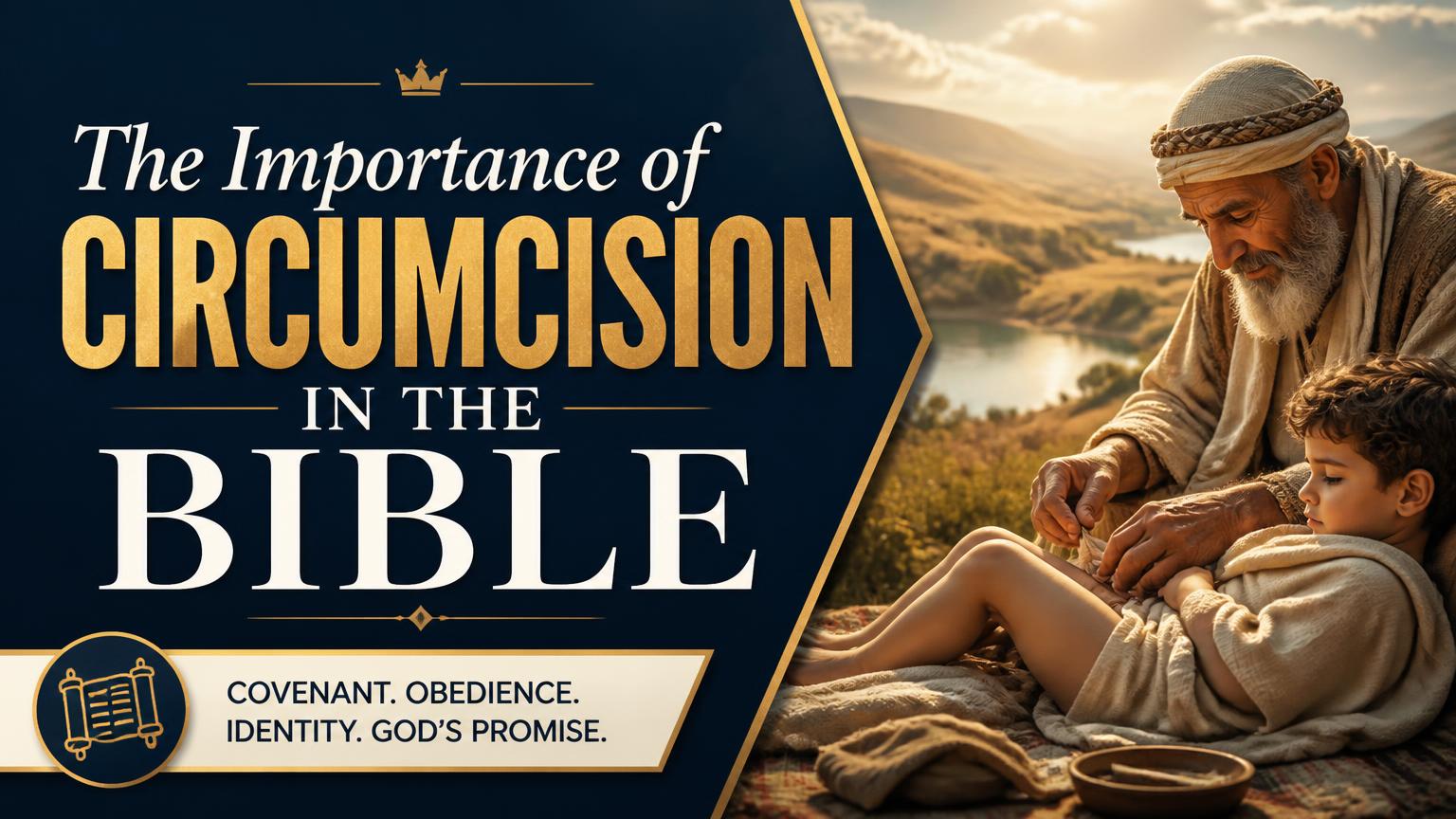
Circumcision is one of the Bible’s most significant covenant symbols. It began as the physical sign of God’s covenant with Abraham and his descendants, marked membership in Israel, and represented a person’s obligation to trust and obey God. The Bible also uses circumcision metaphorically, calling people to have their “hearts” circumcised—that is, to remove stubbornness and respond to God inwardly.
In the New Testament, circumcision remains historically important, but physical circumcision is no longer presented as a requirement for Gentiles to belong to God’s people or receive salvation through Christ. The emphasis shifts from a mark in the body to faith, obedience, and inner transformation.
The Importance of Circumcision in the Bible
A Physical Sign of God’s Covenant With Abraham
The biblical importance of circumcision begins in Genesis 17. God changed Abram’s name to Abraham and established a covenant with him, promising to make him the father of many nations and to bless his descendants. Circumcision was appointed as the sign of that covenant.
Every male in Abraham’s household was to be circumcised, including descendants, servants, and foreign-born members of the household. Israelite boys were to receive circumcision on the eighth day after birth. The sign therefore communicated several things:
- Belonging: Circumcision identified a person with Abraham’s covenant family.
- Obligation: The covenant involved responsibility, not merely privilege.
- Continuity: Each generation received the physical reminder that God’s promises extended through Abraham’s family.
- Separation: Circumcision distinguished Israel from surrounding peoples who did not share the same covenant.
Genesis 17 describes an uncircumcised male as being “cut off” from his people because he had broken the covenant. This language shows that circumcision was not treated as a meaningless custom. It was a visible act of covenant loyalty and an outward declaration of belonging to the community shaped by God’s promises.
At the same time, the sign itself did not operate like magic. Circumcision did not automatically make a person faithful, righteous, or obedient. Its meaning depended on the covenant relationship it represented.
Circumcision Marked Covenant Identity and Obligation
Under the law given through Moses, circumcision continued to identify Israel as God’s covenant people. It was connected with participation in the nation’s religious life, including the Passover. Exodus 12 required circumcision for males who wished to eat the Passover as members of the covenant community.
The practice therefore involved more than personal or family tradition. It expressed a person’s relationship to Israel’s God and to the community governed by the covenant. It also reminded Israel that belonging to God involved obedience.
Joshua 5 illustrates this covenant dimension. After Israel entered the promised land, the new generation of Israelites was circumcised before celebrating Passover. The act functioned as a renewal of covenant identity after the wilderness generation had died. Before Israel moved forward in its mission, the people were reminded that their relationship with God—not merely military strength—defined them.
Circumcision was also an ethnic and religious boundary marker. In later biblical history, the term “the uncircumcised” could refer broadly to peoples outside Israel, especially those who did not worship the Lord. This explains why the issue became so significant when non-Jews began joining the Christian movement.
The Bible Connects Circumcision With the Heart
The prophets and other biblical writers repeatedly warn that physical circumcision is insufficient when a person remains inwardly rebellious. Moses told Israel to “circumcise” its heart and stop being stubborn (Deuteronomy 10:16). He also spoke of God circumcising the hearts of his people so that they would love him (Deuteronomy 30:6).
Jeremiah used similar language when calling Judah to remove the spiritual evil that had made the nation resistant to God (Jeremiah 4:4). These passages do not deny the covenant meaning of physical circumcision. They expose a deeper problem: an outward religious sign can exist alongside inward disobedience.
The biblical idea of heart circumcision refers to the removal of hardness, pride, and resistance to God. It includes repentance, renewed desires, and genuine obedience. This theme establishes an important principle:
A covenant sign has value only when the life it represents is being pursued.
The concern was not that physical circumcision was worthless. Rather, the Bible rejects the idea that an outward mark can substitute for faithfulness. Israel needed both covenant identity and covenant obedience.
Jesus and His Apostles Lived Within the Jewish Covenant
Jesus was circumcised on the eighth day, as Luke 2:21 records. This confirms that he was born into Israel and lived within the requirements of the Mosaic law. Paul likewise described himself as circumcised on the eighth day and as a member of the people of Israel (Philippians 3:5).
Jesus’ circumcision does not mean that Christians must observe every aspect of the Mosaic law. It shows that Jesus entered human history as Israel’s Messiah, born within the covenant people and its scriptural story. The New Testament presents his life as the fulfillment of God’s purposes through Israel, not as a rejection of Israel’s Scriptures.
The question changed after Gentiles began believing in Christ. The central issue became whether non-Jewish believers had to be circumcised and take on the full obligations of the Mosaic law.
The New Testament Reframes the Meaning of Circumcision
The apostles concluded that Gentile believers did not need to be circumcised to become part of the people of God. At the Jerusalem Council, described in Acts 15, the church rejected the requirement that Gentile converts be circumcised and placed under the entire law of Moses.
Paul strongly opposed treating circumcision as a requirement for justification. In Galatians, he argued that people are accepted by God through faith in Christ, not through receiving a physical covenant mark or adopting Jewish boundary practices. In Romans, he explained that a person’s true standing before God is not determined merely by outward circumcision. What matters is faith expressed through obedience and a transformed heart.
Paul’s statement that “neither circumcision counts for anything nor uncircumcision” (Galatians 5:6; 6:15) does not mean that circumcision had never mattered. It means that, in relation to salvation and membership in the new covenant community, physical circumcision is no longer the decisive marker. The decisive issue is belonging to Christ.
Physical Circumcision and Spiritual Circumcision
The Bible uses circumcision in both literal and spiritual ways, and the two meanings should not be confused.
Physical circumcision was the covenant sign given to Abraham and practiced by Israel. It marked male membership in the historical covenant community and remained part of Jewish identity.
Spiritual circumcision describes inward renewal. It concerns the heart, will, and relationship with God. In Colossians 2:11, Paul speaks of believers experiencing a “circumcision” associated with Christ—not a procedure performed by human hands, but a spiritual transformation connected with putting off the old life.
This distinction explains why the New Testament can honor the history of circumcision while denying that it is necessary for Christian salvation. The physical sign pointed to a covenant relationship; the gospel announces that this relationship is received through Christ by faith and demonstrated through a changed life.
Some Christian traditions connect circumcision and baptism as signs associated with covenant membership, especially in light of Colossians 2. Other traditions distinguish them more sharply. The text supports a relationship between the ideas of covenant identity and spiritual transformation, but Christians differ over exactly how baptism relates to circumcision. The central New Testament point remains clear: physical circumcision is not the basis on which a person is justified before God.
Why Circumcision Caused Conflict in the Early Church
Circumcision became controversial because it represented more than a medical practice. For Jewish believers, it was tied to Abraham, Moses, national identity, and faithfulness to Scripture. Requiring it of Gentiles, however, would have implied that faith in Christ was insufficient without entering the Jewish covenant community through its physical boundary marker.
Paul’s treatment of Timothy and Titus shows the distinction between cultural practice and theological requirement. Timothy, whose mother was Jewish, was circumcised so that his ministry among Jews would not create an unnecessary obstacle (Acts 16:1–3). Titus, a Gentile, was not compelled to be circumcised when some wanted to make it a test of Christian freedom (Galatians 2:3–5).
These cases are not contradictory. Timothy’s circumcision was a voluntary accommodation for ministry. Titus’s case involved rejecting the claim that circumcision was necessary for acceptance by God. Paul could adapt to cultural circumstances without surrendering the gospel’s central teaching.
The conflict was therefore about the basis of salvation and the identity of God’s people. If circumcision were required for justification, Gentiles would need to become Jewish before they could fully belong to Christ. The apostles rejected that conclusion.
Is Circumcision Required for Christians?
For most Christian traditions, physical circumcision is not required for salvation, church membership, or obedience to the gospel. Acts 15, Galatians, Romans, and Paul’s teaching in 1 Corinthians 7:18–19 all support this conclusion.
That does not mean the Bible treats circumcision as irrelevant in every context. It remains important for understanding:
- God’s covenant with Abraham
- Israel’s identity and obligations
- the relationship between outward signs and inward faith
- the transition from the Mosaic covenant to the new covenant in Christ
- the inclusion of Gentiles among God’s people
Whether parents choose circumcision for cultural, family, religious, or medical reasons is a separate question from whether it is required as a Christian religious practice. The New Testament does not make the procedure a condition of salvation.
For Jewish people, circumcision continues to carry religious and communal significance through the Abrahamic covenant and Jewish tradition. Christianity and Judaism therefore approach the practice from different covenantal frameworks, and those differences should not be erased.
Conclusion
The importance of circumcision in the Bible lies first in its role as the sign of God’s covenant with Abraham and Israel. It marked belonging, carried an obligation to live faithfully, and distinguished the covenant community. Yet the Bible consistently insists that the outward sign must be matched by inward devotion.
In the New Testament, this inward reality becomes central. Through Christ, physical circumcision is not required for Gentiles or treated as the basis of righteousness. The lasting biblical lesson is that covenant identity cannot be reduced to a bodily mark: God seeks a circumcised heart—faith that responds to him in repentance, trust, and obedience.