
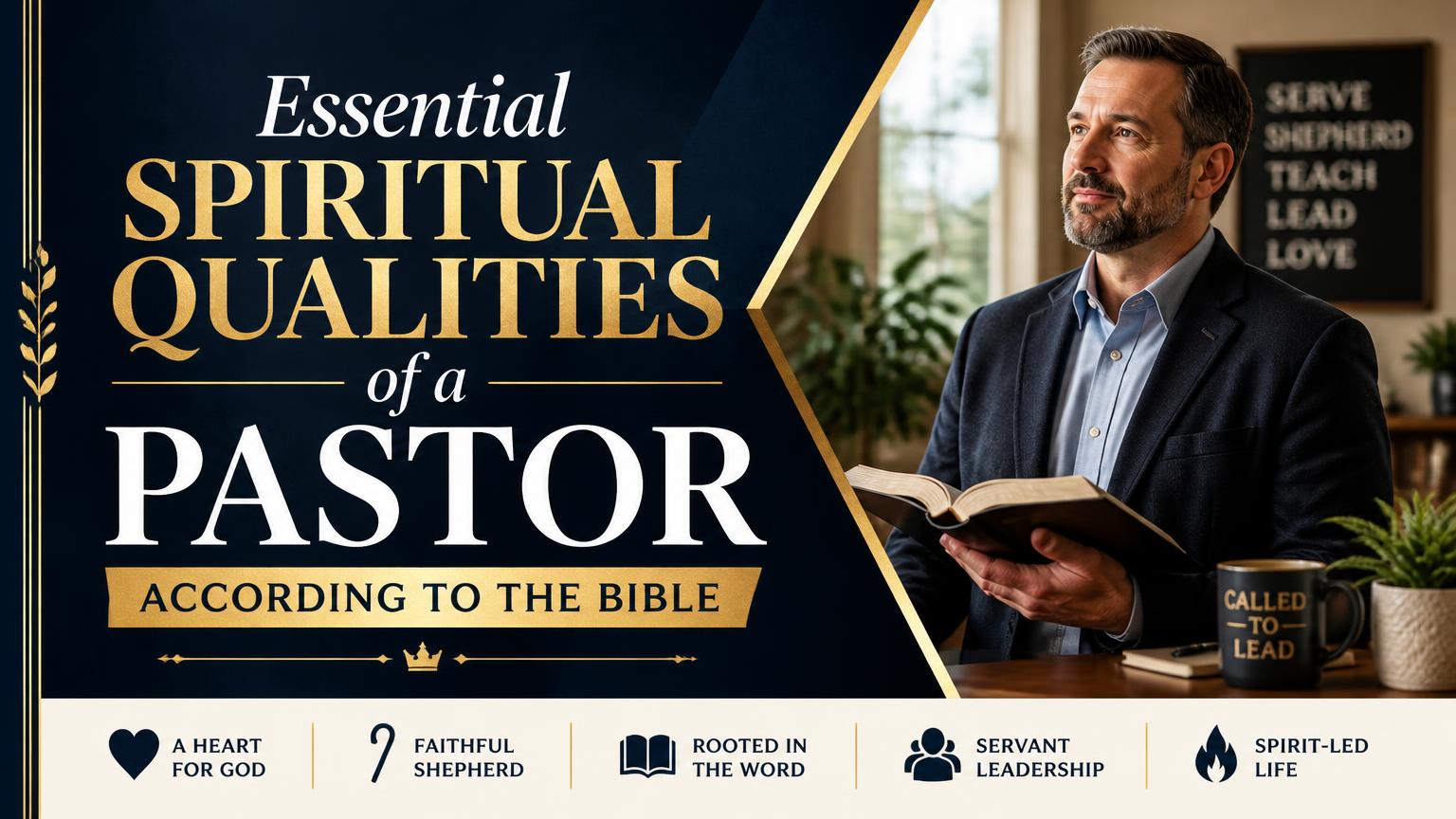
A pastor’s spiritual qualifications are primarily matters of character, not charisma, education, popularity, or public speaking ability. The Bible describes a pastor—also called an elder or overseer—as a shepherd who must be spiritually mature, morally trustworthy, doctrinally sound, humble, self-controlled, faithful in relationships, and devoted to serving God’s people. These qualities do not describe sinless perfection; they describe a consistent pattern of godly life that makes a leader worthy of trust.
Spiritual Qualities of a Pastor
The clearest biblical descriptions appear in 1 Timothy 3:1–7, Titus 1:5–9, 1 Peter 5:1–4, and Acts 20:17–38. Taken together, they show that pastoral leadership rests on who a person is as much as on what he can do.
Spiritual Maturity and Integrity
A pastor must be “above reproach” (1 Timothy 3:2; Titus 1:6–7). This does not mean that he has never failed or committed sin. It means that his life is not characterized by a credible pattern of scandal, hypocrisy, dishonesty, or moral compromise.
Spiritual maturity develops over time through obedience, repentance, wisdom, and tested faithfulness. For this reason, Paul warns against appointing a recent convert, since pride and inexperience can make a new believer vulnerable to spiritual failure (1 Timothy 3:6).
Integrity means that a pastor’s private life agrees with his public ministry. His words, finances, relationships, use of authority, and treatment of people should reinforce rather than contradict his message. A gifted communicator without integrity may attract a crowd, but he cannot safely shepherd a church.
Love for God and People
Pastoral ministry requires more than responsibility toward an institution. A pastor must love God and care genuinely for the people entrusted to him. Jesus identified love for God and love for one’s neighbor as the great commandments (Matthew 22:37–40), and these commands shape the pastor’s entire ministry.
Paul’s description of love in 1 Corinthians 13:4–7 is especially relevant to pastoral character. A loving pastor is patient, kind, not envious, not arrogant, and not easily provoked. He does not treat people as tools for building his reputation or ministry platform.
This love also includes a willingness to correct and protect. Biblical love does not avoid difficult conversations when people are endangered by false teaching, destructive behavior, or unrepentant sin. A pastor seeks restoration and spiritual health, not personal victory.
Humility and Servant Leadership
Jesus rejected leadership based on domination and status. He taught that whoever wants to become great must become a servant (Mark 10:42–45). Peter likewise instructs elders to shepherd willingly, eagerly, and by example rather than by “domineering” over those in their care (1 Peter 5:2–3).
Humility does not mean weakness, indecision, or refusal to lead. It means using authority for the good of others rather than for self-protection, control, admiration, or personal advantage. A humble pastor can receive correction, acknowledge limitations, share responsibility, and give credit to others.
This quality is essential because pastoral authority can easily become self-serving when it is separated from Christlike service. The pastor’s model is not the ruler who demands attention but the Shepherd who lays down his life for the sheep (John 10:11).
Sound Doctrine and Teaching Ability
A pastor must be able to teach faithfully and protect the church from error. Paul says that an overseer must hold firmly to the trustworthy message so that he can encourage believers with sound doctrine and refute those who oppose it (Titus 1:9).
Sound doctrine means more than knowing theological vocabulary. A doctrinally faithful pastor understands Scripture in context, handles it responsibly, and applies it to real life without twisting it to support personal preferences. He should be able to explain central Christian beliefs clearly and distinguish biblical teaching from speculation, manipulation, and cultural fashion.
Teaching ability also includes the character required to teach patiently. Second Timothy 2:24–25 describes the Lord’s servant as kind, able to teach, patient with difficult people, and willing to correct opponents with gentleness. A pastor may be intellectually capable yet spiritually unfit if he uses truth to humiliate people or display superiority.
Self-Control and Wise Judgment
The qualifications in 1 Timothy 3 and Titus 1 repeatedly emphasize sobriety, self-control, discipline, and respectable conduct. A pastor must not be controlled by anger, alcohol, money, ambition, sexual temptation, impulsiveness, or the need for approval.
Self-control reflects the work of the Holy Spirit, who produces qualities such as gentleness, patience, and self-discipline (Galatians 5:22–23). It affects how a pastor responds under pressure. A leader who cannot govern his reactions may create fear, division, or instability throughout a congregation.
Wise judgment also involves recognizing limits. A pastor should know when to seek counsel, involve other leaders, refer a person to specialized help, or delay a decision until the relevant facts are clear. Confidence without discernment can become recklessness.
Faithfulness in Home and Relationships
Paul connects pastoral qualification with the management of one’s household (1 Timothy 3:4–5; Titus 1:6). This does not mean that a pastor’s family must appear flawless or that every family difficulty automatically disqualifies him. It means that his closest relationships should provide meaningful evidence of his ability to lead with love, responsibility, and consistency.
The household qualification matters because pastoral leadership is relational. A person who is gentle and attentive in public but harsh or neglectful at home raises serious questions about the authenticity of his character.
This standard should not be used to demand unrealistic control over other people’s choices. Children and spouses have their own responsibilities before God. The relevant issue is whether the pastor demonstrates faithful care, moral integrity, and responsible leadership in his family relationships.
Shepherding Care and Protection
A pastor is not merely a lecturer or organizational manager. The biblical image is a shepherd who knows, feeds, guides, protects, and cares for the flock. Jesus told Peter to feed and tend his sheep (John 21:15–17). Paul reminded the Ephesian elders to watch over themselves and all the flock, which God had entrusted to them (Acts 20:28).
Shepherding requires presence and attentiveness. A pastor should care about people beyond their attendance, giving, usefulness, or agreement with him. He should notice the vulnerable, encourage the discouraged, seek the wandering, and protect the church from spiritual harm.
Protection must be exercised with wisdom. It does not justify suspicion, secrecy, authoritarian control, or isolating a congregation from accountability. Healthy pastoral protection is grounded in Scripture, shared leadership, transparent processes, and concern for the spiritual welfare of the church.
Prayerful Dependence and Perseverance
A pastor cannot sustain faithful ministry through personality, technique, or willpower alone. Scripture presents spiritual leadership as dependent on God. The apostles devoted themselves to prayer and the ministry of the Word (Acts 6:4), and Paul repeatedly modeled prayerful concern for the churches he served.
Prayer reveals whether a pastor sees himself as the church’s savior or as a servant dependent on Christ. It keeps ministry from becoming merely managerial and places pastoral decisions within submission to God’s wisdom.
Perseverance is equally necessary. Pastoral ministry includes criticism, conflict, disappointment, slow growth, grief, and unseen labor. Paul’s ministry in Acts 20 combined humility, tears, endurance, and faithfulness through difficulty. A pastor must be able to continue serving without becoming hardened, resentful, or dependent on constant praise.
Courage and Moral Faithfulness
A pastor must have enough courage to speak the truth, confront harmful behavior, resist pressure, and remain faithful when obedience is costly. Paul charged Timothy to preach the Word with patience and persistence, even when people preferred messages that confirmed their desires (2 Timothy 4:1–5).
Biblical courage is not aggressiveness. It is the willingness to obey God when fear, opposition, financial pressure, or public opinion makes obedience difficult. Courage must remain joined to love and humility; otherwise, boldness can become harshness.
How the Biblical Qualifications Fit Together
The qualifications in 1 Timothy 3 and Titus 1 are not a checklist for finding a flawless person. They present a unified picture of a trustworthy shepherd.
- “Above reproach” describes a publicly credible life.
- Faithfulness in marriage and family tests character in close relationships.
- Self-control and gentleness show how a leader handles pressure.
- Sound doctrine and teaching ability protect the church from error.
- Hospitality and generosity demonstrate openness rather than self-absorption.
- Freedom from greed guards against exploiting spiritual authority.
- A good reputation outside the church shows that Christian character is visible beyond the congregation.
The qualities reinforce one another. Sound doctrine without love can produce coldness. Love without truth can produce permissiveness. Courage without humility can become domination. Humility without courage can become avoidance. Biblical pastoral character holds these qualities together under the lordship of Christ.
What Spiritual Qualities Do Not Mean
A pastor does not need to be the most naturally charismatic person in the church. Scripture emphasizes faithfulness and qualification, not celebrity appeal. Public speaking, administrative skill, and leadership gifts may help a pastor serve effectively, but they cannot replace holiness or trustworthiness.
Nor does “above reproach” mean that a pastor is incapable of making mistakes. A qualified pastor still needs repentance, forgiveness, correction, and accountability. The issue is whether he responds to failure with honesty and submission to God or with denial, concealment, and blame-shifting.
Finally, pastoral spiritual qualities should not be judged by personality type. A quiet pastor may shepherd faithfully, and an outgoing pastor may be deeply humble. The biblical question is not whether someone fits a preferred style but whether his life reflects Christlike character and faithful service.
How Churches Should Discern These Qualities
Churches should examine a prospective pastor’s consistent life rather than relying on a compelling interview, impressive résumé, or growing ministry reputation. Useful questions include:
- Is his profession of faith supported by observable conduct?
- Do people who know him closely describe him as truthful, gentle, and dependable?
- Does he handle Scripture accurately and humbly?
- How does he respond to disagreement and correction?
- Is his family life marked by faithful care and integrity?
- Does he use authority to serve or to control?
- Has he demonstrated perseverance in ordinary, often unseen ministry?
- Are his finances, relationships, and personal habits above reasonable reproach?
- Does he welcome accountability from other mature believers?
- Is his desire for pastoral office rooted in service rather than status?
Biblical discernment also involves recognizing a person’s calling and gifts while refusing to separate gifting from character. A church should not appoint someone merely because he is talented, successful, or persuasive. The New Testament places spiritual qualifications before ministry influence.
A pastor’s essential spiritual qualities are therefore the character of a mature disciple expressed through the responsibilities of a shepherd. He must love God and His people, teach truth, exercise self-control, lead humbly, protect the flock, and remain faithful under pressure. These qualities do not make a pastor perfect, but they provide the biblical basis for trusting his leadership.