
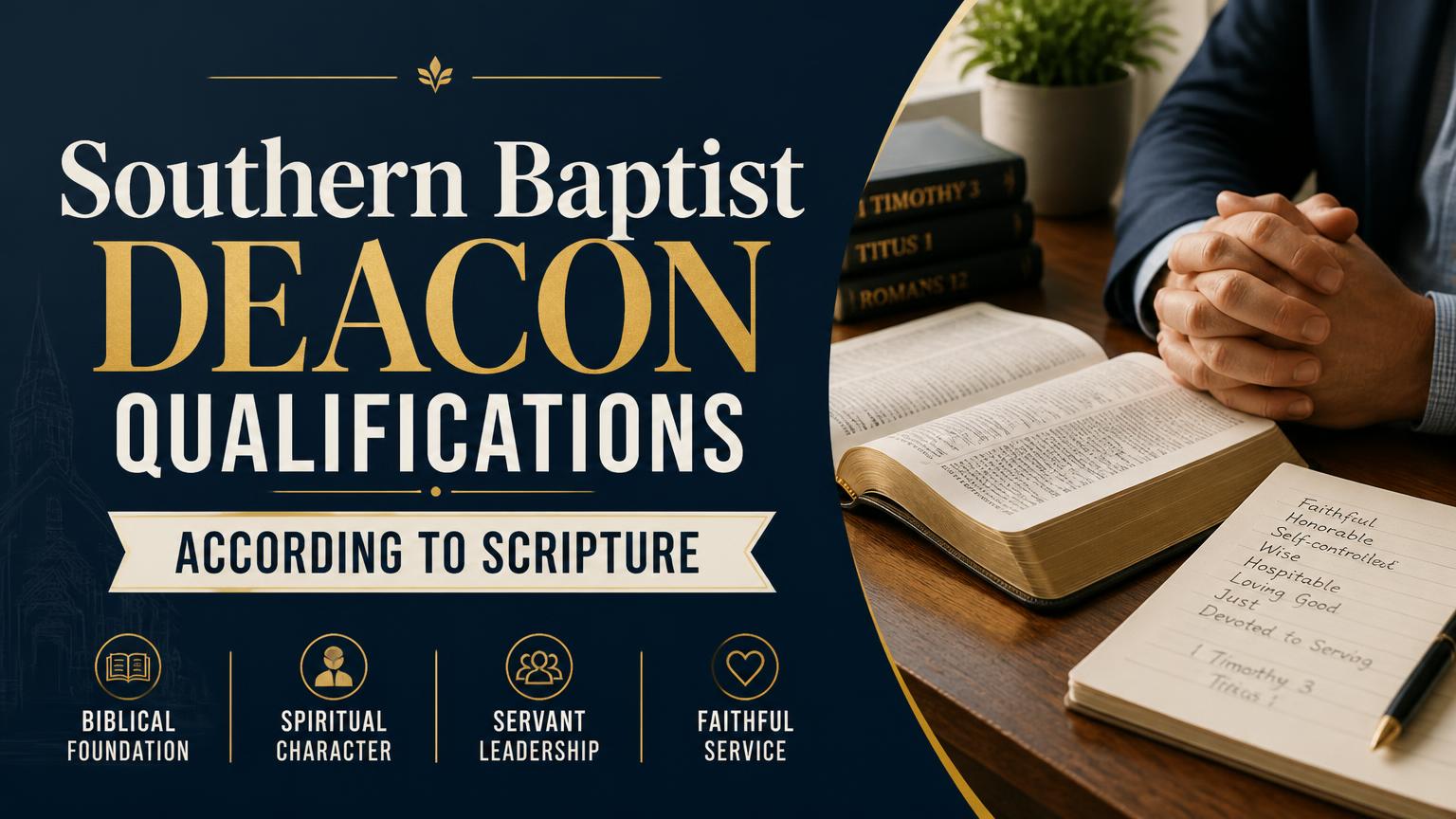
A Southern Baptist deacon should be a spiritually mature servant whose character, faith, family life, and reputation demonstrate readiness for ministry. The clearest qualifications appear in 1 Timothy 3:8–13, while Acts 6:1–7 provides a foundational pattern of selecting men known for integrity, spiritual maturity, wisdom, and practical service. Because Southern Baptist churches are autonomous, each congregation applies these biblical principles through its own bylaws and church polity.
Southern Baptist Deacon Qualifications
Demonstrate Christian Character
Paul begins with character rather than ability: “Deacons likewise must be dignified” (1 Timothy 3:8). A deacon should be worthy of respect because his conduct is consistent, honorable, and spiritually mature.
The passage identifies several specific qualities:
- Not double-tongued: A deacon should not tell different versions of a matter to different people, manipulate conversations, or use speech to create division.
- Not addicted to much wine: He must exercise self-control and avoid substance abuse or any pattern of enslavement.
- Not greedy for dishonest gain: A deacon must handle money and influence with integrity. He should not use church service to pursue financial advantage, status, or personal control.
- Holding the faith with a clear conscience: A deacon must understand and sincerely believe the Christian faith. Biblical service is not merely organizational work; it flows from obedience to the gospel.
These requirements show that a deacon’s private life matters as much as his public usefulness. Skill may help someone perform a task, but character determines whether his service strengthens or harms the church.
Be Spiritually Mature and Tested
“Let them also be tested first; then let them serve as deacons if they prove themselves blameless” (1 Timothy 3:10). The biblical pattern does not treat the office as an experiment or a reward for popularity.
Testing does not mean demanding sinless perfection. “Blameless” means that no credible pattern of serious, unrepentant conduct disqualifies the person from public trust. A church may evaluate whether a candidate’s life demonstrates:
- consistent Christian conduct
- sound judgment
- reliability
- teachability
- humility
- honesty
- ability to handle disagreement without becoming divisive
- a reputation for keeping commitments
Acts 6:3 uses similar language when the apostles instruct the church to select men of “good repute, full of the Spirit and of wisdom.” The men were chosen to address a practical distribution problem, but practical responsibility required spiritual discernment. A deacon therefore should be more than an efficient volunteer; he should be a mature believer whose service reflects the Holy Spirit’s work.
Manage Marriage and Family Faithfully
A qualified deacon must be “the husband of one wife” and must “manage his children and his own household well” (1 Timothy 3:12). The family qualification indicates that leadership begins with faithful responsibility in the home.
The phrase “husband of one wife” is commonly understood to require marital faithfulness and sexual integrity. It rejects adultery, habitual unfaithfulness, and a pattern of treating marriage casually. The qualification is not simply a numerical rule about whether someone has ever been married. Churches differ in how they apply it to divorce, remarriage, widowhood, and other circumstances, so each case requires careful examination of Scripture, repentance, present character, and the church’s convictions.
Managing a household well does not mean ruling through intimidation. Biblical leadership is responsible, sacrificial, and morally credible. A candidate whose home life is marked by neglect, chaos, harshness, or unwillingness to accept responsibility should not be placed in an office that requires trust and care for the congregation.
Maintain a Good Reputation Inside and Outside the Church
Acts 6:3 requires a good reputation, and 1 Timothy 3:7 makes the same principle explicit for church leaders: a person’s conduct should be credible beyond the church community.
This does not mean that every neighbor, employer, or unbelieving person will approve of a Christian’s beliefs. It means that outsiders should not be able to identify a consistent pattern of dishonesty, abuse, corruption, hostility, or unreliability. A deacon’s public reputation affects the church’s witness because he represents its ministry in homes, workplaces, neighborhoods, and community settings.
Serve With Wisdom and Practical Compassion
The setting of Acts 6 illustrates the practical nature of deacon ministry. A dispute arose because some widows were being overlooked in the daily distribution. The solution required men who could address a concrete need without neglecting spiritual priorities.
Deacons commonly serve through ministries such as:
- caring for members in crisis
- assisting widows, widowers, and vulnerable families
- visiting the sick and homebound
- helping with benevolence
- supporting worship and ordinances
- welcoming and integrating members
- assisting with practical church administration
- protecting unity during times of conflict
The tasks may vary by congregation, but the principle remains consistent: deacons serve people wisely and protect the church’s unity. Compassion without wisdom can produce dependency or unfairness; administration without compassion can become cold bureaucracy. Biblical deacon ministry requires both.
What Scripture Says About Deacon Service
Deacons Support the Church’s Mission
Acts 6:1–7 shows that practical service can protect the church’s central mission. The apostles needed to remain devoted to “prayer and the ministry of the word,” while the congregation’s material needs still required faithful attention.
This passage does not present practical ministry as inferior. Instead, it shows that different forms of service support the same mission. Deacons help ensure that people are cared for so that pastors and elders can give proper attention to preaching, prayer, teaching, and spiritual oversight.
The division is one of responsibility, not value. Deacons are not merely church custodians or event organizers, and pastors are not exempt from compassionate service. Both offices serve Christ and the congregation, but they carry different primary assignments.
Deacons Must Protect Unity
The problem in Acts 6 involved a perceived failure to treat Greek-speaking widows fairly. The apostles did not dismiss the concern, and the church did not solve it through accusation or factionalism. Instead, qualified servants were appointed to address the need.
This gives deacons an important ministry of reconciliation. They should listen carefully, identify legitimate concerns, avoid favoritism, and help the church respond with justice and love. A deacon who regularly intensifies conflict, forms factions, or uses confidential information carelessly undermines the purpose of the office.
Deacons Should Serve Rather Than Seek Control
The word commonly translated “deacon” is associated with service or ministry. Although service does not mean passivity, the office is fundamentally pastoral in spirit rather than political. Jesus taught that greatness among His followers is expressed through serving others (Mark 10:42–45).
A deacon may exercise responsibility, but he should not pursue influence for its own sake. He is not called to dominate the pastor, control church decisions, or build a personal following. His authority comes from faithful service, biblical wisdom, and the trust of the congregation—not from force of personality.
The Role of a Deacon’s Wife or Women in Deacon Ministry
The Meaning of 1 Timothy 3:11
Between the qualifications for male deacons, Paul writes: “Their wives likewise must be dignified, not slanderers, but sober-minded, faithful in all things” (1 Timothy 3:11). The Greek term can be translated “wives” or “women,” which has produced two major interpretations.
One interpretation understands the verse as describing the wives of deacons. On this view, a deacon’s wife should be trustworthy, self-controlled, and careful with speech because her conduct can affect confidential and sensitive ministry.
Another interpretation understands the verse as referring to women who served in a recognized ministry role, sometimes described as female deacons or deaconesses. Romans 16:1 refers to Phoebe as a diakonos of the church at Cenchreae, although the term can also mean servant or minister without necessarily identifying the formal office described in 1 Timothy 3.
Faithful Christians and Southern Baptist churches differ on how these passages should be interpreted. Churches that require deacons to be male often still encourage and involve women extensively in mercy ministry, visitation, counseling, missions, and care. Churches that recognize women in a diaconal office generally apply the character requirements of 1 Timothy 3:11 to those women. In either case, the text requires dignity, self-control, reliable speech, and faithfulness.
The Family Is Not Automatically the Candidate
If “wives” is the correct translation in 1 Timothy 3:11, the verse does not make a wife a deacon or imply that she must perform every part of her husband’s ministry. It does show that the home and closest relationships matter when evaluating a candidate’s public service.
Churches should also avoid treating a spouse as a silent extension of the office. A deacon’s wife may participate in ministry according to her gifts, convictions, and calling, but Scripture does not justify coercing her into responsibilities she has not accepted.
How Deacon Qualifications Differ From Pastor Qualifications
The qualifications overlap but are not identical. First Timothy 3:1–7 describes an overseer or elder, emphasizing teaching ability, spiritual oversight, and leadership. First Timothy 3:8–13 describes deacons, emphasizing trustworthy service, tested character, faithful family life, and practical responsibility.
This distinction does not make deacons less spiritual. It recognizes different assignments within the church. Pastors and elders are charged especially with teaching and shepherding; deacons are charged especially with service that meets practical needs and strengthens congregational unity. In Southern Baptist churches, the exact relationship between pastors, elders, and deacons varies because congregations organize their leadership differently.
Common Misunderstandings About Deacon Qualifications
A Deacon Does Not Need to Be Perfect
The requirement of being blameless does not mean having no past sin or never making a mistake. The gospel assumes that church leaders are redeemed sinners. The question is whether a person is presently walking in repentance, faith, integrity, and obedience—or whether serious disqualifying patterns remain unresolved.
A Successful Career Does Not Establish Qualification
Professional competence, wealth, education, age, or public popularity may be useful in some circumstances, but none is a biblical qualification by itself. A highly capable person who lacks humility or integrity is not ready for the office. Conversely, a person with modest social status may be deeply qualified through spiritual maturity and faithful service.
Deacons Are Not a Board of Political Representatives
Some churches use the term “deacon board” for a governing group. That structure may reflect local tradition, but the New Testament emphasis is on qualified servants who care for the church and support its mission. Deacons should not function as a permanent faction competing with pastors or congregational leadership.
The Qualifications Are Not Merely a Voting Checklist
A church should examine a candidate’s life honestly rather than treating an election as a popularity contest. The process should include prayer, time for observation, meaningful questions, and attention to concerns raised by members. Public affirmation is most trustworthy when it confirms a pattern the congregation has already seen.
A Biblical Process for Evaluating Candidates
A Southern Baptist church can apply these principles by asking:
- Is the person a genuine, growing Christian?
- Does he or she have a good reputation?
- Is the person trustworthy in speech and finances?
- Does the candidate show self-control and wisdom?
- Has the person been tested through ordinary service?
- Is the marriage and household life consistent with biblical faithfulness?
- Can the candidate care for vulnerable people without favoritism?
- Does the person promote unity rather than division?
- Does the candidate understand the gospel and the church’s beliefs?
- Is the person willing to serve without seeking status or control?
The goal is not to find someone impressive by worldly standards. It is to recognize a servant whose life already demonstrates the qualities required for public ministry.
Southern Baptist deacon qualifications are therefore centered on tested character, spiritual maturity, family faithfulness, wisdom, reputation, and sacrificial service. First Timothy 3 provides the clearest qualifications, while Acts 6 illustrates their practical purpose: trustworthy servants help protect the church’s unity and ensure that people are cared for. Local churches may differ on questions such as women serving as deacons or how to evaluate remarriage, but every faithful application should preserve the biblical emphasis on holiness, humility, and service rather than status.