
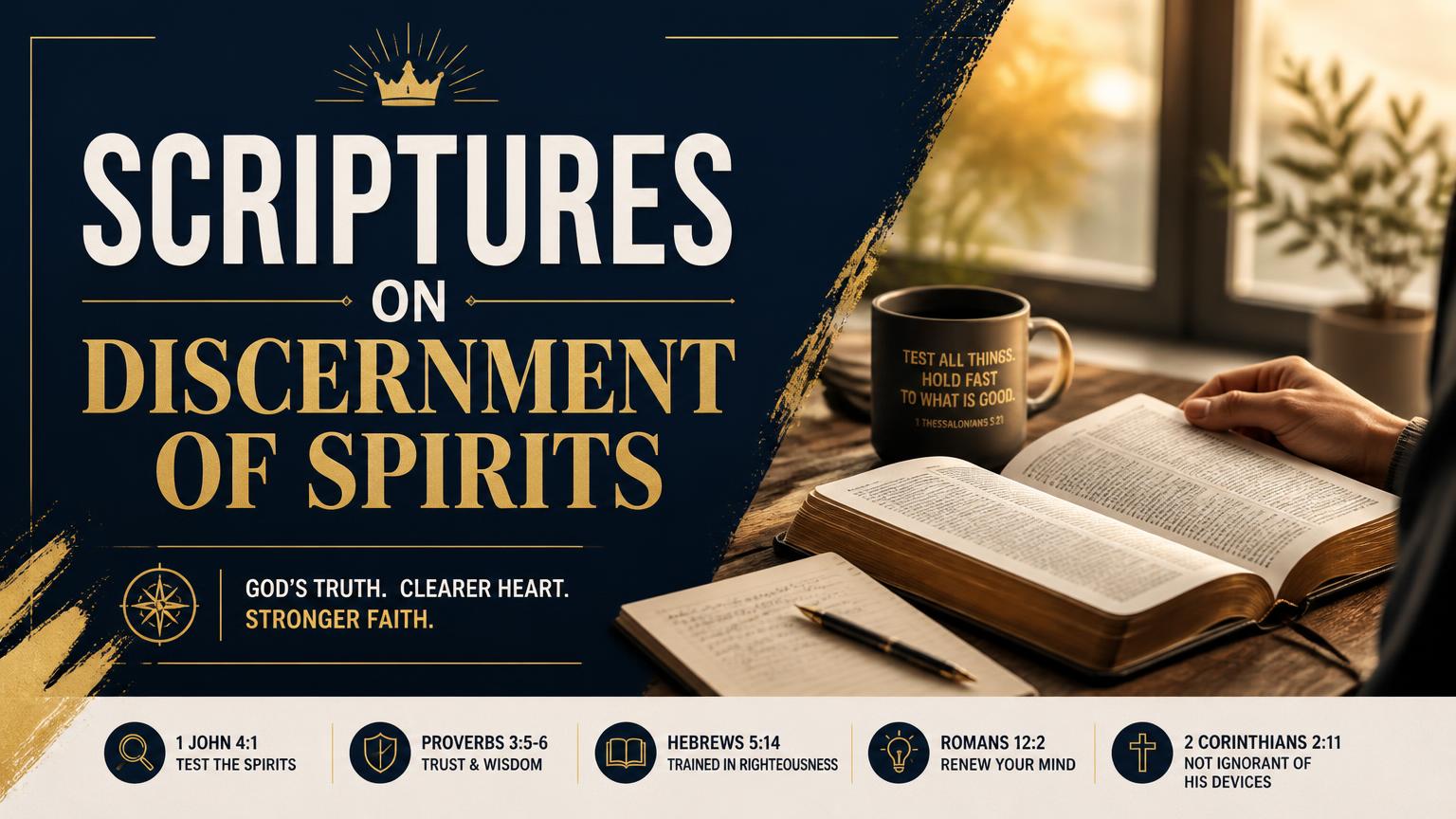
Discernment of spirits in Scripture refers to the ability and responsibility to recognize whether a message, teaching, prophecy, spiritual manifestation, or influence is from the Holy Spirit, a human source, or an evil spirit. The Bible presents this discernment both as a specific spiritual gift and as a necessary practice for all believers. It is not suspicion of everyone, nor is it the same as judging another person’s motives. Biblical discernment tests what is being said and produced against God’s revealed truth, the character of Jesus, and the fruit of a person’s life.
Scriptures on Discernment of Spirits
The Bible’s teaching is spread across passages about spiritual gifts, false prophets, testing teachings, recognizing fruit, and examining claims made in God’s name. Together, these Scriptures provide a balanced framework.
1 Corinthians 12:10—The Gift of Distinguishing Between Spirits
The clearest reference appears in Paul’s list of spiritual gifts:
“To another the distinguishing between spirits” (1 Corinthians 12:10, ESV).
Other translations describe this as “discerning of spirits.” In the context of 1 Corinthians 12, Paul is explaining that the Holy Spirit distributes different gifts among believers. Therefore, this verse identifies discernment of spirits as a particular enablement given by God for the good of the church.
The phrase does not necessarily mean that every believer with this gift constantly identifies demons or receives supernatural information about people. In its immediate context, it concerns distinguishing the spiritual source or character of manifestations and messages within the Christian community. This would have been especially important when believers were evaluating prophecy, teaching, and other claims to spiritual authority.
The gift should not be separated from Scripture, wisdom, humility, and the church’s responsibility to test what is presented. A person who claims discernment is not automatically beyond examination.
1 John 4:1–6—Test the Spirits
John gives a command that applies broadly to Christians:
“Do not believe every spirit, but test the spirits to see whether they are from God” (1 John 4:1).
John’s concern is false prophets who claim to speak under spiritual influence. His central test is their confession about Jesus Christ. A message that refuses the biblical truth about Christ does not come from the Spirit of God.
This passage teaches several important principles:
- Spiritual claims must be tested rather than accepted automatically.
- The truth about Jesus is central to spiritual discernment.
- A person’s popularity, confidence, or apparent spiritual power does not prove that the message is from God.
- The Holy Spirit leads people into the truth about Christ rather than away from Him.
John also contrasts the spirit of truth with the spirit of error. Discernment is therefore not merely the ability to detect unusual experiences. It is the ability to distinguish truth from error according to the apostolic message about Jesus.
Matthew 7:15–20—Recognize False Prophets by Their Fruit
Jesus warns:
“Beware of false prophets, who come to you in sheep’s clothing but inwardly are ravenous wolves” (Matthew 7:15).
He then says that a tree is known by its fruit. The image emphasizes that outward religious appearance can be misleading. A person may sound spiritual, use biblical vocabulary, or attract a large following while producing destructive results.
“Fruit” includes more than visible success. It involves a person’s character, conduct, teaching, treatment of others, and response to correction. Jesus’ warning is not permission to condemn people hastily; it is a call to evaluate patterns over time.
This passage also explains why discernment cannot depend only on a single impressive claim. A message should be considered alongside the life and effects of the person delivering it.
1 Thessalonians 5:19–22—Test Everything
Paul writes:
“Do not quench the Spirit. Do not despise prophecies, but test everything; hold fast what is good. Abstain from every form of evil” (1 Thessalonians 5:19–22).
This instruction holds two responsibilities together. Christians must not suppress genuine work of the Holy Spirit, but neither should they accept every prophecy or spiritual claim without examination.
The passage rejects two opposite errors:
- Uncritical acceptance: Treating every spiritual-sounding message as divine.
- Uncritical rejection: Refusing all prophecy or spiritual activity because some claims are false.
Biblical discernment is therefore neither gullibility nor cynicism. It is careful evaluation followed by obedient acceptance of what is good and rejection of what is evil.
Acts 16:16–18—A True Statement Can Come From a Wrong Source
In Philippi, a slave girl with “a spirit of divination” repeatedly declared that Paul and his companions were servants of the Most High God. Her statement contained factual information, yet Paul did not accept the spirit speaking through her. He commanded the spirit to leave her in the name of Jesus Christ.
This account illustrates an important point: accuracy alone does not establish a spiritual message as godly. A statement may be true while the source, purpose, or spiritual allegiance behind it is corrupt. Discernment therefore asks more than, “Is this claim factually correct?” It also considers:
- What spirit or authority is operating?
- Does the message honor Jesus?
- What is the purpose of the message?
- What does it produce in the people involved?
The passage should not be used to label every unusual person or experience as demonic. It does, however, show that spiritual discernment involves recognizing the source behind a manifestation, not merely evaluating its surface content.
2 Corinthians 11:13–15—Impressive Appearances Are Not Proof
Paul describes false apostles as deceitful workers who disguise themselves as apostles of Christ. He adds that Satan disguises himself as an angel of light.
The warning concerns deceptive appearance. Evil does not always present itself in obviously hostile or irreligious form. False teaching can use Christian language and imitate religious sincerity. Consequently, emotional intensity, supernatural claims, eloquence, visions, or apparent light should be tested rather than treated as self-authenticating.
Paul’s point is not that every spiritual experience is fraudulent. It is that appearance cannot serve as the final standard. The gospel, apostolic teaching, and godly fruit remain necessary tests.
Deuteronomy 13:1–4 and 18:20–22—Testing Prophetic Claims
The Old Testament gives Israel standards for evaluating prophets. Deuteronomy 13 warns that even if a sign or wonder occurs, a prophet must not be followed if the message leads people toward other gods. Deuteronomy 18 addresses claims made in the Lord’s name that do not come true.
These passages show that supernatural signs are not sufficient evidence of divine approval. Loyalty to the true God and conformity to His revealed word take priority. A prediction’s fulfillment, a miracle claim, or an impressive experience cannot authorize teaching that contradicts God.
For Christians, these principles must be read alongside the New Testament’s focus on Jesus Christ and the apostolic gospel. Spiritual power and spiritual truth are not interchangeable.
1 Corinthians 14:29—Let Others Weigh Prophecy
Paul instructs that when prophets speak in the church, others should weigh what is said:
“Let two or three prophets speak, and let the others weigh what is said” (1 Corinthians 14:29).
This provides a model for communal discernment. Prophecy is not presented as exempt from evaluation simply because someone claims divine inspiration. The gathered church listens, examines, and responds under biblical authority.
The practice also protects the congregation from one person controlling the community through unchallengeable spiritual claims. Discernment is strengthened when mature believers evaluate teaching together rather than relying on one individual’s private certainty.
What Biblical Discernment Examines
The Bible does not provide a single short checklist, but its teachings establish several connected tests.
Does the Message Agree With Scripture?
Isaiah 8:20 directs God’s people back to God’s instruction and testimony. Galatians 1:8 likewise warns against accepting a different gospel, even if it is presented by an angel.
A claimed revelation that contradicts Scripture must be rejected. Personal impressions may guide a person’s attention or prompt prayer, but they do not add authority to the Bible or correct it.
Does It Confess and Honor Jesus Christ?
First John 4 places the identity and incarnation of Jesus at the center of spiritual testing. The Holy Spirit glorifies Christ rather than replacing Him with fascination about experiences, personalities, or hidden knowledge.
A message may mention Jesus frequently and still distort the gospel. Discernment therefore considers whether it presents Jesus according to Scripture and leads people toward faith, obedience, repentance, and worship.
What Fruit Does It Produce?
Jesus’ teaching about trees and fruit in Matthew 7 connects discernment with observable outcomes. Galatians 5:22–23 identifies the fruit of the Spirit as qualities such as love, joy, peace, patience, kindness, goodness, faithfulness, gentleness, and self-control.
This does not mean genuine ministry will never involve conflict, correction, or suffering. It means that persistent pride, manipulation, greed, impurity, cruelty, dishonesty, and disorder should not be excused by spiritual gifts or public success.
Does It Encourage Truth, Love, and Order?
James 3:13–18 contrasts earthly wisdom, marked by jealousy and selfish ambition, with wisdom from above, which is pure, peaceable, gentle, open to reason, merciful, and sincere. First Corinthians 14 emphasizes that God is not a God of confusion but of peace.
A spiritual claim that produces fear-driven control, secrecy, division, or dependency on a leader deserves serious examination. Discernment asks not only whether something sounds supernatural but whether it reflects God’s wisdom and serves the good of others.
Is It Confirmed With Humility and Wise Counsel?
Hebrews 5:14 connects maturity with trained powers of discernment through constant practice. Proverbs 11:14 and 15:22 commend wise counsel. These passages support patient, accountable evaluation rather than impulsive certainty.
Discernment is not infallibility. Even sincere Christians can misunderstand an experience or apply a biblical principle poorly. Humility allows a person to seek counsel, revise conclusions, and submit claims to Scripture and the gathered church.
Discernment of Spirits Is Not the Same as Suspicion
Biblical discernment differs from assuming that every difficulty, disagreement, or unusual behavior is demonic. Scripture calls believers to test spiritual claims, but it also commands truthfulness, love, patience, and restraint.
Discernment should focus on teachings, influences, actions, and spiritual fruit rather than claiming to read another person’s inner motives. It should not become a tool for controlling others or avoiding accountability. A person who regularly declares that everyone who disagrees with them is under demonic influence may be demonstrating the very pride and disorder that Scripture warns against.
Nor does discernment mean rejecting everything unfamiliar. The New Testament does not instruct believers to treat every unusual practice as evil. It directs them to compare claims with God’s word, evaluate their fruit, and recognize whether they honor Christ.
How to Practice Biblical Discernment
A sound approach includes several habits:
- Know Scripture. Discernment requires a standard. Romans 12:2 connects a renewed mind with the ability to recognize God’s will.
- Pray for wisdom. James 1:5 encourages believers to ask God for wisdom rather than relying on instinct alone.
- Examine the message. Compare its claims with the whole counsel of Scripture, not a verse isolated from context.
- Evaluate the source and fruit. Consider character, motives, conduct, and long-term effects.
- Seek mature counsel. Important decisions and public spiritual claims should not rest solely on private impressions.
- Allow time. Immediate pressure often benefits manipulation. Time can reveal whether a claim is consistent and whether its fruit is healthy.
- Hold fast to what is good. Testing is not the final goal. The purpose is faithful obedience to truth while rejecting what is false.
Conclusion
The Scriptures on discernment of spirits teach both caution and openness. First Corinthians 12:10 identifies distinguishing between spirits as a gift of the Holy Spirit, while passages such as 1 John 4:1, 1 Thessalonians 5:19–22, and Matthew 7:15–20 call the whole church to test spiritual claims. The central standards are fidelity to Scripture, a true confession of Jesus Christ, godly character, and spiritual fruit. Biblical discernment is therefore neither credulity nor suspicion; it is humble, practiced judgment submitted to God’s truth.