
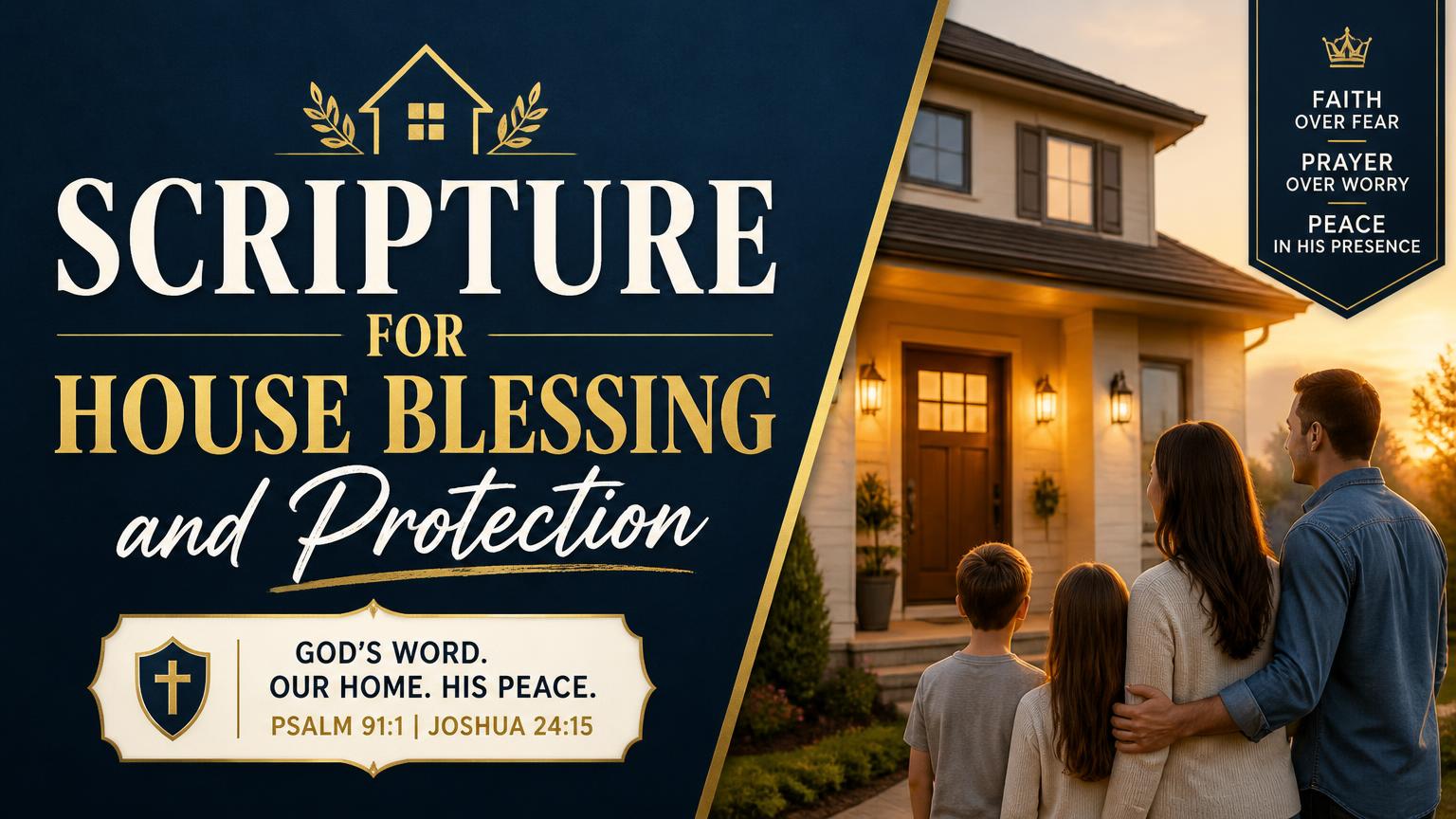
The Bible offers many passages Christians use to pray for God’s blessing, peace, wisdom, and protection over their homes. These Scriptures do not treat a house as spiritually protected by a formula or object. Instead, they direct a household to trust God, honor Him, practice wisdom, and seek His care in ordinary life and times of danger.
Scripture for House Blessing and Protection
The strongest passages for a house blessing combine three themes: dedicating the household to God, recognizing that God is the true source of security, and asking Him to preserve the people who live there.
Joshua 24:15: Dedicate the Household to God
Joshua declared, “As for me and my house, we will serve the LORD” (Joshua 24:15). This is one of the clearest Scriptures for dedicating a home to God.
Joshua’s statement was more than a decoration or slogan. It was a commitment that his household would worship God and order its life around His covenant. A Christian household can use this verse when praying for a home, asking God to shape its values, conversations, decisions, and relationships.
The verse does not mean that every person in a household will automatically believe simply because one family member does. It expresses a faithful responsibility: the home should be a place where God is honored and where family members are encouraged toward truth, love, repentance, and faith.
Psalm 127:1: Ask God to Build and Guard the Home
Psalm 127:1 says:
“Unless the LORD builds the house, those who build it labor in vain; unless the LORD watches over the city, the watchman stays awake in vain.”
This passage identifies the foundation of both blessing and protection. Human effort matters, but it cannot replace God’s care. A family may work hard, install security systems, make wise financial decisions, and maintain a safe property, yet ultimate security does not come from human control.
The “house” can refer to a physical dwelling, a household, or a family line. In each sense, the principle is similar: a stable home must be built according to God’s wisdom, not merely according to ambition, appearance, or material success.
Psalm 91: Trust God as Refuge
Psalm 91 is one of the most frequently read passages for protection. It describes God as “my refuge and my fortress” and speaks of His care amid terror, disease, danger, and warfare.
The psalm encourages confident trust, but it should not be interpreted as a guarantee that believers will never experience illness, loss, persecution, accidents, or death. Satan quoted part of Psalm 91 when tempting Jesus to test God by placing Himself in danger (Matthew 4:5–7). Jesus responded that God must not be tested.
Psalm 91 therefore calls believers to dwell in God’s presence, not to use Scripture as a protective charm. Its comfort is that no danger can separate God’s people from His knowledge, authority, and faithful care. Sometimes God protects by removing danger; at other times He sustains people through suffering and brings them safely into His presence.
Psalm 121: Receive God’s Ongoing Help
Psalm 121 repeatedly emphasizes God’s watchful care:
“The LORD will keep you from all evil; he will keep your life” (Psalm 121:7).
The psalm portrays God as the Keeper of His people—watching over their coming and going, day and night. It is especially appropriate for praying over a household that travels, works unusual hours, faces uncertainty, or needs reassurance.
The promise is not that believers will encounter no hardship. Rather, God’s care is constant and personal. He does not become inattentive when His people sleep, leave home, or face circumstances beyond their control.
Proverbs 3:33: Seek a Home Shaped by Righteousness
Proverbs 3:33 says, “The LORD’s curse is on the house of the wicked, but he blesses the dwelling of the righteous.”
This verse connects the blessing of a dwelling with the character and conduct of the people who live there. Biblical blessing is not merely having a large, attractive, or prosperous home. It includes living under God’s favor through humility, justice, wisdom, and obedience.
The verse should not be used to accuse every suffering family of wickedness. Proverbs often teaches general patterns of wisdom rather than promising that every individual outcome will be immediate or predictable. Its central lesson is that a household built on deceit, oppression, violence, or rebellion against God should not expect material comfort to make it spiritually healthy.
Psalm 128: Pray for Household Fruitfulness and Peace
Psalm 128 describes the blessings associated with fearing the Lord and walking in His ways. It speaks of work, family life, children, and peace in Jerusalem.
This psalm presents blessing as the fruit of a God-centered life rather than as a guarantee of wealth or uninterrupted happiness. It is useful for praying that a home will be marked by faithful work, healthy relationships, gratitude, and peace. Its focus is relational and moral as much as material.
Deuteronomy 6:6–9: Make the Home a Place of Faithful Instruction
Deuteronomy 6:6–9 instructs God’s people to keep His words in their hearts and teach them diligently to their children—in ordinary settings such as sitting at home, walking along the road, lying down, and rising.
This passage gives practical shape to a blessed household. Scripture is not meant to appear only during a formal ceremony. Faith is formed through repeated habits: prayer, honest conversation, forgiveness, worship, wise correction, hospitality, and daily obedience.
A home becomes spiritually strong when biblical truth influences its normal rhythms, not merely its wall art or occasional prayers.
2 Thessalonians 3:3: Trust the Lord’s Faithfulness
Paul writes, “The Lord is faithful. He will establish you and guard you against the evil one” (2 Thessalonians 3:3).
This verse provides a New Testament foundation for praying about spiritual protection. The focus is not on an object, ritual, or special location. Protection rests on the faithfulness of the Lord, who strengthens His people and guards them against evil.
The verse also places protection within a relationship of trust and perseverance. Christians may pray for protection from temptation, deception, hatred, destructive influences, and spiritual attack while also taking responsible action to resist evil.
Isaiah 54:17: Remember God’s Final Authority
Isaiah 54:17 says, “No weapon that is fashioned against you shall succeed.” Christians often pray this verse over their homes, especially during seasons of fear or opposition.
In its original context, the verse belongs to God’s promise concerning His servants and the restoration of His people. It does not mean that believers will never be harmed or opposed. Scripture itself records faithful people who suffered greatly.
The enduring principle is that opposition does not have the final authority over those whom God vindicates. The verse encourages confidence in God’s justice and protection rather than fear-driven attempts to control every threat.
What a Biblical House Blessing Means
A biblical house blessing is an act of prayerful dedication. It asks God to guide the household, protect its residents, provide what they need, and make the home a place of peace and faithful service.
It is not a magical process that guarantees perfect safety. Scripture never teaches that anointing oil, placing a Bible in a room, repeating a verse, or conducting a particular ceremony makes a building immune from harm. Such practices may serve as meaningful reminders of faith, but their value comes from directing people toward God—not from possessing spiritual power in themselves.
A biblical blessing also includes responsibilities. Residents should pursue peace, speak truthfully, reject abuse and destructive behavior, care for one another, and take sensible measures for physical safety. Prayer and practical wisdom are not opposites. Nehemiah prayed for protection while also posting guards (Nehemiah 4:9), illustrating the proper relationship between dependence on God and responsible action.
How to Pray Scripture Over Your Home
A house-blessing prayer can follow the themes found in these passages:
- Praise God as the source of security. Acknowledge that the Lord, not the building or its possessions, is the household’s ultimate refuge.
- Dedicate the household to Him. Use Joshua 24:15 to express a commitment to serve God through the home’s choices and relationships.
- Ask for spiritual protection. Pray for freedom from temptation, deception, bitterness, violence, addiction, and influences that damage the household.
- Ask for peace and wisdom. Pray that residents will communicate honestly, resolve conflict, forgive, and make prudent decisions.
- Pray for physical protection. Ask God to preserve the household during travel, illness, emergencies, and threats while taking reasonable steps to reduce those risks.
- Commit the home to service. A blessed home can become a place of hospitality, encouragement, prayer, and practical care for others.
An example prayer might be:
Lord, thank You for this home and for the people who live here. Unless You build and guard this household, our efforts are incomplete. Help us serve You faithfully, speak with love, practice wisdom, and reject anything that brings harm. Be our refuge and keep us in Your care. Fill this home with peace, truth, hospitality, and compassion. In Jesus’ name, amen.
Protection, Peace, and the Reality of Suffering
The Bible encourages believers to pray boldly for protection, but it also prepares them for suffering. Jesus promised His followers trouble in the world (John 16:33), and the New Testament contains many examples of faithful people facing persecution, imprisonment, sickness, grief, and loss.
Therefore, a house blessing should not imply that tragedy proves a family lacked faith or used the wrong prayer. Nor should it encourage people to remain in an unsafe situation while waiting passively for supernatural intervention. Seeking help, contacting emergency services, setting boundaries, leaving violence, receiving medical treatment, and securing a property can all be consistent with biblical wisdom.
Christian protection ultimately means that God remains faithful through every circumstance. He may provide prevention, deliverance, courage, wise help, endurance, or final salvation. The promise is not human control over every event; it is God’s presence and authority when control is impossible.
Final Perspective
The best Scripture for house blessing and protection is not a verse treated as a charm but God’s Word received as a call to trust and obedience. Joshua 24:15 dedicates the household, Psalm 127:1 recognizes God as its builder and guardian, Psalm 91 and Psalm 121 encourage refuge in His care, and passages such as Deuteronomy 6:6–9 show how faith should shape daily life. A truly blessed home is one that seeks God’s presence, practices wisdom and love, welcomes peace, and trusts Him in both safety and hardship.