
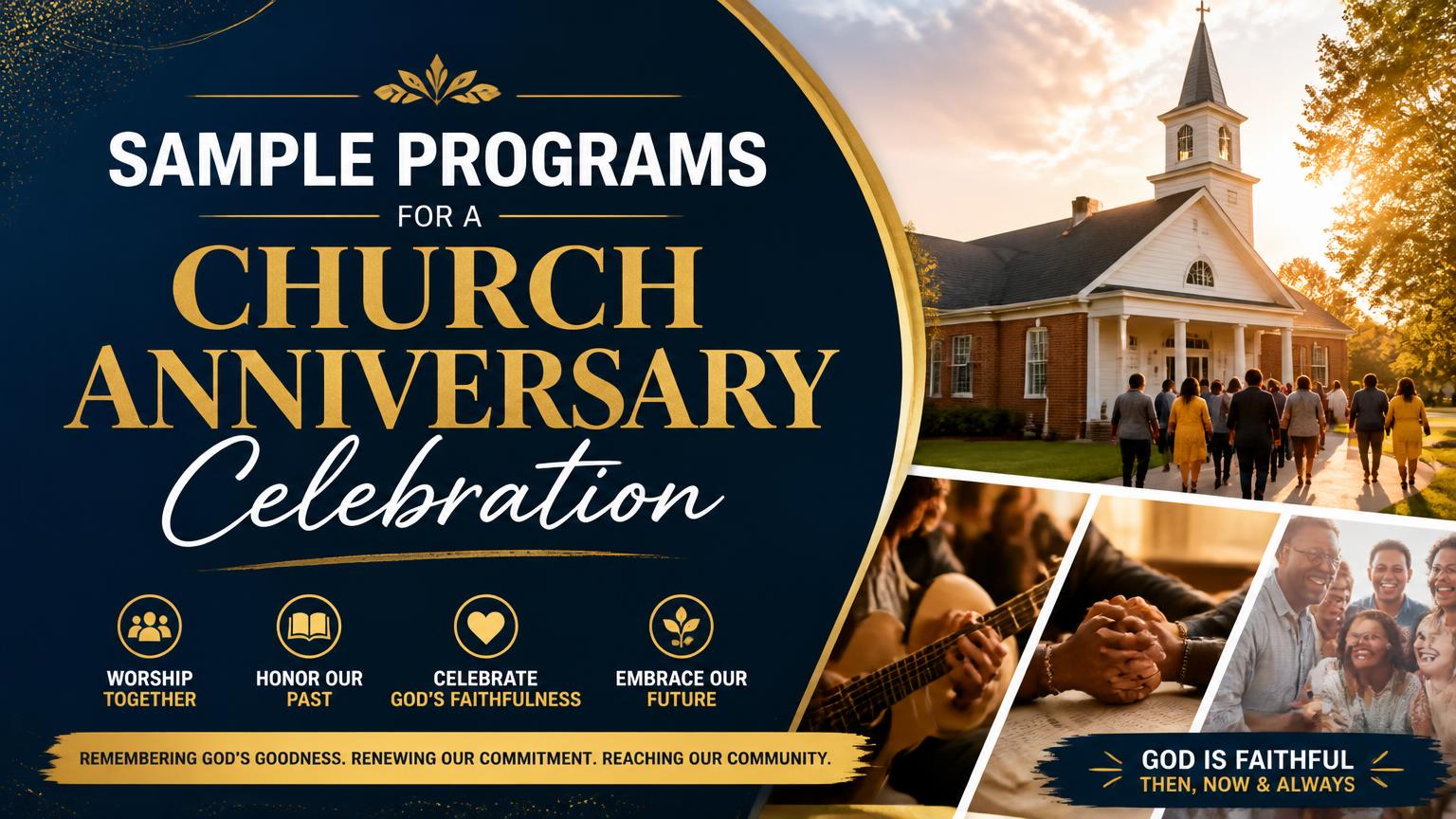
A sample program for a church anniversary celebration should do more than list activities. It should guide the congregation through worship, gratitude, remembrance, fellowship, and renewed commitment to the church’s mission. The program may be a single worship service, a banquet, a weekend observance, or a combination of these formats.
A strong anniversary program usually includes Scripture, prayer, music, a brief account of the church’s history, testimonies, a relevant message, recognition of faithful service, and a clear transition toward the congregation’s future.
Sample Program for Church Anniversary Celebration
One-Day Anniversary Worship Service
The following order works well for a Sunday morning or afternoon anniversary service lasting approximately 90 minutes to two hours.
- Prelude and Musical Welcome — 10 minutes
- Processional or Entrance of Leaders — Optional
- Call to Worship — 3 minutes
- Opening Hymn or Congregational Song — 5 minutes
- Invocation and Anniversary Prayer — 5 minutes
- Welcome and Recognition of Guests — 5 minutes
- Congregational Scripture Reading — 5 minutes
- Anniversary Choir Selection or Special Music — 5 minutes
- Church History Presentation — 10 minutes
- Testimonies or Reflections — 10 minutes
- Offering or Anniversary Gift Presentation — 5 minutes
- Sermon or Anniversary Message — 25–35 minutes
- Recognition of Founders, Leaders, and Faithful Servants — 10 minutes
- Vision and Commitment for the Coming Year — 5 minutes
- Closing Prayer and Benediction — 5 minutes
- Fellowship Meal or Reception — Following the service
This order can be shortened by combining the history presentation with the welcome or limiting the number of testimonies. The service should remain worship-centered rather than becoming a series of unrelated speeches.
Sample Wording for the Order of Service
Theme: “Remembering God’s Faithfulness and Serving With Hope”
Theme Scripture: “I will remember the works of the LORD: surely I will remember thy wonders of old” (Psalm 77:11, KJV).
Program
- Prelude: Instrumental music and seating of the congregation
- Welcome: “We welcome members, former members, visiting ministers, community leaders, families, and friends to this celebration of God’s faithfulness.”
- Call to Worship: Psalm 100:1–5
- Opening Hymn: A congregational song of praise and thanksgiving
- Invocation: Prayer thanking God for the church’s beginning, ministry, people, and continued guidance
- Scripture Reading: Psalm 103:1–5 or Philippians 1:3–6
- Musical Selection: Choir, praise team, youth group, or guest musicians
- Church History: A concise account of the founding, major ministries, significant transitions, and present mission
- Testimonies: Two or three speakers sharing how the church has influenced their faith or community
- Anniversary Offering: Explanation of the designated purpose, followed by prayer and collection
- Anniversary Message: A sermon focused on gratitude, faithfulness, unity, service, or mission
- Recognition: Presentation of certificates, plaques, or verbal acknowledgments
- Future Commitment: Prayer and congregational commitment to continue serving God and neighbors
- Benediction: A closing blessing, such as 2 Corinthians 13:14
- Reception: Meal, refreshments, photographs, and informal fellowship
The wording should be adapted to the church’s tradition and local practice. A printed program can include the names of participants, the anniversary theme, Scripture references, and a brief historical timeline.
Weekend Anniversary Program
A weekend celebration gives the church more time to include different generations, ministries, and community partners without overcrowding one worship service.
Friday Evening: Prayer and Thanksgiving Service
- Welcome and opening prayer
- Congregational singing
- Scripture readings on God’s faithfulness
- Historical reflections from longtime members
- Prayer for former pastors, current leaders, families, and future ministry
- Informal fellowship
Saturday: Community and Fellowship Day
- Breakfast or community meal
- Outreach project, health event, food distribution, or neighborhood service
- Youth and children’s activities
- Church history exhibit or photograph display
- Former members’ gathering
- Anniversary banquet or fellowship dinner
Sunday Morning: Anniversary Worship Service
- Processional or opening music
- Call to worship
- Praise and congregational singing
- Scripture and prayer
- Choir or ministry presentations
- Anniversary sermon
- Recognition of leaders and servants
- Special offering, if planned
- Vision for the next season of ministry
- Benediction and fellowship meal
This format allows the anniversary to express the church’s identity in several ways: worship, memory, service, teaching, and fellowship. It also prevents the main service from becoming too long.
Anniversary Banquet Program
A banquet usually has a more formal structure than a worship service. Because a meal already requires time, the speaking schedule should be carefully limited.
- Welcome and Seating
- Opening Prayer
- Dinner or Meal Service
- Brief Church History
- Guest Greetings
- Testimony or Musical Presentation
- Anniversary Address
- Recognition of Special Servants
- Presentation of Anniversary Project or Ministry Goal
- Closing Prayer
A banquet message may be shorter than a sermon, often focusing on the anniversary theme, the church’s witness, and its responsibility to the surrounding community. If several dignitaries attend, each should receive a defined time limit so that greetings do not displace the central program.
What to Include in a Church Anniversary Program
Worship and Thanksgiving
The central purpose of a church anniversary is to give thanks to God. Scripture, prayer, music, preaching, and congregational participation should therefore form the program’s foundation.
Psalm 103:2 calls worshipers not to forget God’s benefits. Applied to an anniversary, that principle encourages the church to remember answered prayers, faithful service, provision during difficult seasons, and the people through whom ministry has continued. The celebration should honor the congregation’s history without treating the institution itself as the object of worship.
A Clear Historical Record
A history presentation should answer practical questions:
- When and why was the church founded?
- Who were its founders or early leaders?
- Where did the first services take place?
- What major ministries or transitions shaped its development?
- How has the church served its community?
- What mission continues today?
Keep the presentation selective. An anniversary service is not the place to read every name or describe every event in the church’s records. A timeline, slideshow, printed booklet, or display table can preserve additional details while the service presents the most meaningful milestones.
Historical claims should be checked against church minutes, directories, photographs, property records, interviews, and other available documents. When dates or memories conflict, the program should use careful wording rather than presenting uncertain information as fact.
Testimonies That Reflect the Church’s Mission
Testimonies are most effective when they are specific and focused. Speakers might explain how the church supported a family, discipled young people, welcomed new believers, served during a crisis, or helped members grow in faith.
Ask each speaker to address one central question, such as:
- What has this church meant to your faith?
- Which ministry made a lasting difference in your life?
- Where have you seen God’s faithfulness through this congregation?
- What hope do you have for the church’s future?
Two or three concise testimonies are usually more effective than many unprepared speeches. Speakers should avoid turning the occasion into a personal dispute, political address, or lengthy biography.
Recognition of Service
Recognition may include founders, former pastors, current leaders, musicians, teachers, ministry volunteers, youth workers, trustees, administrative staff, and members who have served faithfully over many years.
The purpose is gratitude, not competition. A church should avoid implying that visible roles are more valuable than quiet forms of service. Jesus’ teaching in Mark 10:43–45 connects leadership with serving others, so recognition should emphasize humility, faithfulness, and ministry rather than status.
Some churches use certificates, plaques, flowers, books, or a printed list of honorees. Before naming individuals publicly, confirm the correct names, titles, and years of service. Obtain permission before sharing sensitive personal information.
A Forward-Looking Commitment
An anniversary should connect memory with mission. After reviewing the past, the congregation can identify how it intends to serve in the future.
This section might include:
- A new ministry or outreach goal
- A commitment to disciple children and young adults
- Plans to strengthen care for members
- A building, scholarship, missions, or benevolence project
- Prayer for the next year of ministry
- A congregational pledge to serve faithfully
Philippians 1:3–6 combines thanksgiving for the past with confidence that God continues working among His people. That balance helps the church avoid two extremes: nostalgia that never addresses present needs and forward planning that forgets the lessons of its history.
How to Choose an Anniversary Theme and Scripture
The theme should be short enough to remember and broad enough to guide the service. Suitable themes include:
- Celebrating God’s Faithfulness
- Rooted in Christ, Serving the Community
- Remembering the Past, Embracing the Future
- One Faith, One Family, One Mission
- Built by Grace, Sent to Serve
- Generations of Faithfulness
A theme Scripture should support the actual emphasis of the celebration.
- Psalm 77:11 emphasizes remembering God’s works.
- Psalm 100:1–5 centers on joyful worship and thanksgiving.
- Philippians 1:3–6 connects gratitude with confidence in God’s continuing work.
- Hebrews 10:24–25 highlights gathering, encouragement, and mutual responsibility.
- Joshua 4:1–7 presents memorial stones as a way to help future generations remember God’s acts.
- 1 Corinthians 15:58 encourages steadfast service because labor in the Lord is not worthless.
The Scripture should shape the message and prayers rather than appearing only as decoration on the program cover.
Planning the Program Effectively
Assign Specific Responsibilities
A successful celebration requires more than a printed order. Assign a coordinator or planning team to oversee:
- Worship and music
- Speakers and Scripture readers
- Historical research
- Invitations and guest communication
- Decorations and visual displays
- Food and hospitality
- Audio, video, and livestream support
- Transportation and accessibility
- Photography and documentation
- Follow-up after the event
Each participant should know the time limit, location, dress expectations, arrival time, and responsibility.
Manage Time and Transitions
A program becomes difficult when every segment runs longer than planned. Provide speakers with clear limits and use a printed or discreet timekeeping system. Rehearse transitions between music, speakers, presentations, and prayer.
The master of ceremonies should know what to do if a speaker is absent, equipment fails, or the meal is delayed. A flexible plan is better than attempting to preserve an exact schedule at the expense of congregational participation.
Make the Celebration Accessible
Consider older adults, children, visitors, people with disabilities, and guests unfamiliar with the church. Use readable print, clear sound, accessible seating, plain explanations of unfamiliar practices, and reasonable service length.
If the church serves a multilingual congregation, provide translations or bilingual portions where appropriate. Children and young people can participate through Scripture reading, music, artwork, a history project, or a service activity rather than being included only as spectators.
Common Mistakes to Avoid
A church anniversary program can lose its purpose when it becomes excessively long, centered on personalities, or disconnected from the church’s mission. Common problems include:
- Scheduling too many speakers
- Repeating the same historical information
- Using unverified dates or names
- Giving guests no guidance about their speaking time
- Treating recognition as a popularity contest
- Making the offering’s purpose unclear
- Leaving no time for prayer or congregational singing
- Focusing on buildings and achievements while neglecting people and ministry
- Including a future vision that has no practical next step
A well-designed program creates room for celebration while maintaining reverence, accuracy, participation, and purpose.
A sample program for church anniversary celebration should ultimately lead the congregation through four movements: remember God’s faithfulness, give thanks together, honor faithful service, and renew the church’s mission. The exact order may change, but those purposes provide a reliable framework for a meaningful and well-organized event.