
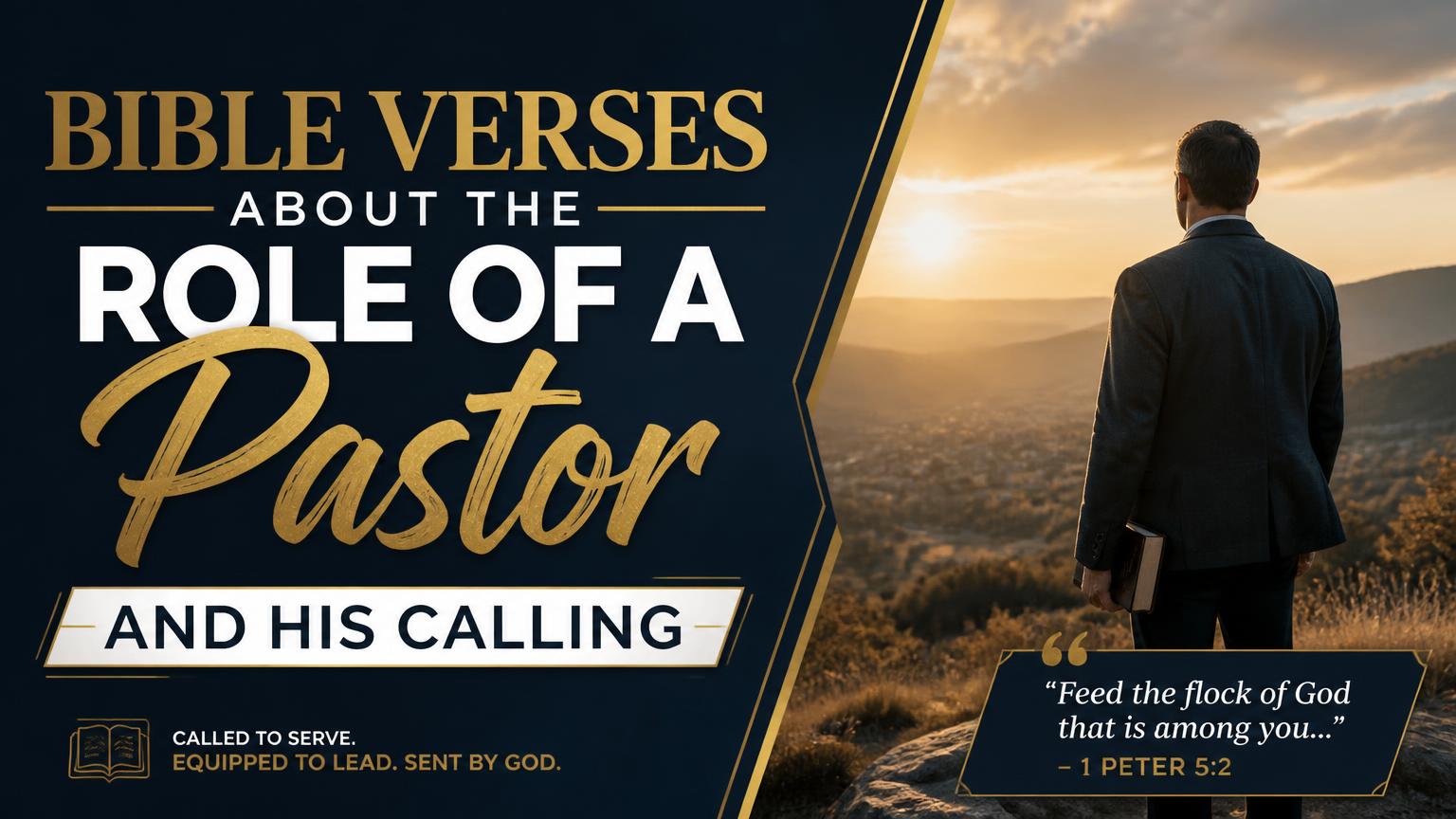
A pastor is called to shepherd God’s people, teach Scripture faithfully, protect the church from error, lead by example, and care for people with humility. The Bible does not give one verse that functions as a complete job description, but several passages together provide a clear picture of pastoral ministry. The central texts include 1 Peter 5:1–4, Ephesians 4:11–16, 1 Timothy 3:1–7, and Titus 1:5–9.
Role of a Pastor: Bible Verses and Responsibilities
A Pastor Shepherds God’s People
The most common biblical picture of pastoral ministry is shepherding. In 1 Peter 5:1–4, Peter instructs elders to “shepherd the flock of God” by exercising oversight willingly, eagerly, and without domineering over those entrusted to them. Pastors are to lead as examples, not as rulers who demand control.
Jesus described Himself as the Good Shepherd who knows His sheep and lays down His life for them (John 10:11–15). Pastors do not replace Christ as the church’s true Shepherd; they serve under Him. Peter therefore calls Jesus the “Chief Shepherd,” who will reward faithful shepherds when He appears (1 Peter 5:4).
Shepherding includes:
- Knowing and caring for people
- Guiding believers toward spiritual maturity
- Protecting the congregation from destructive teaching
- Correcting spiritual danger with patience
- Seeking the restoration of those who wander
- Providing direction during suffering and uncertainty
Acts 20:28 connects this responsibility to the Holy Spirit, who appoints overseers to care for the church. Pastoral leadership is therefore a sacred trust, not merely an organizational position.
A Pastor Teaches and Guards Biblical Truth
Pastors are responsible for explaining God’s Word accurately and applying it faithfully. Ephesians 4:11–12 describes pastors and teachers as gifts Christ gives to His church “to equip the saints for the work of ministry” and to build up the body of Christ.
The goal of preaching and teaching is not simply to transfer information. It is to help believers grow in faith, discernment, obedience, and service. Ephesians 4:13–16 presents mature Christians as people who are no longer easily deceived by false teaching but who grow together in truth and love.
Paul gives Timothy a direct pastoral charge:
“Preach the word; be ready in season and out of season; reprove, rebuke, and exhort, with complete patience and teaching” (2 Timothy 4:2).
This verse shows that pastoral teaching includes encouragement, correction, and patient instruction. A pastor must address both what people want to hear and what they need to hear from Scripture.
Titus 1:9 adds that an overseer must hold firmly to the trustworthy Word so that he can encourage others with sound doctrine and refute those who contradict it. Teaching and guarding truth are connected: a pastor cannot protect a congregation from error without knowing and communicating biblical truth.
A Pastor Leads by Example
Pastoral authority is meant to be exercised through character and service rather than intimidation. In 1 Peter 5:3, leaders are told not to dominate those in their care but to become examples to the flock.
Jesus gave the same pattern when He taught that greatness among His followers is expressed through service rather than worldly power (Mark 10:42–45). A pastor’s influence should therefore come from faithfulness, humility, integrity, and sacrificial care.
This does not mean pastors have no authority. Scripture calls the church to respect faithful leaders and to respond to their spiritual oversight (1 Thessalonians 5:12–13; Hebrews 13:17). It does mean that pastoral authority is accountable to Christ and limited by Scripture. A pastor leads the church; he does not own it.
A Pastor Equips the Church for Ministry
Pastors are not called to perform every ministry themselves. Ephesians 4:12 says that leaders equip the saints for ministry so that the whole body of Christ can be strengthened.
This principle corrects two opposite mistakes. A congregation should not expect one pastor to carry every spiritual, emotional, and practical responsibility. At the same time, a pastor should not use leadership as a way to keep all ministry under personal control.
A healthy pastoral ministry helps believers discover and use their gifts, serve one another, care for those in need, share the gospel, and participate in the church’s mission. The pastor provides teaching, direction, oversight, and encouragement while the entire church serves as the body of Christ.
A Pastor Cares for People Personally
Pastoral work includes more than preaching from a pulpit. Paul described his ministry in Ephesus as involving persistent teaching, warning, and personal care “night and day” (Acts 20:31). He also urged believers to admonish the idle, encourage the discouraged, help the weak, and be patient with everyone (1 Thessalonians 5:14).
Pastors may express this care through prayer, counseling, visitation, discipleship, crisis support, conflict resolution, and practical guidance. Scripture does not prescribe one modern ministry schedule or organizational model, but it does require spiritual attentiveness to the people entrusted to a leader’s care.
Pastoral care should also be wise and appropriately shared. Serious mental-health concerns, abuse, medical needs, and legal matters may require qualified professionals or civil authorities. Seeking additional help is not a failure of pastoral ministry; it can be an expression of responsible care.
Biblical Qualifications for a Pastor
Character Comes Before Ability
The main passages describing pastoral qualifications focus more on character than charisma, popularity, education, or public speaking ability. First Timothy 3:1–7 and Titus 1:5–9 emphasize qualities such as:
- Being above reproach
- Faithfulness in marriage
- Self-control and sound judgment
- Hospitality
- Gentleness rather than violence
- Freedom from greed
- A willingness to manage personal responsibilities well
- A good reputation with outsiders
- The ability to teach
- A commitment to sound doctrine
These qualifications do not describe sinless people. They describe a consistent pattern of mature Christian character. A gifted communicator who lacks integrity does not meet the biblical standard for pastoral leadership.
A Pastor Must Be Able to Teach
Teaching ability is specifically included in the qualifications for an overseer (1 Timothy 3:2). This involves more than having knowledge or delivering engaging sermons. A pastor must understand Scripture, communicate it clearly, apply it responsibly, and respond to error without becoming quarrelsome.
Titus 1:9 shows why doctrine matters: the pastor must be able both to encourage believers with truth and to challenge teaching that contradicts the gospel. Because teaching shapes the faith and conduct of a congregation, James warns that teachers will be judged with greater strictness (James 3:1).
A Pastor’s Home Life Matters
First Timothy 3:4–5 connects leadership in the church with responsible leadership at home. The point is not that a pastor’s family must appear perfect. Rather, a person who consistently neglects, abuses, or cannot responsibly lead those closest to him raises serious questions about his readiness to care for a larger spiritual family.
This qualification also shows that pastoral ministry cannot be separated from ordinary conduct. Public ministry does not compensate for private unfaithfulness.
Pastor, Elder, and Overseer in the Bible
The New Testament uses three related terms in its description of local church leadership:
- Pastor comes from a word meaning shepherd.
- Elder refers to a mature leader and is commonly translated from presbyteros.
- Overseer refers to someone who watches over or supervises the church and translates episkopos.
These terms overlap significantly in several passages. In Acts 20:17, Paul calls for the elders of the church at Ephesus; in Acts 20:28, he describes them as overseers who must shepherd the church. First Peter 5:1–2 likewise instructs elders to shepherd the flock and exercise oversight.
Many Christian traditions therefore understand pastor, elder, and overseer as closely related descriptions of the same local leadership ministry, while some traditions distinguish them as different offices or levels of leadership. The precise church structure varies, but the essential responsibilities remain clear: spiritual oversight, biblical teaching, shepherding, godly character, and accountable leadership.
What Pastors Are Not
A Pastor Is Not the Church’s Chief Shepherd
Jesus remains the head of the church (Ephesians 1:22–23; Colossians 1:18). A pastor serves Christ and is accountable to Him. No pastor has the right to claim ownership over people’s consciences or demand unquestioning loyalty.
A Pastor Is Not the Only Person Who Ministers
The New Testament gives spiritual gifts and ministry responsibilities to the whole church (1 Corinthians 12:4–27; Ephesians 4:12). Pastors equip believers rather than eliminating their responsibility to serve.
A Pastor Is Not Above Correction or Accountability
Because pastors influence doctrine and people’s lives, they require appropriate accountability. First Timothy 5:19–20 provides principles for handling accusations against elders, protecting leaders from careless allegations while also addressing genuine, established wrongdoing. Spiritual leadership must never be used to conceal abuse, financial misconduct, or moral failure.
A Pastor Is Not Measured Only by Visible Success
The Bible emphasizes faithfulness over status, size, or popularity. A pastor’s biblical success is seen in loyalty to Christ, truthfulness in teaching, integrity of life, sacrificial care, and the spiritual strengthening of the congregation. External results may matter, but they are not the final standard.
The Best Bible Passage Summarizing a Pastor’s Role
If one passage must be selected, 1 Peter 5:1–4 provides one of the clearest summaries. It describes pastors and elders as people who:
- Shepherd God’s flock
- Exercise oversight willingly
- Serve eagerly rather than for selfish gain
- Lead by example rather than domination
- Remain accountable to Christ, the Chief Shepherd
Ephesians 4:11–16 adds the pastor’s teaching and equipping responsibility, while 1 Timothy 3:1–7 and Titus 1:5–9 explain the character required for the work.
A pastor’s role, biblically understood, is therefore to serve under Christ by caring for God’s people, teaching the truth, guarding the church, developing other believers, and leading with accountable, Christlike character. The title itself is less important than faithfulness to these responsibilities.