
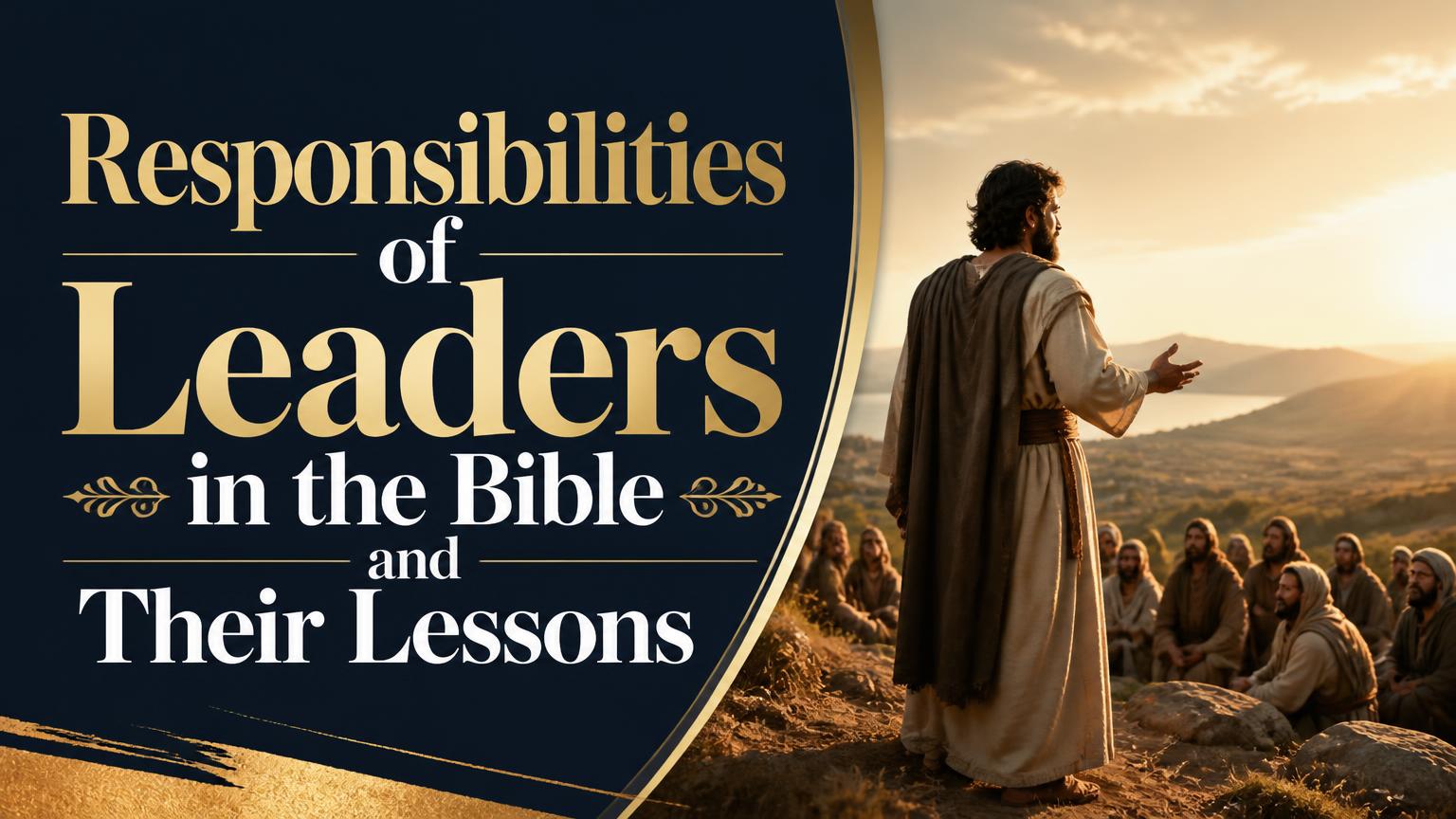
Biblical leaders are entrusted with authority for the good of the people and remain accountable to God for how they use it. The Bible presents leadership as stewardship rather than personal ownership: leaders must seek God’s purposes, teach what is true, protect those under their care, pursue justice, model godly character, and prepare others to serve. These responsibilities apply differently to kings, priests, prophets, elders, parents, and church leaders, but the central standard remains consistent: authority must be exercised with humility, faithfulness, and love.
What Is the Responsibility of Leaders in the Bible?
The responsibility of leaders in the Bible is to guide people faithfully under God’s authority, serve rather than exploit them, and give an account for their influence. Scripture does not treat leadership as a privilege detached from moral obligation. The greater a person’s authority, the greater the responsibility to use it wisely and answerably.
Lead as Stewards Under God
Biblical leaders do not ultimately own the people, community, nation, or ministry entrusted to them. They are stewards—people managing something that belongs to another. Israel’s kings, for example, were expected to rule under God’s law rather than treat the kingdom as personal property. Deuteronomy 17:18–20 required the king to know, read, and obey God’s law so that his heart would not become proud.
This principle limits leadership. A leader may possess real authority, but that authority is never absolute. Leaders must ask whether their decisions reflect God’s character, protect the community, and serve a legitimate purpose rather than advancing personal status, wealth, or control.
Teach Truth and Wisdom
Leaders are responsible for helping people understand what is true and how truth should shape life. Priests and teachers in Israel were expected to instruct the people in God’s law, while prophets confronted kings and communities when they departed from God’s commands. In the New Testament, elders and overseers were required to be able to teach and to hold firmly to sound doctrine.
Teaching involves more than communicating information. It includes interpreting God’s truth faithfully, correcting error, applying wisdom to difficult situations, and ensuring that people are not misled by persuasive but destructive ideas. James 3:1 warns that teachers will be judged more strictly, emphasizing that influence creates moral accountability.
Protect and Shepherd God’s People
The Bible frequently describes leaders as shepherds. Shepherding includes guidance, protection, provision, correction, and personal care. Ezekiel 34 condemns Israel’s leaders because they fed themselves instead of caring for the flock; they failed to strengthen the weak, heal the sick, or seek the lost.
Jesus applies the same principle to his disciples in Mark 10:42–45. Unlike rulers who “lord it over” others, his followers are to become servants. In Acts 20:28, church leaders are told to watch over themselves and the people entrusted to them. Biblical protection includes resisting false teaching, addressing injustice, caring for the vulnerable, and preventing authority from becoming a tool of exploitation.
Pursue Justice and Defend the Vulnerable
Leadership in Scripture carries a public responsibility to uphold justice. Kings, judges, elders, and other authorities were repeatedly instructed to judge impartially, reject bribes, defend the poor, and protect widows, orphans, foreigners, and other vulnerable people. A leader who preserves order while tolerating oppression has not fulfilled the biblical purpose of authority.
Micah 6:8 summarizes the moral direction of leadership: to do justice, love mercy, and walk humbly with God. Justice is not merely punishment after wrongdoing occurs. It also means creating fair processes, listening carefully to those without power, correcting partiality, and refusing to allow wealth or influence to determine whose needs matter.
Model Integrity and Accept Accountability
Leaders teach through their conduct as much as through their words. Their private decisions, treatment of opponents, handling of money, and response to correction all reveal what they truly believe about authority. Paul instructed Timothy and Titus to appoint leaders whose character was credible in family life, relationships, self-control, and reputation.
Scripture also shows that leaders must be confronted when they sin. Nathan confronted David after David abused royal power to take Bathsheba and arrange Uriah’s death (2 Samuel 12). David’s position did not exempt him from accountability. His repentance was significant, but the consequences of his actions remained. This distinction matters: forgiveness does not erase the need for truth, justice, restitution, or appropriate limits on future authority.
Equip Others and Share Responsibility
Healthy biblical leadership does not concentrate every task around one individual. Moses initially attempted to judge every dispute himself, but Jethro advised him to appoint capable leaders and reserve only the most difficult matters for himself (Exodus 18:17–26). The result was a more sustainable and trustworthy system of care.
The New Testament likewise describes leaders as equipping believers for ministry rather than performing every ministry themselves (Ephesians 4:11–12). Delegation is not simply an efficiency technique. It recognizes that God gives different gifts to different people, reduces unhealthy dependence on one personality, and allows a community to mature in responsibility.
How Biblical Leadership Handles Power
Biblical leadership does not reject authority, but it rejects authority used for domination, vanity, or self-enrichment. Romans 13:1–4 describes governing authority as having a legitimate role in restraining wrongdoing and promoting public order. Yet the Bible also repeatedly criticizes rulers who misuse that authority. Authority is therefore judged by its purpose and conduct, not merely by its existence.
Jesus provides the clearest standard. In Mark 10, he contrasts the self-serving rule of earthly rulers with servant leadership among his disciples. Jesus’ command does not mean leaders should be passive, indecisive, or incapable of making difficult decisions. It means that decisions must be directed toward the good of those served. Leadership may require correction, discipline, or firm action, but it cannot be justified by the leader’s desire for admiration or control.
Examples of the Responsibility of Leaders in the Bible
Biblical narratives show that leadership responsibilities are tested in real situations rather than expressed only as abstract principles. The following examples also demonstrate that Scripture evaluates leaders honestly: it records their faithfulness, failures, repentance, and consequences.
Moses Shows the Need for Delegation and Intercession
Moses carried the responsibility of guiding Israel, teaching God’s commands, resolving disputes, and interceding for the people. His leadership included courageous obedience, but it also exposed the danger of carrying responsibility in an unsustainable way. Exodus 18 shows that wise leadership requires shared responsibility, qualified helpers, and structures that prevent exhaustion from damaging judgment.
Moses also repeatedly prayed for the people after their rebellion. His role was not merely administrative. He stood before God on behalf of the community, combining practical governance with spiritual concern.
David Demonstrates Both Leadership and Failure
David was a gifted king who united Israel, defended the nation, and expressed dependence on God. Yet his abuse of power in the account of Bathsheba and Uriah demonstrates how leadership failure can harm individuals, families, and an entire kingdom. David’s position made his actions more damaging, not less serious.
Nathan’s confrontation shows that even a powerful leader needs truthful correction. David’s response—confessing his sin rather than denying it—offers an example of repentance, but it does not present leadership failure as harmless. The story warns that personal charisma and past faithfulness cannot substitute for present integrity.
Elders and Overseers Must Care for the Church
First Peter 5:1–4 instructs church elders to shepherd God’s flock willingly, eagerly, and by example rather than through domineering control or pursuit of dishonest gain. The passage places leaders under the authority of Christ, described as the “Chief Shepherd.” Their position is therefore temporary and accountable.
Similarly, Paul’s farewell to the Ephesian elders in Acts 20 emphasizes vigilance, teaching, and personal responsibility. Church leaders must guard both the community and themselves, because neglect of their own character can eventually undermine the people they serve.
Jesus Defines Greatness Through Service
Jesus did not merely teach servant leadership; he embodied it. He welcomed the overlooked, touched the unclean, corrected the powerful, washed his disciples’ feet, and gave his life for others. John 13 connects the washing of the disciples’ feet with a pattern they were expected to follow.
His example does not erase the distinction between leader and follower. Instead, it redefines what legitimate greatness looks like. The leader’s authority is measured by faithfulness to God and sacrificial service, not by the number of people compelled to obey.
Applying Biblical Leadership Responsibilities Today
Modern applications require wisdom because biblical leadership roles are not identical to one another. A pastor, parent, government official, business manager, ministry volunteer, and community organizer do not carry the same authority or obligations. Nevertheless, each should use influence within appropriate limits, tell the truth, keep promises, protect people from harm, and accept accountability.
Churches and organizations should therefore value transparent finances, shared decision-making, clear boundaries, competent oversight, and credible processes for reporting misconduct. Biblical submission to leaders never requires submitting to abuse, criminal behavior, manipulation, or false teaching. Passages that commend respect for authority must be read alongside the Bible’s repeated commands to confront injustice and protect the vulnerable.
A practical test is to examine what a leader’s influence produces. Does it cultivate maturity, truth, service, justice, and responsibility among others? Or does it create fear, dependency, secrecy, and personal glorification? The answer helps reveal whether authority is being exercised in the biblical spirit.
Conclusion
The responsibility of leaders in the Bible is fundamentally a responsibility of stewardship. Leaders are to remain under God’s authority, teach truth, protect and shepherd people, pursue justice, model integrity, accept correction, and equip others to serve. Scripture honors legitimate authority but consistently rejects domination, pride, exploitation, and self-serving power.
Jesus gives the fullest expression of this pattern by joining authority with humility and greatness with service. Biblical leadership is therefore more than holding an office or making decisions. It is the faithful use of influence for God’s purposes and the good of others, with the recognition that every leader remains accountable to the One who entrusted that influence.