
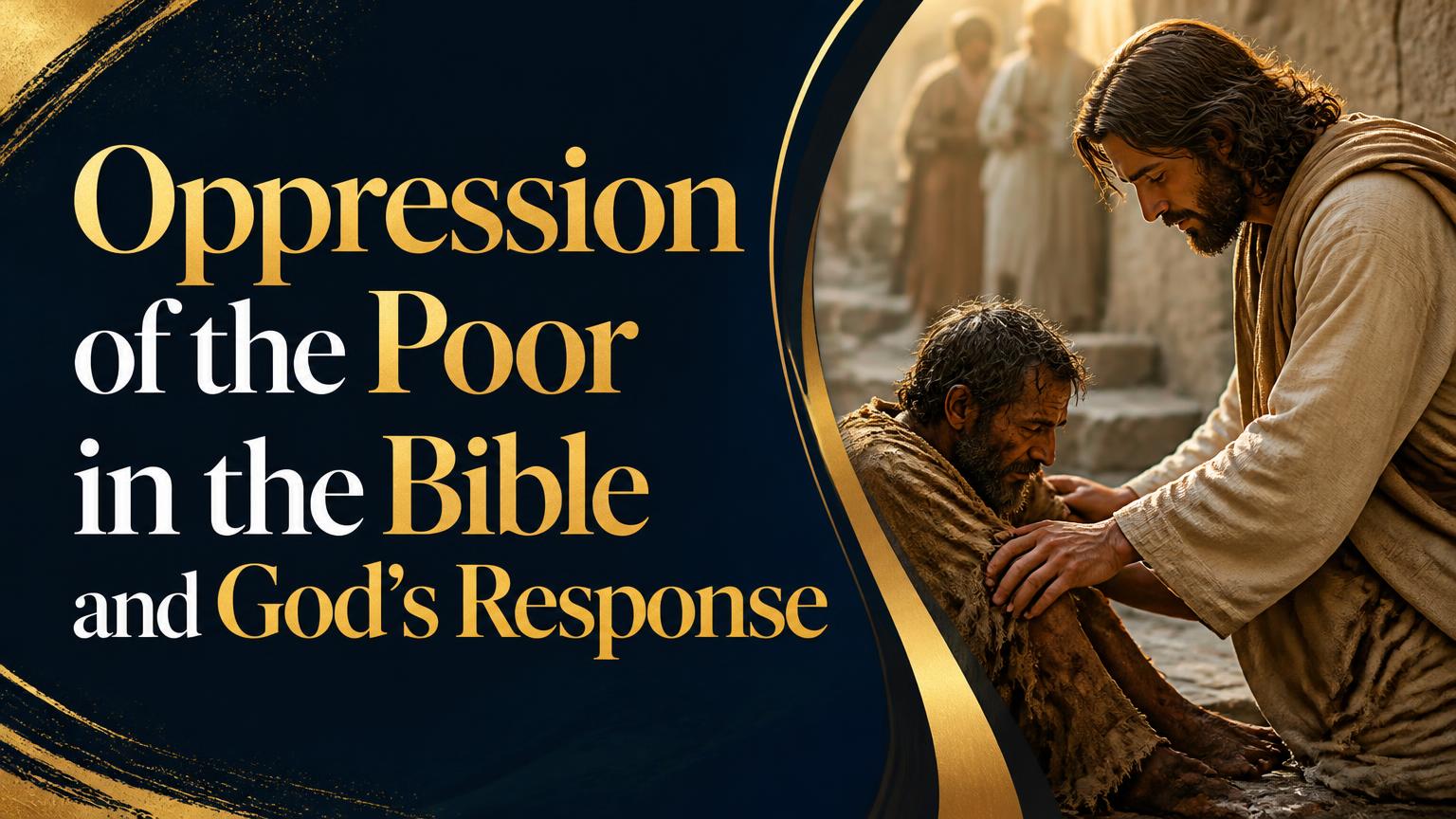
The Bible treats oppression of the poor as a serious violation of justice, neighbor-love, and faithfulness to God. It describes oppression not only as personal cruelty but also as the exploitation of vulnerable people through dishonest business, withheld wages, corrupt courts, land seizure, political power, and religious hypocrisy. Across Scripture, God presents himself as the defender of the poor, condemns those who profit from their weakness, commands his people to protect and provide for them, and promises judgment and restoration. The biblical response therefore includes compassion, generosity, justice, accountability, and structural responsibility.
Oppression of the Poor in the Bible
The oppression of the poor in the Bible refers to using power, wealth, law, or social position to take advantage of people who lack protection or resources. The Bible consistently rejects the idea that poverty makes a person less valuable. It also refuses to separate worship from treatment of the vulnerable: devotion to God is shown to be false when it coexists with exploitation.
What the Bible Means by Oppressing the Poor
Biblical oppression includes more than direct violence. It can involve withholding a worker’s wages, using dishonest measures, charging exploitative interest, manipulating courts, taking a poor person’s property, or refusing practical help when someone is in need. Deuteronomy 24:14–15 commands Israel not to exploit a poor laborer, while Leviticus 19:35–36 prohibits dishonest scales and measures.
The poor in Scripture are often both materially needy and socially vulnerable. Widows, orphans, immigrants, day laborers, and the disabled could lack the family connections or legal power needed to defend themselves. Proverbs 22:22–23 warns against robbing the poor because God himself will defend their cause. Oppression, therefore, occurs whenever someone turns another person’s vulnerability into an opportunity for personal gain or control.
God’s Concern for the Poor and Vulnerable
God’s concern for the poor is grounded in his character, not merely in temporary sentiment. Deuteronomy 10:17–18 describes God as one who shows no partiality and defends the cause of the fatherless and widow, while providing food and clothing for the foreigner. Psalm 146:7–9 similarly portrays him as the one who gives justice to the oppressed and watches over the vulnerable.
Proverbs 14:31 connects treatment of the poor with treatment of their Maker: whoever oppresses the poor shows contempt for God, but whoever is kind to the needy honors him. This principle gives poverty-related ethics a theological foundation. Helping or harming a vulnerable person is not morally insignificant; it reveals how a person regards the God who made that person in his image.
Israel’s Laws Against Economic Exploitation
The law given to Israel included practical protections designed to limit poverty’s destructive effects. Landowners were commanded to leave portions of their harvest for the poor and the foreigner through gleaning (Leviticus 19:9–10; Deuteronomy 24:19–22). Israelites were also instructed to release certain debts and lend generously rather than hardening their hearts toward the poor (Deuteronomy 15:7–11).
These laws did not eliminate every difference in wealth, nor did they create a modern economic system. They did, however, establish that private property and profit were not absolute claims. Possessions carried obligations toward neighbors, especially those with fewer resources. The Sabbath-year and Jubilee provisions in Exodus 23, Leviticus 25, and Deuteronomy 15 also expressed a broader principle: economic arrangements must not permanently reduce vulnerable people to hopelessness, although interpreters debate how fully and how often some of these provisions were implemented.
Prophetic Condemnation of the Powerful
The prophets repeatedly condemned societies in which the wealthy and powerful prospered by exploiting the weak. Amos denounced those who trampled the needy, manipulated trade, sold the poor for profit, and longed for religious festivals to end so business could resume (Amos 2:6–7; 8:4–6). Isaiah condemned rulers who made unjust laws and deprived the poor of justice (Isaiah 10:1–2). Micah criticized leaders who hated justice and built wealth through oppression (Micah 3:1–3, 9–12).
The prophets also exposed religious hypocrisy. Israel could not compensate for injustice through songs, sacrifices, or solemn assemblies. In Amos 5:21–24, God rejects worship that is separated from justice and calls instead for justice to flow like a river. This does not mean that biblical faith is merely social activism; it means that genuine worship necessarily affects how people use power, money, and authority.
Jesus, the Poor, and the Early Church
Jesus continued this concern while placing it within the announcement of God’s kingdom. In Luke 4:18–19, he describes his mission in terms of good news for the poor, freedom for the oppressed, and release for the captive. He warned against greed, challenged wealthy people to use possessions responsibly, and treated marginalized people with dignity. His teaching in Luke 6:20–25 also confronts both the suffering of the poor and the spiritual danger of placing security in wealth.
Jesus did not teach that every poor person is morally superior or that every wealthy person is automatically condemned. Instead, he exposed wealth’s power to produce indifference, self-sufficiency, and neglect. The early church expressed this responsibility through practical sharing so that needy believers were not abandoned (Acts 2:44–45; 4:32–35). James 2:1–9 condemns favoritism toward the rich in Christian gatherings, showing that discrimination based on economic status contradicts faith in Christ.
How God Responds to the Oppression of the Poor
The Bible presents God’s response in several connected ways: he hears the oppressed, confronts oppressors, commands his people to act, and promises a final setting right of what human power has distorted. These responses do not imply that God always removes suffering immediately. Scripture openly records delayed justice, lament, and situations in which oppression appears to continue unchecked for a time.
God Hears the Cry of the Oppressed
When the Israelites suffer under forced labor in Egypt, God hears their groaning, remembers his covenant, sees their condition, and acts (Exodus 2:23–25). These verbs communicate attention and commitment rather than passive awareness. God’s concern is not abstract; he responds to identifiable suffering caused by identifiable power.
The Psalms frequently give language to this confidence. Psalm 10 asks why the wicked seem able to trap the helpless, then affirms that God does see the trouble of the afflicted and will defend the fatherless. Such passages also permit honest lament. Faith does not require pretending that oppression is minor or that deliverance has already arrived.
God Judges Those Who Exploit Others
God’s judgment falls especially heavily on people who use authority to enrich themselves at the expense of those who cannot resist. Ezekiel 22:6–12 describes rulers, officials, priests, and merchants participating in different forms of corruption and exploitation. Jeremiah 22:13–17 condemns a ruler who builds an expensive palace through forced labor and contrasts him with a king who practices justice and defends the poor.
The Bible’s judgment is directed at actions and systems of advantage, not at wealth as a material fact alone. Abraham, Job, Joseph of Arimathea, and other faithful figures possessed significant resources. The moral question is whether wealth is gained unjustly, treated as ultimate security, or used without regard for the neighbor whose need is visible.
God Commands His People to Provide Justice and Mercy
God does not tell his people merely to feel pity. They are commanded to defend the weak, share food, pay workers fairly, lend generously, welcome strangers, and correct partiality in judgment. Isaiah 58 links true fasting with feeding the hungry, sheltering the homeless, clothing the naked, and ending oppressive practices. Micah 6:8 summarizes the calling as doing justice, loving mercy, and walking humbly with God.
The New Testament maintains this practical emphasis. First John 3:17 asks how God’s love can remain in someone who sees a brother or sister in need but closes the heart. James 1:27 identifies care for orphans and widows as part of pure religion. Compassion is therefore more than an emotion; it requires costly action, wise stewardship, and willingness to use personal influence for another person’s protection.
God Promises Final Justice and Restoration
Scripture recognizes that earthly justice is often incomplete. Ecclesiastes 5:8 observes that the oppression of the poor may exist within layers of official authority. Jesus’ parable of the rich man and Lazarus in Luke 16:19–31 portrays a reversal in which a neglected poor man receives comfort while an indifferent rich man faces judgment.
These passages do not encourage passivity. The promise of final judgment strengthens the demand for present faithfulness because God will expose hidden exploitation and vindicate those whom society ignores. The hope of restoration also prevents Christian concern for the poor from becoming merely political or economic. The biblical vision includes reconciliation with God, bodily resurrection, righteous community, and the renewal of creation.
Biblical Justice Is More Than Charity
Charity addresses immediate need, while justice also examines why the need exists and whether people are being prevented from escaping it. The Bible values direct generosity: Jesus tells the rich ruler to give to the poor, and Paul organizes relief for believers facing famine. Yet Scripture also condemns dishonest trade, corrupt courts, exploitative labor, and laws that benefit the powerful. A meal may relieve hunger today; fair wages and protection from theft may reduce the conditions producing hunger tomorrow.
This distinction should not turn charity and justice against each other. Emergency help is essential when people are suffering, while long-term justice seeks dignity, voice, safety, and opportunity. Biblical wisdom also requires discernment. Helping someone does not mean enabling abuse, ignoring responsibility, or treating every situation identically. Second Corinthians 8:13–15 presents generosity as a movement toward fairness, not as a demand that eliminates all differences through careless redistribution. Faithful action combines compassion with truth, accountability, and attention to real conditions.
How Christians Should Respond to Oppression Today
Christian responsibility begins with seeing vulnerable people as neighbors rather than as problems or statistics. Churches and individuals can provide food, housing support, debt assistance, fair employment, emergency aid, and companionship, but effective care should listen to the people receiving help. Proverbs warns against dishonest gain, James condemns favoritism, and Proverbs 31:8–9 calls God’s people to speak for those who cannot speak for themselves.
Christians should also examine the systems and habits through which they benefit. That may involve paying workers fairly, refusing exploitative business practices, supporting trustworthy relief efforts, challenging discriminatory treatment, and using civic or professional influence to protect vulnerable people. The Bible does not prescribe one modern political program, so applications require wisdom and prudence. It does require that economic convenience never become an excuse for ignoring injustice.
Finally, Christian action should preserve dignity and reject self-congratulation. Jesus warns against giving in order to receive public praise (Matthew 6:1–4), while Paul teaches generosity that is willing and cheerful rather than coerced (2 Corinthians 9:6–8). The goal is not to make the giver appear virtuous or make the poor dependent on a benefactor. It is to practice neighbor-love in ways that meet real needs, confront exploitation, and reflect God’s impartial concern.
Conclusion
The oppression of the poor in the Bible is condemned because it violates both human dignity and God’s justice. Scripture addresses personal neglect, dishonest commerce, abusive labor, corrupt government, legal discrimination, and religious hypocrisy. God hears the cries of the oppressed, judges those who exploit them, commands his people to act, and promises a final restoration in which hidden injustice will be revealed.
A faithful biblical response therefore cannot stop at occasional generosity or private sympathy. It must include practical mercy, fair dealing, advocacy, self-examination, and resistance to systems that profit from vulnerability. The Bible’s central message is not that poverty makes people holy or wealth automatically makes people guilty. It is that every person belongs to God, and anyone who possesses power or resources is accountable for how those advantages affect the poor.