
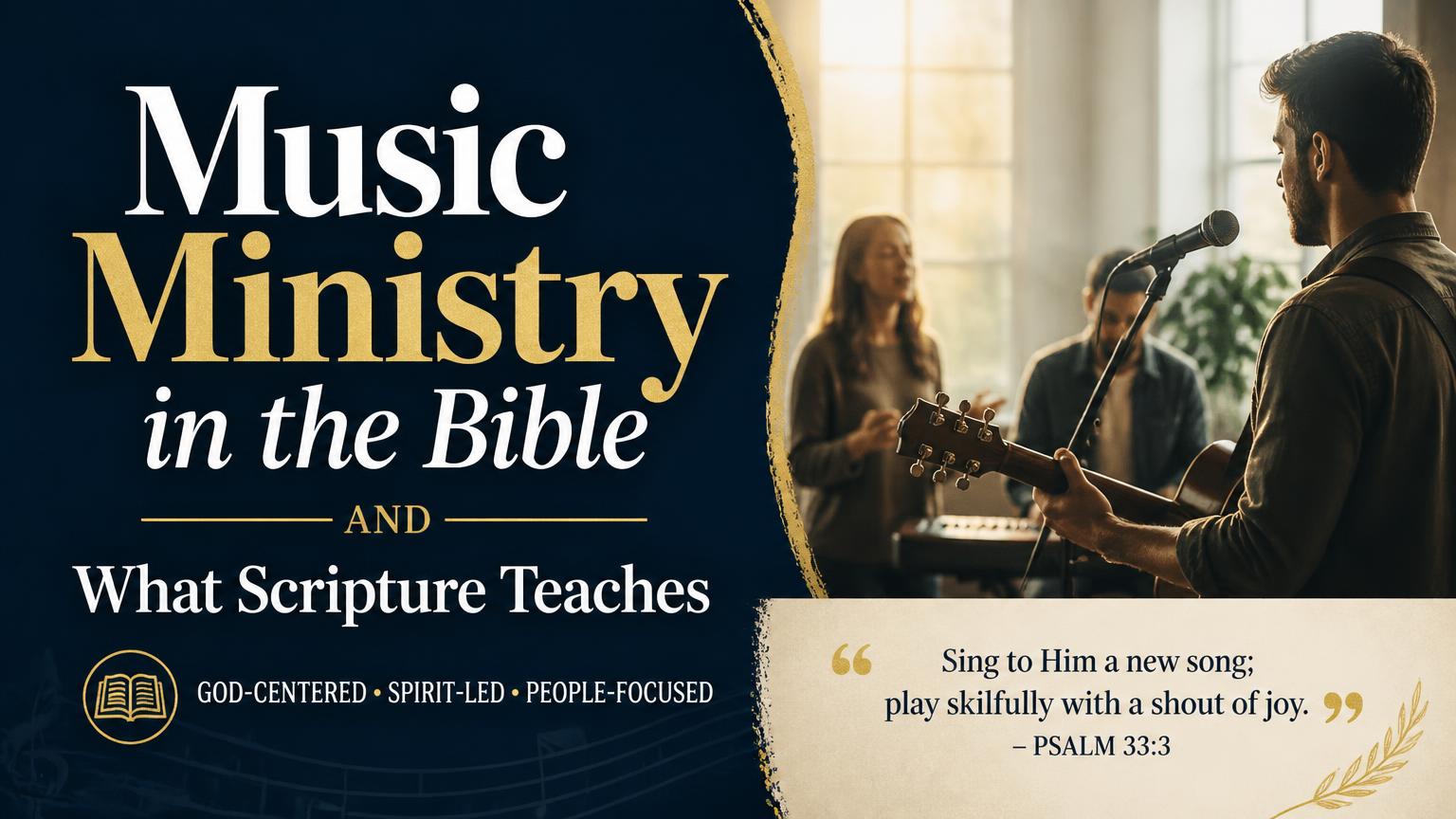
Music ministry in the Bible is service to God and His people through singing, instrumental music, praise, lament, teaching, prayer, remembrance, and communal participation. Scripture presents music as more than a performance or a decorative part of a worship service. It can proclaim God’s character, express faithful emotion, reinforce truth, unite the congregation, and direct attention toward the Lord.
The Bible does not prescribe one musical style or establish a modern “worship leader” role in the exact form used by many churches today. It does, however, provide enduring principles for those who lead, perform, write, teach, or participate in Christian music.
Music Ministry in the Bible: Meaning and Biblical Pattern
The biblical pattern shows music serving the purposes of worship, formation, proclamation, and fellowship. Its value does not rest primarily on technical quality, emotional intensity, or public visibility, but on whether it honors God and strengthens His people.
Music Ministry Includes Singing, Instruments, and Leadership
Scripture describes many forms of musical service. Miriam led the women of Israel in song and dance after the exodus (Exodus 15:20–21). David played the lyre, and his music brought relief to Saul during periods of distress (1 Samuel 16:14–23). The Levites were appointed to sing and play instruments in Israel’s worship, particularly in connection with the tabernacle and temple (1 Chronicles 6:31–32; 15:16–24).
Under David’s organization, particular families were set apart for musical service. Asaph, Heman, and Jeduthun, along with their descendants, ministered with lyres, harps, cymbals, and singing (1 Chronicles 25:1–7). These musicians were not portrayed merely as performers. They served as part of Israel’s public worship and helped the congregation praise God.
The biblical account also emphasizes preparation. The musicians were appointed, organized, and trained. First Chronicles 25:7 refers to those who were “trained in singing to the Lord.” This suggests that musical skill and spiritual service are not opposites. Preparation can be an expression of stewardship when it is directed toward faithful worship rather than personal status.
Biblical Music Proclaims God’s Character and Works
Many biblical songs recount what God has done. Moses’ song celebrates the Lord’s deliverance at the Red Sea and His faithfulness to Israel (Exodus 15). The Psalms repeatedly call God’s people to remember His creation, covenant, mercy, judgment, and saving acts.
This gives music a teaching and remembrance function. A congregation may remember truth more readily when it is sung, but the song must communicate truth accurately. Colossians 3:16 connects “psalms and hymns and spiritual songs” with teaching and admonishing one another. In that passage, music is part of how the word of Christ dwells richly among believers.
Biblical music therefore does more than create a religious atmosphere. It gives words to what the community believes. It can preserve the memory of God’s faithfulness, confront false thinking, and help worshipers respond to biblical truth with conviction.
Music Gives Voice to the Full Range of Faithful Emotion
The Bible includes joyful praise, sorrow, fear, confession, longing, thanksgiving, and hope. The Psalms contain celebrations of God’s goodness as well as cries from people who feel abandoned, threatened, or confused.
This breadth matters because biblical worship does not require people to pretend that suffering is absent. A lament can express pain while still turning toward God. Psalm 13 begins with repeated questions about God’s apparent absence but ends in trust: “I have trusted in your steadfast love.” The movement is not from fake optimism to praise; it is from honest distress toward renewed confidence in God.
Music ministry can therefore serve people in grief, repentance, waiting, and difficulty, not only in moments of celebration. Songs that acknowledge hardship while affirming God’s character may help a congregation pray faithfully when ordinary words are insufficient.
Music Unites the Congregation in Shared Worship
In biblical worship, music is frequently communal. The people sing together after God’s deliverance, respond to God’s covenant, and praise Him in gathered assemblies. The Psalms repeatedly address the congregation with commands such as “sing to the Lord” and “give thanks.”
The New Testament continues this emphasis. Believers are instructed to address one another through psalms, hymns, and spiritual songs, singing and making melody to the Lord (Ephesians 5:18–20). Colossians 3:16 likewise presents singing as a mutual ministry among Christians.
This does not eliminate the value of gifted leaders or instrumentalists. It does mean that the congregation should not become a passive audience. Biblical music ministry helps people participate in worship, confess truth together, encourage one another, and respond personally to God.
What the New Testament Teaches About Music in the Church
The New Testament gives fewer details about musical organization than the Old Testament, but it makes the purpose of congregational singing clear: music should be directed toward God and should build up the church.
Music Should Be Rooted in the Word of Christ
Ephesians 5:18–20 and Colossians 3:16 closely connect singing with being filled by the Spirit and with the word of Christ. These passages suggest that Christian music is not detached from Christian teaching. Its content should help believers understand, remember, and respond to the gospel.
This does not mean every song must sound like a theological lecture. Poetry, repetition, metaphor, and emotional expression have important biblical precedents. But poetic language should not contradict the truth it is intended to express. A song may be memorable and moving while still giving a distorted picture of God, sin, salvation, suffering, or Christian hope. Sound biblical content is therefore more fundamental than musical popularity.
Music Should Edify Rather Than Center the Performer
Paul’s instructions about gathered worship repeatedly emphasize edification. In 1 Corinthians 14, he insists that spiritual activity in the assembly should strengthen the church and be conducted in an orderly way. Although the chapter addresses several gifts rather than music alone, its principle applies to musical leadership: public ministry should serve the congregation rather than display the minister.
That principle challenges both pride and false modesty. A musician should not seek attention as an end in itself, but neither should excellence be rejected as unspiritual. The relevant question is whether skill, volume, arrangement, staging, and leadership help people attend to God and participate meaningfully.
Music Can Be an Act of Prayer and Witness
Jesus and His disciples sang a hymn after the Last Supper (Matthew 26:30). Paul and Silas prayed and sang hymns while imprisoned in Philippi (Acts 16:25). Their singing did not depend on comfortable surroundings or public approval. It became an expression of trust in God under pressure, and the other prisoners heard them.
James 5:13 gives a simple instruction: “Is anyone cheerful? Let him sing praise.” First Corinthians 14:15 brings prayer and singing together: Paul says he will pray with his spirit and with his mind, and sing with his spirit and with his mind. These passages show that music can function as prayer, personal devotion, and testimony, not merely as a scheduled portion of a meeting.
Principles for Faithful Music Ministry
The biblical material supports several practical principles. These are not a single prescribed program, but they provide a framework for evaluating musical service.
Serve From Love, Not From Recognition
Jesus warned against practicing religious acts to be seen by others (Matthew 6:1). The warning applies to musicians and worship leaders as much as to other ministers. Public visibility can tempt people to measure faithfulness by applause, platform size, or audience response.
A healthy music ministry treats visibility as a responsibility rather than a reward. The leader’s task is to direct attention toward God, communicate truth clearly, and help others participate.
Combine Spiritual Character With Musical Preparation
Skill matters because poor preparation can distract, confuse, or burden a congregation. The Levites’ organization and training show that competence has a legitimate place in worship. Yet Scripture also gives sustained attention to character. Those who serve publicly should pursue humility, integrity, teachability, and obedience rather than assuming musical ability proves spiritual maturity.
Musical excellence cannot compensate for hypocrisy. Conversely, sincere devotion does not remove the need to prepare. Faithful ministry brings character and craftsmanship together.
Keep the Congregation in View
A song may be artistically impressive but difficult for a congregation to sing. A wise ministry considers range, tempo, theological clarity, repetition, cultural context, and the abilities of the people present. The goal is not to make every song simple, but to make participation possible and meaningful.
This also requires sensitivity to different ages, backgrounds, and experiences. A church’s musical choices should express biblical truth without treating one cultural preference as the only legitimate form of worship.
Use Music to Serve the Whole Counsel of Scripture
A balanced repertoire includes praise, confession, thanksgiving, lament, intercession, testimony, assurance, and hope. If a church sings only celebration, people may struggle to bring grief or repentance before God. If it sings only introspection, it may lose sight of God’s mighty acts and future promises.
The Psalms provide a model of theological breadth. They teach worshipers how to rejoice in God, fear Him, question honestly, confess sin, seek protection, and hope for His final justice.
Practice Order and Accountability
Music ministry should operate within the church’s wider spiritual leadership rather than as an isolated platform. Leaders benefit from theological review, pastoral oversight, rehearsals, clear communication, and honest evaluation.
Order does not mean lifelessness. In the New Testament, orderly worship protects the congregation from confusion and ensures that freedom serves love. Spontaneity may be appropriate, but it should not be treated as automatically more spiritual than preparation.
What the Bible Does Not Require
Scripture does not command one universal instrument, musical genre, stage arrangement, or emotional style. The Old Testament mentions many instruments, including strings, percussion, and wind instruments (Psalm 150), while the New Testament does not establish a fixed instrumental pattern for every church.
Nor does the presence of music prove that a service is spiritually healthy. Music can stir emotion without producing repentance, faith, or obedience. Scripture consistently joins worship with the life of the worshiper. Jesus criticized outward religious activity that concealed disobedience, and the prophets rejected songs offered alongside injustice and hypocrisy (Isaiah 1:11–17; Amos 5:21–24).
The temple arrangements also should not be transferred mechanically into the church. Israel’s Levitical priesthood, sacrifices, and temple system belonged to the old covenant. Their musical service offers principles about ordered worship, trained service, and praise, but it is not a complete blueprint for modern church structure.
A Biblical Test for Music Ministry
A church or individual can evaluate its musical ministry by asking:
- Does the music express truth about God and the gospel?
- Does it help people worship rather than merely watch?
- Does it make room for praise, lament, confession, thanksgiving, and hope?
- Are leaders serving humbly and preparing responsibly?
- Does the music strengthen the church and encourage mutual participation?
- Is the ministry accountable to Scripture and the church’s pastoral oversight?
- Do the lives of those serving support the message they proclaim?
These questions keep music connected to its biblical purpose. They also allow legitimate diversity in style while preserving essential convictions about truth, love, holiness, and edification.
Music ministry in the Bible is fundamentally an offering of service: people use their voices, instruments, creativity, and skill to glorify God and build up His people. Scripture supports excellence but rejects performance-centered pride; it welcomes emotional expression but anchors it in truth; and it values gifted leaders while calling the whole congregation to sing. The central measure is not how impressive the music appears, but whether it helps the church know, love, remember, and respond to God faithfully.