
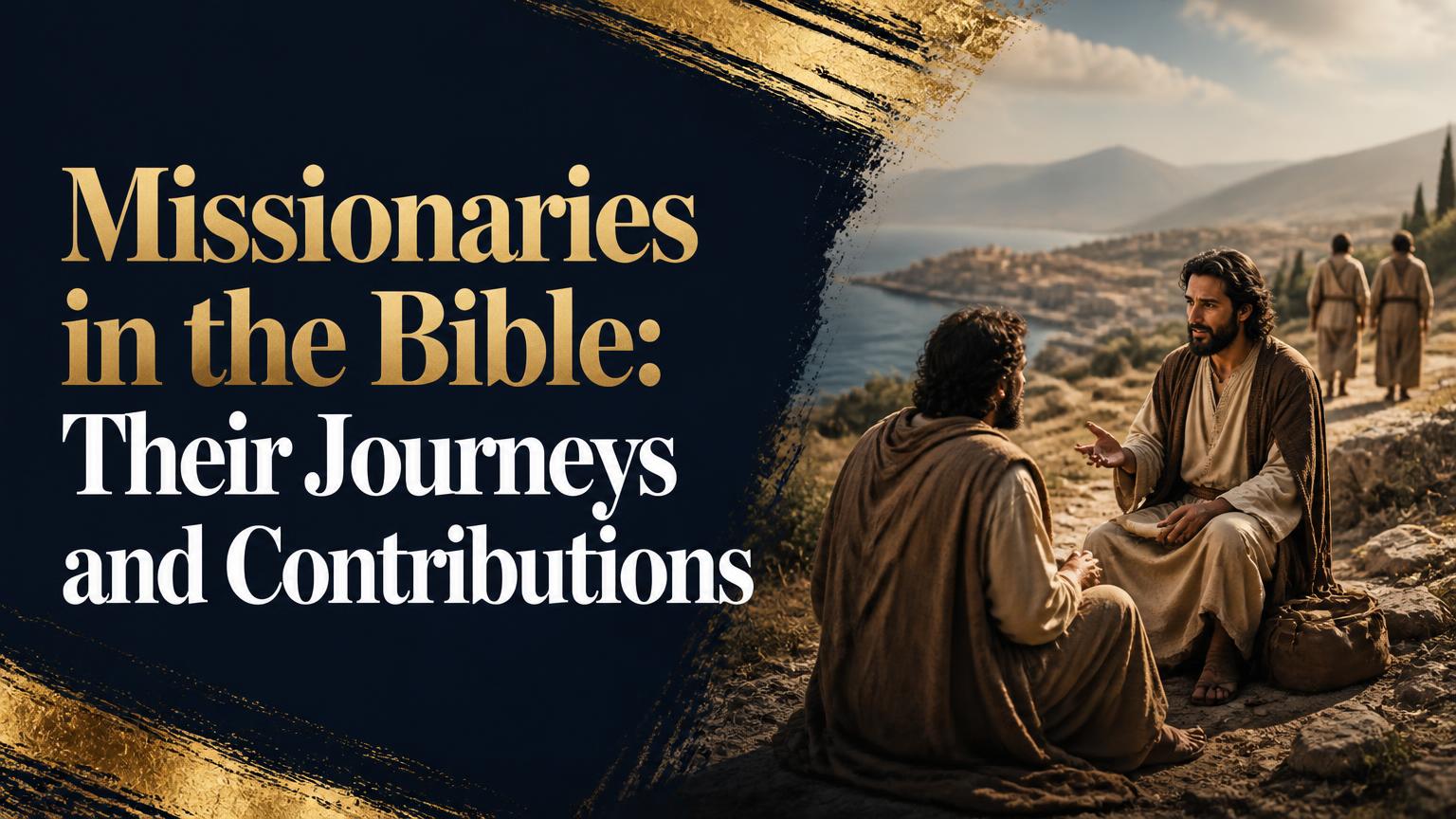
The Bible does not use “missionary” as a formal job title in the way modern churches do, but it repeatedly describes people whom God sends to proclaim his message, make disciples, strengthen believers, and serve communities. Some traveled across political and cultural boundaries; others witnessed faithfully in their own towns. Their work was grounded in God’s purpose to bless the nations, centered on Jesus Christ, and carried out through proclamation, teaching, practical service, suffering, and partnership with local believers.
Missionaries in the Bible
Biblical missionaries were people commissioned by God, sent by Jesus, guided by the Holy Spirit, or recognized by the church for ministry among people who needed to hear and understand God’s message. The category includes apostles, evangelists, teachers, church planters, fellow workers, and faithful witnesses. The Bible presents mission as more than travel: it involves announcing the gospel, forming Christian communities, discipling converts, caring for the vulnerable, and helping established churches grow in faith and obedience.
God’s Missionary Purpose in the Old Testament
The missionary pattern begins before the New Testament. God called Abraham and promised that “all peoples on earth” would be blessed through him (Genesis 12:1–3). Israel was also called to be a “kingdom of priests” and a holy nation (Exodus 19:5–6), indicating a representative role among the nations. Israel’s mission was not always expressed through organized travel, but its worship, justice, holiness, and testimony were intended to display the character of God.
Several Old Testament figures were explicitly sent to people outside their immediate community. Jonah was sent to Nineveh, a foreign city, even though he resisted the assignment (Jonah 1:1–2; 3:1–5). Prophets such as Elijah and Elisha also ministered beyond Israel’s borders. These accounts show that God’s concern was never restricted to one ethnic group, even though his covenant relationship with Israel had a unique place in biblical history.
Jesus Sends His Disciples
Jesus is the central model of biblical mission. He described himself as sent by the Father and then sent his followers to continue proclaiming God’s kingdom. He sent the Twelve to preach, heal, and call people to repentance (Matthew 10:5–8), and he also sent seventy-two disciples ahead of him (Luke 10:1–9). Their work combined verbal proclamation with compassionate ministry and dependence on God rather than personal status or wealth.
After his resurrection, Jesus commissioned his disciples to make disciples of all nations, baptize them, and teach them to obey his commands (Matthew 28:18–20). This commission explains the purpose of later missionary activity in Acts. Christian mission is therefore not merely the spread of an institution or culture. Its stated aim is to announce Jesus, invite people into faithful relationship with him, and establish communities shaped by his teaching.
Paul and Barnabas Travel Across the Roman World
Paul is the Bible’s most extensive example of a traveling missionary. After his conversion, he proclaimed Jesus in synagogues, public settings, homes, and marketplaces. The church at Antioch commissioned Paul and Barnabas, and the Holy Spirit directed them toward their first major missionary journey (Acts 13:1–4). They traveled through Cyprus and parts of Asia Minor, preaching, forming disciples, and helping organize local congregations.
Paul’s later journeys took him into Macedonia and Greece, including Philippi, Thessalonica, Berea, Athens, and Corinth. He also spent substantial time in Ephesus and other cities. His ministry involved preaching, teaching, debate, pastoral correspondence, leadership development, and enduring opposition. Acts ends with Paul under guard in Rome, where he continued proclaiming the kingdom of God (Acts 28:16–31). His letters further strengthened churches he could not always visit personally.
Paul did not work alone. Barnabas, Silas, Timothy, Titus, Luke, and many other coworkers shared the labor. Paul’s letters refer to these companions as fellow workers, ministers, messengers, and partners. This corrects the impression that mission depends on one unusually gifted individual. Biblical mission was collaborative, accountable to churches, and sustained through relationships.
Philip, Peter, Priscilla, Aquila, and Other Witnesses
Philip provides an important example of evangelistic mobility. He preached in Samaria and later explained Isaiah’s prophecy to an Ethiopian official on the road from Jerusalem to Gaza (Acts 8:4–8, 26–39). The encounter shows the importance of explaining Scripture clearly and recognizing that the gospel crosses ethnic, geographic, and social boundaries. Philip is later identified as an evangelist (Acts 21:8).
Peter’s visit to Cornelius was another decisive step in the expansion of the church. Although Peter initially struggled with the implications of associating with Gentiles, God showed him that he should not call any person impure or unclean (Acts 10:9–35). Peter then proclaimed Jesus to Cornelius’s household, and the Holy Spirit came upon Gentile believers. The episode demonstrated that Gentiles could receive the gospel without first becoming Jewish proselytes.
Priscilla and Aquila were a married couple who worked with Paul and helped explain “the way of God” more accurately to Apollos (Acts 18:24–26). They hosted a church in their home and were honored as coworkers (Romans 16:3–5). Women also participated in mission as witnesses and proclaimers: Mary Magdalene announced the risen Christ to the disciples (John 20:17–18), and the Samaritan woman told her community about Jesus (John 4:28–30, 39). These examples show that biblical mission was not limited to one personality, social class, or gender.
Missionaries Build, Strengthen, and Serve Churches
The contribution of biblical missionaries extended beyond initial conversions. Paul and Barnabas returned to new congregations to strengthen disciples and appoint leaders (Acts 14:21–23). Paul wrote letters to correct false teaching, resolve conflict, answer ethical questions, and explain the meaning of the gospel. Mission therefore included long-term discipleship rather than simply obtaining an initial response.
Missionaries also encouraged cooperation among churches. Paul organized a collection for impoverished believers in Jerusalem, linking Gentile congregations with Jewish Christians in practical solidarity (Romans 15:25–27; 1 Corinthians 16:1–4). This collection expressed the spiritual unity of the church through material generosity. Biblical missionaries preached, taught, counseled, defended the faith, developed leaders, and connected separated communities into one body.
The Missionary Pattern in the Bible
The Bible presents mission as a combination of message, character, method, and community. Its messengers were not merely religious travelers. They carried a particular announcement about God’s action in Jesus Christ and embodied that message through sacrificial service.
Proclaiming Christ and Making Disciples
The central message was the death and resurrection of Jesus, his lordship, the forgiveness of sins, and the call to repentance and faith. Peter’s sermon at Pentecost focused on Jesus’ crucifixion, resurrection, exaltation, and the promised Holy Spirit (Acts 2:22–39). Paul similarly described his ministry as proclaiming Christ and teaching people with the goal of presenting them mature in him (Colossians 1:28–29).
Conversion and discipleship were connected but not identical. Missionaries announced the gospel and invited people to respond, but the task continued through baptism, instruction, worship, moral formation, and mutual care. A church was not simply a crowd that had heard a sermon; it was a community learning to live under Christ’s authority.
Crossing Cultural Boundaries With Wisdom
Biblical missionaries communicated the same gospel in different cultural settings. Paul reasoned from Israel’s Scriptures in synagogues, while in Athens he began with observations about the city’s religious practices and quoted language familiar to his audience (Acts 17:16–34). This was adaptation in communication, not a change in the identity of Jesus or the substance of the gospel.
Paul also rejected the idea that Gentile converts had to adopt every Jewish cultural practice. At the same time, he urged believers to limit their freedom when exercising it would unnecessarily harm others (1 Corinthians 9:19–23; 10:32–33). The missionary principle is neither cultural domination nor indiscriminate accommodation. It is faithful communication that removes unnecessary barriers while preserving the message and ethical demands of Christ.
Depending on God and Accepting Suffering
Missionary work in the Bible is carried out through prayer, the Holy Spirit, Scripture, and the support of fellow believers. Jesus instructed his disciples to depend on God’s provision (Luke 10:4–7), and the church in Antioch prayed and fasted before sending Paul and Barnabas (Acts 13:2–3). The emphasis on dependence did not prohibit planning or responsible support; Paul sometimes worked as a tentmaker and also received assistance from churches.
Suffering was a recurring feature, not proof that the mission had failed. Paul faced imprisonment, beatings, rejection, danger, and exhaustion (2 Corinthians 11:23–28). Yet the New Testament does not glorify suffering for its own sake. It presents suffering as a cost sometimes attached to faithful witness and calls missionaries to integrity, courage, humility, and care for the people they serve.
Apostle, Evangelist, and Missionary: What Is the Difference?
“Missionary” is a useful modern umbrella term, but it should not be treated as an exact biblical office. The word apostle means “one who is sent,” yet the New Testament uses apostle in more than one way. The Twelve and Paul held a foundational role connected to witnessing to the risen Christ, while other people were also described as sent representatives or coworkers. Not every modern missionary should claim apostolic authority.
An evangelist is someone associated with announcing the good news; Philip is specifically called an evangelist (Acts 21:8). A pastor or teacher may primarily strengthen an existing congregation, while a missionary may focus on cross-cultural evangelism and church formation. These roles can overlap. Paul evangelized, taught, pastored, defended doctrine, and trained leaders. The important distinction is function, not prestige: biblical ministry is measured by faithfulness to Christ and service to people rather than by travel, visibility, or title.
The Bible also distinguishes between being sent by God and acting independently. Paul and Barnabas were recognized and commissioned by the church at Antioch. Their authority was connected to the gospel, the Holy Spirit, and accountable Christian community. This pattern cautions against treating missionary work as personal adventure or self-appointed leadership.
Why the Biblical Model Still Matters
The biblical model gives churches a fuller understanding of mission. Mission is not limited to foreign travel, public preaching, or dramatic conversion stories. A believer may participate through translation, teaching, hospitality, medicine, business, administration, prayer, financial support, leadership development, or direct evangelism. These forms of service become missionary in character when they support faithful witness and the flourishing of people and churches.
The model also supplies necessary safeguards. Mission should not be confused with cultural superiority, political conquest, or pressure that violates conscience. The New Testament calls for truthful proclamation, persuasion, sacrificial service, respect for people, and care for the poor. It also recognizes the importance of local believers rather than treating outside workers as permanent owners of a ministry. Healthy mission aims to form mature churches capable of worshiping, serving, teaching, and bearing witness within their own communities.
Conclusion
Missionaries in the Bible were sent witnesses who proclaimed God’s message, centered their work on Jesus Christ, crossed social and geographic boundaries, formed disciples, strengthened churches, and served people in practical ways. Abraham, Jonah, Peter, Philip, Paul, Barnabas, Priscilla, Aquila, and many others illustrate different dimensions of this calling. Their ministries varied greatly, but they shared dependence on God, commitment to truth, partnership with other believers, and willingness to endure difficulty.
The biblical picture also prevents a narrow definition of mission. Mission is not simply traveling to another country, and missionaries are not spiritual celebrities. It is faithful participation in God’s purpose to make Christ known and to bless the nations through transformed communities. Travel may be part of that work, but proclamation, discipleship, service, humility, and accountability are its defining marks.