
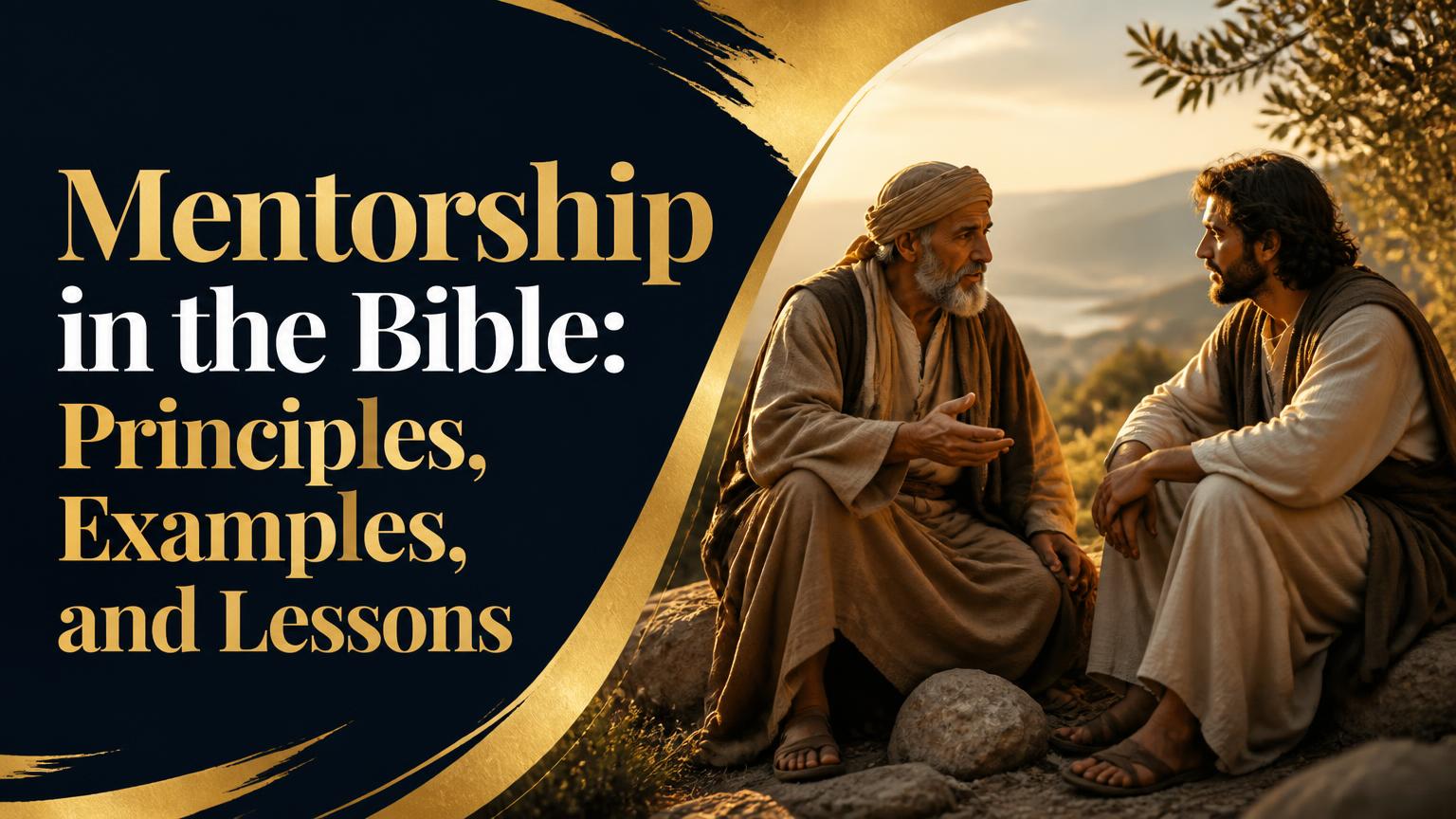
Mentorship in the Bible is a relational process of helping another person grow in faith, character, wisdom, and faithful service. Although the Bible does not use “mentorship” as a formal modern category, it repeatedly presents older or more experienced believers guiding others through instruction, example, correction, encouragement, responsibility, and shared life. Biblical mentorship is therefore more than career advice or personal coaching: its central aim is maturity before God and usefulness in serving others.
Mentorship in the Bible
Biblical mentorship is best understood as intentional spiritual formation within a trustworthy relationship. One person helps another recognize God’s truth, develop godly character, discern responsibility, and practice faithful obedience. The relationship may be formal, as with Paul and Timothy, or emerge naturally through shared ministry, as with Priscilla and Aquila instructing Apollos.
The mentor is not meant to replace God, Scripture, the church, or the mentee’s own responsibility. Instead, a mentor provides an example and offers wisdom that helps another person obey God more faithfully. The biblical pattern includes both receiving guidance and eventually helping others grow.
The Meaning and Purpose of Biblical Mentorship
The purpose of biblical mentorship is transformation, not dependence. A mentor teaches truth, demonstrates its application, identifies strengths and weaknesses, and gradually entrusts meaningful responsibility to the learner. This process involves the whole person: beliefs, motives, relationships, habits, decisions, and service.
Jesus’ relationship with the Twelve illustrates this comprehensive approach. Mark 3:14 says that Jesus appointed them first “to be with him” and then to be sent out to preach. Presence came before public assignment. The disciples learned by listening to Jesus, observing His compassion and courage, asking questions, receiving correction, and participating in ministry. Biblical mentorship therefore combines instruction with proximity and practice.
Moses and Joshua: Preparing a Successor
Moses and Joshua provide one of the clearest examples of leadership development in Scripture. Joshua served Moses, accompanied him in significant moments, and gradually became prepared to lead Israel. Moses did not simply give Joshua information; he brought him into the realities of leadership, dependence on God, conflict, obedience, and public responsibility.
Before Moses’ death, God commissioned Joshua, and Moses publicly encouraged him to be strong and courageous (Deuteronomy 31:7–8). This shows that biblical mentorship includes a transition of responsibility. A mentor should not preserve personal control indefinitely. The goal is to prepare another person to obey God and carry responsibility faithfully, even when the mentor is no longer present.
Elijah, Elisha, and Naomi: Guidance Through Shared Life
Elijah and Elisha demonstrate the value of sustained companionship. Elisha followed Elijah, observed his prophetic ministry, and eventually received a commission to continue that work (1 Kings 19:19–21; 2 Kings 2). Elisha’s request for a “double portion” was not merely a desire for status; it expressed a request to inherit the responsibility and spiritual calling associated with Elijah’s ministry.
Naomi and Ruth show a different form of mentorship. Naomi did not train Ruth for public leadership, but she gave counsel about family, survival, covenant loyalty, and wise action within a difficult social setting. Their relationship included mutual commitment rather than one-sided instruction. Ruth’s faithfulness also strengthened Naomi, showing that mentoring relationships can be reciprocal: the more experienced person guides, while the learner’s courage and loyalty may also encourage the guide.
Jesus and the Twelve: Formation Through Example and Correction
Jesus mentored His disciples by combining teaching, example, correction, service, and mission. He explained the meaning of God’s kingdom, but He also showed the disciples how to pray, welcome outsiders, confront hypocrisy, respond to suffering, and serve without seeking status. In John 13, Jesus washed their feet and connected leadership with humble service.
Jesus also corrected the disciples when they misunderstood greatness, faith, power, or sacrifice. These corrections were not intended to shame them but to reshape their understanding. He gave them opportunities to minister, allowed them to encounter failure, and later commissioned them to make disciples of all nations (Matthew 28:18–20). Effective biblical mentorship therefore does not protect learners from every difficulty. It gives them appropriate opportunities to act, reflect, repent, and grow.
Paul, Timothy, Priscilla, Aquila, and Apollos
Paul’s relationship with Timothy illustrates spiritual mentorship that combines affection, doctrine, endurance, and responsibility. Paul calls Timothy his “true son in the faith” (1 Timothy 1:2), encourages him to remain faithful despite insecurity and opposition, and urges him to entrust what he has learned to reliable people who can teach others (2 Timothy 2:2). This reveals the multiplying purpose of mentorship: truth received should eventually be passed on.
Priscilla and Aquila provide another important model in Acts 18:24–26. Apollos was eloquent and knowledgeable, yet his understanding was incomplete. The couple took him aside and explained “the way of God more accurately.” They corrected him privately, respectfully, and constructively rather than humiliating him publicly. Their example shows that mentorship may involve refining the gifts a person already possesses, not merely teaching someone who is inexperienced.
The Main Principles of Mentorship in the Bible
Biblical mentorship begins with character. Skill, intelligence, influence, and public success do not compensate for dishonesty, pride, or spiritual instability. Paul’s instructions concerning leaders in 1 Timothy 3 and Titus 1 emphasize observable character because those who guide others inevitably influence them beyond their spoken lessons. A mentor teaches through conduct as much as through words.
The relationship should also be grounded in Scripture and directed toward obedience. Proverbs emphasizes the value of wise counsel, while Titus 2 describes older believers teaching younger believers how faith should shape everyday life. Biblical advice is not simply personal preference. It should help a person think and live in ways consistent with God’s revealed truth.
Correction is another essential element. Proverbs 27:17 compares sharpening one person with another, and Galatians 6:1 instructs spiritual people to restore someone caught in sin with gentleness. Correction must therefore be truthful without becoming controlling, harsh, or self-righteous. A mentor’s authority is meant to restore and equip, not to create fear or dependence.
Finally, biblical mentorship leads toward multiplication and release. The mentor does not seek to become indispensable. Moses prepared Joshua, Jesus sent the disciples, and Paul trained Timothy to teach others. A healthy relationship gradually increases the learner’s wisdom, responsibility, and ability to serve beyond the mentor’s immediate presence.
Mentorship, Discipleship, and Spiritual Parenting
Mentorship, discipleship, and spiritual parenting overlap, but they emphasize different aspects of spiritual formation. Discipleship is the broadest term: it describes learning to follow Jesus in every area of life. Mentorship usually emphasizes guidance from someone with relevant maturity or experience. Spiritual parenting describes a particularly caring, formative relationship in which a believer helps another person grow with patience and personal investment.
A single relationship may include all three dimensions. Paul’s relationship with Timothy involved discipleship because Timothy followed Christ, mentorship because Paul trained him for ministry, and spiritual parenting because Paul related to him with affection and concern. The distinction matters because not every mentor must direct every part of someone’s life. A person may receive theological guidance from one believer, vocational wisdom from another, and pastoral care from a church community.
Biblical mentorship also differs from celebrity leadership or guru culture. A mentor should point people toward Christ rather than demand unquestioned loyalty. “Follow me” can be appropriate when it means following a faithful example, as Paul says in 1 Corinthians 11:1, but it must remain subordinate to following Jesus. No mentor is infallible, and mature believers remain accountable to Scripture and the wider body of Christ.
How to Practice Biblical Mentorship Today
Choose Character Before Influence
A suitable mentor should demonstrate humility, integrity, teachability, and consistency rather than merely possessing an impressive platform. Biblical examples place strong emphasis on trustworthy character because private behavior eventually shapes public guidance. A mentor does not need to be perfect, but should be willing to acknowledge failure, receive correction, and pursue repentance.
Those seeking mentorship should also look for wisdom that fits their actual need. A person may need help with spiritual disciplines, leadership, marriage, ministry, work, or decision-making. Selecting someone solely because of fame or success can create an unhealthy relationship. The better question is whether the person’s life reflects the kind of faithfulness the learner hopes to develop.
Build the Relationship Around Truth and Practice
Biblical mentorship requires more than occasional inspirational conversation. It may include studying Scripture together, discussing decisions, praying, observing ministry, reviewing failures, and setting appropriate responsibilities. The learner should have opportunities to apply what is being taught, because knowledge becomes mature wisdom through faithful practice.
Clear expectations also protect the relationship. Both people should understand the purpose, frequency, and boundaries of their meetings. A mentor offers counsel rather than controlling every decision. The learner remains responsible for prayerful discernment and obedience. Healthy guidance strengthens agency; it does not replace it.
Correct Gently and Release Responsibility
Correction should address real issues with clarity and respect. Private conversations are usually more appropriate than public embarrassment, following the constructive pattern seen in Priscilla and Aquila’s conversation with Apollos. The mentor should distinguish between biblical principles and personal preferences, explaining why a correction matters rather than simply demanding compliance.
As the learner grows, responsibility should increase. A mentor might invite the person to teach, lead a project, make a decision, or serve someone else. Mistakes can then become occasions for reflection and growth. The ultimate measure of success is not the learner’s permanent attachment to the mentor but the learner’s increasing faithfulness, wisdom, and readiness to help others.
What Biblical Mentorship Is Not
Biblical mentorship is not a substitute for a local church, pastoral care, professional treatment, or specialized expertise. A mentor may provide valuable perspective, but serious mental-health concerns, abuse, legal matters, medical conditions, and financial decisions may require qualified professionals. Spiritual language should never be used to conceal harm or discourage someone from seeking appropriate help.
It is also not a license for manipulation. A mentor who demands secrecy, unquestioned obedience, excessive access, financial loyalty, or isolation from other relationships is acting contrary to the servant-shaped pattern of Scripture. Jesus warned His disciples against authority modeled on domination and taught that greatness is expressed through service (Mark 10:42–45). Biblical influence remains accountable, transparent, and oriented toward another person’s good.
Lessons for Mentors and Learners
Mentors should teach with patience, model what they commend, listen before advising, and give correction that preserves dignity. They should resist creating dependence and should celebrate the learner’s growth even when it leads in directions the mentor would not have chosen. Faithful mentorship requires humility because the mentor is also still being formed.
Learners should approach mentorship with teachability but not passivity. They should test counsel against Scripture, ask honest questions, accept appropriate correction, and take responsibility for decisions. They should also recognize that one person cannot provide every kind of wisdom. A mature Christian community offers multiple relationships, accountability, encouragement, and protection against placing excessive authority in one individual.
Conclusion
Mentorship in the Bible is purposeful relationship-based formation that helps people grow in faith, character, wisdom, and service. Moses prepared Joshua, Elijah invested in Elisha, Jesus formed and commissioned the disciples, and Paul equipped Timothy to teach others. These examples show that mentorship includes presence, instruction, imitation, correction, responsibility, and eventual multiplication.
The central test of biblical mentorship is not whether the learner remains attached to the mentor, gains status, or copies every personal preference. It is whether the learner becomes more faithful to God, more capable of serving others, and more prepared to help others grow. A mentor’s influence is healthiest when it directs attention away from personal control and toward the character and mission of Jesus Christ.