
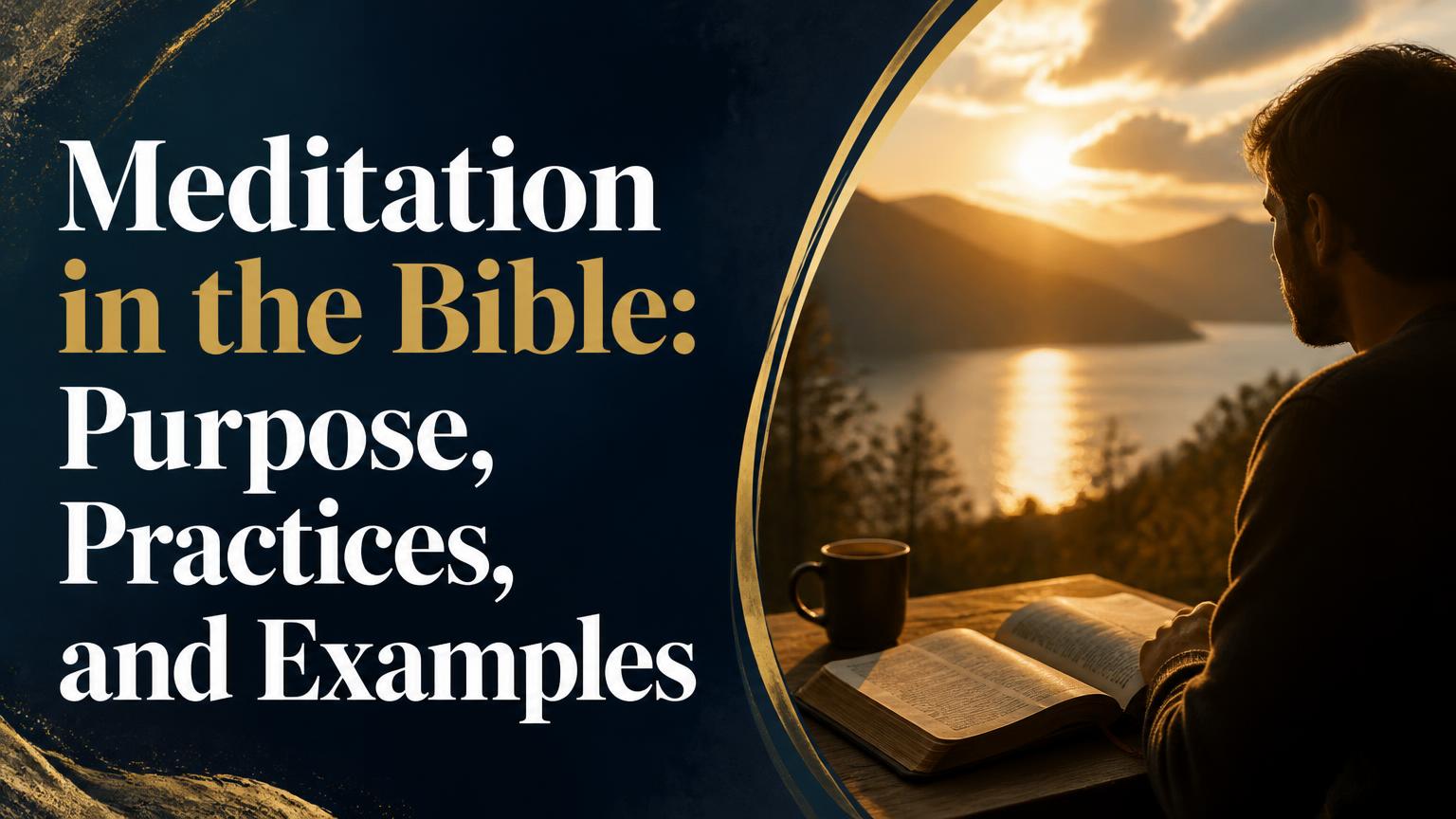
Meditation in the Bible is deliberate reflection on God, his character, his works, and his revealed Word, leading to worship, obedience, wisdom, and renewed thinking. Biblical meditation is more than quietly reading a verse and more than repeating words mechanically. It involves giving sustained attention to truth, considering its meaning, bringing it before God in prayer, and allowing it to shape one’s attitudes and conduct. Scripture presents meditation as a practice for ordinary life: believers remember God’s works, examine his instruction, rehearse his promises, and respond faithfully to what they understand.
Meditation in the Bible
What Biblical Meditation Means
Biblical meditation means thoughtfully dwelling on spiritual truth rather than passing over it quickly. The Old Testament often uses the Hebrew word hagah, which can carry the sense of murmuring, speaking quietly, pondering, or rehearsing something. This suggests an active process in which a person turns God’s truth over in the mind and may repeat it with the mouth.
Psalm 1:2 describes the righteous person as someone who meditates on the law of the Lord “day and night.” The image is not necessarily of uninterrupted Bible reading. It describes a life continually oriented toward God’s instruction. The person allows that instruction to influence decisions, desires, reactions, and priorities.
Biblical meditation is therefore neither passive daydreaming nor an attempt to achieve spiritual power through a mental technique. It is attentive reflection before God. The goal is not simply to know more information but to understand truth deeply enough that it produces trust, repentance, praise, courage, and obedience.
What Christians Meditate On
The Bible identifies several appropriate subjects for meditation. God’s instruction is central. Joshua 1:8 connects meditation on the Book of the Law with careful obedience, showing that biblical reflection is meant to result in faithful action. Psalm 119 repeatedly connects meditation with God’s statutes, promises, ways, testimonies, and commands.
Scripture also calls people to reflect on God himself and on his works. The psalmists meditate on God’s steadfast love, power, holiness, faithfulness, creation, past acts of deliverance, and present care. Psalm 143:5, for example, recalls God’s works and considers what he has done. This kind of remembrance strengthens faith because it connects present uncertainty with the record of God’s character.
The New Testament broadens the practice without separating it from truth. Philippians 4:8 directs believers to think about what is true, honorable, just, pure, lovely, commendable, excellent, and worthy of praise. Colossians 3:16 calls Christians to let the word of Christ dwell richly among them. Biblical meditation can therefore include reflecting on Christ’s teaching, the gospel, Christian virtues, God’s promises, and the implications of living as his people.
How Biblical Meditation Is Practiced
A person can practice biblical meditation by slowing down over a short passage instead of trying to cover a large amount of material. Read the text in context, identify its main claim, notice repeated or significant words, and ask what it reveals about God, people, sin, grace, wisdom, or faithful action. The purpose is not to force a novel interpretation from every phrase but to understand and receive what the passage actually communicates.
Repetition can help bring a truth from brief recognition to settled understanding. Someone meditating on Psalm 23:1 might consider what “The Lord is my shepherd” says about God’s guidance, provision, authority, and care. The reader can then connect that truth to a specific fear or decision and respond in prayer.
Meditation may include speaking a passage quietly, memorizing it, writing observations, praying its words, or recalling it during ordinary activities. These methods are means rather than rules. The Bible does not prescribe one universal posture, duration, or setting. A quiet room may help, but meditation can also occur while walking, working, or responding thoughtfully to a difficult situation.
Examples of Meditation in Scripture
Joshua 1:8 presents meditation as preparation for faithful leadership. Joshua is told to keep God’s instruction continually before him so that he will observe it carefully. The passage does not promise effortless success or guaranteed wealth; it connects wise progress with covenant faithfulness and obedience to God’s revealed will.
Psalm 1 presents meditation as the difference between two ways of life. The person who delights in the Lord’s law becomes like a well-watered tree, while the wicked are unstable and ultimately unable to endure. The psalm uses poetic imagery to show that repeated attention to a source of truth gradually shapes a person’s character and direction.
The psalms also model meditation through remembrance. Psalm 77 recalls God’s past deeds during a season of distress, and Psalm 145 reflects on God’s greatness and goodness. In Luke 2:19, Mary treasures and ponders events concerning Jesus in her heart. The wording emphasizes careful reflection on God’s work rather than instant understanding. In the New Testament, Paul tells Timothy to give himself fully to the responsibilities and teaching entrusted to him in 1 Timothy 4:15. The underlying idea includes concentrated attention and disciplined practice.
What Biblical Meditation Produces
The expected result of meditation is transformed living. Psalm 1 connects it with stability and fruitfulness; Joshua 1:8 connects it with obedience; Psalm 119 connects it with hatred of false ways and love for God’s commands. These passages do not describe meditation as a way to manipulate circumstances. They describe it as a means through which a person’s thinking becomes aligned with God’s truth.
Meditation can also reshape emotional responses. Remembering God’s faithfulness may produce hope during anxiety. Reflecting on God’s holiness may lead to confession. Considering Christ’s humility may challenge pride. Rehearsing biblical promises may strengthen perseverance, while thinking carefully about God’s justice can encourage integrity even when wrongdoing appears to prosper.
The effect is usually gradual rather than spectacular. Repeated attention forms patterns of perception: a believer becomes more likely to recognize temptation, interpret suffering with wisdom, speak graciously, and choose obedience when immediate feelings point elsewhere. Biblical meditation matters because what continually occupies the mind often influences what the person eventually loves and does.
How Biblical Meditation Differs From Other Practices
Biblical meditation overlaps with Bible study, prayer, memorization, and contemplation, but it is not identical to any one of them. Bible study emphasizes understanding a passage’s context, meaning, structure, and theological claims. Meditation takes understood truth and dwells on its significance. Memorization stores words in the mind; meditation revisits and applies them. Prayer speaks to God, while meditation may involve listening carefully to Scripture before responding to him. In practice, these activities often belong together.
The Bible does not present meditation as emptying the mind of all thought or entering an altered state of consciousness. It directs attention toward something: God’s law, God’s works, his promises, his character, or what is true and excellent. Silence and stillness can be useful, and Christian traditions differ in how they use them, but biblical meditation is not defined by mental blankness. Its central movement is attentive engagement with God’s truth.
It is also different from magical repetition. Repeating a verse does not control God, guarantee a desired outcome, or substitute for obedience. The words matter because they communicate truth, not because they function as a formula. Biblical meditation remains relational: the believer considers what God has said and responds with trust, worship, repentance, and action.
A Simple Pattern for Practicing Biblical Meditation
A practical pattern can make the practice focused without turning it into a rigid ritual:
- Choose a short passage. Select a paragraph, psalm, saying of Jesus, or verse that can be understood in context.
- Read it slowly. Read several times and notice the speaker, audience, command, promise, contrast, and repeated ideas.
- Identify the central truth. Ask what the passage teaches rather than beginning with what it makes you feel.
- Reflect on its significance. Consider what the truth reveals about God and how it addresses your beliefs, conduct, relationships, or present circumstances.
- Respond in prayer. Thank God, confess resistance, request help, or praise him using the passage’s meaning.
- Apply one concrete implication. Decide what faithfulness will look like in a conversation, decision, habit, or trial.
- Return to the truth. Recall the passage later instead of treating the meditation period as an isolated spiritual exercise.
For example, meditating on Philippians 4:8 does not mean denying painful realities or forcing positive thoughts. It means learning to evaluate what occupies the mind and deliberately giving attention to what is true, honorable, and worthy of praise. That may lead someone to reject destructive speculation, speak honestly about a problem, and focus on faithful action rather than rehearsing fear.
Common Misunderstandings About Meditation in the Bible
One misconception is that biblical meditation means thinking positively until circumstances improve. Scripture does encourage hope, but its foundation is God’s character and promises rather than human optimism. Meditation should not require pretending that grief, injustice, temptation, or uncertainty do not exist. Many psalms meditate in the presence of distress and bring that distress honestly before God.
Another misunderstanding is that meditation replaces careful interpretation. A strong emotional response to a verse does not establish its meaning. Reading a passage in context protects against turning an isolated sentence into a personal guarantee. Joshua 1:8, for instance, should not be used to promise every believer material success; its original setting concerns Joshua’s calling to lead Israel under God’s covenant instruction.
Meditation also does not earn acceptance with God. Christians do not become righteous by performing a certain number of quiet times or achieving a particular mental state. In the New Testament, life with God rests on his grace in Christ, and spiritual practices are responses to that grace. Meditation is valuable because it helps believers receive, remember, and practice truth—not because it makes God more willing to love them.
Finally, meditation should not become a substitute for the rest of Christian faithfulness. Scripture, prayer, fellowship, worship, service, wise counsel, and practical obedience reinforce one another. A person who meditates extensively but refuses correction or neglects love of neighbor has misunderstood the purpose of the practice.
Conclusion
Meditation in the Bible is sustained, prayerful attention to God’s Word, character, works, and ways. Its purpose is not to empty the mind, manipulate circumstances, or gain God’s favor through a technique. Biblical meditation joins understanding with response: believers remember what God has said, consider what it means, bring it to him in prayer, and allow it to guide their conduct.
The clearest biblical pattern is therefore simple but demanding. Read truth carefully, dwell on it honestly, connect it with God’s character and present circumstances, and obey what it requires. Over time, this practice can deepen wisdom, strengthen faith, correct disordered thinking, and form a life increasingly shaped by Scripture rather than by impulse or fear.