
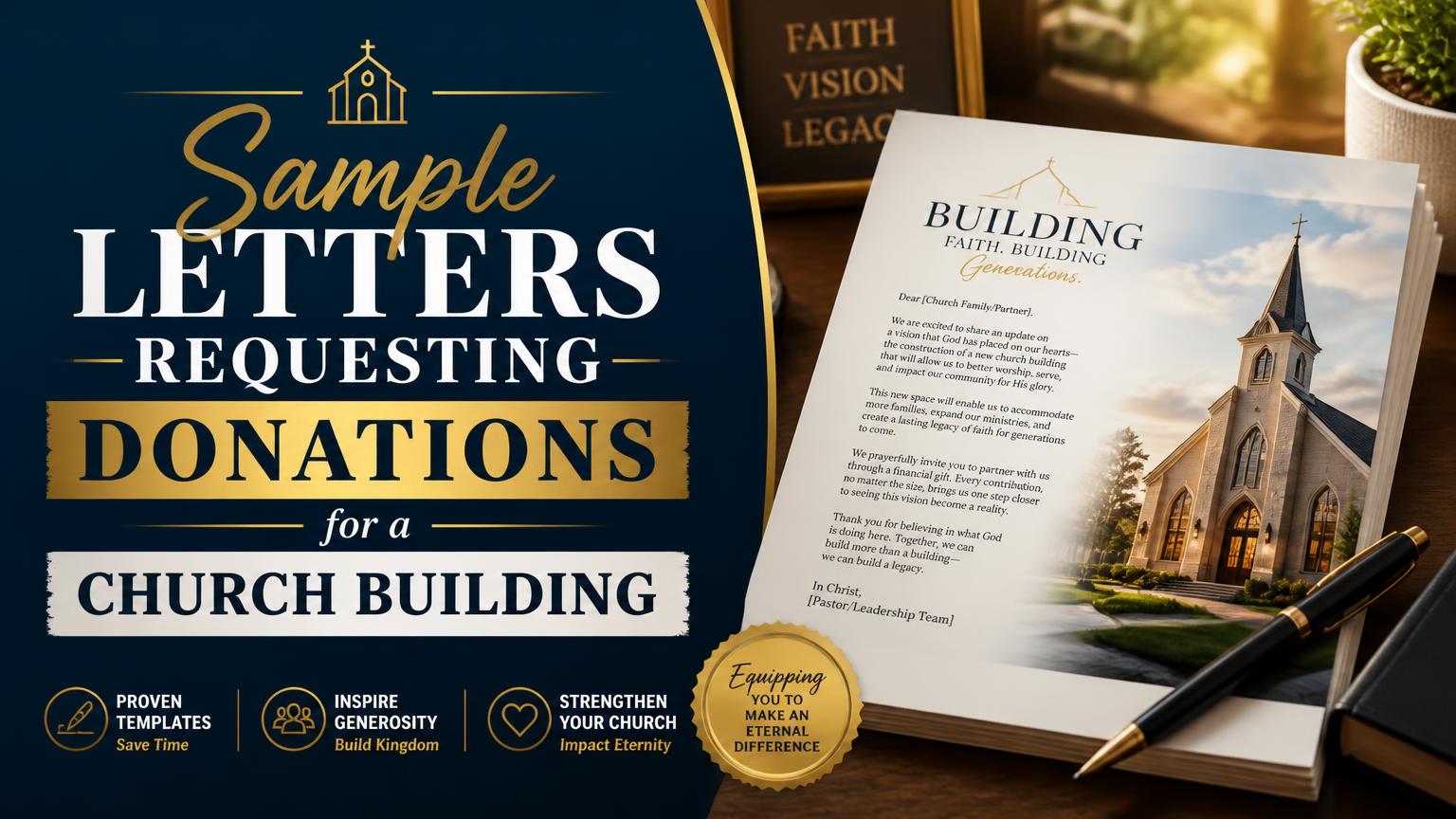
A letter requesting a donation for a church building should explain the project clearly, show how contributions will be used, and make a specific but respectful request. The strongest letters combine a compelling ministry purpose with practical details such as the fundraising goal, construction timeline, giving options, and contact information.
Letter Requesting Donation for Church Building
Use the templates below as starting points. Replace the bracketed details with accurate information about your church, project, and fundraising needs.
Formal Church Building Donation Request Letter
Subject: Help Us Build a Home for [Church Name]
Dear [Name],
[Church Name] is preparing to build a permanent facility to serve our congregation and the wider [community name] community. For [number] years, our church has gathered at [current location or temporary facility], but our growing ministry now requires a safe, accessible, and suitable building.
The proposed church building will include [briefly describe important spaces, such as a worship area, classrooms, offices, children’s facilities, or community meeting rooms]. These spaces will allow us to [explain the ministry and community benefits].
Our total project goal is [$ amount], and we are seeking financial partners who believe in the importance of creating a place for worship, teaching, fellowship, and community service. A gift of any size will help move this project forward. Contributions will be used for [land purchase, architectural work, construction, furnishings, accessibility improvements, or another specific purpose].
Would you prayerfully consider donating [$ suggested amount or “an amount meaningful to you”] toward this project? You may contribute by [online giving link, check, bank transfer, or other method]. Checks may be made payable to [church name] and sent to:
[Church Name]
[Mailing Address]
[City, State, ZIP Code]
We are committed to handling every contribution responsibly and providing updates as the project progresses. If you have questions or would like to discuss the building plans, please contact [name] at [phone number] or [email address].
Thank you for considering this request and for supporting the ministry of [Church Name]. We appreciate your prayers, generosity, and encouragement.
Sincerely,
[Name]
[Title]
[Church Name]
[Contact Information]
Personal Letter to Church Members and Friends
Subject: Will You Help Us Build Our Church Home?
Dear [Name],
Our church family is taking an important step. After [describe the relevant history or need], we are raising funds to build a permanent home for [Church Name].
This building will give us room to worship together, teach children and adults, host ministry programs, and serve people in our community. It will be more than a structure; it will provide a stable place where relationships can grow and practical ministry can take place.
We need to raise [$ amount] to complete [specific phase of the project]. We invite you to be part of this effort by making a one-time gift or a commitment of [$ amount] per month for [number] months. Every contribution matters, and no one should feel pressured to give beyond their means.
You can donate through [giving method or website]. Please write “[building fund]” in the memo line if you are sending a check.
We will share regular updates about the campaign, including progress toward our goal and the stages of construction. If you would like more information, please contact [contact person] at [phone or email].
Thank you for standing with us in this season. Whether you give, pray, volunteer, or share this request with others, your support is valuable to our church family.
With gratitude,
[Name]
[Position or Ministry Role]
[Church Name]
Donation Request to a Business or Community Partner
Subject: Partnership Opportunity With [Church Name]
Dear [Business Owner or Organization Representative],
[Church Name] is raising funds to construct a new facility at [location]. The building will provide space for worship and ministry while also supporting programs that benefit residents of [community name], including [food distribution, counseling, youth programs, meeting space, disaster response, or other services].
We are seeking support from local businesses and community organizations that value strong families, community service, and responsible use of shared resources. Our construction project has an estimated cost of [$ amount], and we are currently raising [$ amount] for [specific phase or need].
Would [business or organization name] consider making a donation or becoming a project sponsor? Support may be recognized through [lawful and appropriate acknowledgment, such as a donor list, event recognition, or project signage]. We would be glad to provide a project summary, budget information, and details about the ways the completed facility will serve the community.
Please contact [name] at [phone number] or [email address] to discuss this opportunity. Donations may be sent to [address] or made online at [website].
Thank you for considering a partnership with [Church Name]. We appreciate the contribution your organization already makes to [community name].
Respectfully,
[Name]
[Title]
[Church Name]
[Contact Information]
Short Email or Online Donation Request
Subject: Support the [Church Name] Building Project
Dear [Name],
[Church Name] is raising [$ amount] to [build, purchase, or complete] a facility that will provide space for worship, children’s ministry, community programs, and service to [community name].
We have already [mention a meaningful milestone, such as purchased land, completed the design, or raised a stated amount]. We are now seeking donations for [specific next step].
Would you consider giving [$ amount or “a gift of any size”]? Donations can be made at [link] or sent to [mailing address]. We will provide updates as the project progresses and explain how funds are being used.
Thank you for considering this request and for supporting the ministry of [Church Name].
Sincerely,
[Name]
[Church Name]
[Contact Information]
What to Include in an Effective Church Building Donation Letter
A donation letter should answer the reader’s practical questions before asking for money. Include the following information where it applies:
- The specific need: Explain why the church needs a new building, renovation, expansion, or permanent location.
- The ministry purpose: Describe what the facility will make possible. Mention worship, education, youth programs, counseling, food assistance, outreach, or community use.
- The fundraising goal: State the total project cost and, if relevant, the amount still needed.
- The current stage: Tell readers whether the church is purchasing land, completing design work, beginning construction, or paying for a particular phase.
- The intended use of donations: Identify whether gifts will fund construction, permits, furnishings, accessibility features, equipment, or debt reduction.
- A clear request: Ask directly for a donation, a monthly commitment, prayer, or another specific form of support.
- Giving instructions: Provide a website, mailing address, payment instructions, or contact person.
- Accountability information: Explain how the church will provide updates, report progress, or communicate changes to the project.
- A deadline, when genuine: A real campaign deadline or construction milestone can help readers understand the timing without creating false urgency.
Specific information builds confidence. “We need help with our building” is less effective than “We are raising $75,000 to complete the electrical and accessibility work before construction begins in September.”
How to Make the Request Persuasive and Trustworthy
The letter should connect the building to the church’s mission rather than presenting construction as an end in itself. Readers are more likely to respond when they understand who will be served and what activities the facility will support.
Use a realistic story or example. For instance, explain that the current meeting space cannot accommodate children’s classes, wheelchair access, evening programs, or community gatherings. A concrete situation helps donors understand the consequences of the current limitation.
Suggested giving amounts can make the request easier to evaluate. A letter might say, “Gifts of $50, $250, $1,000, or any amount you choose will help fund this phase.” Do not imply that every donor should give the same amount or use language that shames people who cannot contribute.
Transparency is equally important. If the project budget is still being finalized, say so. If construction costs, permits, or financing could change the total, explain that donations will be directed according to the church’s stated building plan. Avoid promising that a gift will produce a particular result unless the church can reasonably guarantee it.
The letter should also distinguish between a donation, a pledge, and a sponsorship:
- A donation is a gift given now.
- A pledge is a promise to give later or over a specified period.
- A sponsorship may involve public recognition or another agreed benefit and can have different legal and accounting implications.
If the church claims that donations are tax-deductible, confirm that the organization qualifies under the applicable law and use accurate language. In the United States, tax treatment depends on the church’s status, the nature of the payment, and whether the donor receives goods or services. A church should consult a qualified tax or legal professional rather than making blanket claims in a fundraising letter.
Common Mistakes to Avoid
Avoid vague requests that do not explain the project, the amount needed, or how to give. Readers should not have to search for basic information.
Do not exaggerate the building’s benefits, guarantee spiritual or financial outcomes, or suggest that donating is a test of someone’s faith. A respectful request allows people to make an informed decision without pressure.
Be careful with emotional language. A compelling explanation of the church’s mission is appropriate, but guilt, fear, and exaggerated urgency can damage trust. The same is true of unsupported claims such as “this is the last opportunity” or “everyone in the community supports this project.”
Do not hide important conditions. If the project depends on permits, financing, additional fundraising, or a future land purchase, state that plainly. Donors deserve an accurate picture of the project’s status.
Finally, proofread names, amounts, dates, payment instructions, and web links. A small error can prevent donations and make the campaign appear poorly managed.
How to Follow Up After Sending the Letter
Send a brief acknowledgment after receiving a donation. Thank the donor without immediately making another request. For larger gifts or pledged contributions, provide a written record and clarify the expected payment schedule.
Share meaningful progress updates at reasonable intervals. These might include the completion of architectural plans, a construction milestone, a revised fundraising total, or photographs of the work. If circumstances change, explain what changed, why it changed, and how the church will respond.
A follow-up message can also invite continued involvement:
Thank you for supporting the [Church Name] building project. Because of gifts from people like you, we have completed [milestone]. Our next goal is [specific goal], and we will provide another update by [date].
Good follow-up turns a one-time request into an accountable relationship. It shows donors that their contributions were noticed and connected to real progress.
A strong church building donation letter is clear, specific, respectful, and transparent. Explain the ministry need, identify the exact project or phase being funded, request a realistic contribution, and make the giving process simple. The goal is not merely to raise money for a structure but to help readers understand the people and ministries the building is intended to serve.