
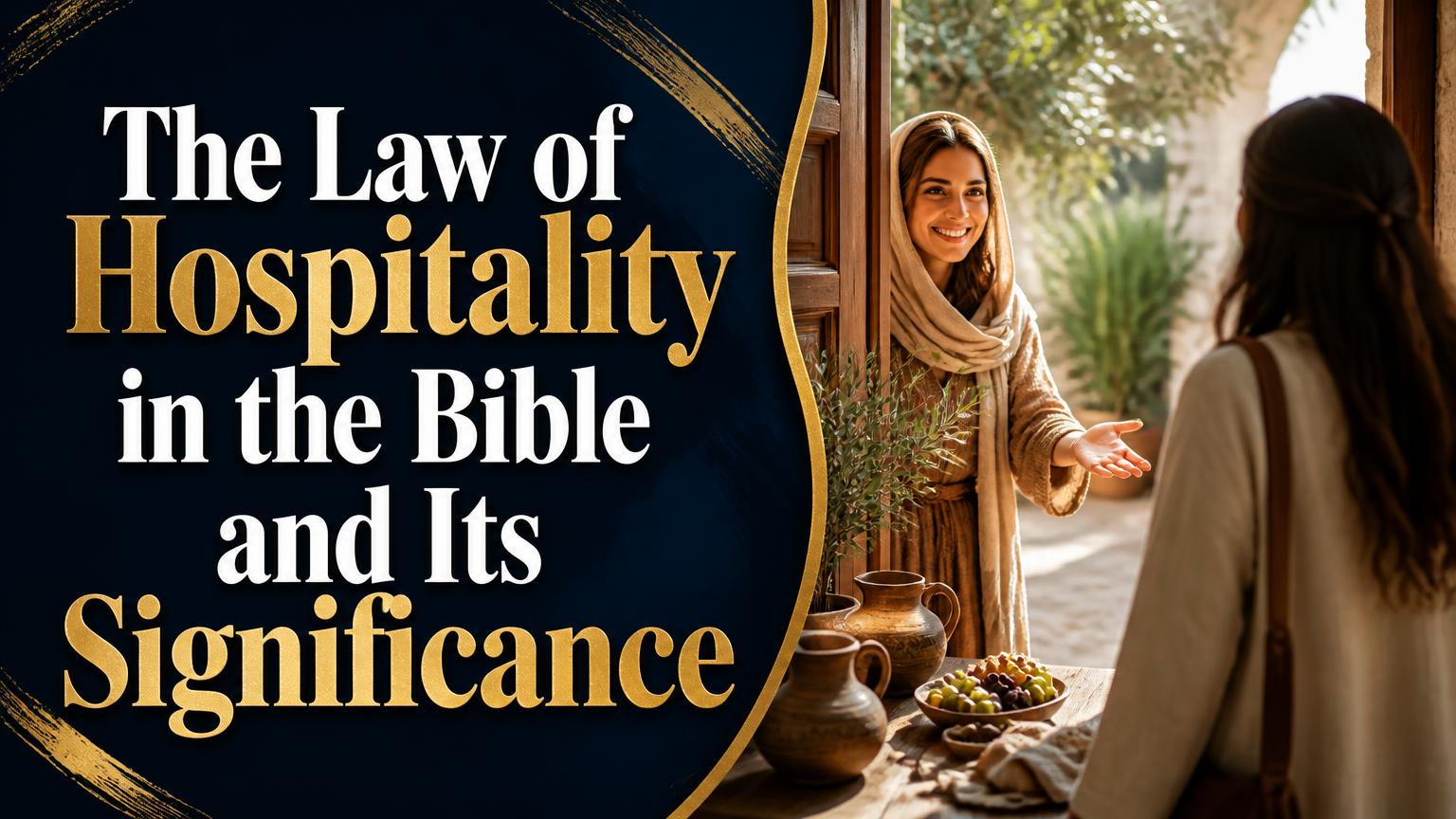
Hospitality in the Bible is more than entertaining friends or offering polite welcome. It is a practical expression of love, justice, mercy, and faithfulness to God. Biblical hospitality gives attention to strangers, travelers, foreigners, the poor, and other people who may lack protection or resources. It also includes food, shelter, safety, welcome, and fellowship. The Bible presents hospitality as both an obligation toward others and a way believers reflect God’s character.
The Law of Hospitality in the Bible: Meaning and Main Requirements
The Bible does not present one statute formally titled “the law of hospitality.” Instead, hospitality appears through a network of commands and examples. Israel was instructed to protect the foreigner, remember its own history as a vulnerable people, care for the needy, and treat others with love. The New Testament carries these principles into Christian community life and makes hospitality a visible expression of devotion to Christ.
Hospitality Is a Commanded Form of Love
Biblical hospitality begins with the command to love people beyond one’s immediate family or social circle. Leviticus 19 connects love for the resident foreigner with love for one’s neighbor, while Deuteronomy repeatedly reminds Israel that its ancestors had lived as foreigners in Egypt. This memory was meant to produce empathy: people who had experienced dependence on the mercy of others were not to exploit or ignore outsiders.
Hospitality therefore involves deliberate action. It may mean providing a meal, offering temporary lodging, helping someone find safety, welcoming a new member into a congregation, or making room for someone who is socially isolated. The principle is not that every person must host strangers in a private home under every circumstance. The principle is that God’s people must not treat vulnerable outsiders as invisible or disposable.
The New Testament gives this command a direct place in Christian discipleship:
“Don’t forget to show hospitality to strangers, for by doing this some have welcomed angels without knowing it.” — Hebrews 13:2 (WEBU)
The reference to angels recalls biblical accounts in which visitors brought divine messages or blessing. Its practical force is that a person cannot always know the importance of someone who needs welcome. Hospitality trains believers to treat apparently insignificant encounters with seriousness and generosity.
The Stranger Is Central to the Biblical Principle
Modern English often uses “hospitality” for social entertaining, but biblical hospitality gives special attention to people outside the household’s normal circle. The relevant biblical categories include the stranger, foreign resident, traveler, widow, orphan, poor person, prisoner, and Christian worker who needs support.
In ancient societies, travelers could face danger, hunger, exposure, and exploitation. Inns existed in some places, but they were not equivalent to the secure lodging systems available in many modern communities. A household that received a traveler could provide protection and basic necessities that the person might not otherwise obtain.
This background explains why Israel’s laws repeatedly addressed the foreign resident. The command was not merely to be pleasant to outsiders; it was to prevent oppression and extend a measure of social protection. The foreigner was not automatically granted every role or privilege within Israel, but neither was he or she to be abused, cheated, or excluded from all concern.
The same principle challenges congregations that welcome people who already possess social connections while overlooking immigrants, the poor, the elderly, people with disabilities, or those who are unfamiliar with church customs. Biblical hospitality crosses barriers of ethnicity, class, nationality, and familiarity.
Hospitality Includes Practical Provision
Hospitality in Scripture is concrete rather than sentimental. Food, water, shelter, protection, and companionship are recurring elements. Abraham’s welcome to the visitors in Genesis 18 involved rest, washing, and a substantial meal. Lot’s actions in Genesis 19 likewise show the ancient expectation that a host should take responsibility for guests’ safety, although the surrounding events also reveal how badly a society can distort and violate hospitality.
Jesus presents feeding the hungry, welcoming the stranger, clothing the needy, and visiting the sick and imprisoned as acts done in relation to him:
“for I was hungry, and you gave me food to eat. I was thirsty, and you gave me drink. I was a stranger, and you welcomed me.” — Matthew 25:35 (WEBU)
In this teaching, hospitality is not merely a personality trait. It becomes evidence of whether people have recognized the value Christ places on those who are vulnerable. The passage does not reduce salvation to charitable performance; rather, it exposes whether a person’s professed allegiance to Christ has produced mercy in practice.
Welcome Requires Discernment and Holiness
Biblical hospitality is generous, but it is not careless. Scripture commands believers to welcome people while also rejecting exploitation, violence, false teaching, and destructive behavior. A household or church can offer food, conversation, referrals, financial assistance, or temporary accommodation without surrendering every boundary.
This distinction matters because hospitality is sometimes misunderstood as unlimited access. Christian love does not require enabling abuse, exposing children or vulnerable adults to danger, or ignoring laws and wise safeguarding practices. A church may help a person find shelter through a reputable ministry rather than inviting an unknown individual into a private home. Discernment determines the form hospitality should take; love determines whether the person’s need will be ignored.
Peter places hospitality within a broader call to faithful Christian service:
“Be hospitable to one another without grumbling.” — 1 Peter 4:9 (WEBU)
The command addresses fellow believers, but it also identifies an inner challenge. A person may perform an outward welcome while inwardly resenting the cost, inconvenience, or interruption. Christian hospitality seeks to serve freely rather than turning generosity into a public display of superiority or a private source of complaint.
How Hospitality Develops Across the Bible
Hospitality appears in different settings throughout Scripture, but the underlying concern remains consistent: people who possess resources or security are called to use them for the good of others. The Bible moves from household customs and Israelite law toward a church community in which welcome becomes part of ordinary Christian ministry.
The Patriarchs Model Active Welcome
The stories of Abraham, Sarah, Lot, Rebekah, and other patriarchal figures show hospitality operating through ordinary household actions. Visitors are offered water, food, rest, and personal attention. These accounts should not be treated as a complete set of universal hosting procedures, because they belong to a specific ancient culture. They do show, however, that biblical hospitality requires initiative.
The host does not always wait for a formal invitation or a carefully planned social event. A need becomes visible, and the household responds. Abraham’s welcome in Genesis 18 is especially significant because the visitors initially appear to be travelers. The narrative then connects the encounter with God’s purposes, reinforcing Hebrews’ warning that the spiritual significance of a guest may not be obvious at first.
Israel’s Law Protects the Vulnerable
Israel’s law repeatedly forbids oppression of the foreigner and commands care for widows, orphans, and the poor. Gleaning laws allowed vulnerable people to gather food from fields, vineyards, and olive trees. Tithes and festival practices also created channels through which those without land or family security could receive provision.
These commands show that hospitality was not limited to private kindness. It also had a public and economic dimension. Landowners, households, and the wider covenant community were expected to structure their practices so that vulnerable people could live rather than merely depend on occasional generosity.
The reason given is theological as well as social: Israel belonged to God and remembered its own experience of oppression and dependence in Egypt. Hospitality was therefore a form of obedience shaped by gratitude. Those who had received mercy were expected to extend mercy.
Jesus Makes Welcome a Sign of Discipleship
Jesus welcomed people whom religious and social conventions often marginalized, including tax collectors, sinners, the sick, children, and outsiders. He ate with people across social boundaries, while still calling them to repentance and faithfulness. His meals were not endorsements of every behavior; they were settings in which grace, truth, and restored community could meet.
Jesus also taught that generosity should not be restricted to people who can repay it. In Luke 14, he challenges the practice of inviting only friends, relatives, or wealthy neighbors who can return the favor. His teaching exposes the difference between social exchange and kingdom hospitality. Hospitality shaped by the kingdom gives attention to people whose presence offers no obvious advantage.
The Early Church Shares Life and Resources
The early Christian communities treated hospitality as essential because traveling teachers, missionaries, persecuted believers, and new converts often needed support. Households became places for worship, instruction, meals, and mutual care. Church leaders were expected to have a reputation for hospitality, and believers were instructed to welcome one another.
This practice helped the gospel spread through relationships rather than through public gatherings alone. It also tested the church’s unity. Sharing a table required believers from different ethnic, economic, and religious backgrounds to recognize one another as members of one body. Hospitality thus became both a ministry of care and a practical demonstration that the gospel creates a new community.
What the Biblical Law of Hospitality Does Not Mean
The biblical law of hospitality does not mean that every Christian must host every person in a private residence. Scripture emphasizes generosity, but it also recognizes different responsibilities, capacities, and risks. A person with limited resources may practice hospitality through a meal, transportation, a phone call, advocacy, financial help, or service through a church and community organization.
Nor does hospitality mean treating every request as genuine without examination. Biblical wisdom includes testing claims, protecting dependents, confronting wrongdoing, and refusing participation in evil. The command to welcome strangers should not be used to pressure people into unsafe situations or to silence victims who need protection.
Hospitality also differs from people-pleasing. A host can welcome someone while maintaining moral clarity. Jesus ate with sinners but did not affirm sin; the early church shared possessions but still exercised discipline; Christian love receives people without pretending that harmful behavior is harmless. The goal is not indiscriminate access but faithful care shaped by truth and wisdom.
Finally, hospitality is not a way to purchase God’s acceptance. Scripture presents salvation as God’s grace, not a reward earned by charitable acts. Yet grace produces visible consequences. Those who have received God’s welcome are called to become welcoming people, especially toward those who cannot repay them.
Practicing Biblical Hospitality Today
Modern Christians can apply the biblical principle without copying every feature of ancient household life. The central question is how available resources, relationships, and influence can be used to protect dignity and meet real needs.
Hospitality in the Home
Home-based hospitality may include inviting a newcomer for a meal, providing temporary accommodation to a trusted person in crisis, welcoming international students, or making ordinary family life available to someone who would otherwise be alone. The emphasis is not on expensive food or impressive surroundings. A simple meal offered with attention may express more biblical hospitality than an elaborate event designed to impress guests.
Hosts should also consider practical safeguards. Families can agree on boundaries, clarify the length and purpose of a stay, protect children, and seek help when a situation exceeds their ability. These measures do not weaken hospitality; they make sustained and responsible care more possible.
Hospitality in the Church
A congregation practices hospitality through more than greeting visitors at the door. It can explain unfamiliar customs, make worship accessible, include people who are often overlooked, provide meals, support refugees, assist people leaving homelessness, and connect those in crisis with appropriate professional help.
Church hospitality should also examine patterns of exclusion. Are meals and small groups open only to established friendships? Are newcomers expected to understand unspoken rules? Do people with disabilities, language barriers, or limited income receive genuine participation rather than token attention? These questions turn hospitality from a slogan into an assessment of communal life.
Hospitality Through Advocacy and Service
A person may practice biblical hospitality without entertaining anyone. Supporting a shelter, preparing food, visiting someone who is isolated, helping a displaced family navigate local systems, offering transportation, or defending the dignity of an exploited worker can all express the same biblical concern.
This wider application is especially important when private hosting would be unwise or impossible. Hospitality asks how a person can use time, money, skills, influence, and relationships to help another person experience safety and belonging. The form varies, but the moral direction remains constant: move toward need with mercy rather than turning away.
Conclusion
The law of hospitality in the Bible is best understood as a broad biblical obligation to welcome, protect, and care for people—particularly strangers and vulnerable neighbors—through practical love. It grows from God’s concern for the foreigner and needy, Israel’s memory of suffering, Jesus’ treatment of outsiders, and the early church’s shared life. Biblical hospitality is generous without being reckless, welcoming without abandoning discernment, and practical without becoming a means of earning salvation.
For Christians today, hospitality may involve a home, a meal, a church community, financial help, advocacy, or simple presence. Its essential question is whether people use what God has entrusted to them to preserve another person’s dignity and meet a real need.