
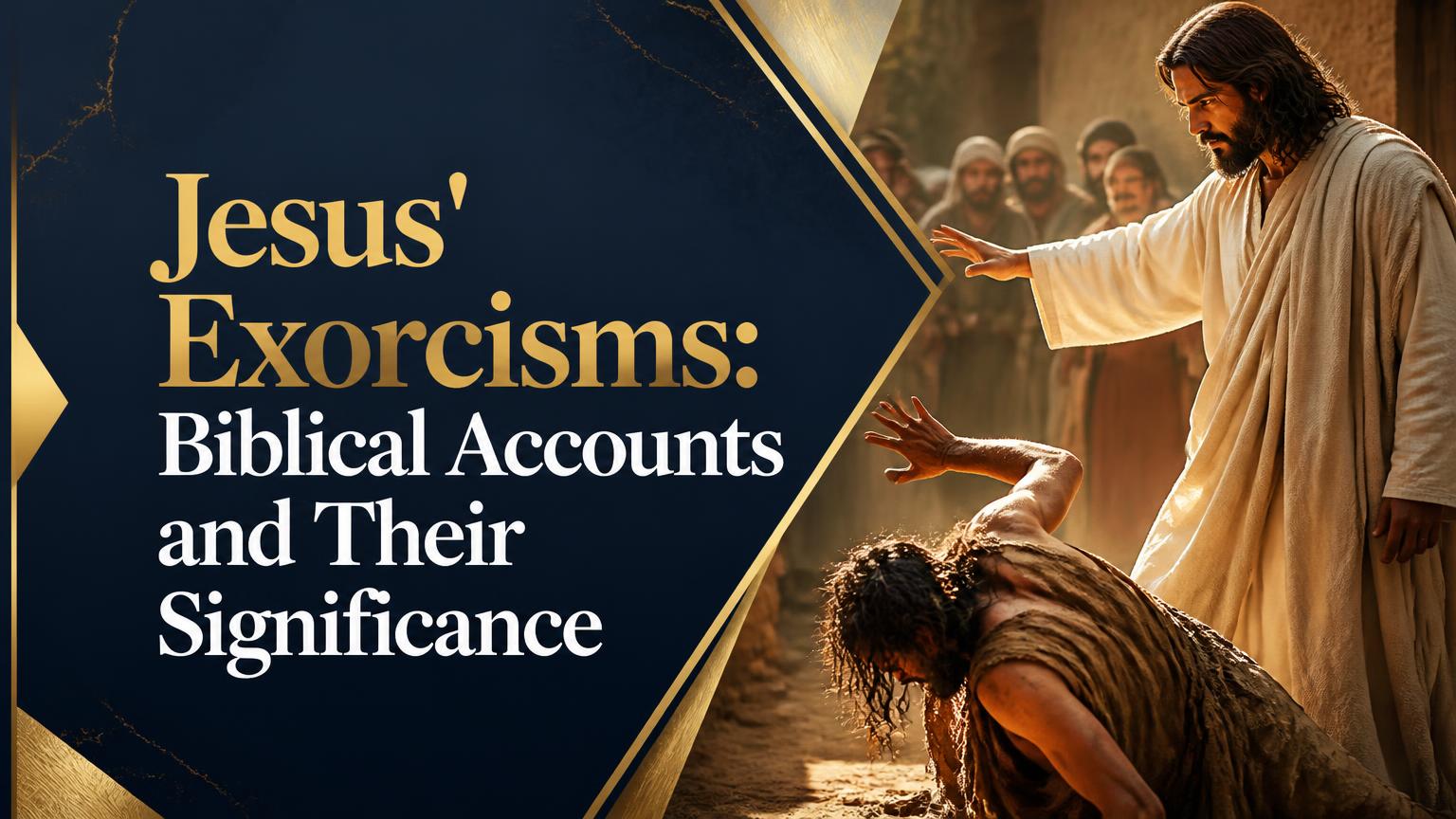
Jesus’ exorcisms are among the clearest demonstrations of authority in the Gospel accounts. The Evangelists describe Jesus confronting demons or “unclean spirits,” freeing afflicted people, and restoring them to ordinary community life. These episodes are not presented as isolated displays of supernatural power. They reveal the arrival of God’s kingdom, expose the limits of opposing spiritual powers, and show Jesus’ compassion toward people whose lives have been devastated by spiritual oppression. Understanding them requires attention to both the individual stories and the theological claims they make.
Jesus’ Exorcisms in the Gospels
The Gospel accounts differ in setting and detail, but they present a consistent pattern: Jesus encounters a person in distress, commands the unclean spirit to leave, and demonstrates authority without relying on a magical formula, elaborate ritual, or physical combat. The response often includes astonishment, restoration, and controversy.
The Capernaum Synagogue: Authority Without Ritual
In Mark 1:21–28 and Luke 4:31–37, Jesus encounters a man with an unclean spirit in the synagogue at Capernaum. The spirit recognizes Jesus as “the Holy One of God” and reacts to his presence. Jesus rebukes it, commands it to be silent, and orders it to come out. The spirit convulses the man and leaves him with a loud cry.
The crowd is astonished because Jesus teaches and commands with unusual authority. Unlike exorcists who might invoke a higher power, Jesus speaks directly to the spirit. The account therefore emphasizes more than the man’s deliverance: it presents Jesus’ authority as immediate and intrinsic. His teaching and his command over evil belong together.
The Gerasene Demoniac and the Name Legion
Mark 5:1–20 and Luke 8:26–39 describe a man living among the tombs in the region of the Gerasenes. Matthew 8:28–34 presents a related account involving two demon-possessed men. The differences in number and geographical naming reflect the distinct ways the Evangelists report the event; they do not erase the central features of the story.
The spirit identifies itself as “Legion,” a term suggesting overwhelming number and power. The man is isolated, violent, physically tormented, and unable to live normally. Jesus permits the demons to enter a herd of pigs, which then rushes down the slope into the lake. The precise meaning of every detail is debated, but the narrative clearly portrays the demons as destructive and Jesus as sovereign over them.
Afterward, the man is sitting, clothed, and “in his right mind.” Jesus does not allow him simply to follow the traveling disciples. Instead, he sends him home to tell others what God has done. Restoration therefore includes more than the removal of spiritual oppression; it includes recovered dignity, social reintegration, and a renewed vocation as a witness.
The Syrophoenician Woman’s Daughter
In Mark 7:24–30, and in the parallel account of Matthew 15:21–28, a Gentile woman asks Jesus to cast a demon out of her daughter. The child never appears in the scene. Jesus responds to the mother’s persistent request, and when she returns home, she finds the girl lying on the bed with the demon gone.
This account is distinctive because the exorcism occurs at a distance. It also places the deliverance within a conversation about Israel’s priority in Jesus’ mission and the eventual inclusion of Gentiles. Matthew identifies the woman as a Canaanite, while Mark calls her a Syrophoenician. Her persistence and trust become central to the narrative, showing that Jesus’ authority is not limited by physical proximity or ethnic boundaries.
The Boy With an Oppressing Spirit
Matthew 17:14–20, Mark 9:14–29, and Luke 9:37–43 recount the deliverance of a boy whose spirit causes violent convulsions and repeatedly throws him into fire or water. Mark describes the spirit as making the boy unable to speak. The disciples have tried and failed to remove it, so the father appeals to Jesus.
Jesus rebukes the spirit, and it leaves after convulsing the boy. The passage highlights the disciples’ dependence on God rather than on a technique they can control. Mark’s reference to prayer—along with a textual variation that includes fasting—points toward reliance on God’s power. The symptoms resemble conditions that modern readers might associate with epilepsy or another neurological disorder, but the Gospel writers explicitly interpret this particular case in spiritual terms. The text should not be used to label every modern illness as demonic.
Other Deliverances and Summary Reports
The Gospels also mention shorter exorcism accounts. Matthew 9:32–34 describes a mute man brought to Jesus after being demon-possessed. Matthew 12:22–32 describes a demon-oppressed man who is blind and unable to speak; after Jesus heals him, the crowd wonders whether Jesus is the Son of David. Luke 11:14 presents a similar account of a mute demon being cast out.
In addition, the Synoptic Gospels frequently summarize Jesus’ activity by saying that he healed the sick and cast out many demons. Mark 1:32–34 and Luke 4:40–41 place exorcisms among Jesus’ evening healings. Luke 10:17 records the return of the seventy-two disciples, who report that demons submit to them in Jesus’ name. These summaries show that exorcism was a recurring part of Jesus’ ministry, not an isolated event.
What Makes Jesus’ Exorcisms Distinctive?
Biblical exorcism accounts should be read within their ancient setting while also avoiding careless assumptions about modern medical or psychological conditions. The Gospel writers use terms such as “demon,” “unclean spirit,” and “spirit” to describe personal spiritual powers opposed to God. Those categories overlap with physical symptoms in some narratives, but they are not simply interchangeable with modern diagnoses.
Exorcism Is Related to Healing but Not Identical to It
The Gospels distinguish between casting out demons and healing diseases, even though the two activities often appear together. Jesus heals fever, paralysis, blindness, leprosy, and other conditions, while he also commands unclean spirits. Some episodes involve both physical symptoms and spiritual oppression, which means the distinction is not always mechanically simple.
This matters because the biblical text does not authorize readers to diagnose every illness, disability, mental-health crisis, or unusual behavior as demonic. A responsible interpretation respects the categories used by the Gospel writers without turning them into a universal explanation for medical conditions. Spiritual care and appropriate medical or psychological care need not be treated as enemies.
Jesus Uses Authority Rather Than a Standard Formula
Jesus does not follow one fixed ritual. He rebukes, commands silence, orders spirits to leave, and sometimes asks questions, as in the Gerasene account. He does not depend on amulets, incantations, elaborate gestures, or the authority of another human exorcist.
This lack of a repeatable formula is theologically significant. The stories are not manuals for producing dramatic encounters. They identify Jesus himself as the decisive authority. In the later ministry of his disciples, deliverance takes place in Jesus’ name, but the power remains derivative rather than autonomous.
Why Jesus’ Exorcisms Matter
The exorcism stories contribute directly to the Gospel portrait of Jesus. They are not merely accounts of unusual healings; they function as signs that demand an interpretation of his identity and mission.
They Announce the Arrival of God’s Kingdom
Jesus connects his exorcisms with the kingdom of God in Matthew 12:28 and Luke 11:20: if he casts out demons by the Spirit of God, then God’s kingdom has come upon his hearers. The logic is important. Deliverance is evidence that God’s reign is invading a sphere previously marked by oppression.
The kingdom is therefore not presented only as a future hope. In Jesus’ ministry, it becomes visible through liberation, healing, forgiveness, and restored human life. Exorcism points beyond the individual miracle to a larger conflict between God’s rule and the forces that damage creation.
They Reveal Jesus’ Authority and Identity
The spirits sometimes recognize Jesus before the crowds fully understand him. They call him the Holy One of God, the Son of God, or the Son of the Most High. Yet Jesus often silences them. Recognition from hostile spiritual beings is not the same as faithful discipleship, and Jesus will not allow them to define his mission on their own terms.
The stories also support the Gospel claims about Jesus’ identity. His authority extends over disease, nature, sin, death, and demonic powers. The exorcisms do not prove every theological conclusion by themselves, but within the whole Gospel narrative they contribute to the portrait of Jesus as the one through whom God’s saving rule is being revealed.
They Emphasize Compassion and Restoration
The people in these narratives are not treated as spectacles. The Gerasene man has lost freedom, safety, relationships, and social belonging. The boy’s family lives with fear and helplessness. The daughter’s mother pleads from a distance because someone she loves is suffering. Jesus’ actions address real human misery.
The result is frequently described in relational terms: a person returns home, sits among others, rejoices, or becomes able to speak. This emphasis guards against sensationalism. The purpose of deliverance is not to produce an impressive scene but to restore a person to wholeness, community, and meaningful responsibility.
They Expose Misunderstandings About Spiritual Power
The Pharisees accuse Jesus of casting out demons by the power of Beelzebul, the ruler of demons, in Matthew 12:22–32, Mark 3:20–35, and Luke 11:14–23. Jesus answers that a divided kingdom cannot stand. He describes the situation as the binding of a “strong man,” presenting his work as an invasion and defeat of the enemy’s domain rather than cooperation with it.
The controversy shows that miracles do not automatically produce faith. The same event can lead one person to worship and another to accuse. Jesus’ warning about blasphemy against the Holy Spirit belongs to this setting: it concerns persistent, willful rejection of God’s liberating work by calling it satanic, not an accidental doubt or a frightened question.
Common Misreadings of Jesus’ Exorcisms
One common mistake is to treat the Gospel accounts as though they were modern clinical case reports. They are theological narratives that describe events using the categories of their time and community. This does not make them meaningless, but it does require interpretive care. Readers should neither dismiss the accounts as primitive misunderstandings nor transfer every ancient description directly into a modern diagnosis.
Another mistake is to focus on the spectacular elements while ignoring the narrative outcome. The central question is not how dramatic the confrontation appears. It is what Jesus’ authority accomplishes: an oppressed person is freed, a family receives hope, a community witnesses God’s kingdom, and Jesus’ identity becomes harder to evade.
The accounts also do not encourage curiosity about demons for its own sake. Jesus’ ministry is centered on God’s reign, repentance, faith, mercy, and discipleship. Spiritual warfare is present, but it is not detached from ethical responsibility or ordinary care for suffering people. Any contemporary Christian response should therefore combine prayer and spiritual discernment with humility, safety, medical attention when needed, and protection from manipulation or abuse.
Conclusion
Jesus’ exorcisms are Gospel accounts of liberation from demons and unclean spirits, but their significance extends beyond the individual encounters. They display Jesus’ direct authority, announce that God’s kingdom has arrived, expose the defeat of opposing spiritual powers, and restore suffering people to dignity and community. The stories should be distinguished from ordinary healing without treating every modern illness as demonic. Read in their biblical context, they present Jesus not as a ritual specialist but as the authoritative bringer of God’s saving rule, whose power is exercised for freedom, restoration, and faithful witness.