
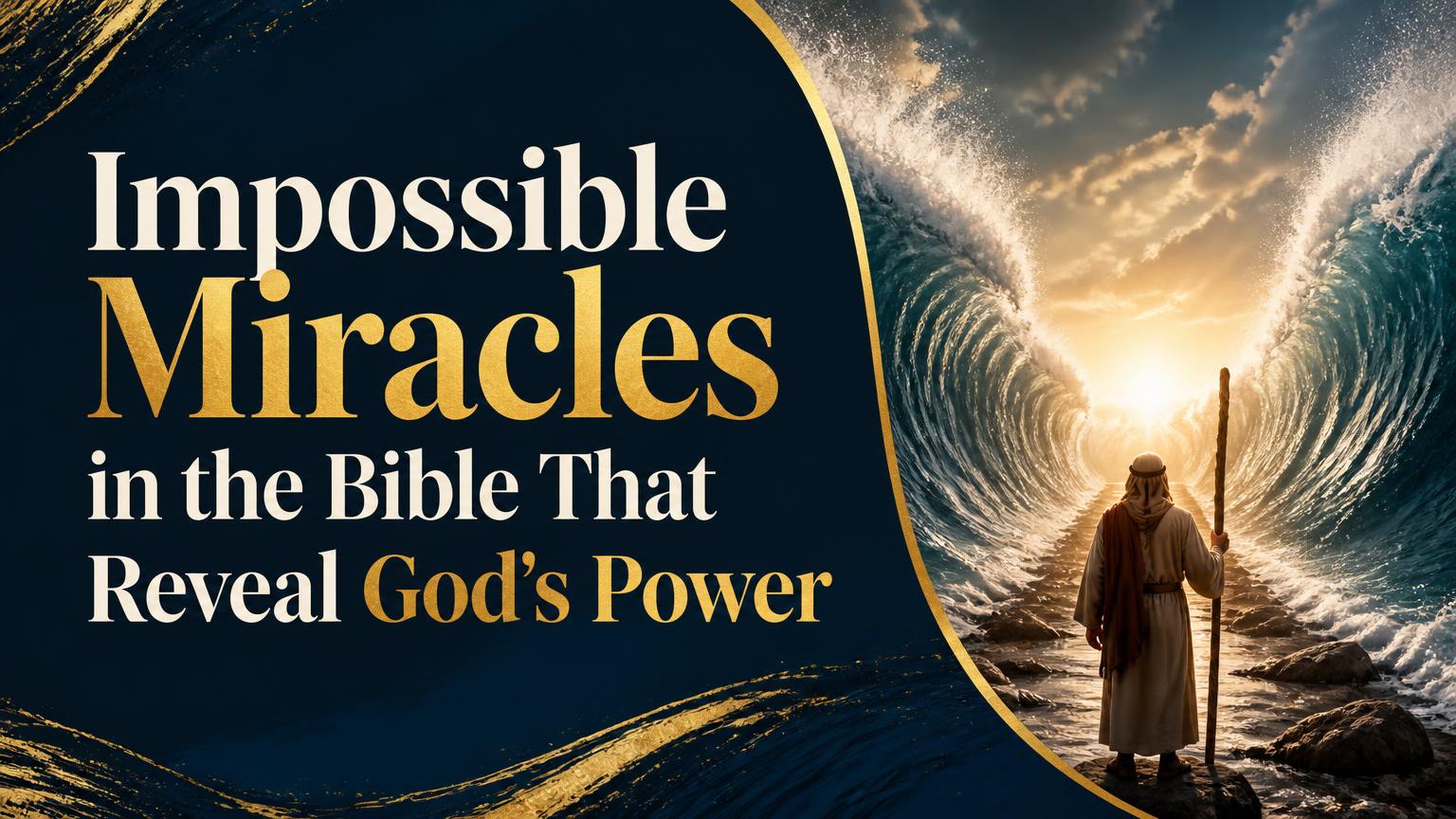
Impossible miracles in the Bible are events presented as beyond ordinary human ability and natural processes, including creation, the parting of the sea, miraculous provision, supernatural protection, healings, resurrection, and the virgin birth of Jesus. Their purpose is not simply to amaze. Biblical miracles reveal God’s authority, authenticate His messengers, express compassion, advance His redemptive purposes, and point beyond the event itself to what God is saying and doing.
What Are Impossible Miracles in the Bible?
In biblical language, a miracle is an extraordinary act of God that cannot be explained adequately as an ordinary human achievement or routine natural event. “Impossible” therefore means impossible for people and beyond the normal order of creation—not a logical contradiction. The Bible presents these events as signs of divine power and as part of a larger message about God’s character, covenant, judgment, mercy, and salvation.
The following examples are among the Bible’s most significant impossible miracles. Some concern the origin of life, some deliver God’s people, and others reveal the authority of Jesus in ways that reach the central Christian claim: death itself has been overcome.
Creation and the Origin of Life
Genesis 1–2 presents creation as God’s direct act. Light, land, living creatures, and humanity come into existence because God speaks and orders the world. This is more foundational than a miracle occurring within the natural world; it describes the world itself as dependent on God’s creative power.
The account also gives creation a theological meaning. Humanity is made in the image of God, the created order is declared good, and the universe is not portrayed as divine or self-originating. Whether readers debate the literary structure or chronology of Genesis, the central biblical claim remains that life and existence ultimately depend on God rather than arising independently of Him.
The Parting of the Red Sea
Exodus 14 describes Israel trapped between Pharaoh’s army and the sea. God commands Moses to raise his staff, a strong wind divides the waters, and the Israelites cross on dry ground. When the Egyptians pursue them, the waters return, bringing the escape to an end.
The passage emphasizes both divine intervention and an instrument—a wind through which God acts. This matters because biblical miracles do not always exclude every natural process; they present God as sovereign over timing, circumstance, and outcome. Debates about the precise body of water involved do not change the narrative’s central claim: God delivers an apparently helpless people and defeats the power pursuing them.
Elijah’s Fire and Miraculous Provision
During a period of drought, God provides food for Elijah through ravens and later sustains a widow’s household through an inexhaustible supply of flour and oil (1 Kings 17). These miracles address ordinary needs—food, survival, and protection—rather than merely displaying power.
In 1 Kings 18, fire falls from heaven on Mount Carmel and consumes Elijah’s sacrifice, wood, stones, dust, and water. The event answers the contest between the worship of the Lord and the worship of Baal. Together, these accounts show that biblical miracles can reveal God’s identity while also caring for vulnerable people. Divine power is portrayed as purposeful, not theatrical.
Protection from Fire and Lions
The accounts of Shadrach, Meshach, and Abednego in the fiery furnace and Daniel in the lions’ den present miracles of preservation. The three Hebrews are thrown into a furnace because they will not worship the king’s image, yet they emerge without the expected destruction (Daniel 3). Daniel survives a night among lions after being punished for praying to God (Daniel 6).
These stories do not teach that faithful people will never suffer. Both accounts occur in contexts of real threat, political pressure, and possible death. Their point is that God can preserve His servants and remains worthy of loyalty even when deliverance is uncertain. The miracles therefore concern both protection and faithfulness under persecution.
Jesus’ Healings and Authority Over Death
The Gospels describe Jesus healing blindness, paralysis, leprosy, chronic illness, and other conditions. He also raises Jairus’s daughter (Mark 5) and Lazarus (John 11). These events are impossible in the ordinary human sense because the sufferers cannot restore themselves, and the dead cannot return to normal bodily life through human power.
Jesus’ miracles carry several meanings at once. They show compassion toward particular people, fulfill expectations associated with God’s coming kingdom, and support His authority to forgive sins and command creation. In the healing of the paralyzed man in Mark 2, for example, the physical healing serves as visible evidence of Jesus’ less visible authority to forgive. The miracle is therefore a sign pointing to Jesus’ identity, not an isolated display of ability.
The Virgin Birth of Jesus
Matthew 1:18–25 and Luke 1:26–38 present Jesus’ conception as an act of the Holy Spirit rather than the result of ordinary human fatherhood. The virgin birth is not merely a biological curiosity in the biblical narrative. It is connected with the identity and mission of Jesus, who is called Emmanuel—“God with us”—and the Son of God.
Christian traditions differ in how they explain some details surrounding the infancy narratives, but historic Christianity has treated the virgin conception as a genuine miracle. Its significance lies in the claim that Jesus’ coming originates in God’s initiative. Salvation begins with divine action rather than human achievement.
The Resurrection of Jesus Christ
The resurrection is the Bible’s central impossible miracle. The Gospels report that Jesus was crucified, died, was buried, and rose from the dead on the third day (Matthew 28; Mark 16; Luke 24; John 20). The New Testament does not describe this simply as resuscitation, like Lazarus returning to ordinary life. It presents Jesus as raised into a transformed, death-conquering life.
This distinction explains why the resurrection is foundational to Christian faith. If Jesus merely survived crucifixion or returned temporarily to mortal life, the meaning would be radically different. The resurrection represents God’s vindication of Jesus, the defeat of death, and the basis for Christian hope in the future resurrection of believers. Paul treats it as essential rather than optional in 1 Corinthians 15.
What Makes These Miracles Impossible?
They Exceed Ordinary Human Power
A biblical miracle involves an outcome that people cannot produce through skill, technology, medicine, political strength, or ritual technique. Moses cannot rescue Israel by military force; Elijah cannot manufacture fire from heaven; the disciples cannot raise Jesus from the dead. The limitation belongs to human power, not to God.
This distinction also prevents exaggeration. The Bible does not call every unusual event a miracle. A favorable circumstance, an impressive recovery, or an unexpected provision may be understood providentially by a believer, but the biblical narratives use miracles more specifically for extraordinary acts connected with God’s revealed purposes.
They Are Signs, Not Merely Wonders
The Bible often treats miracles as signs. A sign has significance beyond itself: it directs attention to a person, promise, judgment, or message. The plagues of Egypt expose the weakness of Egypt’s gods and establish the Lord’s authority. Jesus’ signs reveal the arrival of God’s kingdom and confirm aspects of His identity.
This means that the event cannot be understood fully by asking only, “How did it happen?” Biblical interpretation also asks, “What does this reveal about God?” A miracle may demonstrate power, but its meaning includes the relationship between the event and the message surrounding it.
They Do Not Eliminate Every Question
Calling an event miraculous does not settle every historical, scientific, or interpretive question. Readers may debate the location of the sea in Exodus, the literary features of Genesis, the scale of the flood, or how a passage should be translated. Such questions should not be dismissed, but neither should they be confused with the theological claim made by the text.
A miracle is, by definition, not an ordinary repeatable event that can be placed neatly under laboratory conditions. Belief in miracles depends partly on prior conclusions about God, revelation, history, and the reliability of testimony. The Bible presents miracles as public acts within particular narratives, while acknowledging that observers can resist their meaning.
What Do Impossible Miracles Reveal About God?
God Has Authority Over Creation
Creation, the sea, weather, disease, animals, and death all appear within the biblical miracle accounts. This range communicates that God’s authority is not limited to one sphere. He is not merely a tribal deity or a spiritual helper; He is presented as Lord over the entire created order.
That authority also challenges human claims to ultimate control. Pharaoh’s army, royal decrees, hostile powers, and physical limitations cannot finally determine the outcome when God chooses to act. The miracles do not promise that every danger will be removed immediately, but they establish that danger and death do not possess absolute authority.
God Uses Power to Deliver and Restore
Many biblical miracles are connected with mercy. God feeds a widow, protects threatened servants, frees enslaved people, heals the sick, and restores the dead. Power is therefore joined to compassion. The Bible does not portray divine strength as valuable merely because it is overwhelming; it matters because it is directed toward justice, covenant faithfulness, restoration, and life.
Jesus’ miracles make this connection especially clear. His healings often involve people who are socially excluded or physically helpless. The acts reveal what the kingdom of God looks like when suffering is confronted rather than ignored.
God’s Greatest Sign Is Redemption
The miracles surrounding the Exodus anticipate a broader biblical pattern: God rescues people from bondage and brings them into a new relationship with Him. The miracles of Jesus develop that pattern by showing authority over sin, sickness, spiritual oppression, and death. The resurrection brings the pattern to its climax.
For this reason, biblical miracles should not be separated from redemption. Their ultimate significance is not that unusual events can occur, but that God is acting to restore creation and reconcile people to Himself. The resurrection especially joins divine power with forgiveness, judgment, hope, and new life.
How Should Readers Approach Difficult Miracle Accounts?
Readers should distinguish the text’s central claim from questions the text does not directly answer. A passage may clearly present God as acting while leaving the precise physical mechanism unexplained. Exodus, for example, mentions wind, but the narrative’s emphasis is not a technical account of meteorology. It is the Lord’s timely deliverance of Israel. Seeking historical or natural context can be valuable, but reducing the event to a proposed mechanism may miss its theological purpose.
Readers should also recognize that the Bible contains different literary forms, including narrative, poetry, prophecy, wisdom, and apocalyptic imagery. Not every extraordinary image functions as a straightforward report of the same kind. At the same time, the central Christian claims about Jesus’ death and resurrection are presented within Gospel narratives and treated by the apostles as historical events. Sound interpretation considers genre, context, wording, and the role of each account in the Bible’s larger message.
Conclusion
Impossible miracles in the Bible are portrayed as acts of God that exceed ordinary human power and reveal more than supernatural ability. Creation displays God’s authority over existence; the Exodus shows His power to deliver; prophetic miracles reveal His faithfulness; Jesus’ healings show compassion and kingdom authority; and the resurrection stands as the decisive Christian claim that death has been defeated. These accounts invite readers to consider both what happened and what the events signify: God acts in creation and history to reveal Himself, rescue His people, and bring life where human power has reached its limit.