
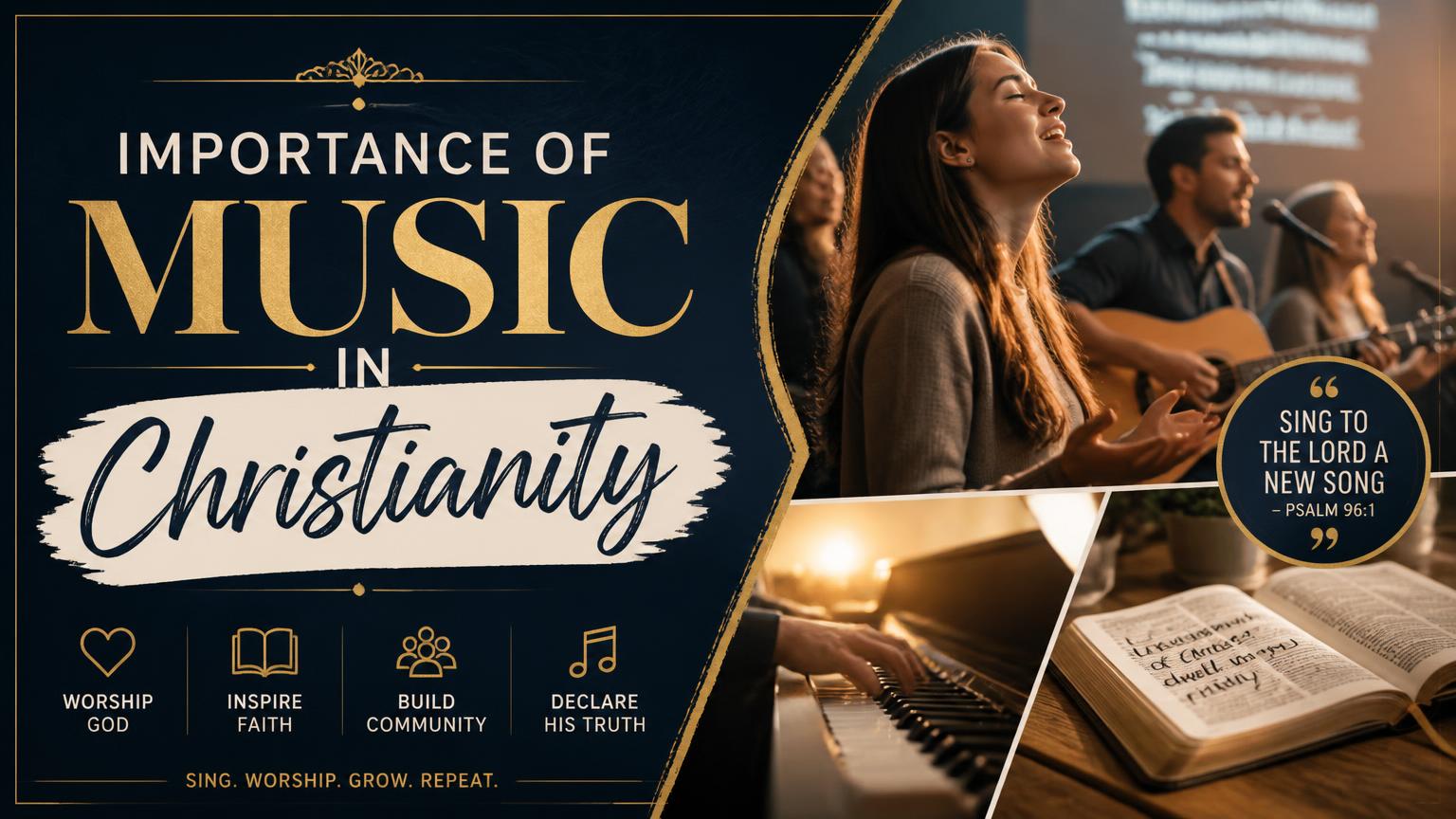
Music has a central place in Christianity because it helps believers praise God, express faith, remember biblical truth, unite as a congregation, and respond emotionally to the realities of life with God. Scripture presents singing and instrumental music in worship, personal devotion, communal celebration, lament, teaching, and mission. Yet Christian music is not valuable merely because it produces strong feelings: its deepest purpose is to direct the mind, heart, and community toward God.
Importance of Music in Christianity
Music Helps Christians Worship God
The primary importance of music in Christianity is its role in worship. Singing allows believers to respond to God’s character and actions with praise, thanksgiving, confession, trust, and reverence.
The Psalms repeatedly connect music with worship: “Sing to the LORD,” “make a joyful noise,” and “give thanks.” These commands show that biblical worship is not only silent reflection or spoken prayer. Music gives the gathered community a shared language for honoring God.
Christian singing may focus on different aspects of God:
- Praise celebrates who God is—His holiness, power, mercy, wisdom, and faithfulness.
- Thanksgiving responds to what God has done, including creation, forgiveness, provision, and salvation.
- Confession acknowledges sin and the need for mercy.
- Adoration expresses love and wonder before God.
- Dedication offers the believer’s life and obedience to Him.
Music does not make worship more acceptable to God by itself. The biblical prophets frequently criticized worship that used songs and instruments while people practiced injustice or hypocrisy. Amos 5:23–24, for example, shows that God rejects musical worship when it is separated from righteousness. Music serves worship faithfully when it expresses genuine devotion rather than substituting for it.
Music Teaches and Preserves Christian Truth
Christian music is also a vehicle for theology. Hymns, psalms, worship songs, and spiritual songs can teach believers about God, Jesus Christ, salvation, the church, Christian hope, and faithful living.
Paul instructs Christians to teach and admonish one another through “psalms and hymns and spiritual songs” (Colossians 3:16). This instruction presents singing as more than an emotional response. Songs can communicate doctrine in a memorable form and help a congregation rehearse the central claims of the faith.
The New Testament itself contains poetic and hymn-like passages. Philippians 2:5–11, for example, describes Christ’s humility, incarnation, obedience, death, exaltation, and lordship. Whether or not it was originally sung in a church gathering, its structured language shows how early Christians expressed and remembered major theological truths.
Music supports Christian memory because melody, rhythm, and repetition can make words easier to recall. A believer may remember a line from a hymn or worship song during illness, temptation, grief, or uncertainty. However, memorable music can preserve error as easily as truth. For this reason, Christian songs should be evaluated by the biblical accuracy and clarity of their words, not only by their popularity or emotional power.
Music Unites the Christian Community
Congregational music gives a church a physical and audible expression of shared faith. People of different ages, backgrounds, personalities, and levels of biblical knowledge can sing the same words together. This does not erase genuine differences, but it creates a visible practice of belonging to one body.
Ephesians 5:19 connects singing with being filled by the Spirit, while Colossians 3:16 places singing within the community’s mutual instruction. In both passages, music is directed toward one another as well as toward God. Christians sing to praise God, but they also strengthen fellow believers by declaring the faith together.
This communal function explains why music can be especially significant during baptismal services, Communion, weddings, funerals, festivals, and times of crisis. A congregation’s song can express hope when individuals struggle to find words of their own.
Unity does not require every Christian church to use the same musical style. Christian communities have developed diverse traditions involving chants, hymns, gospel music, spirituals, contemporary worship, classical compositions, and many regional forms. The central question is not whether every church sounds alike, but whether its music serves truthful worship and allows the community to participate faithfully.
Music Gives Voice to the Full Range of Christian Experience
The Bible does not limit religious music to celebration. The Psalms include joy, fear, grief, anger, repentance, confidence, confusion, and longing. This makes biblical music a realistic guide for life with God.
Songs of lament are especially important. A lament does not necessarily express unbelief. It brings pain, injustice, loss, or apparent abandonment before God while continuing to address Him. Psalms such as Psalm 13 and Psalm 42 show that faith can include honest questions and sorrow.
This matters because Christians experience suffering, disappointment, doubt, persecution, and bereavement. Music can give shape to emotions that ordinary conversation cannot easily express. A song of lament may help believers pray when they cannot formulate a complete prayer themselves.
Christian music also expresses hope. Songs about resurrection, Christ’s return, God’s faithfulness, and eternal life do not deny present suffering; they place it within the larger story of redemption. This combination of honesty and hope is one reason music remains meaningful in both celebration and mourning.
Music Supports Personal Discipleship and Spiritual Formation
Music can shape Christian character by repeatedly directing attention toward particular truths and habits. What believers sing can influence what they remember, desire, celebrate, and expect.
A song about forgiveness may encourage repentance and the willingness to forgive others. A song about God’s sovereignty may steady believers during uncertainty. A song about serving the poor or loving enemies may confront self-centered attitudes. The effect depends partly on whether the singer understands and practices the words; singing alone does not produce obedience.
Music can also help establish patterns of prayer and meditation. Many Christians use sung Scripture, hymns, or worship songs during private devotion, morning routines, travel, or times of distress. Such practices can help a person focus, but they should complement—not replace—Bible reading, prayer, ethical action, and participation in the church.
The formative power of music also creates a responsibility. Repeatedly singing vague, exaggerated, or self-focused lyrics may shape an understanding of Christianity that differs from the gospel. Music forms the imagination, so churches should consider what their songs teach about God, humanity, sin, grace, suffering, holiness, and discipleship.
Biblical Foundations for Christian Music
The Bible presents music throughout the history of God’s people. In the Old Testament, the Psalms provide an extensive collection of songs and prayers. David is associated with musical leadership, and music appears in Israel’s worship, celebrations, military events, royal ceremonies, and personal devotion.
The temple included singers and instrumentalists, and passages such as 1 Chronicles 16 and 2 Chronicles 5 describe organized musical worship. These accounts demonstrate that music was treated as a serious ministry rather than an incidental decoration.
At the same time, Christians should interpret Old Testament worship practices carefully. The temple’s priesthood, sacrifices, ceremonies, and instruments belonged to Israel’s covenant life and are not all direct commands for every Christian church. The New Testament emphasizes singing but does not prescribe one universal instrument, musical scale, performance style, or worship format.
Jesus and His disciples sang a hymn after the Last Supper (Matthew 26:30). Paul and Silas sang while imprisoned in Philippi (Acts 16:25), showing that Christian song could function as faithful witness even in suffering. The New Testament also refers to “psalms, hymns, and spiritual songs” in Ephesians 5:19 and Colossians 3:16, though the precise boundaries among these terms are not fully defined.
Revelation portrays heavenly worship involving praise to God and to the Lamb. These scenes connect Christian music with the ultimate hope of creation: the gathered people of God honoring Him in the presence of His completed redemption.
What Makes Christian Music Faithful and Useful?
Christian music is faithful when its content and use align with the character of Christian worship. Several principles help evaluate it.
Biblical Truth and Theological Clarity
A song does not need to quote Scripture word for word, but it should agree with the biblical message. It should avoid presenting God as a means to personal success, reducing faith to positive emotion, or treating human desire as the center of worship.
The strongest songs often unite several truths: God’s holiness and mercy, human sin and divine grace, Christ’s death and resurrection, present discipleship and future hope.
Congregational Participation
Music in a church service should ordinarily help the congregation worship rather than turn worshipers into an audience. Skilled musicians and singers can serve the church well, but technical excellence should support participation instead of making people feel unnecessary.
This does not mean every service must use simple music. Complex music can glorify God and enrich the church when it is presented appropriately. The issue is whether the musical arrangement serves the gathered community and the message of worship.
Emotional Honesty
Christian music may be joyful, reflective, solemn, energetic, quiet, sorrowful, or triumphant. No single emotional style is automatically more spiritual. A faithful song connects emotion with truth rather than manipulating people into a response disconnected from the words.
Strong feelings can accompany genuine worship, but emotion is not a reliable measure of spiritual depth. A quiet hymn may express profound faith, while an energetic song may be sung without meaningful attention. Conversely, emotional engagement is not inherently superficial. Christian worship involves the whole person, including the affections.
Cultural Awareness and Hospitality
Musical preferences are shaped by culture, age, language, and experience. A church should avoid treating one cultural tradition as the only legitimate Christian form. At the same time, contextual adaptation should not abandon theological substance.
Using multiple musical traditions can help a congregation recognize the worldwide character of Christianity. It can also require patience, humility, and careful leadership because unfamiliar styles may initially feel uncomfortable. The goal is not to satisfy every preference but to worship truthfully and welcome the community into faithful participation.
Common Misunderstandings About Music in Christianity
One misunderstanding is that music is inherently sacred or inherently secular. Music is a created form of expression; its use and content matter. A musical style does not automatically make a song Christian or un-Christian. Lyrics, purpose, context, and the way the music shapes worship all require consideration.
Another misunderstanding is that musical excellence guarantees spiritual excellence. Good musicianship can help communicate a song, but it cannot replace sincerity, truth, love, or obedience. First Corinthians 13 warns that impressive religious activity without love has no lasting spiritual value.
A third misunderstanding is that a worship service must produce a strong emotional experience to be effective. Feelings may accompany worship, but Christian faith rests on God’s truth and promises rather than on the intensity of a particular moment. Some believers experience deep worship through singing; others engage more readily through spoken prayer, silence, Scripture, or reflection. A healthy church makes room for the full biblical range of expression.
Conclusion
The importance of music in Christianity rests on what it does: it helps believers worship God, remember and teach Christian truth, unite as a church, express lament and hope, and form patterns of faithful living. Music is not a substitute for obedience or sound doctrine, and no single style is required by the New Testament. When its words are truthful, its purpose is God-centered, and its practice serves the congregation, music becomes a powerful means through which Christians praise God and encourage one another.