
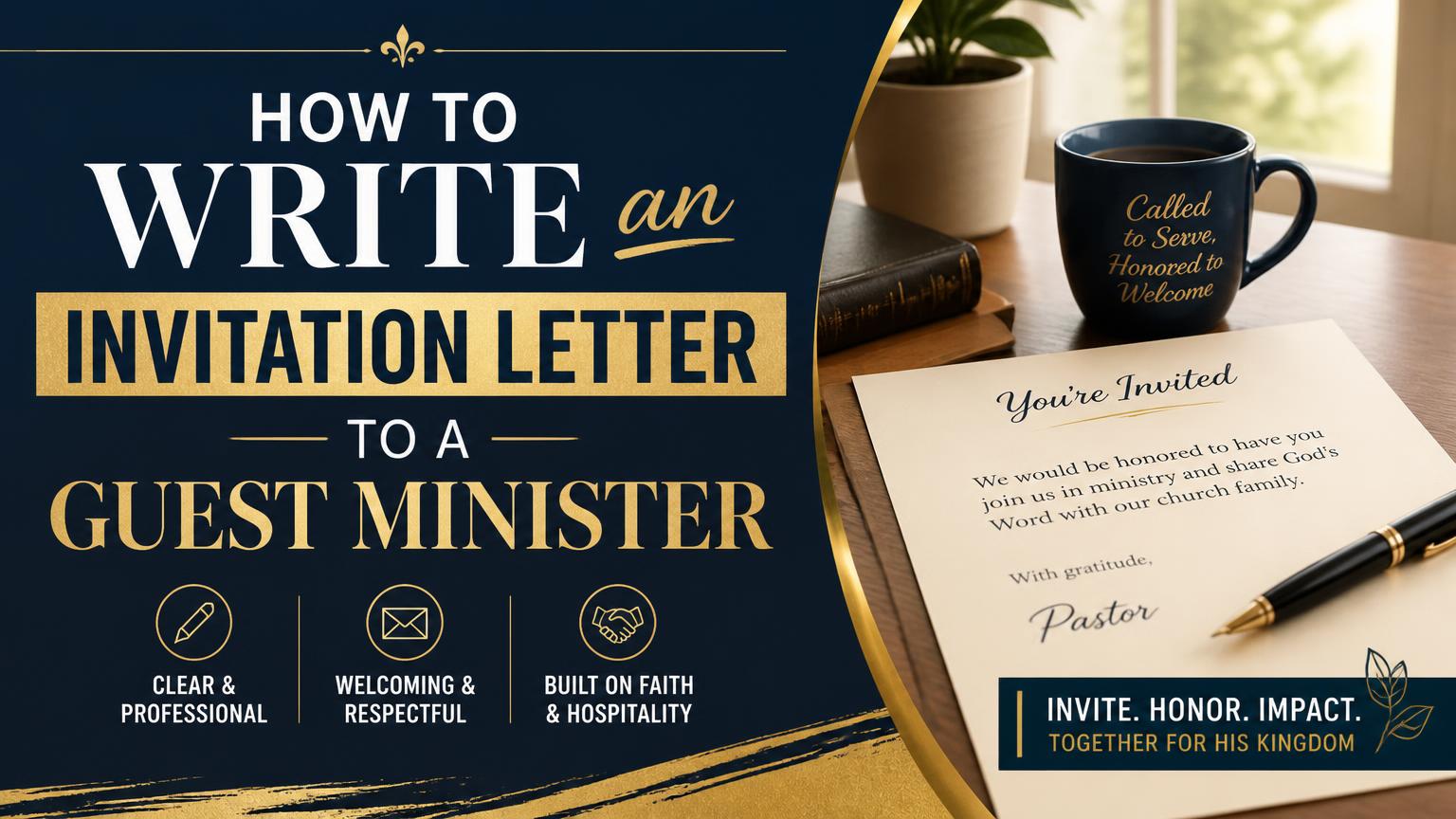
An effective invitation letter to a guest minister should be warm, specific, and practical. It should clearly explain why the minister is being invited, what the event involves, when and where it will occur, what responsibilities are expected, and what support or compensation the church will provide. The goal is to help the minister make an informed decision without having to request basic information afterward.
How to Write an Invitation Letter to a Guest Minister
State the Invitation Clearly and Personally
Begin by directly inviting the minister to participate. Identify the church, ministry, or organization sending the letter and briefly explain why you would value the minister’s involvement.
A personal reason is more meaningful than a generic request. For example, you might mention the minister’s experience with the subject of the event, connection to the congregation, or history of faithful service. Keep the explanation sincere rather than excessively flattering.
Include:
- The minister’s name and appropriate title
- The name of the inviting church or organization
- The name and purpose of the event
- The specific role being requested, such as guest preacher, Bible teacher, worship leader, conference speaker, or revival minister
- The proposed date or dates
The central request should appear early. Do not make the minister read several paragraphs before discovering what you are asking.
Include the Details the Minister Needs
A guest minister needs enough information to evaluate the invitation and prepare appropriately. At a minimum, provide:
- Event name and theme: Explain whether it is a Sunday service, revival, conference, anniversary, retreat, ordination, youth event, or another gathering.
- Date and time: Include arrival time, service time, and expected end time. If multiple services are involved, list each one.
- Location: Give the complete venue address and distinguish it from the church’s mailing address if necessary.
- Audience: Describe the expected congregation, such as adults, families, young adults, pastors, ministry leaders, or students.
- Requested assignment: State whether the minister is expected to preach, teach, lead worship, conduct a workshop, pray, moderate a session, or perform several duties.
- Expected length: Specify the approximate preaching or teaching time.
- Dress or program expectations: Mention these only when they are genuinely relevant.
- Response deadline: Give a reasonable date by which the minister should accept or decline.
If the event has a theme or Scripture focus, include it, but do not imply that the guest must develop a message before accepting the invitation.
Explain the Ministry Assignment and Expectations
A vague invitation can create misunderstandings. “Please come and minister at our event” does not tell the guest what participation involves. Clearly distinguish between what is required and what is optional.
For example, explain whether the minister will:
- Preach one message or several
- Participate in a question-and-answer session
- Attend a meal or meeting
- Lead a prayer service
- Teach a workshop
- Meet with church leaders
- Participate in worship or altar ministry
- Provide materials or presentation slides
- Permit audio, video, or livestream recording
If the minister is expected to address a particular topic, describe the desired emphasis while allowing appropriate freedom in preparation. A useful wording might be:
We would appreciate a message related to the conference theme, “Faithful Service in Every Season,” while leaving the specific text and message structure to your prayerful preparation.
State any important theological, denominational, or pastoral expectations respectfully and in advance. This is especially important when inviting someone from another church tradition. Clarity protects both the congregation and the guest minister from an avoidable mismatch.
Address Honorarium, Travel, and Hospitality
Financial and logistical details should not be treated as embarrassing or secondary. Discussing them openly demonstrates respect for the minister’s time and helps the church plan responsibly.
Explain:
- Whether an honorarium will be provided
- The amount, if already determined
- Whether transportation, mileage, airfare, lodging, meals, or local travel will be covered
- When and how payment will be made
- Whether the minister should submit receipts
- Whether a spouse or assistant may accompany the minister
- Who will serve as the event contact
If the amount has not yet been finalized, say so honestly and identify when the details will be confirmed. Do not promise reimbursement without knowing whether the church has approved the necessary funds.
For an international guest minister, the invitation may also need information about accommodation, transportation, funding, and immigration documentation. An invitation letter by itself does not guarantee entry into a country or approval of a visa. The minister should verify the current requirements with the relevant embassy, consulate, or immigration authority.
Use a Clear Letter Structure
A professional invitation letter can follow this order:
- Date
- Minister’s name and address
- Greeting
- Purpose of the letter
- Event details
- Requested responsibilities
- Honorarium and practical arrangements
- Response deadline
- Contact information
- Closing and signature
Use church letterhead when appropriate. The letter should normally be signed by the pastor, church chairperson, ministry director, or another person authorized to make the invitation. An email is acceptable for many invitations, but a formal PDF or signed letter may be preferable for conferences, official records, travel arrangements, or visa-related documentation.
Sample Invitation Letter to a Guest Minister
[Date]
[Minister’s Name and Title]
[Church or Organization]
[Address]Dear [Title and Last Name],
On behalf of [Church or Organization Name], I am pleased to invite you to serve as our guest minister for [event name]. The event will be held on [date] at [location] and will focus on [theme or purpose].
We would be honored for you to [preach/teach/lead worship/speak at the conference] during [specific service or session]. The service will begin at [time], and we anticipate that your message will be approximately [length]. Our expected audience is [brief description].
We would appreciate a message connected to [theme, Scripture, or ministry emphasis], although we welcome your prayerful guidance regarding the specific text and subject. [Mention any additional responsibilities, such as a second service, workshop, or meeting.]
The church will provide an honorarium of [amount]. We will also arrange or reimburse [travel, lodging, meals, mileage, or other expenses]. [Name and role] will coordinate your travel and serve as your primary contact.
Please let us know by [response date] whether you are available to accept this invitation. You may contact [name] at [phone number] or [email address] with any questions.
We are grateful for your consideration and pray that this opportunity will serve the congregation and honor Christ.
Sincerely,
[Signature]
[Name]
[Title]
[Church or Organization]
[Contact Information]
This template should be adapted to the relationship and occasion. A letter to a minister who already knows the congregation may be shorter and more personal. A first-time or formal invitation should provide more context.
Choosing the Right Tone
The best tone is respectful, warm, and straightforward. A guest minister should feel genuinely welcomed, but the letter should not pressure the person into accepting.
Use language such as:
- “We would be honored to invite you…”
- “We would value your ministry at…”
- “Please prayerfully consider this invitation…”
- “We understand that your availability may be limited…”
- “We would be grateful if you could let us know by…”
Avoid language that assumes acceptance:
- “We are expecting you to speak…”
- “You must make yourself available…”
- “God has already told us that you should come…”
- “We cannot hold the event without you…”
Spiritual language can appropriately express the church’s purpose, but it should not be used to manipulate the minister. An invitation is a request, not a test of faithfulness or spiritual commitment.
Match the Formality to the Relationship
A formal letter is suitable when:
- The minister does not know the church well
- The event is large or denominational
- Travel and accommodation must be arranged
- The letter may be used for administrative purposes
- Multiple responsibilities or financial terms are involved
A shorter email may be suitable when:
- The minister has an established relationship with the church
- The event is local
- The details have already been discussed
- The message confirms an earlier conversation
Even an informal email should confirm the date, time, location, assignment, compensation, and response expectations in writing.
Common Mistakes to Avoid
Leaving Important Details Unclear
Do not assume the minister knows the event schedule, audience, location, or expected role. Missing information creates extra correspondence and may lead to conflicting expectations.
Combining Several Duties Without Saying So
A request to preach may quietly become a request to lead prayer, teach a class, attend a leadership meeting, and stay for a meal. List additional duties separately so the minister can evaluate the full commitment.
Avoiding Compensation Discussions
If an honorarium or expense reimbursement is customary, state it clearly. If the church cannot provide compensation, say so before the minister accepts. Transparency is more respectful than leaving financial matters until the last minute.
Sending the Invitation Too Late
Give the minister enough time to check the calendar, prepare, and arrange travel. Several weeks may be sufficient for a local service, while conferences, holiday events, and travel invitations often require much more advance notice.
Failing to Assign a Contact Person
Name one person who can answer questions and coordinate arrival, parking, lodging, technology, and payment. The guest minister should not have to contact several people to obtain basic information.
Overloading the Letter With Unnecessary Information
The letter should be complete but focused. Long histories of the church, excessive biographical material, and unrelated announcements can obscure the actual invitation. Attach a fuller schedule or event brochure only when it helps the minister prepare.
A Final Review Before Sending
Before sending the invitation, confirm that it answers these questions:
- Who is inviting the minister?
- Why is the minister being invited?
- What is the event?
- What role is being requested?
- When and where will it occur?
- How long will the assignment last?
- Who is the audience?
- What preparation or materials are expected?
- What honorarium or expenses will be provided?
- Who will coordinate logistics?
- When should the minister respond?
Review names, dates, times, addresses, payment amounts, and contact details carefully. If the invitation is approved by a church board or ministry committee, make sure the letter reflects the arrangements that have actually been authorized.
A strong invitation letter combines genuine hospitality with precise information. It honors the guest minister by making the purpose, expectations, schedule, and practical arrangements clear before the person agrees to serve.