
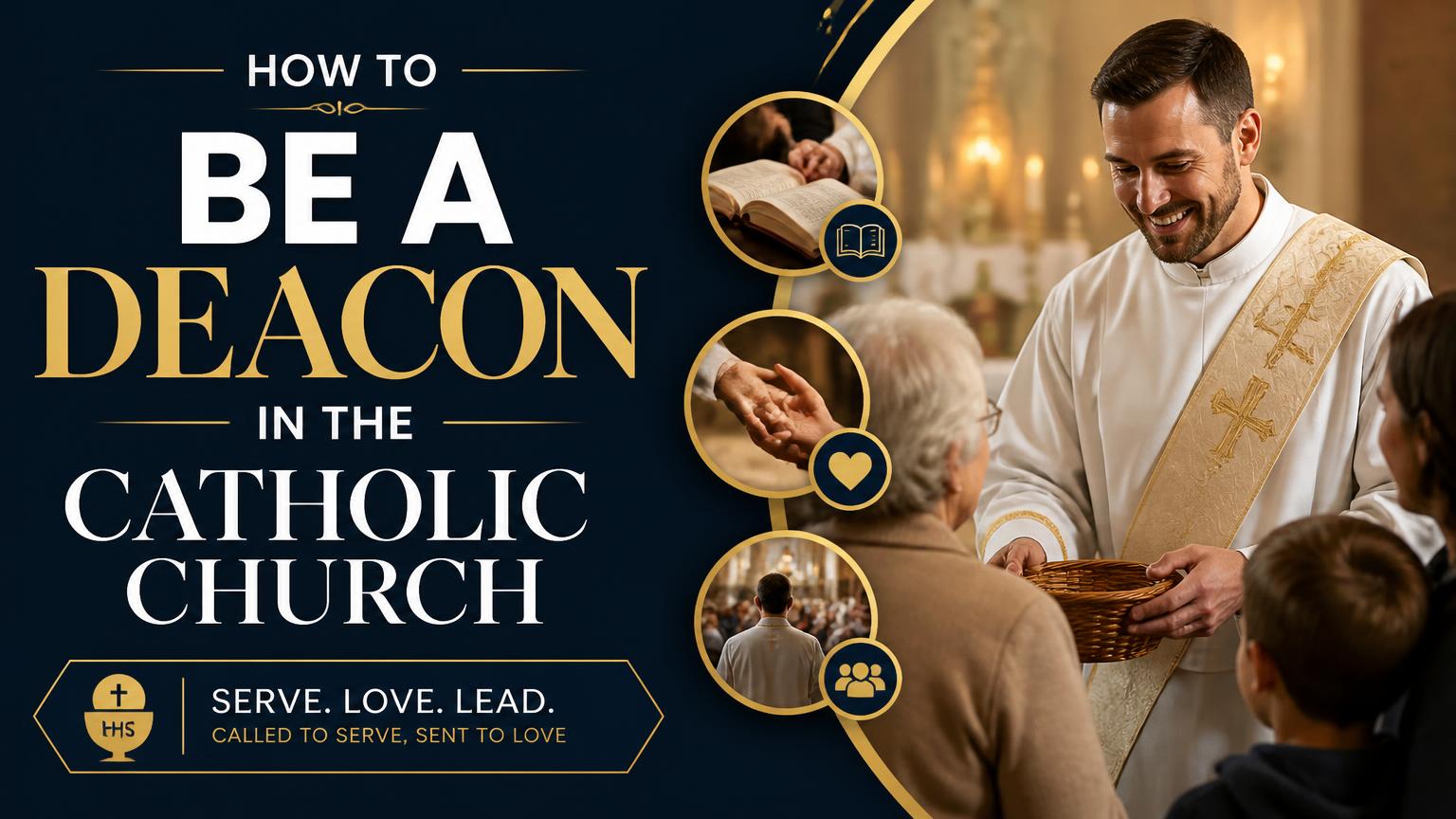
A Catholic deacon is an ordained minister who serves the Church through the ministries of the Word, liturgy, and charity. Becoming one involves more than completing a course of study: a man must discern a vocation, meet the Church’s requirements, complete formation, and receive ordination from his diocesan bishop.
Catholic deacons may be permanent deacons, who generally remain deacons for life, or transitional deacons, who are preparing for priestly ordination. The process and detailed requirements vary by diocese and country, so anyone considering the vocation should begin by contacting the diocesan office for the permanent diaconate.
How to Be a Deacon in the Catholic Church
Understand What a Deacon Is
A deacon receives the Sacrament of Holy Orders and shares in Christ’s mission in a way distinct from both lay ministry and the priesthood. The diaconate is ordered toward service, especially service of:
- The Word: proclaiming the Gospel, preaching when permitted, teaching, and evangelizing
- The Liturgy: assisting the bishop and priests at Mass and leading certain rites
- Charity: serving the poor, vulnerable, sick, imprisoned, isolated, and marginalized
A deacon is not simply a highly trained altar server or a parish administrator. Ordination gives him a sacramental identity and a public responsibility to represent Christ the Servant.
At Mass, a deacon may proclaim the Gospel, preach, prepare the altar, distribute Holy Communion, and dismiss the assembly. Outside Mass, he may baptize, witness marriages in the name of the Church, preside at funerals and burial services, lead Communion services, conduct prayer services, and coordinate works of charity.
He cannot celebrate Mass, consecrate the Eucharist, hear sacramental confessions, or administer the Anointing of the Sick. Those responsibilities belong to priests or bishops.
Determine Whether You Are Seeking the Permanent or Transitional Diaconate
The permanent diaconate is normally the path for a man who believes he is called to serve as a deacon without intending to become a priest. Permanent deacons may be married or unmarried, subject to Church requirements.
The transitional diaconate is the stage through which seminarians pass before priestly ordination. A transitional deacon ordinarily serves as a deacon for a period before being ordained a priest.
This distinction matters because the formation process, expectations, and rules can differ. A man interested in the permanent diaconate should contact his diocese’s permanent-diaconate director rather than a seminary admissions office unless the diocese directs otherwise.
Meet the Church’s Basic Requirements
The Catholic Church reserves ordination to the diaconate to men. A candidate must be a practicing Catholic whose life, faith, and relationships demonstrate readiness for public ecclesial ministry.
General requirements commonly include:
- Baptism and full communion with the Catholic Church
- Confirmation and a mature sacramental life
- A stable pattern of prayer and participation in Sunday Mass
- Good moral character and a reputation for responsible Christian living
- Emotional and psychological maturity
- Physical and mental ability to undertake formation and ministry
- Sufficient education and intellectual ability for theological study
- Freedom from canonical impediments to ordination
- Support for the vocation from one’s spouse and family, when applicable
Canon law establishes minimum ages, but dioceses may set higher standards. In practice, many dioceses accept permanent-diaconate candidates only after they have reached an age that reflects substantial personal, professional, and family maturity. Some also set a maximum age for admission or ordination.
A married candidate must have a stable marriage, and his wife must freely consent to his formation and ordination. The diaconate affects the entire household: formation may require evenings and weekends, and ministry can place demands on family schedules. A candidate should not treat his vocation as a private project separate from his marriage.
An unmarried permanent deacon ordinarily embraces celibacy. A married deacon who becomes widowed is generally not free to marry again, although individual cases can involve particular pastoral or canonical considerations.
Discern the Vocation With the Diocese
A desire to serve is valuable, but it does not by itself establish a vocation. Discernment asks whether the candidate’s desire corresponds to the Church’s needs, his actual abilities, his family responsibilities, and the judgment of the bishop.
The first practical step is usually a conversation with a pastor or the diocesan director of diaconate formation. The diocese may invite the candidate to information sessions, spiritual direction, interviews, and an application process.
Discernment commonly examines questions such as:
- Does the candidate have a deepening relationship with Christ?
- Does he serve others without needing status or recognition?
- Can he proclaim and explain the faith faithfully?
- Does he have a genuine concern for people on the margins?
- Can he balance ministry with marriage, employment, health, and family duties?
- Is he willing to serve under the bishop and in cooperation with priests and other ministers?
- Does his life show the stability and integrity expected of ordained clergy?
The Church’s discernment is mutual. The candidate discerns whether God may be calling him, while the diocese discerns whether he is suited for ordination and whether the vocation is authentic.
The Formation Process for a Catholic Deacon
Apply and Complete the Initial Screening
Dioceses usually require an application before formal formation begins. The process may include:
- Personal interviews
- Written application materials
- Baptismal, confirmation, and marriage records
- Letters of recommendation
- Background checks
- Psychological or other professional assessments
- Medical information
- Academic evaluation
- A formal interview with diocesan leadership
The purpose is not merely administrative. Ordination is a public and permanent commitment, so the Church examines a candidate’s faith, history, relationships, health, finances, employment, and capacity for ministry.
Complete Human, Spiritual, Intellectual, and Pastoral Formation
Diaconal formation is normally organized around four connected areas.
Human formation develops maturity, communication, emotional health, responsibility, and the ability to work constructively with people who have different backgrounds and needs.
Spiritual formation deepens prayer, Eucharistic faith, Scripture, moral conversion, devotion, retreats, spiritual direction, and a life shaped by service rather than ambition.
Intellectual formation generally includes Scripture, Catholic doctrine, moral theology, liturgy, Church history, canon law, pastoral theology, evangelization, and social teaching. Candidates need enough theological understanding to preach and teach accurately rather than relying on personal opinion.
Pastoral formation places candidates in real ministry. They may serve in parish outreach, hospitals, prisons, nursing homes, schools, shelters, or other settings. The goal is to connect theological learning with compassionate and competent service.
Formation commonly takes several years. In many places, it includes an introductory period followed by formal candidacy and progressive ministries before ordination. Exact length, academic requirements, and stages differ among dioceses.
Receive the Ministries and Ordination
Before ordination, a candidate may be formally instituted as a lector and acolyte or receive equivalent preparation according to the norms governing his diocese and country. These ministries help him grow in service of Scripture and the altar.
Ordination takes place through the laying on of hands by the bishop and the prayer of consecration. The newly ordained deacon receives a stole worn diagonally and a dalmatic, and he makes the promises required by the Church. His ordination is permanent: even if he later leaves active ministry, he remains a deacon sacramentally.
Ordination does not make a man spiritually superior to other Catholics. It gives him a particular responsibility to serve, teach, and witness to Christ in communion with the bishop and the wider Church.
What Deacons Actually Do
Serve the Word
The deacon’s ministry begins with the Gospel. He may proclaim the Gospel at Mass and, with the necessary authorization, preach. His preaching should arise from prayer, sound Catholic teaching, awareness of the congregation, and attention to the real circumstances of human life.
A deacon also teaches through baptismal preparation, marriage preparation, Bible study, adult faith formation, evangelization, and personal accompaniment. His credibility depends on whether his conduct supports the message he proclaims.
Serve the Liturgy
Deacons assist at the Eucharistic liturgy and may lead certain celebrations when a priest is not required. They can baptize, witness marriages, preside at funeral rites outside Mass, lead the Liturgy of the Hours or other approved prayer services, and distribute Holy Communion.
Their liturgical service should point toward Christ rather than personal performance. A deacon does not replace the priest, and the diaconate should not be understood merely as a way to fill parish scheduling needs.
Serve Through Charity
Charity is not an optional activity added to liturgical duties. It is central to the diaconate. A deacon may organize assistance for families in crisis, visit the sick and homebound, advocate for the poor, accompany immigrants, support prisoners and their families, or coordinate parish responses to local needs.
Effective charitable ministry requires more than good intentions. It involves listening, respecting dignity, protecting confidentiality, cooperating with qualified agencies, and understanding when professional or emergency help is needed. Christian service should empower people rather than create unhealthy dependence.
Biblical and Historical Foundations
The New Testament presents Christian leadership as service. Jesus identifies greatness with serving others, and the First Letter to Timothy describes qualities expected of deacons, including dignity, integrity, sound faith, and a well-ordered life (1 Timothy 3:8–13).
Acts 6 describes men chosen to address a practical need in the early Christian community. This passage has traditionally been associated with the origins of the diaconate, although it does not provide a complete description of the modern threefold structure of bishop, priest, and deacon. The Church’s understanding of ordained ministry developed over time.
The Second Vatican Council renewed the permanent diaconate in the Latin Church, allowing it to be restored as a stable vocation rather than existing only as a temporary step toward priesthood. Since then, dioceses have developed formation programs adapted to local pastoral circumstances.
Common Misunderstandings About Becoming a Deacon
A deacon is not a “part-time priest.” He has a distinct vocation and cannot perform every sacramental function of a priest.
A deacon is not ordained only to work at Mass. The ministries of charity and the Word are essential, even when they are less visible than liturgical service.
A married man does not become a deacon without consequences for his household. His wife’s free consent and the family’s realistic ability to support the vocation matter throughout formation and ministry.
Ordination is not a reward for parish volunteering. A candidate may have served faithfully for years and still need further discernment, formation, or personal growth before the bishop can recommend ordination.
A deacon does not automatically receive authority over parish programs. His ministry is exercised according to the bishop’s assignment and in cooperation with the pastor and other Church leaders.
How to Begin the Process
A man who believes he may be called should take practical steps:
- Establish a consistent life of prayer and sacramental participation.
- Speak honestly with his pastor and, if married, with his wife.
- Contact the diocesan office responsible for the permanent diaconate.
- Attend an information session or discernment gathering.
- Review the diocese’s age, education, marital, employment, and residency requirements.
- Begin spiritual direction if the diocese recommends it.
- Discuss the demands of formation with family members and employers.
- Apply only after prayerful discernment rather than acting from pressure or prestige.
The diocese will explain the local process, because requirements are not identical everywhere.
Becoming a deacon in the Catholic Church is therefore a vocation to ordained service, not simply a ministry position. The essential path is discernment, diocesan approval, several years of integrated formation, and ordination by the bishop. A suitable candidate is a mature Catholic man whose prayer, family life, doctrine, character, and practical service show that he can help the Church proclaim the Gospel, celebrate the faith, and serve those in need.