
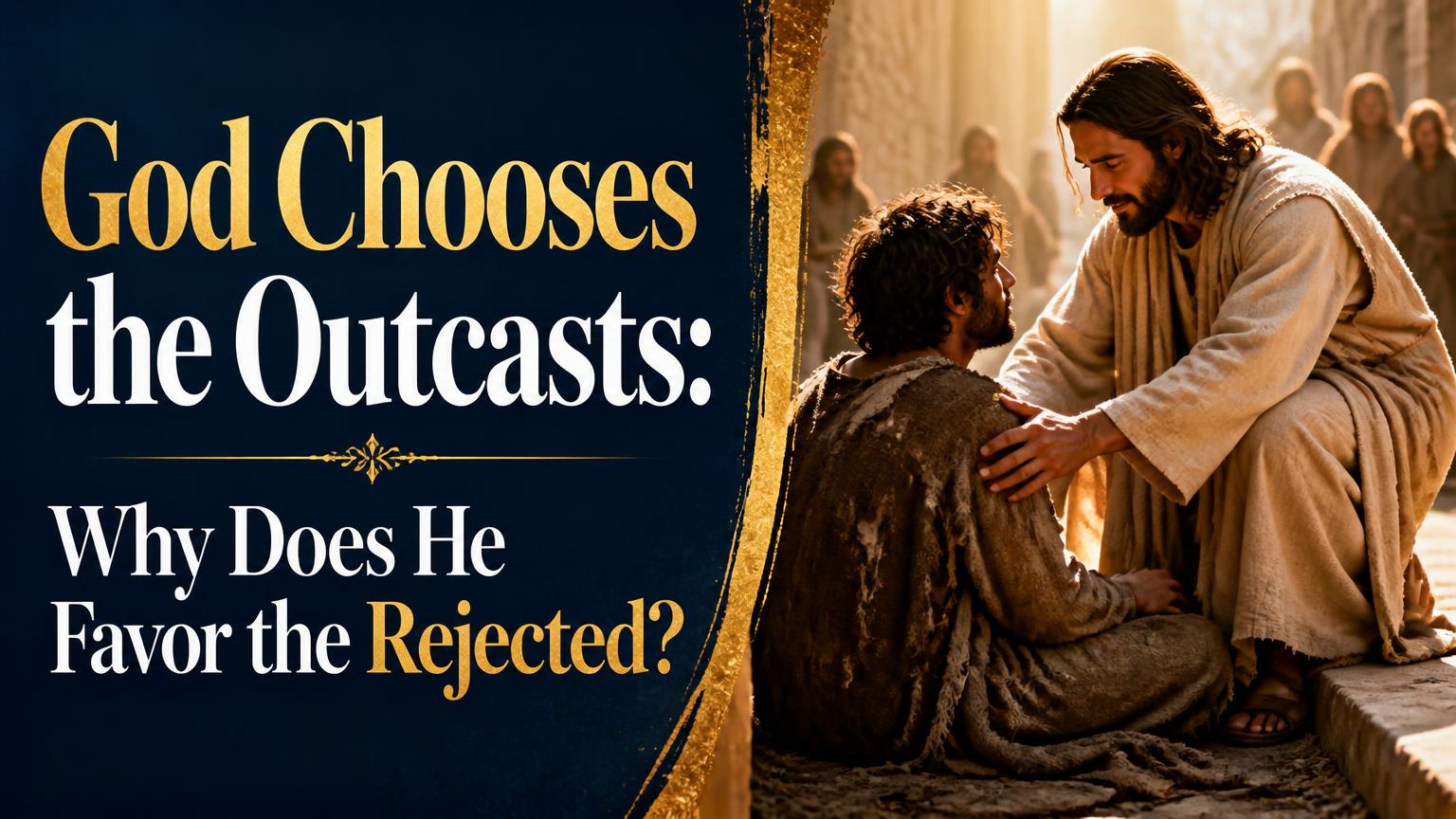
God’s concern for outcasts is a repeated theme throughout Scripture. He sees people whom society ignores, protects those who are vulnerable, welcomes those excluded by prejudice, and often entrusts meaningful work to people others consider insignificant or unworthy. Yet “God chooses the outcasts” does not mean that God automatically approves every action of every marginalized person or rejects everyone with social privilege. It means that human status does not determine a person’s value, access to mercy, or usefulness in God’s purposes.
God Chooses the Outcasts: What Does This Mean?
The Bible presents God as one who notices the overlooked and confronts systems of pride, partiality, and exclusion. His welcome is grounded in mercy and truth: he receives people as they are, but he also calls them toward healing, repentance, faith, and restored relationships.
God Sees People Others Overlook
Hagar illustrates this pattern early in Scripture. She was an enslaved foreign woman whose position left her vulnerable within Abraham’s household. After fleeing into the wilderness, she encountered God and recognized him as the God who sees her (Genesis 16:13). Her circumstances did not make her invisible to God, even though powerful people had treated her as disposable.
The same concern appears in God’s law. Israel was commanded to care for the foreigner, widow, orphan, and poor because Israel itself had experienced oppression in Egypt (Deuteronomy 10:17–19; 24:17–22). God’s attention to the excluded is not sentimental language. It creates moral obligations for his people: they must not measure human worth by wealth, ethnicity, social influence, or power.
Jesus Makes Welcome Visible
Jesus’ ministry gives this theme its clearest expression. He touched lepers, spoke publicly with women, welcomed children, ate with tax collectors, responded to Gentiles, and treated the sick and disabled as people rather than problems. His actions challenged the assumption that suffering, disease, poverty, or social disgrace proved that someone was spiritually inferior.
Jesus’ welcome did not erase moral distinctions or make sin irrelevant. He called Zacchaeus to a transformed life, and Zacchaeus responded by promising restitution to those he had harmed (Luke 19:1–10). Christ’s acceptance opened the way to change. Biblical hospitality is therefore more than social politeness; it restores a person to dignity, community, and responsibility.
God Reverses Human Status
Scripture often describes God overturning ordinary status systems. Hannah’s prayer celebrates a God who brings down the proud and raises the poor from the dust (1 Samuel 2:1–8). Mary’s song similarly praises God for lifting the humble and filling the hungry (Luke 1:46–55). Jesus declares blessings upon the poor, grieving, meek, merciful, and persecuted, while warning those who are satisfied with their present status (Matthew 5:3–12; Luke 6:20–26).
This reversal does not mean that poverty or rejection is inherently virtuous. It means that privilege can create false security, while suffering can expose a person’s need for God. The kingdom of God cannot be evaluated by the same standards as social prestige. A person may be ignored by society and honored by God, while a respected person may be spiritually poor despite outward success.
God Calls the Unlikely to Serve
God’s choice of unlikely people also reveals that divine calling is not limited to the impressive. Ruth was a Moabite widow, yet she became part of Israel and an ancestor of David (Ruth 1–4; Matthew 1:5). Rahab, a Canaanite woman with a troubled reputation, protected Israel’s spies and was later remembered among those associated with God’s purposes (Joshua 2; Hebrews 11:31).
The apostle Paul tells the Corinthian church that God often chooses what the world considers weak, lowly, or despised so that human boasting cannot take credit for his work (1 Corinthians 1:26–29). This does not glorify weakness for its own sake. It demonstrates that God’s power and grace cannot be reduced to education, reputation, social rank, or conventional success.
Why Does God Draw Near to the Rejected?
God’s concern for outcasts flows from his character. He is not partial in the corrupt sense of favoring the powerful, and Scripture explicitly condemns showing preference based on wealth or appearance (Deuteronomy 10:17; James 2:1–9). At the same time, God gives particular protection to people who are vulnerable to exploitation because justice requires attention to unequal power. Caring for the oppressed is not favoritism; it is a response to wrongdoing and need.
The rejected also expose the limitations of human judgment. People often exclude others because of fear, prejudice, disease, ethnicity, poverty, disability, criminal history, or religious suspicion. When God welcomes those whom respectable society dismisses, he reveals that dignity comes from being made in God’s image, not from public approval. His choices challenge communities to ask who they have treated as inconvenient, dangerous, inferior, or beyond redemption.
This theme also guards against pride. The gospel teaches that everyone approaches God by grace rather than personal worthiness. The distinction is not between people who need mercy and people who do not. It is between those who recognize their need and those who believe their status makes them self-sufficient. The “outcast” may know this need more visibly, but no human being stands before God on the basis of social respectability.
What God Choosing Outcasts Does Not Mean
It Does Not Mean Every Outsider Is Automatically Righteous
The Bible does not romanticize marginalized people. Some outcasts are victims of injustice; others have harmed people themselves; many are both wounded and responsible for wrongdoing. Jesus showed compassion to sinners without calling sin harmless. His mercy included truth, accountability, and a summons to repentance.
This distinction matters because simplistic teaching can replace one stereotype with another. The poor are not automatically morally superior, and the socially accepted are not automatically corrupt. God judges justly, sees the whole person, and refuses to define anyone only by a label such as “victim,” “criminal,” “foreigner,” “failure,” or “respectable.”
It Does Not Mean God Rejects All Insiders
The Bible includes wealthy, educated, politically connected, and socially respected people among God’s servants. Joseph, Daniel, Lydia, Nicodemus, and the Roman centurion demonstrate that privilege does not make faith impossible. The problem is not possessing resources or influence; the problem is trusting those advantages, using them selfishly, or refusing to share them.
God can call people with influence to use it for protection, generosity, justice, and service. Boaz used his position to protect Ruth. Joseph used authority to preserve lives during famine. The biblical question is not simply, “Do you have status?” but, “What do you do with the power and resources entrusted to you?”
It Does Not Mean the Church Should Preserve Exclusion
Jesus’ welcome requires more than inviting outsiders into a room while keeping them permanently at the edge. The early church had to confront ethnic and religious barriers when Gentiles received the Holy Spirit (Acts 10–15). The conclusion was not that Gentiles could remain tolerated guests indefinitely, but that God had cleansed and welcomed them as full members of his people.
Christian communities therefore must examine their practices, not only their words. A church may preach acceptance while its leadership, assumptions, language, or social habits communicate that certain people are still second-class participants. Biblical inclusion involves shared dignity, genuine belonging, mutual responsibility, and equal access to the grace of God—not the removal of wisdom, boundaries, or accountability.
How Should Christians Respond to Outcasts?
Reject Favoritism in Ordinary Relationships
James 2 applies the issue of exclusion to a practical church situation: a wealthy visitor receives an honored seat while a poor person is treated as insignificant. The sin is not merely bad manners. It reveals a system that ranks people according to economic value. Christians should therefore examine whom they notice, trust, invite, employ, defend, and listen to.
This may involve welcoming people who are socially isolated, making space for those with disabilities, refusing ethnic prejudice, treating immigrants and the poor with dignity, or resisting assumptions about people with mental illness or criminal records. Compassion should be concrete. It includes patient listening, fair treatment, protection from exploitation, and friendship that does not reduce someone to a charitable project.
Serve With Both Mercy and Wisdom
Care for vulnerable people requires more than emotional sympathy. Some situations involve abuse, addiction, manipulation, mental illness, unsafe behavior, or complex financial needs. Love may require boundaries, professional help, reporting wrongdoing, or refusing to enable destructive conduct. Protecting the vulnerable can mean confronting the person who causes harm rather than simply offering unlimited access.
Jesus combined compassion with discernment. Christians should do the same. They can affirm a person’s God-given dignity while setting appropriate limits, seeking accountability, and encouraging genuine restoration. Mercy becomes more trustworthy when it protects victims and tells the truth.
Let Welcome Lead to Shared Community
The goal is not to create permanent categories of helpers and helped. God’s people are a body in which each member has value and contributes something (1 Corinthians 12:12–27). People who have been excluded may receive care, but they also possess gifts, wisdom, testimony, leadership, and spiritual insight that the wider community needs.
Ruth was not merely rescued; she became part of Israel’s story. The Samaritan woman did not remain a passive recipient of Jesus’ attention; she testified to her community (John 4:28–30, 39). Authentic welcome makes room for participation. It asks not only, “How can we help this person?” but also, “What has God placed in this person that our community must learn to receive?”
The Central Message of God’s Welcome
“God chooses the outcasts” means that rejection by society does not equal rejection by God. Scripture consistently shows him defending the vulnerable, welcoming outsiders, exposing pride, and calling unlikely people into faithful service. His grace reaches those whom others overlook, but it does not flatter them or leave them unchanged. God’s welcome restores dignity while confronting sin, creating belonging while establishing responsibility.
The message also challenges people who consider themselves insiders. No one earns God’s favor through reputation, wealth, ethnicity, religious performance, or social approval. Everyone depends on mercy. Those who understand that mercy will become less willing to rank people by status and more willing to make room for the overlooked. In that sense, God’s choice of the rejected is both comfort for the wounded and a summons to the accepted: receive others as God has received you.