
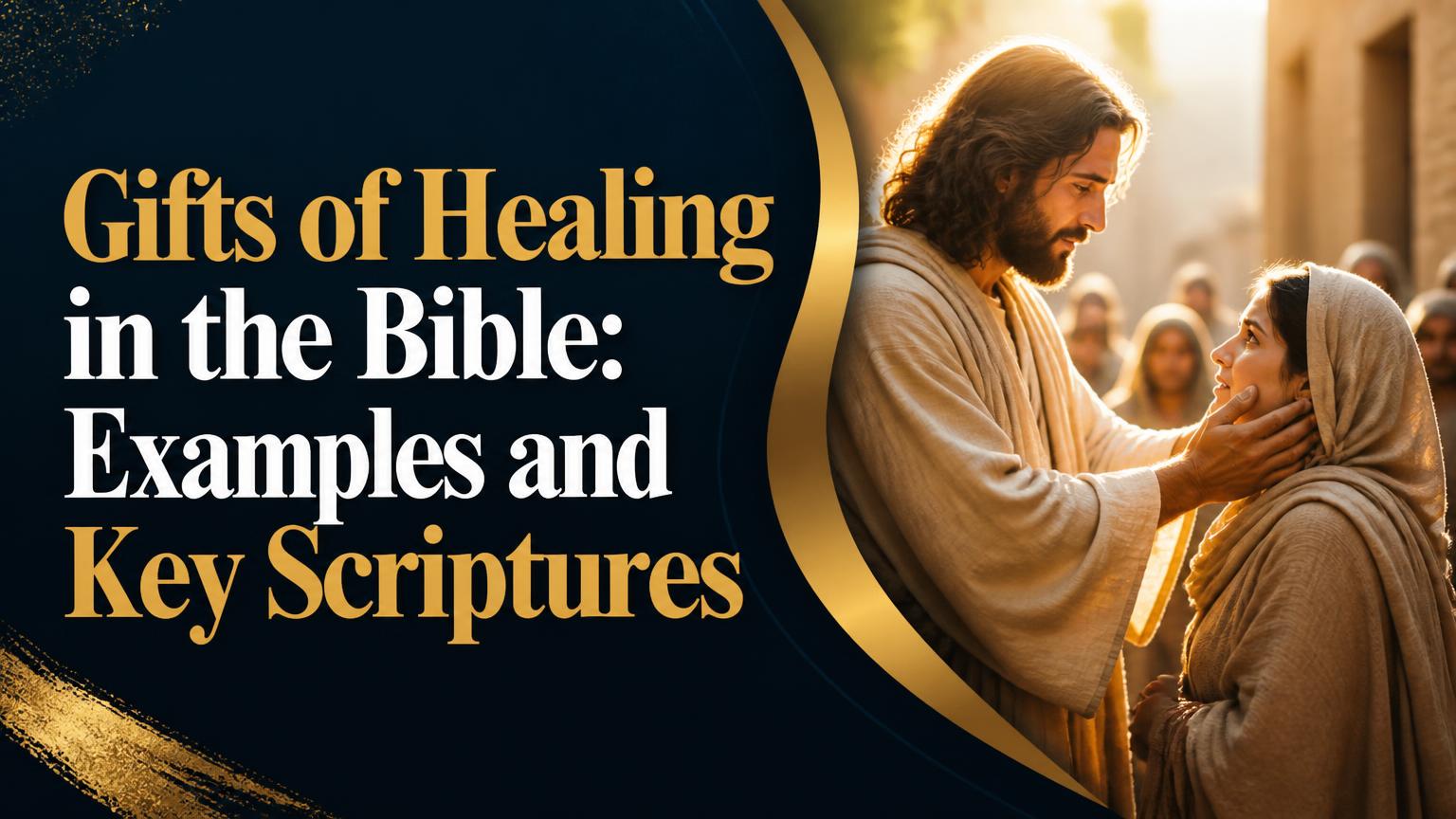
Gifts of healing in the Bible refer to Spirit-given manifestations through which God brings physical, emotional, or sometimes broader restoration to people. The clearest teaching appears in 1 Corinthians 12, where Paul lists “gifts of healings” among the workings of the Holy Spirit. The Bible also records healings performed by Jesus, the apostles, and other believers. These accounts show both God’s compassion and power, while also making clear that healing is not a guaranteed result of a particular person’s faith, prayer, or ministry.
Gifts of Healing in the Bible: Meaning, Examples, and Scriptures
The Meaning of Healing Gifts in 1 Corinthians 12
Paul identifies “gifts of healings” in 1 Corinthians 12:4–11, 28–30. He places them among the spiritual gifts given by the Holy Spirit for the good of the church. The wording is plural in the original text: “gifts” and “healings.” This may point to different kinds of healing or varied ways God works through different people, although the passage does not provide a precise classification.
The central principle is that healing originates with God and is distributed according to the Spirit’s will. A person may serve as an instrument of healing, but the gift does not make that person the source of power or give complete control over when healing occurs. Paul’s teaching therefore directs attention away from spiritual personalities and toward God’s grace.
These gifts should also be understood within the wider purpose of spiritual gifts. They are given to strengthen and serve the body of Christ, not primarily to create status, attract crowds, or enrich a minister. Any claimed healing ministry must therefore be evaluated by its faithfulness to Christ, its treatment of vulnerable people, and its fruit in the church.
How Healing Appears in Jesus’ Ministry and Acts
The Gospels repeatedly describe Jesus healing the sick. He healed people with conditions such as paralysis, blindness, leprosy, fever, and long-term bleeding. These acts demonstrated compassion, fulfilled messianic expectations, and revealed his authority over sickness and the effects of sin and death. Jesus sometimes healed through touch, sometimes through spoken commands, and sometimes without being physically present.
Jesus also commissioned the Twelve to preach the kingdom and heal the sick, as seen in Matthew 10:1 and Luke 9:1–2. In Luke 10:9, the seventy-two were instructed to heal the sick while announcing that the kingdom of God had come near. Healing was therefore connected with proclamation: it served as a sign of God’s reign, not as an isolated display of supernatural ability.
Acts continues this pattern. Peter’s healing of the lame man at the temple appears in Acts 3:1–10. Ananias prayed for Saul, later known as Paul, and Saul’s sight was restored in Acts 9:17–18. Peter healed Aeneas in Acts 9:32–35, and Paul’s ministry included healing Publius’s father and others on Malta in Acts 28:7–10. These accounts emphasize the name of Jesus and God’s power rather than the reputation of the human servant.
Why the Bible Speaks of “Gifts” and “Healings”
The plural wording in 1 Corinthians may suggest that healing ministry is diverse. Scripture does not present every healing as identical. Some healings occurred immediately; others followed an act of obedience, prayer, or physical action. Jesus used different methods in different situations, including touch, commands, and symbolic actions.
The plural may also acknowledge that God works through different people and circumstances. One believer might pray for a particular kind of illness, while another may minister in a different setting or through a different expression of compassion and faith. However, the text does not establish a technical system in which each person receives a permanent specialty, such as a guaranteed ability to heal one specific disease.
The phrase should not be used to support the idea that every person who claims a healing gift will heal everyone who seeks prayer. First Corinthians 12 itself teaches that the Spirit distributes gifts as he chooses, and Paul asks rhetorically whether all possess gifts of healing. The expected answer is no. Healing gifts are real within the biblical account, but they are neither universal nor subject to human control.
What Healing Gifts Do Not Mean
The Bible does not teach that sickness always proves personal sin or insufficient faith. Jesus rejected that assumption in John 9:1–3 when discussing a man born blind. Although faith is sometimes connected with healing, the Gospels also record healings where the sick person could not demonstrate a particular level of understanding or faith. The emphasis remains on God’s mercy and authority.
Healing gifts also do not mean that Christians should reject physicians, medicine, or ordinary care. Luke was a physician, and Paul advised Timothy to use a little wine for his stomach in 1 Timothy 5:23. Scripture presents prayer and practical care as compatible rather than mutually exclusive. Seeking medical treatment does not necessarily indicate unbelief, just as praying for healing does not require refusing responsible treatment.
Nor does the absence of healing prove that God has abandoned someone. Paul prayed repeatedly about his “thorn in the flesh” in 2 Corinthians 12:7–10, yet God answered by promising sufficient grace rather than removing the affliction. In 2 Timothy 4:20, Paul mentioned leaving Trophimus sick at Miletus. These passages prevent Christians from turning healing into a formula or using a person’s illness as evidence of spiritual failure.
Key Scriptures About Healing Gifts
1 Corinthians 12:4–11, 28–30
These verses provide the primary New Testament teaching about gifts of healing. Paul places them alongside gifts such as wisdom, knowledge, faith, miracles, prophecy, discernment, tongues, and interpretation. The list shows that healing is one expression of the Spirit’s activity, not the entire measure of spiritual maturity.
Paul’s argument also supplies an important safeguard: the church is one body with many members and gifts. No single gift should dominate the community or become a test by which every Christian is judged. Healing ministry must operate with humility, love, order, and concern for the whole church. First Corinthians 13 follows the discussion of spiritual gifts because love governs how every gift should be used.
The Healing Ministry of Jesus and the Apostles
Matthew 8–9, Mark 1–2, Luke 4–9, and John 5 contain numerous healing accounts. These passages show Jesus’ authority, compassion, and willingness to touch people who were socially or ceremonially excluded. His healings often restored people to community as well as to physical health.
Acts 3, 9, 14, and 28 record significant healings associated with the early Christian mission. In Acts 14:8–10, Paul addressed a man unable to walk, while Acts 19:11–12 describes extraordinary miracles associated with Paul’s ministry. These narratives should not be reduced to techniques. The healings function as signs pointing to Jesus’ resurrection and the advance of the gospel.
James 5:14–16 and Other Qualifying Passages
James 5:14–16 instructs the sick to call the elders of the church, who are to pray and anoint the person with oil in the Lord’s name. The passage emphasizes communal pastoral care, prayer, confession, and dependence on God. It does not present anointing oil as a magical substance or promise that every illness will end immediately.
Other passages add needed balance. Philippians 2:25–30 describes Epaphroditus as seriously ill, although he recovered through God’s mercy. First Timothy 5:23 mentions a practical remedy, and 2 Timothy 4:20 acknowledges that Trophimus remained sick. Together, these texts show that the early Christian experience included healing, ongoing illness, prayer, treatment, and unresolved suffering.
Healing, Faith, Prayer, and Ordinary Care
Healing Gifts Are Different From Saving Faith
The New Testament uses the word “faith” in more than one way. Saving faith means trusting in Christ, while the spiritual gift of faith in 1 Corinthians 12:9 refers to a particular Spirit-given enablement for a situation. Faith associated with healing may also describe confidence in God’s ability and willingness to act.
These ideas should not be confused. A Christian may possess genuine faith in Christ without possessing a gift of healing or receiving physical healing. Conversely, a healing account should not be interpreted as proof that the person healed had superior faith. God’s grace, not human spiritual performance, is the foundation of biblical healing.
Prayer, Medical Treatment, and Discernment Belong Together
Christians may pray boldly for healing while also seeking diagnosis, medication, surgery, counseling, rehabilitation, or other appropriate care. Prayer recognizes God as the ultimate source of life and restoration; medical care uses knowledge and means that may also be understood as gifts of God’s common grace.
Discernment becomes especially important when someone claims a healing ministry. Biblical practice does not support pressuring sick people to give money, blaming those who remain ill, discouraging necessary treatment, or treating unverifiable testimonies as unquestionable proof. A responsible ministry welcomes honest evaluation, protects vulnerable people, and points attention to Christ rather than creating dependence on a particular leader.
Are Gifts of Healing Still Given Today?
Continuationist and Cessationist Interpretations
Christians disagree about whether gifts of healing continue in the church today. Continuationists believe the spiritual gifts described in 1 Corinthians remain available until Christ returns. They point to the absence of a clear biblical statement that healing gifts ended and encourage the church to pray expectantly while submitting outcomes to God.
Cessationists believe some sign gifts were especially connected with the apostles and the foundational period of the church. They argue that the New Testament gives a unique role to apostolic signs and that the church should not assume the same miraculous pattern must continue in every era. Both positions seek to interpret biblical teaching faithfully, and neither view permits manipulation or guarantees that every prayer for healing will produce a miracle.
A Biblical Approach to Claims of Healing
A balanced approach holds together expectation and humility. Christians can ask God for healing, anoint the sick, invite church elders to pray, and celebrate genuine recovery. At the same time, they should acknowledge that God’s answer may involve gradual improvement, medical treatment, endurance, spiritual transformation, or final resurrection rather than immediate relief.
The New Testament directs believers to test spiritual claims, value truth, and judge ministry by its fruit. Healing should lead to gratitude, compassion, holiness, and witness to Christ—not fear, financial exploitation, or exaggerated promises. The strongest biblical confidence is not that every illness will be removed now, but that God remains present and that complete restoration will ultimately come through Christ’s victory over death.
Conclusion
The gifts of healing in the Bible are Spirit-enabled works through which God brings restoration and bears witness to the gospel. First Corinthians 12 identifies healing as a genuine spiritual gift, while the Gospels and Acts show healings occurring through Jesus, the apostles, and other servants. Yet Scripture does not turn healing into a human technique or a test of spiritual worth. God distributes gifts as he wills, and the Bible includes faithful believers who remained sick or were not immediately healed.
Biblical Christians can therefore pray with confidence, use wise medical care, support the sick through the church, and remain humble about outcomes. Healing is a sign of God’s mercy, but it is not a promise that eliminates suffering in the present age. The final hope of Scripture is complete restoration in Christ, where sickness and death will be overcome permanently.