
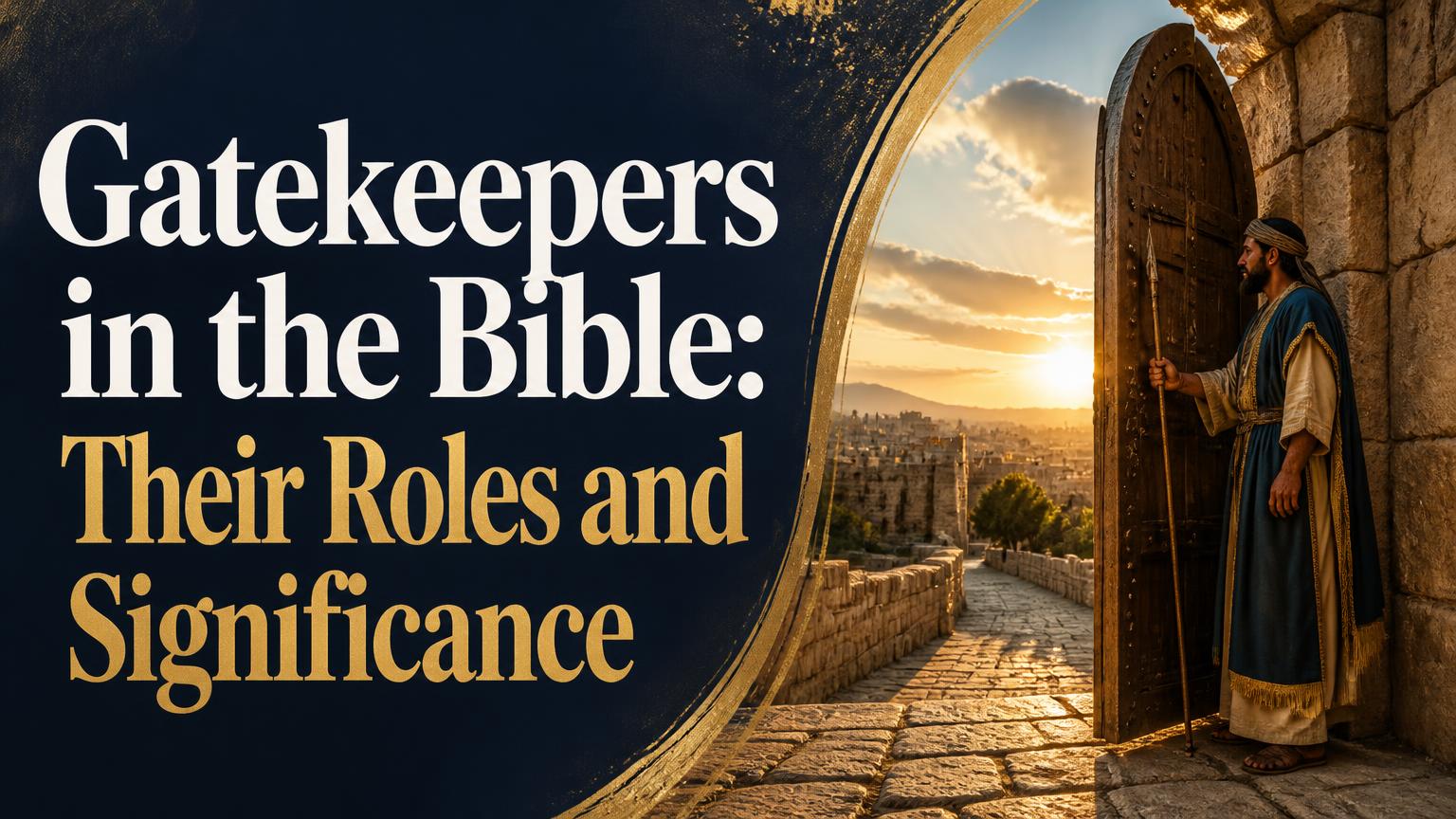
Gatekeepers in the Bible were appointed servants responsible for controlling access to sacred and civic spaces, protecting temple entrances, supervising storerooms, and supporting the orderly worship of Israel. They were usually Levites, especially members of the Korahite and Merarite families. Although their work could appear ordinary, Scripture presents it as a trusted ministry involving vigilance, holiness, stewardship, and faithful service. Their responsibilities extended beyond simply opening and closing doors.
Gatekeepers in the Bible
The biblical gatekeeper was more than a doorkeeper. Gatekeepers guarded entrances, regulated access, watched over temple chambers and treasuries, helped manage offerings, and served in organized shifts. Their duties protected the worshiping community and helped ensure that sacred responsibilities were carried out properly.
What Were Gatekeepers Responsible For?
Gatekeepers controlled who entered particular areas and helped preserve order around the sanctuary. First Chronicles 9:26–27 describes four chief gatekeepers who were entrusted with the temple chambers and storehouses. They stayed near the house of God and opened the entrances each morning.
Their work included several related responsibilities:
- Guarding temple and city gates
- Opening and closing entrances at appointed times
- Protecting sacred rooms, supplies, and treasures
- Helping regulate access to restricted areas
- Receiving or distributing certain offerings
- Serving according to assigned rotations
- Maintaining order during festivals and public worship
Second Chronicles 31:14 identifies Kore the Levite as a gatekeeper who was responsible for voluntary offerings and their distribution. This shows that gatekeepers could have administrative responsibilities as well as security duties. Their role involved trust, judgment, and accountability.
Where Did Gatekeepers Serve?
Gatekeepers served primarily at the tabernacle, the Jerusalem temple, and the gates of restored Jerusalem. In the temple, they watched entrances and guarded areas connected with worship. In the city, they helped protect the community and regulate activity at important access points.
After Jerusalem’s wall was rebuilt, Nehemiah appointed gatekeepers along with singers and Levites (Nehemiah 7:1). Nehemiah 11:19 mentions gatekeepers stationed at the city gates, while Nehemiah 13:22 describes Levites guarding the gates to prevent commercial activity on the Sabbath.
This distinction matters. Some gatekeepers served in the temple, while others served at city gates. Both assignments involved protecting the community, but temple gatekeeping had a particularly direct relationship to holiness and worship.
Who Were the Biblical Gatekeepers?
Gatekeepers were generally drawn from Levitical families. First Chronicles 9 connects the gatekeeping ministry with the Korahites, and First Chronicles 26 describes divisions among the sons of Korah and Merari. These families received specific assignments and served according to an organized system.
The position was not an improvised task given to whoever happened to be available. Chronicles presents gatekeeping as an established Levitical ministry with leaders, family responsibilities, rotations, and designated locations. Some gatekeepers were appointed by lot, a method that emphasized an ordered distribution of responsibility rather than personal competition (1 Chronicles 26:12–19).
The returning exiles also included gatekeepers among those who came back to Jerusalem and Judah (Ezra 2:42). Their presence shows that the role remained significant during the restoration of the community after exile.
How Was Their Work Organized?
Gatekeeping operated through divisions and scheduled service. First Chronicles 26 lists families assigned to particular gates and describes responsibilities connected with entrances, storehouses, and oversight. The system allowed the temple and city to remain guarded without requiring every servant to perform every duty at all times.
Organization was especially important during festivals. Second Chronicles 23 describes priests and Levites being placed at temple entrances during the inauguration of Joash’s reign. They were instructed to prevent unauthorized people from entering the temple precincts. During Josiah’s Passover, the gatekeepers remained at their posts while other Levites prepared the sacrifices and worship arrangements (2 Chronicles 35:15).
The arrangement demonstrates that worship required cooperation among different ministries. Priests offered sacrifices, singers led praise, Levites assisted with sacred tasks, and gatekeepers protected the places where those activities occurred.
Why Was Gatekeeping Considered Important?
Gatekeeping mattered because biblical worship involved both welcome and boundaries. The temple was a place where Israel approached God, but it was not treated as an ordinary public building. Certain spaces, objects, and activities were set apart, and access had to be managed responsibly.
A gatekeeper therefore protected more than a physical doorway. The role helped protect the community’s obedience to God’s commands. Poor oversight could lead to disorder, misuse of offerings, or disregard for sacred boundaries. Faithful oversight supported worship by ensuring that the sanctuary, its resources, and its regulations were respected.
The position also carried an element of trust. First Chronicles portrays the gatekeepers as people entrusted with valuable rooms and supplies. Their responsibility was not glamorous, but it was essential to the functioning of the temple.
Key Biblical Passages About Gatekeepers
Several passages provide a fuller picture of what gatekeepers did and why their ministry mattered. Together, they show that gatekeeping included security, administration, worship support, and community protection.
First Chronicles 9 and Daily Temple Service
First Chronicles 9 identifies Shallum and his relatives as gatekeepers connected with the Korahite family. The passage says their ancestors had previously been responsible for guarding the entrance to the camp of the Lord. It then describes gatekeepers assigned to the entrances of the temple.
The chapter emphasizes their daily reliability. They were responsible for opening the house of God each morning, and some remained near the temple during the night. This was continuous service rather than occasional ceremonial work. The gatekeepers’ ministry required alertness, dependability, and willingness to perform duties that many people might overlook.
First Chronicles 26 and Divided Responsibilities
First Chronicles 26 gives the most detailed account of the gatekeepers’ organization. It names families, leaders, assigned gates, and divisions selected for service. The passage also connects gatekeepers with the treasuries and storehouses of the temple.
This chapter helps correct the idea that gatekeepers merely stood at an entrance. Some watched the gates, while others supervised valuable resources or served as officers over related responsibilities. The use of lots distributed assignments within an ordered system and reinforced the idea that every position had a legitimate place in the worship of Israel.
Nehemiah and the Restoration of Jerusalem
Nehemiah shows gatekeepers serving in a city whose walls and religious life were being restored after exile. Their assignment helped establish security and order in a vulnerable community. Nehemiah 7:1 records the appointment of gatekeepers after the wall was completed, and Nehemiah 13:22 describes Levites guarding Jerusalem’s gates during the Sabbath.
The Sabbath example illustrates that gatekeepers were involved in protecting communal obedience, not merely preventing physical intrusion. Their work helped stop commercial activity from undermining the day set apart for worship and rest. In this setting, gatekeeping served both practical security and covenant faithfulness.
Psalm 84:10 and the Desire to Serve
Psalm 84:10 says that being a doorkeeper, or standing at the threshold, in God’s house is better than dwelling elsewhere. The verse comes from a psalm associated with the sons of Korah, a family connected with temple service and gatekeeping.
The statement is not a technical description of the gatekeeper’s job. It is a poetic expression of devotion. The psalmist values even the humblest place near God’s presence above comfort or status far away. The verse gives dignity to faithful service without claiming that every role is identical. Its emphasis is proximity to God and the privilege of belonging to his worshiping community.
Gatekeepers and Related Biblical Roles
Several biblical terms and offices overlap with gatekeeping, but they should not automatically be treated as identical. Understanding the distinctions prevents the role from being either minimized or exaggerated.
Gatekeepers and Priests
Gatekeepers were Levites, but they were not ordinarily priests. Priests descended from Aaron and carried out duties such as offering sacrifices and handling specific rituals. Gatekeepers supported the worship system by protecting access, resources, and order.
This distinction does not make gatekeeping less valuable. Biblical ministry depended on different responsibilities working together. A person did not need to offer sacrifices in order to make a meaningful contribution to worship. The gatekeeper’s assignment was different from the priest’s, but it served the same covenant community.
Gatekeepers and Watchmen
Gatekeepers protected entrances and regulated access. Watchmen, especially in prophetic passages such as Ezekiel 3:17 and 33:1–7, were responsible for warning people of approaching danger and calling them to respond. Both roles involve vigilance, but they are not interchangeable.
A gatekeeper’s assignment was usually concrete and institutional: guard this entrance, oversee this chamber, or protect this city gate. A prophetic watchman had a message-bearing responsibility and was accountable for warning the people. The shared theme is alertness, not identical office or authority.
Gatekeepers and Doorkeepers
“Doorkeeper” is a natural translation of the same basic idea, while older English Bibles sometimes use “porter.” In these passages, “porter” does not mean someone who carries luggage. It refers to a person assigned to a door or gate.
The New Testament also uses gate imagery. In John 10:3, a gatekeeper opens for the shepherd, and in John 10:9 Jesus describes himself as the door or gate for the sheep. These images draw on familiar ideas of access, protection, and recognition, but they do not establish a continuing temple office for Christian leaders. The symbolism points beyond physical gatekeeping to safety, belonging, and access through Christ.
The Significance of Gatekeepers for Biblical Service
Gatekeepers illustrate several principles that Scripture applies to faithful service. These principles should be drawn from the biblical accounts without turning the role into a simplistic formula for every modern ministry.
Faithfulness in Unnoticed Work
Gatekeepers often worked at thresholds, during night watches, or in supporting roles that attracted less public attention than preaching, sacrifice, or music. Yet Scripture records their names, families, assignments, and responsibilities. Their work mattered because dependable service sustains the visible work that people notice.
The lesson is not that public leadership is unimportant. It is that visibility does not determine value. A ministry can be significant because it is faithful, necessary, and entrusted by God, even when few people praise it.
Stewardship Requires Boundaries
Gatekeepers show that stewardship includes protecting what has been entrusted to a community. Their work involved physical boundaries, but the underlying principle includes responsible care of worship, resources, people, and shared commitments.
Boundaries are not automatically expressions of exclusion or fear. In the temple context, they helped preserve holiness and order. At the same time, gatekeepers did not own the temple or replace God as judge of his people. Their authority was delegated and limited, which provides an important caution for anyone who uses “gatekeeper” as a modern spiritual title.
Service Is Cooperative
The temple could not function through one office alone. Priests, Levites, singers, musicians, gatekeepers, officials, and worshipers each had different responsibilities. Gatekeeping therefore presents service as coordinated rather than competitive.
The New Testament develops a related principle when it describes the church as a body with different members and gifts (1 Corinthians 12:12–27). The comparison should not erase the differences between Israel’s temple system and the church, but it does clarify a shared biblical emphasis: faithful communities need varied forms of service, including practical work that makes other ministry possible.
What Gatekeepers Do Not Mean in the Bible
The Bible does not present gatekeepers as people who controlled salvation, decided who God could forgive, or possessed unlimited authority over access to God. Their authority concerned specific entrances, sacred spaces, resources, and community regulations. It was real, but it was delegated and bounded.
Nor does the existence of gatekeepers mean that every modern church leader who manages access, membership, or teaching should automatically be called a biblical gatekeeper. The term may function as a metaphor, but the metaphor must remain accountable to Scripture. In the Old Testament, gatekeeping was a defined Levitical assignment within Israel’s temple and civic life, not a general title for spiritual influence.
Conclusion
Gatekeepers in the Bible were trusted Levites who guarded temple and city entrances, supervised sacred resources, supported worship, and helped preserve order within Israel’s community. Their ministry combined practical vigilance with spiritual responsibility. Passages such as First Chronicles 9 and 26, Nehemiah 7 and 13, and Psalm 84 show that their work was organized, demanding, and honored even when it received little public attention.
Their significance lies partly in the way they reveal biblical service: different responsibilities can contribute to the same worship, and faithful stewardship does not require public recognition. Gatekeepers protected boundaries without owning what they guarded. That balance remains essential whenever biblical gatekeeping is used as a metaphor for responsibility, leadership, or care within a community.