
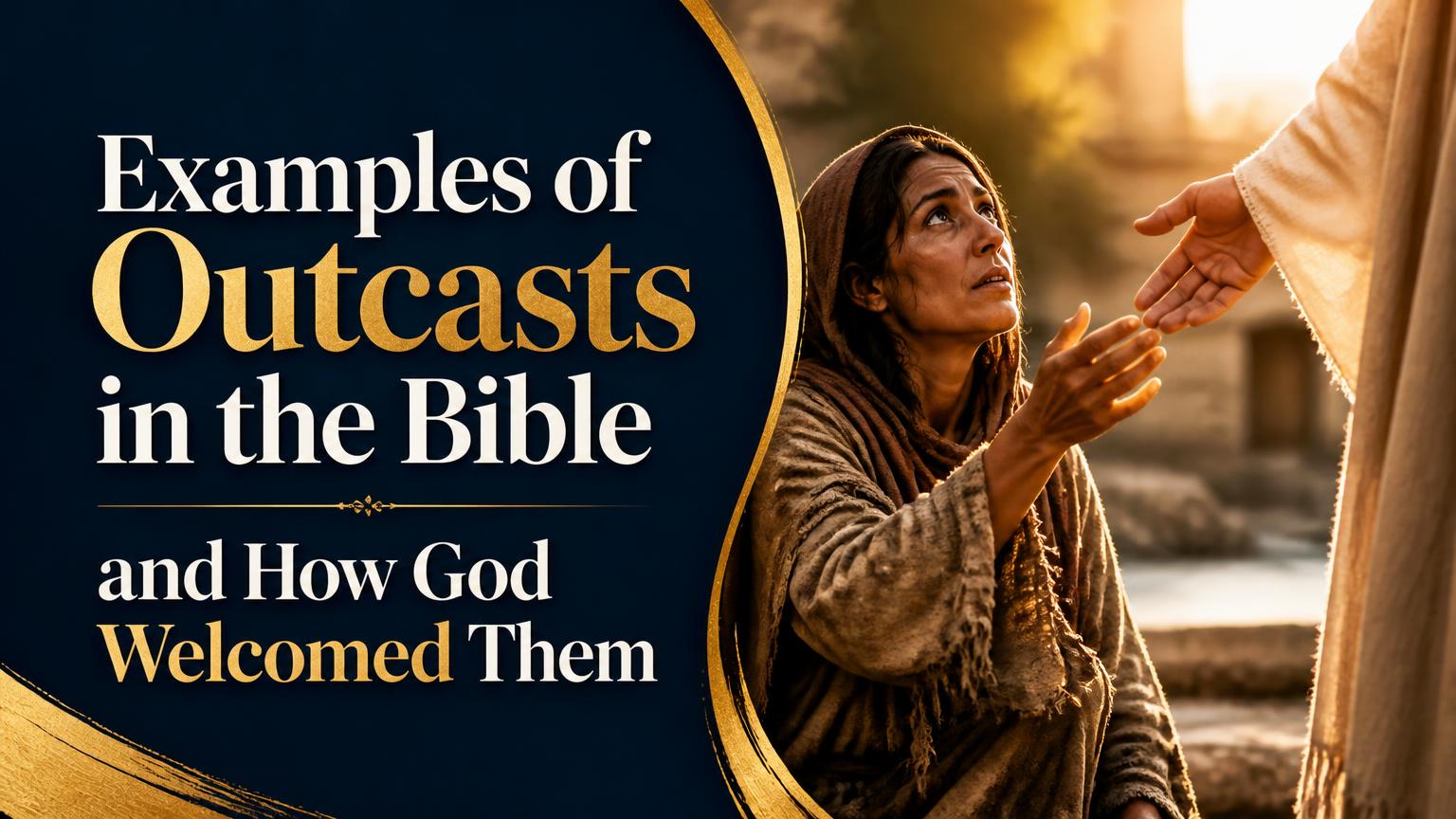
The Bible presents many people who lived at the edges of society because of ethnicity, illness, poverty, disability, occupation, moral reputation, or religious boundaries. Some were openly rejected, while others were simply vulnerable and easily overlooked. Their stories show that God does not define people by the labels society gives them. He sees their dignity, responds to their faith and suffering, and often brings them into fellowship, responsibility, healing, or renewed purpose.
Examples of Outcasts in the Bible
The Bible’s examples of outcasts include Hagar, Ruth, Rahab, Mephibosheth, the Samaritan woman, Zacchaeus, people with skin diseases, a woman with chronic bleeding, and the Ethiopian eunuch. These people were not all outcasts in exactly the same way. Some faced ethnic hostility, some ritual exclusion, and others social suspicion or physical vulnerability. Together, their stories reveal the breadth of God’s welcome.
Hagar: the Enslaved Egyptian Woman Who Was Cast Out
Hagar was an Egyptian servant in Abraham’s household who became pregnant by Abraham at Sarah’s demand. After conflict arose, Sarah treated her harshly, and Hagar fled into the wilderness. Later, she and her son Ishmael were sent away with limited provisions in Genesis 21.
God met Hagar in the wilderness, promised to care for Ishmael, and revealed Himself as the God who sees. Her story does not erase the injustice she experienced or suggest that rejection is harmless. It shows that God notices the enslaved, displaced, and abandoned person whom powerful households may overlook. Hagar was outside Abraham’s immediate household, but she was not outside God’s attention.
Ruth: the Moabite Widow Welcomed Among God’s People
Ruth was a Moabite widow who accompanied Naomi to Bethlehem after both women lost their husbands. As a foreign widow, she occupied a particularly vulnerable position. She had no obvious economic security, family protection, or social influence. Her survival depended on gleaning leftover grain in the fields.
Ruth’s loyalty to Naomi and her trust in Israel’s God led her into a new community. Boaz protected her from exploitation, allowed her to glean safely, and eventually married her. Ruth became the great-grandmother of King David, and Matthew includes her in Jesus’ genealogy. Her story demonstrates that foreign origin and social vulnerability do not prevent a person from belonging to God’s redemptive purposes.
Rahab: a Canaanite Woman Received into Israel
Rahab lived in Jericho and is identified in Joshua 2 as a prostitute. She was also a Canaanite, belonging to a people opposed to Israel. Yet she recognized the power of Israel’s God, protected the Israelite spies, and acted courageously when doing so placed her own life at risk.
Joshua 6:25 says that Rahab and her family were preserved and lived among Israel. Her past and ethnicity did not prevent her from being received into the community. Hebrews 11:31 and James 2:25 remember her faith through her actions. Rahab’s inclusion does not celebrate exploitation or ignore her history; it shows that a person’s former identity does not determine the limits of God’s mercy or future usefulness.
Mephibosheth: a Vulnerable Man Seated at David’s Table
Mephibosheth, the son of Jonathan and grandson of Saul, was disabled in both feet after being injured as a child. He lived in Lo-debar, away from the center of royal power. Although the biblical text does not simply label him an outcast, his disability, political vulnerability, and connection to a former royal family placed him in a precarious position.
David restored Saul’s land to Mephibosheth and invited him to eat continually at the king’s table, honoring the covenant David had made with Jonathan. This action replaced fear and insecurity with protection and belonging. The account in 2 Samuel 9 also challenges the assumption that disability diminishes a person’s dignity or right to participate fully in communal life.
the Samaritan Woman: From Social Suspicion to Witness
In John 4, Jesus speaks with a Samaritan woman beside Jacob’s well. The encounter crosses several boundaries: Jews and Samaritans were divided by ethnic and religious hostility, and public interaction between a Jewish teacher and a Samaritan woman was socially unexpected. Jesus also knows that she has had five husbands and is living with a man who is not her husband.
The text does not provide enough information to reduce her history to a simple accusation of sexual immorality. Jesus speaks truthfully with her while treating her as a serious theological conversation partner. After recognizing Him as the Messiah, she tells her community about Him, and many Samaritans believe. Jesus does not leave her trapped under shame; He gives her dignity, truth, and a role as a witness.
Zacchaeus: a Tax Collector Restored Through Repentance
Zacchaeus was a chief tax collector and a wealthy man in Jericho. Tax collectors were widely despised because they worked within a system associated with Roman rule and could exploit their own people for personal gain. His occupation made him morally suspect and socially isolated, regardless of what every individual tax decision involved.
Jesus chose to stay at Zacchaeus’s house, an act that provoked criticism because it signaled fellowship with a “sinner.” Zacchaeus responded by promising generous restitution to those he had wronged and giving half his possessions to the poor. Jesus then declared that salvation had come to his household. The story in Luke 19 shows that welcome is not approval of exploitation; it creates space for repentance, repair, and restored participation.
People With Skin Diseases: Excluded and Touched by Jesus
Leviticus describes procedures for people with certain skin conditions who might be declared ceremonially unclean and required to live outside the camp. The biblical term often translated “leprosy” covered more than modern Hansen’s disease, so it should not automatically be identified with one specific modern diagnosis. The exclusion served ritual and communal purposes, but it also carried painful social consequences.
Jesus repeatedly encountered and healed such people. In Mark 1:40–45, He touched a man with a skin disease before cleansing him, crossing the barrier that others would have avoided. Priestly examination was still part of formal reintegration, but Jesus’ action restored more than physical health. It returned the man to worship, family, work, and public fellowship. Luke 17 further highlights a Samaritan among ten healed men, linking physical restoration with gratitude and faith.
the Woman With Chronic Bleeding: Made Clean and Called Daughter
A woman who had suffered continuous bleeding for twelve years approached Jesus in Mark 5. Her condition likely brought physical weakness, financial hardship, and ceremonial uncleanness under the purity regulations of Leviticus 15. The account does not give a complete description of her social life, but it clearly portrays long-term suffering and desperation.
When she touched Jesus’ garment, she was healed. Jesus did not allow the moment to remain private or reduce her to a medical problem. He brought her forward, listened to her account, and called her “Daughter.” That personal address publicly affirmed her dignity and belonging. Jesus’ response shows that compassion includes both relieving suffering and restoring a person’s place among others.
the Ethiopian Eunuch: Welcomed Into the People of God
In Acts 8, Philip meets an Ethiopian eunuch who is a high official in the court of the queen of Ethiopia. He has traveled to Jerusalem to worship and is reading Isaiah. As a foreigner and eunuch, he may have stood near boundaries that affected full participation in Israel’s religious community, although Acts does not explicitly call him an outcast.
Philip explains Isaiah’s message about Jesus, and the eunuch responds by requesting baptism. He leaves the encounter rejoicing. His story strongly illustrates the gospel crossing ethnic, geographic, and bodily boundaries. It also resonates with Isaiah 56, where God promises a honored place for faithful eunuchs in His house. The man is not merely tolerated as an exception; he is welcomed as a full participant in the community formed around Christ.
What These Examples Reveal About Biblical Welcome
God Sees People Before Society’s Labels
The people in these accounts are often introduced through labels that could define them in the eyes of others: foreigner, widow, tax collector, sinner, disabled man, unclean person, or eunuch. Yet Scripture gives them names, voices, decisions, relationships, and significant roles. God’s attention reaches beyond the category that society uses to simplify them.
This does not mean that every label is meaningless. Zacchaeus really had responsibilities connected to an unjust system, and Rahab’s past is part of her story. Biblical welcome holds a person’s full truth together. It refuses to treat one characteristic, wound, sin, or social status as the whole person.
Welcome Leads to Restoration and Participation
God’s welcome often produces a concrete change in a person’s life. Hagar receives protection and a future for her son. Ruth gains security and family. Mephibosheth receives a place at the king’s table. The healed and cleansed are able to return to ordinary community life. Zacchaeus enters repentance that includes restitution.
Biblical inclusion is therefore more than polite language or private sympathy. It involves access, protection, fellowship, responsibility, and the removal of barriers that needlessly keep people at a distance. The goal is not merely to make outsiders feel noticed but to recognize them as neighbors and, where appropriate, fellow participants in the people of God.
Inclusion Does Not Erase Truth or Justice
Jesus welcomed people without pretending that sin, exploitation, suffering, or social conflict did not exist. He confronted Zacchaeus with a response that required changed behavior. He spoke honestly with the Samaritan woman. He challenged the assumptions people made about suffering and personal guilt.
This balance matters. Christian welcome is not the same as approving every action, ignoring harm, or removing every wise boundary. It means refusing contempt and dehumanization while pursuing truth, repentance, safety, healing, and justice. The biblical pattern is both compassionate and morally serious.
What “Outcast” Means—and Does Not Mean—in the Bible
“Outcast” is a useful modern category for discussing people who were rejected, excluded, or socially vulnerable, but it is not a single biblical classification. Scripture distinguishes among ritual uncleanness, ethnic hostility, poverty, disability, moral reputation, political danger, widowhood, and physical disease. These conditions had different causes and required different responses. Treating them as identical can distort the individual stories.
The Bible also warns against assuming that exclusion proves personal guilt. In John 9, Jesus rejects the disciples’ assumption that a man’s blindness must have been caused by his own sin or his parents’ sin. At the same time, Scripture does not portray every socially excluded person as morally innocent. Its consistent concern is that people must not be judged, neglected, or denied dignity on the basis of simplistic assumptions.
Practicing Biblical Welcome Today
A biblical response to outcasts begins with careful attention. Churches and individuals should learn people’s actual stories rather than relying on stereotypes about poverty, disability, addiction, ethnicity, illness, incarceration, homelessness, or family history. Listening does not remove the need for wisdom, but it prevents a person from being reduced to a problem or category.
Welcome should also become practical. It may involve accessible buildings, protection from exploitation, meaningful friendship, fair opportunities to serve, help with immediate needs, patient discipleship, or support for restoration after harm. The examples of Jesus and the early church point toward communities where outsiders encounter both grace and truth—where repentance is possible, suffering is taken seriously, and belonging is expressed through real participation rather than empty sentiment.
Conclusion: God Sees and Welcomes the Outcast
The examples of outcasts in the Bible show that God’s welcome reaches people excluded because of ethnicity, illness, disability, poverty, occupation, gendered vulnerability, moral reputation, or religious boundaries. Hagar, Ruth, Rahab, Mephibosheth, the Samaritan woman, Zacchaeus, the sick, and the Ethiopian eunuch were not all welcomed in the same way. Some received protection, some healing, some forgiveness, some restoration, and some a place in God’s mission.
Their stories also establish an important qualification: biblical welcome does not mean ignoring truth or excusing harm. It means seeing people as God sees them, refusing contempt, offering mercy, and making room for repentance, restoration, and faithful participation. The God who noticed those pushed to the margins still calls His people to practice that same kind of attentive and transforming welcome.