
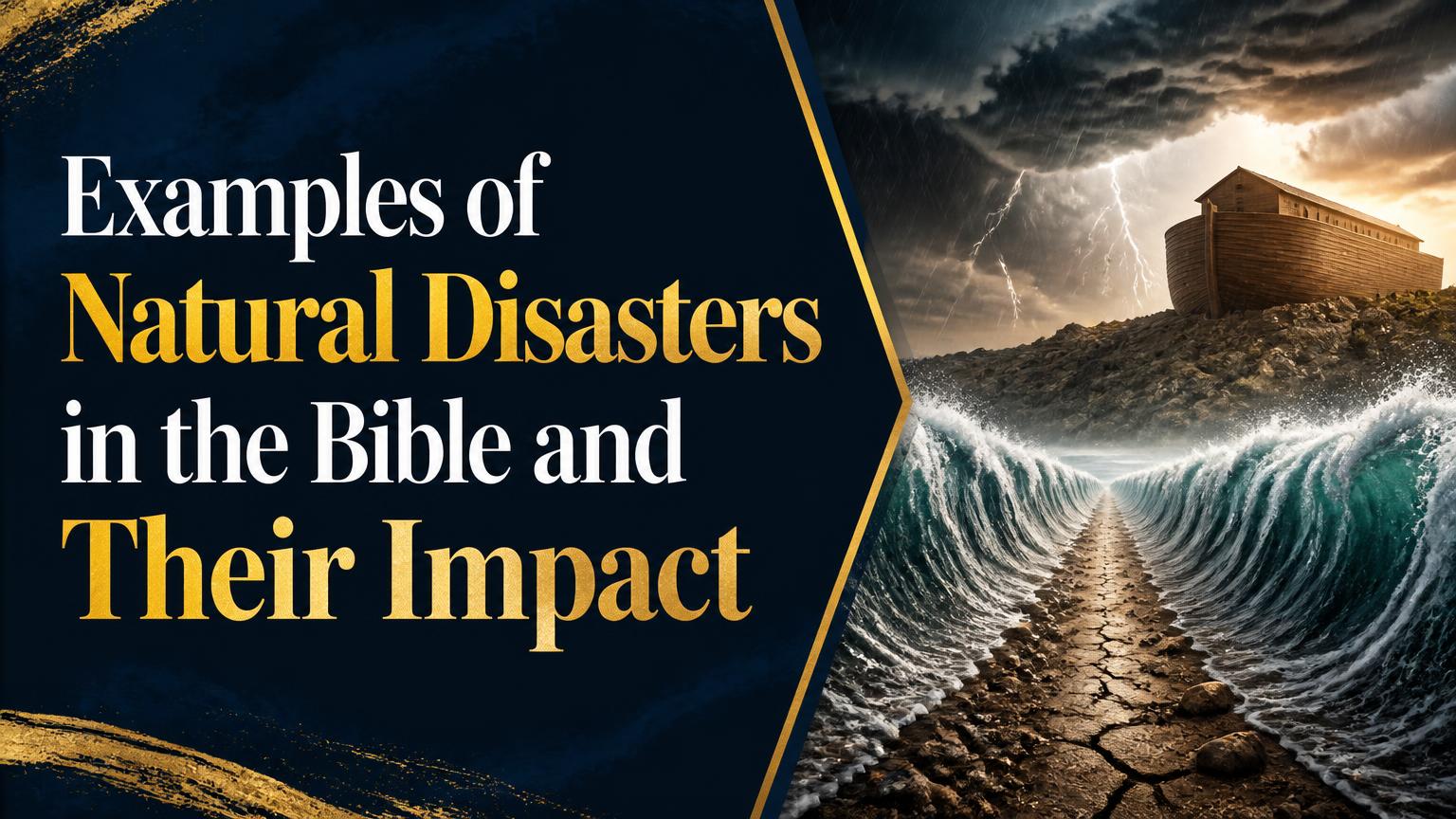
The Bible contains numerous accounts of floods, famines, droughts, earthquakes, storms, locust invasions, hail, and other destructive events. These narratives describe more than physical damage: they show how disasters caused death, displacement, hunger, economic collapse, fear, repentance, compassion, and hope. Biblical writers also interpret disasters through theological categories such as judgment, warning, providence, human vulnerability, and restoration. Those interpretations should be handled carefully, because Scripture does not authorize people to assume that every disaster proves its victims were especially sinful.
Examples of Natural Disasters in the Bible
The Bible uses a broader category of catastrophic events than modern emergency-management language usually does. Some passages describe recognizable natural hazards, while others present unusual events as miracles or direct acts of divine judgment. The examples below include both kinds, while distinguishing ordinary physical processes from explicitly supernatural events.
The Flood in Noah’s Day
The flood in Genesis 6–9 is the Bible’s most extensive disaster narrative. Genesis describes pervasive violence and corruption before God sends waters that cover the earth, destroying life outside the ark. Noah, his family, and representatives of the animals survive because they enter the ark according to God’s command.
The impact is physical, social, and theological. The flood brings mass death, separates survivors from the former world, and begins a new stage of human history. Afterward, God establishes a covenant with Noah and places the rainbow as its sign. The account therefore presents catastrophe alongside judgment, preservation, and a commitment that the earth will not again be destroyed by a flood in the same manner.
Drought and Famine Across Generations
Famine is one of the Bible’s most frequent disaster conditions. In Genesis 41–47, Egypt experiences seven years of abundance followed by seven years of severe famine. Joseph’s administrative planning stores grain during the prosperous years, allowing Egypt and surrounding peoples to survive when crops fail. The story shows that preparation can reduce suffering, even when it cannot eliminate the crisis itself.
Other examples include the famine during the time of Ruth, which contributes to Elimelech’s family leaving Bethlehem for Moab (Ruth 1:1), and the drought during Elijah’s ministry (1 Kings 17–18). Drought affects more than agriculture. It threatens livestock, reduces income, raises food prices, drives migration, and can intensify political conflict. In biblical narratives, famine often exposes how dependent communities are on rainfall, harvests, trade, and just leadership.
Earthquakes and Violent Ground Shaking
Earthquakes appear in both historical and prophetic passages. Amos begins his prophetic ministry in connection with “the earthquake” during the reigns of Uzziah and Jeroboam II (Amos 1:1), suggesting that the event was memorable enough to serve as a chronological marker. Zechariah 14:5 also refers to a major earthquake in an end-times vision.
Earthquakes occur in the New Testament at significant moments. Matthew 27:51 associates an earthquake with Jesus’ death, Matthew 28:2 with the opening of the tomb, and Acts 16:26 with the release of Paul and Silas from prison. These accounts give the physical event symbolic significance, but they do not imply that every earthquake carries an identifiable message. The earthquake at the tower of Siloam, which killed eighteen people, becomes an important example of this distinction in Luke 13:4–5.
Destructive Storms and Winds
Storms at sea create danger in several biblical accounts. In Jonah 1, a violent storm threatens a ship carrying Jonah, and the sailors respond with fear, prayer, and urgent efforts to preserve the vessel. In Mark 4:35–41, Jesus calms a storm while crossing the Sea of Galilee with his disciples. The event becomes a lesson about fear and faith as well as a demonstration of Jesus’ authority.
Acts 27 provides a different perspective. Paul’s ship encounters a prolonged and severe storm while traveling to Rome. The passengers lose cargo, equipment, and hope, although everyone ultimately survives the shipwreck. This account emphasizes practical courage, wise decisions, shared danger, and the value of competent action. Biblical storm narratives therefore include both miraculous intervention and the ordinary human struggle to endure dangerous weather.
Locust Invasions and Crop Failure
Locusts could devastate an agricultural society by consuming crops over a short period. Exodus 10 describes a locust plague in Egypt, while Joel 1 portrays successive waves of agricultural destruction: the cutting locust, swarming locust, hopping locust, and destroying locust. Whether these terms describe distinct stages or poetic descriptions of devastation, the result is clear—fields, vineyards, trees, and food supplies are ruined.
Joel connects the locust crisis with mourning, economic loss, worship, and a call to return to God. The disaster affects farmers, priests, animals, and the wider community rather than only one group. Amos 7:1–3 also depicts a vision of locusts threatening the harvest, followed by intercession. These passages show how environmental disasters can provoke both fear and communal responsibility.
Hail, Fire, and Extraordinary Signs
The seventh plague in Exodus 9 combines hail, thunder, fire, and destruction of crops, livestock, servants, and trees. The narrative presents the event as a direct act of God against Egypt and as a sign that distinguishes Israel from Pharaoh’s kingdom. Joshua 10:11 describes large hailstones falling during Israel’s battle in Canaan.
These accounts should not automatically be treated as ordinary weather reports. The text presents them within a framework of miraculous judgment and divine purpose. Similarly, the destruction of Sodom and Gomorrah in Genesis 19 involves fire and sulfur from heaven, but the passage does not provide enough information to identify the event confidently with a volcanic eruption, meteor strike, or another modern geological explanation. The theological meaning is explicit; the physical mechanism remains uncertain.
How the Bible Interprets Natural Disasters
Biblical disaster accounts do not all use the same explanation. Some attribute an event directly to God, some describe it without explaining its physical cause, and others use it symbolically in prophecy or teaching. Reading them responsibly requires keeping those categories separate.
Divine Sovereignty and Physical Events
Many biblical writers affirm that God remains sovereign over creation, including weather, seas, harvests, and nations. That conviction explains why disasters may be interpreted theologically even when the physical event itself resembles a recognizable natural hazard. The claim is about ultimate authority and meaning, not necessarily about identifying a separate supernatural interruption in every storm, earthquake, or famine.
The Bible also depicts natural processes as part of ordinary creation. Rain can nourish crops, winds can move ships, and harvests can fail. A theological reading therefore does not require denying physical causes. It asks what human beings should learn about dependence, responsibility, mortality, justice, and hope in a world where creation is powerful and vulnerable.
Judgment, Warning, and the Limits of Blame
Some disasters are explicitly connected with judgment, especially the flood, the plagues of Egypt, and certain prophetic visions. In those passages, the connection is supplied by the biblical text itself. It should not be transferred automatically to contemporary disasters or to every tragedy recorded in Scripture.
Jesus directly challenges simplistic blame in Luke 13:1–5. He mentions Galileans killed by Pilate and the eighteen people who died when the tower of Siloam fell. Jesus does not say those victims were worse sinners than other people. Instead, he uses the tragedy to confront the living with their own need for repentance. The passage permits moral reflection without permitting confident claims about the hidden guilt of disaster victims.
Compassion, Preparation, and Restoration
Disaster narratives frequently move toward practical responsibility. Joseph stores grain before famine arrives. The sailors in Jonah and Acts 27 attempt to manage life-threatening conditions. Nehemiah later rebuilds Jerusalem’s walls after social and political devastation, showing how communities respond to ruin through organized labor and shared purpose.
Compassion is equally central. Famine threatens the poor most severely, widows and migrants face heightened vulnerability, and displaced people depend on hospitality. Biblical commands to protect the needy, share resources, welcome the stranger, and care for the vulnerable become especially relevant during crisis. Disaster is therefore not only a question of why suffering occurs; it is also a test of how people respond to those who suffer.
The Impact of Natural Disasters in Biblical Accounts
The effects described in Scripture extend beyond the immediate hazard. A flood, drought, earthquake, or plague can alter family structures, economies, political relationships, religious practices, and the future of an entire community.
Death, Displacement, and Survival
The most direct impact is the loss of life. The flood, the destruction associated with Sodom, earthquakes, famine, and war-related disasters all show that communities can be permanently changed by sudden mortality. Survivors may face grief, isolation, and the challenge of rebuilding without relatives, neighbors, workers, or leaders.
Displacement is another recurring consequence. Ruth’s family leaves Bethlehem because of famine, Israel is threatened with exile in prophetic warnings, and shipwreck survivors in Acts 27 reach shore without the vessel or possessions that supported their journey. Survival in biblical narratives is rarely portrayed as a return to normal life immediately; it usually requires adaptation, trust, cooperation, and reconstruction.
Food Insecurity and Social Breakdown
Crop failure affects every level of society. Farmers lose income, laborers lose work, animals lose feed, and governments face pressure to distribute scarce supplies. Genesis 41–47 shows how famine can reshape regional power because the nation that controls stored grain gains influence over those who lack food. The story also raises ethical questions about economic dependence and the responsibilities of administrators during crisis.
Scarcity can expose injustice. People with land, money, or political access may endure longer than those without resources. Biblical concern for gleaning, debt relief, generosity, and care for widows and foreigners addresses precisely this vulnerability. Disaster relief in biblical terms is not merely private charity; it includes social practices designed to prevent the weakest from being abandoned.
Repentance, Hope, and Restoration
Biblical communities sometimes respond to disaster with fasting, prayer, confession, and renewed obedience. Joel calls the people to return to God after the locust devastation, while Elijah’s drought narrative connects national crisis with a confrontation over worship and leadership. These responses interpret disaster as an occasion for examining communal life, not simply as a private misfortune.
Hope does not erase the damage. In Joel, restoration involves renewed crops and rainfall; in Genesis, survival after the flood includes a covenant; in Acts, rescue from the storm preserves the lives of those aboard the ship. Biblical hope therefore includes both spiritual renewal and concrete recovery—food, safety, restored land, rebuilt communities, and confidence that destruction will not have the final word.
Reading Biblical Disaster Narratives Responsibly
The Bible’s examples of natural disasters should not be reduced to either scientific reports or simplistic morality tales. They are theological narratives grounded in real human experiences of danger, loss, hunger, displacement, and recovery. Some events are presented as direct divine judgments; others are described as physical occurrences whose broader meaning emerges through the surrounding story.
The most responsible reading distinguishes what the text clearly says from what readers may infer. Scripture supports humility about the causes of particular tragedies, compassion toward victims, preparation for foreseeable dangers, and serious reflection on human responsibility. It also warns against treating suffering as proof of superior righteousness or another person’s secret guilt.
Conclusion
Examples of natural disasters in the Bible include the flood, droughts and famines, earthquakes, violent storms, locust invasions, hail, and other destructive phenomena. Their impacts include death, displacement, food insecurity, economic disruption, fear, and social change. Yet the biblical emphasis extends beyond destruction. These accounts examine divine sovereignty, human vulnerability, moral responsibility, compassion, preparation, repentance, and restoration.
The Bible sometimes identifies a disaster as judgment, but it does not permit readers to assign hidden guilt to every victim. Its broader message is more demanding: suffering should produce humility rather than accusation, and crisis should call forth wisdom, generosity, courage, and hope.