
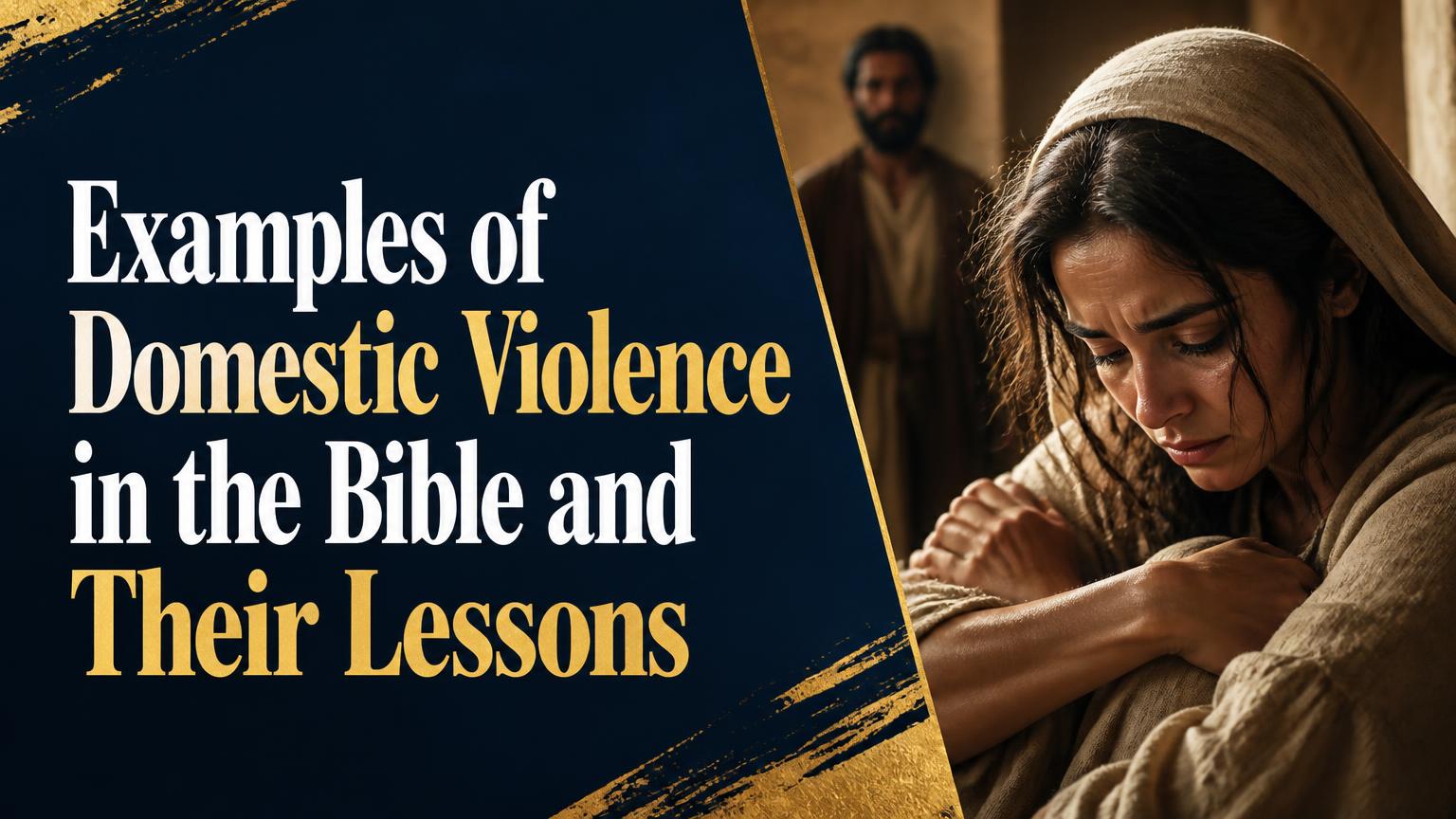
Examples of domestic violence in the Bible appear in narratives involving sexual assault, coercion, household exploitation, intimidation, and the abuse of social or religious authority. The Bible does not use the modern legal and psychological category “domestic violence,” so not every violent household story fits the definition precisely. However, these accounts clearly show that family relationships and positions of authority can be corrupted by abuse—and that describing such behavior is not the same as approving it.
Examples of Domestic Violence in the Bible
Hagar: Abuse Through Household Power
Hagar’s story in Genesis 16 and 21 shows how a vulnerable woman can be exploited within a household controlled by people with greater social and economic power.
Hagar was an enslaved Egyptian woman belonging to Sarai. At Sarai’s direction, Abram took Hagar as a secondary wife or concubine so that she could bear a child for the household. The arrangement reflected the customs of the ancient world, but it involved a severe power imbalance: Hagar could not negotiate as an equal.
After Hagar became pregnant, Sarai treated her harshly, and Hagar fled into the wilderness (Genesis 16:4–6). Later, Hagar and her son Ishmael were sent away with limited provisions (Genesis 21:8–21). The narrative does not describe every action using modern terms such as sexual coercion or domestic abuse, but it plainly presents household exploitation, harsh treatment, and the abandonment of a vulnerable mother and child.
God’s response is significant. He sees Hagar, hears Ishmael’s cry, and provides for them. That does not erase the harm they experienced, nor does it make the actions of Abram and Sarai acceptable. It shows that God’s concern extends to people with little social power, including those mistreated within a family or household.
Tamar: Sexual Violence Within a Family
The account of Tamar and Amnon in 2 Samuel 13 is one of the Bible’s clearest examples of sexual violence within a family.
Amnon, the king’s son, became obsessed with his half-sister Tamar. He manipulated her into entering his room and then overpowered her despite her protests. Tamar explicitly objected to what he was attempting. After assaulting her, Amnon’s desire turned to hatred, and he expelled her from the room.
The story exposes several elements commonly associated with domestic and sexual abuse:
- manipulation and isolation
- misuse of family and royal authority
- disregard for the victim’s refusal
- sexual assault
- rejection and humiliation after the assault
- failure of powerful people to provide adequate justice
David was angry when he heard what happened, but the narrative does not show him taking effective action against Amnon. Absalom eventually killed Amnon, but personal revenge did not restore Tamar’s dignity or repair the broader failure of justice.
The account is not a model of family life. It is a condemnation of what happens when power, entitlement, and silence protect an abuser.
David, Bathsheba, and Uriah: Abuse of Royal Power
David’s actions involving Bathsheba in 2 Samuel 11–12 are often described as adultery, but that label can obscure the unequal power involved. David was the king; Bathsheba was summoned to him. The text does not record her consent, and a person summoned by an absolute ruler could not refuse on equal terms.
David then arranged for Bathsheba’s husband, Uriah, to be placed in a position where he would be killed in battle. David’s abuse therefore involved more than sexual wrongdoing. It combined royal authority, sexual exploitation, deception, and lethal violence against a spouse.
The prophet Nathan confronted David through a story about a rich man taking a poor man’s beloved lamb. David recognized the injustice in the story before realizing that it represented his own conduct (2 Samuel 12:1–7). The confrontation establishes an important biblical principle: power does not make exploitation legitimate, and rulers remain accountable for how they treat people under their authority.
The consequences described later in David’s household should not be mistaken for a simple formula in which every victim’s suffering is a direct punishment for a perpetrator’s sin. The passage instead shows that abuse and injustice can produce lasting damage across a family and community.
Nabal and Abigail: Intimidation in a Marriage
First Samuel 25 presents Nabal as harsh, hostile, and foolish, while Abigail is portrayed as wise and discerning. Nabal’s behavior is not described in enough detail to establish a definite pattern of physical domestic violence, but the account suggests a threatening and emotionally oppressive household environment.
Abigail acts quickly when Nabal’s actions place the household in danger. She appeals to David, provides provisions, and prevents David from responding with mass violence. When Nabal later hears what happened, he becomes incapacitated and dies shortly afterward.
This story should be handled carefully. It is reasonable to discuss Nabal as an example of destructive marital character and intimidation, but the text does not explicitly say that he beat Abigail. Not every unhappy or conflict-filled marriage in the Bible should be labeled domestic violence. Responsible interpretation distinguishes clear evidence from plausible inference.
The story also warns against replacing one form of violence with another. David’s anger could have led to the killing of Nabal and every male in his household. Abigail’s intervention prevents that retaliation, showing that stopping abuse and preventing further violence require wisdom rather than uncontrolled revenge.
Lot and His Daughters: A Father’s Betrayal of Protective Responsibility
In Genesis 19:1–11, Lot offers his daughters to an angry crowd in an attempt to protect male guests in his home. The threatened violence is communal and sexual, but Lot’s response makes the event directly relevant to family abuse: he treats his daughters as possessions whose bodies can be exchanged to protect others.
The passage does not approve Lot’s decision. It presents a society so morally distorted that a father is willing to surrender his daughters to sexual violence. Later in the chapter, Lot’s daughters intoxicate him and have sexual relations with him (Genesis 19:30–38). The text reports this disturbing episode without presenting it as a model of family conduct.
The larger lesson is that violence damages the moral judgment of an entire community. It is not limited to the person who commits the final physical act. Those who endanger, trade, silence, or abandon vulnerable people also participate in the failure of protection.
The Levite’s Concubine: Domestic and Communal Sexual Violence
Judges 19 describes the abuse and death of a concubine in one of the Bible’s most horrifying narratives. The woman is connected to the Levite’s household, and the account begins with conflict between them. The exact meaning of the Hebrew description of her departure is debated; translations differ over whether she was unfaithful, angry, or simply left him.
What happens afterward is clear. The Levite retrieves her, and when a mob demands access to his male guest, he sends the woman outside. She is sexually abused throughout the night and found near the door in the morning. The Levite then transports her body and cuts it into pieces, using her death to mobilize the tribes of Israel.
This is primarily an account of communal sexual violence, but it also involves the betrayal of household responsibility. The men who should have protected the vulnerable instead treat her as expendable. The narrative’s placement within the repeated refrain that “everyone did what was right in his own eyes” presents the episode as evidence of social collapse, not divine approval.
It is also important not to blame the woman for the violence against her. Whatever conflict preceded the event, nothing justifies the Levite’s decision to surrender her or the mob’s assault.
How to Read These Passages Responsibly
Description Is Not Approval
The Bible frequently records human wrongdoing without endorsing it. Narratives about rape, abuse, betrayal, murder, and exploitation often expose the consequences of sin by showing the suffering these acts produce.
A biblical character’s action should not automatically be treated as a biblical command. The fact that Abraham, Lot, David, or the Levite behaved in a particular way does not make that behavior acceptable. Interpretation must consider the whole narrative, including who is harmed, whether anyone confronts the wrongdoing, and what consequences follow.
Ancient Context Explains Abuse but Does Not Excuse It
Ancient societies often gave men greater legal, economic, and sexual power than women. Enslavement, arranged marriages, concubinage, royal authority, and patriarchal household structures shaped the events described in the Bible.
That context helps explain why abuse could occur and why victims had limited options. It does not make the abuse morally harmless. Understanding historical context should increase precision, not become an excuse for violence.
Keep Clear Cases and Debated Cases Distinct
Tamar’s assault is an unmistakable example of sexual violence within a family. Hagar’s story clearly involves household exploitation. By contrast, Nabal’s treatment of Abigail may indicate intimidation, but the text does not document physical abuse.
These distinctions matter. Overstating uncertain evidence weakens interpretation and can make readers less attentive to cases where the text is unmistakably clear. At the same time, limiting domestic violence only to visible physical assault ignores sexual coercion, threats, exploitation, humiliation, and the misuse of authority.
Biblical Lessons About Domestic Violence
God Sees People Who Are Abused
God’s attention to Hagar and Ishmael demonstrates that social status does not determine whose suffering matters. Tamar’s desolation, the concubine’s death, and the vulnerability of women in patriarchal households reveal the human cost of treating people as property.
The biblical concern for widows, foreigners, children, the poor, and other vulnerable people provides a broader moral framework: those with power are responsible for protecting rather than exploiting those who depend on them.
Authority Must Be Used to Serve, Not Dominate
Biblical authority is never a license for cruelty. Jesus defined leadership through service and self-giving rather than control (Mark 10:42–45). Christian household teaching also instructs husbands to love their wives sacrificially and not treat them harshly (Ephesians 5:21–33; Colossians 3:19).
Those passages cannot rightly be used to command a victim to submit to assault, conceal abuse, or remain in immediate danger. Forgiveness does not remove the need for safety, truth, boundaries, or accountability.
Silence and Inaction Can Deepen Harm
David’s anger after Tamar’s assault did not provide justice. Abraham’s passivity contributed to Hagar’s vulnerability. In Judges 19, the men who should have protected the concubine failed catastrophically.
These stories show that abuse is sustained not only by perpetrators but also by people who minimize wrongdoing, protect reputations, avoid confrontation, or leave victims without practical support.
Justice Is Different From Revenge
Absalom’s killing of Amnon did not heal Tamar. David’s proposed retaliation against Nabal would have harmed many innocent people. Biblical justice seeks truth and accountability rather than uncontrolled vengeance.
For modern readers, this means that responding to domestic violence should involve protection, documentation where appropriate, competent authorities, pastoral or professional support, and care for victims—not private retaliation.
Examples of domestic violence in the Bible are therefore warnings, not templates for family life. They reveal how sexual violence, coercion, exploitation, and silence destroy individuals and communities. The central biblical lesson is that family authority must protect human dignity, and abuse must be named rather than excused through appeals to tradition, marriage, forgiveness, or religious submission.
If these passages connect to your own situation, abuse is not your fault. If you face immediate danger, contact emergency services or a trusted local domestic-violence professional, and prioritize reaching a safe place.