
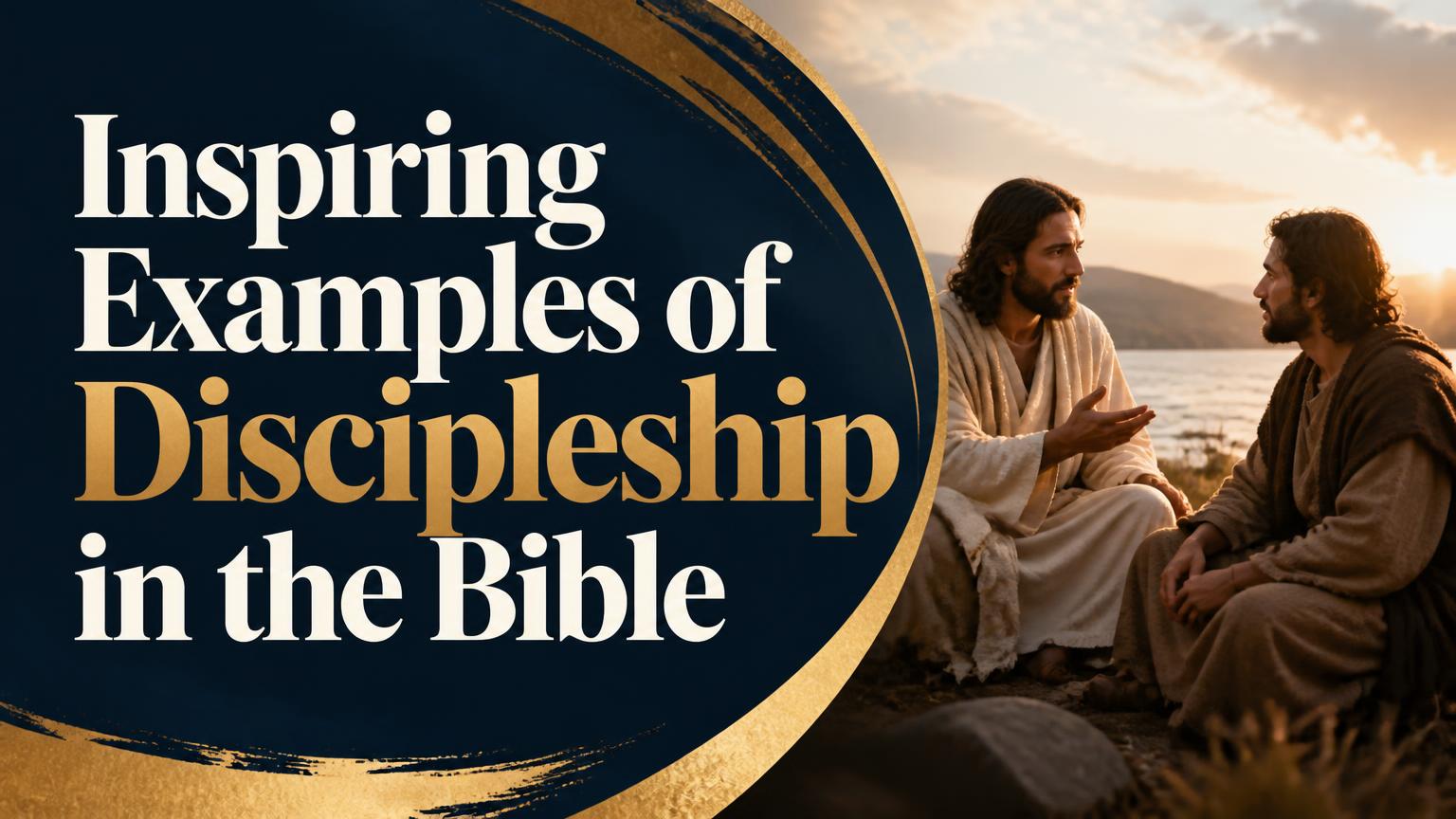
Discipleship in the Bible is more than learning religious information. It is a life of following God, being formed through instruction and example, obeying what God commands, and helping others grow in faith. The Bible presents discipleship through relationships such as Jesus and the Twelve, Moses and Joshua, Elijah and Elisha, Paul and Timothy, and Priscilla and Aquila with Apollos.
Examples of Discipleship in the Bible
The following relationships show that biblical discipleship includes teaching, imitation, correction, service, spiritual formation, mission, and eventually multiplication.
Jesus and the Twelve: Learning Through Presence, Correction, and Mission
Jesus’ relationship with the Twelve is the clearest example of discipleship in the Bible. He called ordinary people to follow Him, saying, “Follow me,” and they left their former occupations to become His disciples (Matthew 4:18–22; Mark 1:16–20).
Jesus formed them through several connected practices:
- Presence: The disciples lived and traveled with Jesus, observing how He prayed, taught, served, confronted evil, and responded to suffering.
- Instruction: He explained the meaning of God’s kingdom, Scripture, faith, prayer, humility, forgiveness, and obedience.
- Correction: Jesus confronted their fear, ambition, unbelief, and misunderstanding. When they argued about greatness, He taught them that leadership in God’s kingdom is expressed through servanthood (Mark 9:33–37; 10:35–45).
- Practice: He sent them to preach, heal, and serve, giving them opportunities to apply what they had learned (Luke 9:1–6).
- Restoration: After Peter denied Jesus, the risen Christ restored him and entrusted him with responsibility for caring for His people (John 21:15–19).
Jesus did not merely transfer information. He shaped the disciples’ character and eventually sent them to make more disciples: “Go therefore and make disciples of all nations…teaching them to observe all that I have commanded you” (Matthew 28:19–20). Biblical discipleship therefore includes both learning from Jesus and helping others obey Jesus.
Jesus and Women Disciples: Receiving, Following, and Bearing Witness
The Gospels show that discipleship was not limited to the Twelve. Women followed Jesus, learned from Him, supported His ministry, and became important witnesses to His death and resurrection.
Luke identifies Mary Magdalene, Joanna, Susanna, and many others as women who accompanied Jesus and supported His ministry (Luke 8:1–3). Mary of Bethany is commended for sitting at Jesus’ feet and listening to His teaching, a posture associated with deliberate learning (Luke 10:38–42). After the resurrection, Mary Magdalene became one of the first people to see the risen Christ and announce the news to the disciples (John 20:11–18).
These examples correct the idea that discipleship is primarily a formal leadership position. It begins with receiving Jesus’ teaching, trusting Him, remaining faithful, and bearing witness to what He has done.
Moses and Joshua: Preparing a Successor Through Service
Joshua’s relationship with Moses illustrates discipleship as long-term preparation for responsibility. Joshua served as Moses’ assistant and accompanied him in significant moments, including the ascent of Mount Sinai (Exodus 24:13; 33:11).
Joshua learned by serving before he led publicly. He observed Moses’ dependence on God, experienced Israel’s challenges, and participated in the work of guiding the nation. After Moses’ death, Joshua assumed leadership, and Scripture describes him as being filled with the spirit of wisdom because Moses had laid his hands on him (Deuteronomy 34:9).
This pattern shows why biblical discipleship often develops slowly. A disciple may begin with practical service, receive instruction through close observation, and gradually accept greater responsibility. Leadership is not treated as a platform to seize but as a stewardship for which a person is prepared.
Elijah and Elisha: Following Faithfully and Continuing the Work
Elisha’s relationship with Elijah provides another example of discipleship and succession. Elijah found Elisha working in the field and called him to follow (1 Kings 19:19–21). Elisha then served Elijah and remained with him through the final stage of Elijah’s ministry.
When Elijah was taken into heaven, Elisha asked for a “double portion” of Elijah’s spirit (2 Kings 2:9–12). This request was not simply a desire for personal power. It expressed a desire to continue faithfully in the prophetic calling. Elisha’s ministry carried forward the work God had begun through Elijah, although Elisha was not merely a copy of his predecessor.
The relationship demonstrates that discipleship involves both imitation and distinct calling. A disciple learns from a spiritual predecessor but must ultimately serve God in the responsibilities God assigns.
Barnabas and Paul: Encouraging and Making Room for Emerging Leaders
Barnabas demonstrates a form of discipleship that is often overlooked: recognizing potential in someone others distrust. After Paul’s conversion, many believers were afraid of him because of his previous persecution of Christians. Barnabas, however, took Paul to the apostles and testified about his conversion and preaching (Acts 9:26–27).
Later, Barnabas went to Tarsus to find Paul and brought him to Antioch, where they taught the church together for a year (Acts 11:25–26). Barnabas did not treat Paul’s abilities as a threat. He helped create an environment in which Paul could mature and serve.
This example highlights advocacy as part of discipleship. Mature believers sometimes disciple others by giving them credibility, opening opportunities, offering partnership, and helping the wider community recognize God’s work in them. Discipleship is therefore not only one-on-one instruction; it can also involve collaboration that develops ministry capacity.
Paul and Timothy: Teaching Faith for Future Generations
Paul’s relationship with Timothy is one of the most explicit examples of intentional Christian discipleship. Paul invited Timothy to join his ministry team (Acts 16:1–3), addressed him as a beloved and faithful son (1 Corinthians 4:17), and trusted him with significant pastoral responsibilities.
Paul instructed Timothy to remain faithful to the gospel, develop his character, teach sound doctrine, and endure hardship. In 2 Timothy 2:2, Paul gives a pattern of multiplication: Timothy is to entrust what he has learned to faithful people who will be able to teach others also.
The sequence contains four generations of transmission:
- Paul receives and teaches the gospel.
- Timothy receives it from Paul.
- Timothy teaches reliable believers.
- Those believers teach others.
Paul also discipled Timothy through personal example. Timothy had observed Paul’s teaching, conduct, purpose, faith, patience, love, endurance, and suffering (2 Timothy 3:10–11). This reveals that discipleship depends on both doctrine and visible character. People learn not only from what a disciple says but from how that person lives under pressure.
Priscilla and Aquila With Apollos: Correcting With Humility and Respect
Apollos was an eloquent and knowledgeable teacher who understood aspects of the message about Jesus but had an incomplete understanding. Priscilla and Aquila heard him speaking and “took him aside” to explain the way of God more accurately (Acts 18:24–26).
Their approach is significant. They corrected Apollos privately rather than humiliating him publicly. Apollos, in turn, continued to serve effectively and became a valuable teacher and defender of the faith (Acts 18:27–28).
This account presents discipleship as a relationship in which correction strengthens ministry rather than diminishing the person being corrected. It also shows that discipleship can occur between people with different backgrounds and that mature disciples should be willing both to teach and to learn.
What These Biblical Examples Reveal About Discipleship
Although the relationships differ, they share a recognizable pattern. Biblical discipleship is:
- Centered on God’s call: Moses, Joshua, Elijah, Elisha, Jesus, and the apostles act in response to God’s purposes rather than personal ambition.
- Relational: Growth takes place through close association, trust, conversation, service, and shared life.
- Grounded in truth: Disciples are taught Scripture, the gospel, God’s commands, and the meaning of faithful obedience.
- Demonstrated through example: Jesus, Paul, Moses, and others model the attitudes and practices they teach.
- Open to correction: Peter, the Twelve, Timothy, and Apollos all needed instruction or redirection.
- Directed toward service: Discipleship prepares people to serve God and others, not merely to accumulate knowledge.
- Reproductive: Healthy discipleship equips people to help others grow, as seen in Jesus’ commission and Paul’s instruction to Timothy.
These features also distinguish discipleship from simple mentoring or information transfer. A mentor may help someone gain a skill, while a biblical disciple is formed in faith, character, obedience, and mission. The goal is not dependence on the discipler’s personality but deeper dependence on God and faithful participation in His work.
How to Practice Biblical Discipleship Today
A church, small group, or individual can apply these patterns without copying the exact circumstances of the biblical relationships. Effective discipleship may include:
- Studying Scripture together: Discuss not only what a passage means but how it calls people to think and live.
- Sharing life honestly: Trust grows when people can discuss temptation, suffering, decisions, and spiritual questions without pretending.
- Modeling obedience: A discipler should demonstrate prayer, repentance, service, generosity, and integrity rather than merely assigning religious activities.
- Practicing ministry: Invite developing disciples to serve, teach, visit, encourage, or lead appropriate tasks with guidance.
- Giving constructive correction: Address error clearly but with humility, respect, and the aim of restoration.
- Releasing responsibility: Disciples mature when they are trusted with meaningful work rather than kept permanently dependent on a leader.
- Preparing them to disciple others: The process should continue beyond one relationship, allowing faith and wisdom to be passed on.
Jesus’ command in Matthew 28:19–20 includes baptizing and teaching people to observe everything He commanded. That means discipleship involves the whole life: beliefs, relationships, habits, decisions, worship, suffering, and service.
Common Misunderstandings About Biblical Discipleship
Biblical discipleship is not limited to clergy, pastors, or formal teachers. Every Christian is called to follow Jesus, and many believers can help others grow through ordinary faithfulness.
It is also not the same as controlling another person. Jesus corrected and instructed His disciples, but He formed them to obey God rather than to remain dependent on His human presence. Christian discipleship should build maturity, wisdom, responsibility, and freedom to serve.
Finally, discipleship does not require perfection from the discipler. Peter failed, the Twelve misunderstood Jesus, and Paul had to grow. What matters is faithful dependence on Christ, willingness to repent, and commitment to help others follow Him.
The Bible’s examples show that discipleship is a shared process of following, learning, obeying, serving, and reproducing faith. Jesus provides the central model: He calls people into relationship, teaches them truth, corrects them with patience, restores them after failure, gives them opportunities to serve, and sends them to make disciples of others.