
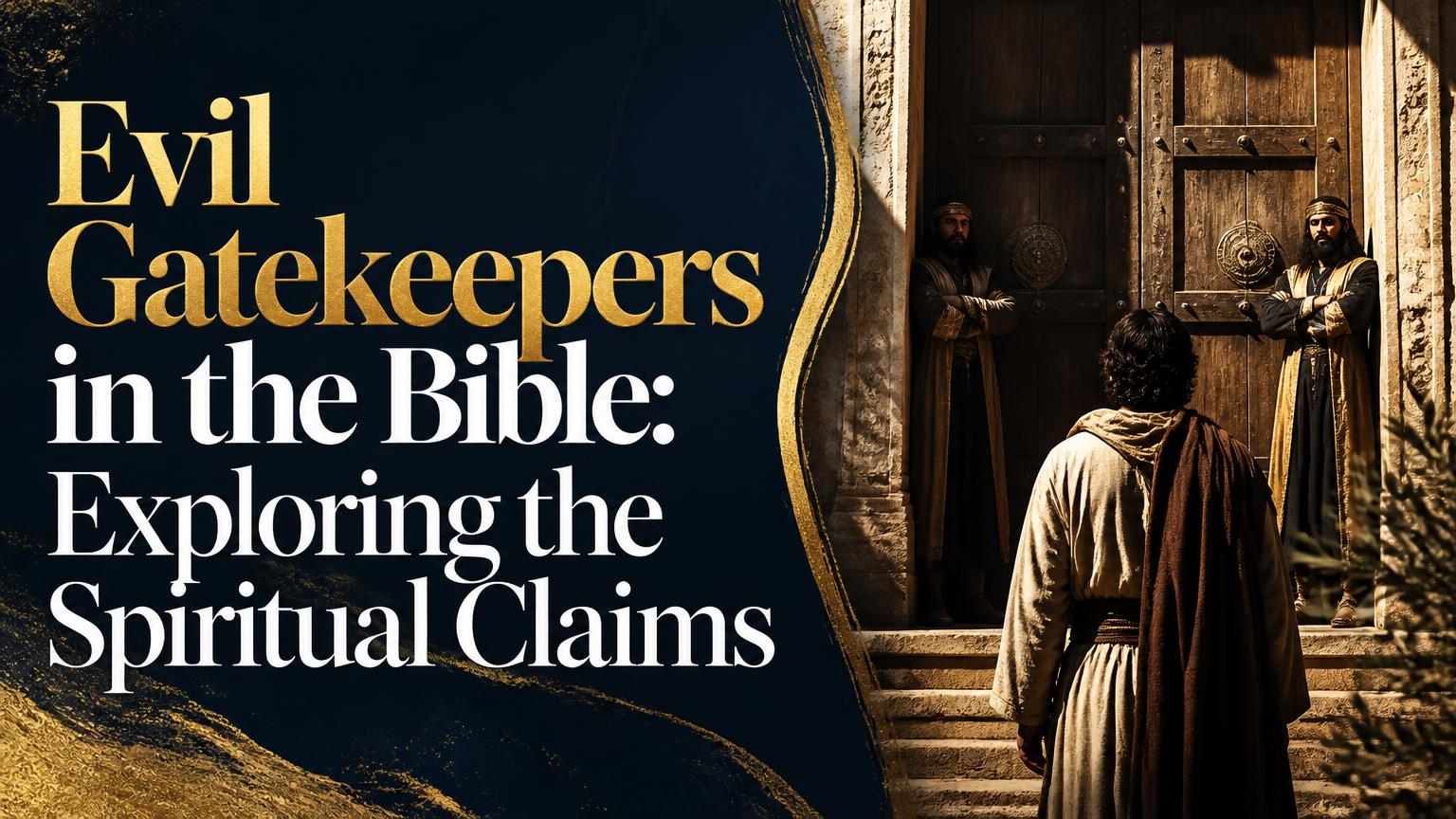
The Bible does not use “evil gatekeepers” as a formal category for a special class of demons or spiritual beings. In Scripture, gatekeepers were usually Levites assigned to guard the entrances, rooms, and treasures of the temple. However, the Bible does condemn human authorities who obstruct people from knowing God, burden them with extra requirements, exploit spiritual power, or prevent access to truth. Understanding the difference between faithful protection and abusive control is essential when interpreting claims about evil gatekeepers in the Bible.
What Are Evil Gatekeepers in the Bible?
“Evil gatekeepers” is best understood as a descriptive phrase rather than a biblical title. It can refer metaphorically to people who control access to religious truth, worship, community, or influence in ways that oppose God’s character. Scripture also uses gates symbolically for authority, judgment, power, and access.
The Bible therefore supports a careful distinction: some people are entrusted with legitimate responsibility, while others misuse that responsibility to exclude, manipulate, or deceive. It does not, however, clearly teach that a standardized group of evil spirits guards spiritual portals, family lines, cities, blessings, or secret dimensions.
Biblical Gatekeepers Were Usually Servants, Not Villains
The Old Testament describes gatekeepers as Levites who served at the tabernacle and temple. First Chronicles 9:19–27 and 1 Chronicles 26 describe their assignments, which included guarding entrances, supervising chambers, protecting sacred objects, and managing temple stores. Second Chronicles 23:19 says that gatekeepers were placed at the entrances of the house of the Lord to prevent anything unclean from entering.
Their work was practical and religiously significant. They helped preserve order, protect holy property, and ensure that worship took place according to Israel’s covenant responsibilities. The term itself does not imply wickedness. In many cases, these gatekeepers were performing a faithful ministry of stewardship.
This matters because a biblical role should not be judged by a modern spiritual label. Guarding a boundary is not automatically oppressive. The moral question is whether the boundary serves God’s purposes, protects people, and agrees with revealed truth—or whether it is being used for control and exclusion.
The Bible Condemns Leaders Who Block Access to God
Although temple gatekeepers were generally legitimate servants, Scripture strongly criticizes religious leaders who place themselves between people and God. Jesus condemned scribes and Pharisees for shutting the kingdom of heaven in people’s faces and refusing to enter themselves, as described in Matthew 23:13. In Luke 11:52, he accused legal experts of taking away the “key of knowledge,” preventing others from entering while failing to enter themselves.
These passages provide the clearest biblical basis for speaking metaphorically about evil gatekeeping. The problem was not that leaders taught, interpreted Scripture, or exercised responsibility. The problem was that they distorted God’s will, burdened others, rejected correction, and used religious authority to preserve their status.
John 10:1–10 uses related imagery. Jesus contrasts himself with thieves and false shepherds who approach the sheep improperly and harm them. The passage does not establish a technical doctrine of evil gatekeeper spirits. Instead, it exposes leaders who exploit God’s people rather than protect and serve them.
The Bible Does Not Teach a Standard Class of Evil Gatekeeper Spirits
The Bible clearly teaches the existence of Satan, demons, spiritual opposition, and “rulers and authorities” of darkness, particularly in passages such as Ephesians 6:12. Yet it does not identify a formal hierarchy called “evil gatekeepers” whose assigned task is to control spiritual entrances or determine who can receive God’s favor.
Some modern teachings use “gatekeeper” language to describe territorial spirits, ancestral powers, occult entities, or invisible beings believed to control access to blessings. Such claims may draw on biblical words such as “gates,” “keys,” or “powers,” but those words do not by themselves establish the teaching.
Biblical interpretation must distinguish what Scripture explicitly says from later theological systems or spiritual vocabulary. The Bible warns believers about spiritual evil, but it directs them toward faith in Christ, truth, prayer, obedience, and discernment—not toward fear of an undefined network of gatekeeping spirits.
What Biblical Gatekeepers Actually Did
Temple gatekeepers had a defined institutional role within Israel’s worship. Their responsibilities show that biblical gatekeeping was connected to stewardship and accountability rather than mystical control. This background helps prevent the common mistake of treating every reference to a gate as evidence of a spiritual portal or demonic guardian.
Guarding the Temple and Its Treasures
The gatekeepers watched the temple entrances, cared for rooms and storage areas, and helped protect offerings and sacred equipment. First Chronicles 26 presents organized divisions of gatekeepers, including families assigned to particular gates. Their work required trustworthiness because they were responsible for material connected with worship.
Their authority was limited and delegated. They did not own the temple, invent the requirements for approaching God, or decide who was spiritually worthy according to personal preference. They served within a structure established by God’s law and Israel’s worship.
This distinction remains useful. A person may have genuine responsibility in a religious community without possessing unlimited authority over other people’s consciences. Faithful guardianship protects what belongs to God; abusive gatekeeping treats God’s people and truth as private property.
Protecting Holiness Without Claiming Spiritual Ownership
The Old Testament included real restrictions concerning holiness, priestly service, sacrifices, and access to particular parts of the sanctuary. These restrictions belonged to Israel’s covenant system and were tied to God’s presence among his people. They should not be transferred carelessly into claims that modern leaders can personally control access to God.
The New Testament places access to God in Christ rather than in a class of human intermediaries. Jesus says, “I am the way” in John 14:6, while Hebrews 10:19–22 describes believers approaching God through Jesus with confidence. First Timothy 2:5 also emphasizes the unique mediating role of Christ.
Church leaders still teach, shepherd, correct, and exercise appropriate responsibility. But those duties do not make them owners of salvation or exclusive brokers of God’s presence.
How Gates Represent Spiritual Authority and Opposition
Biblical references to gates often carry meanings broader than physical entrances. A gate could represent a city’s public life, a place of legal judgment, political influence, military strength, or access to worship. The context determines whether the gate is literal, symbolic, or both.
City Gates as Places of Judgment and Influence
In ancient Israel, city gates were centers of public life. Elders conducted legal proceedings there, agreements were witnessed there, and community decisions were often made there. References to leaders “sitting in the gate,” such as in Ruth 4 and Proverbs 31:23, can indicate public authority and social standing.
That background explains why “gatekeeping” can function as a useful metaphor. A person with influence may shape who receives a hearing, which ideas are accepted, or how a community treats outsiders. If that authority is used to silence truth, exploit the vulnerable, or protect injustice, the conduct is morally wrong.
The metaphor should still be used carefully. Not every person who makes a decision, enforces a boundary, or evaluates teaching is an evil gatekeeper. Biblical communities require discernment and order. The issue is the purpose, fairness, and accountability behind the authority.
The Gates of Hades and the Power of Death
In Matthew 16:18, Jesus says that the “gates of Hades” will not prevail against his church. The phrase is commonly understood as an image of death and the powers opposed to God. It does not describe a named gatekeeper standing at a literal entrance to the underworld.
The emphasis of the passage is the inability of death and opposition to overcome Christ’s purposes. Revelation 1:18 reinforces this theme by presenting Jesus as the one who holds the keys of death and Hades. The text points authority toward Christ rather than toward human spiritual specialists or imagined gatekeeping entities.
Consequently, Christians should not use Matthew 16:18 as proof that particular people possess secret knowledge about demonic gates. The passage is a declaration of Christ’s authority and the ultimate security of his mission.
Jesus as the True Door to God
John 10 presents Jesus as the gate, or door, of the sheep. Through him, the sheep enter, find safety, and receive pasture. The image communicates protection, belonging, and access to life. It also contrasts Jesus’ self-giving care with leaders who exploit the flock.
This teaching directly challenges any system in which a person claims that God can be reached only through their private permission, special revelation, payment, or personal loyalty. Christian faith includes teachers and shepherds, but their role is to direct people toward Christ and Scripture, not to replace Christ.
A leader who points beyond himself, welcomes honest examination, and serves the vulnerable reflects the biblical pattern. A leader who demands dependence on his personality or claims exclusive control over spiritual access resembles the kind of authority Jesus condemned.
How to Recognize Harmful Spiritual Gatekeeping Today
The biblical concern is not simply whether someone controls an entrance. It is whether that control is faithful, truthful, and accountable. Modern religious abuse often appears when legitimate leadership becomes a system of fear and dependency.
Signs of Abusive Religious Control
Harmful spiritual gatekeeping may involve several recurring behaviors:
- Claiming exclusive access to God, Scripture, prophecy, healing, or salvation
- Treating questions as rebellion rather than allowing responsible examination
- Adding personal rules to the gospel and presenting them as divine commands
- Using threats, shame, or predictions of spiritual disaster to secure compliance
- Exploiting money, labor, personal information, or emotional dependence
- Protecting leaders from accountability while demanding total submission from followers
- Excluding sincere believers for reasons unrelated to biblical truth
- Silencing reports of abuse or discouraging victims from seeking outside help
These signs do not mean every disagreement proves that a leader is evil. Churches may have legitimate doctrines, membership expectations, safeguarding procedures, and disciplinary processes. The concern arises when authority becomes coercive, self-protective, and resistant to truth.
The Biblical Standard for Spiritual Leaders
The New Testament presents leadership as service rather than domination. Jesus teaches in Mark 10:42–45 that greatness among his followers is expressed through serving others. First Peter 5:2–3 instructs elders to shepherd willingly and not to domineer over those entrusted to them.
Leaders are also accountable to sound teaching and moral character. The qualifications in 1 Timothy 3 and Titus 1 emphasize self-control, integrity, hospitality, faithfulness, and the ability to teach. These requirements show that spiritual authority is not validated by charisma, impressive claims, or supernatural language alone.
A faithful leader may warn, correct, and establish boundaries, but those actions should aim at protection, restoration, and truth. Authority becomes corrupt when it serves the leader’s image, wealth, or control instead of the good of the people and the honor of God.
A Wise Response to Manipulation
Believers should test spiritual claims rather than accepting every statement about gates, curses, demons, or hidden powers. The Bereans in Acts 17:11 are commended for examining teaching against the Scriptures. Prayer, mature counsel, careful reading, and honest conversation can expose claims that depend more on fear than on biblical evidence.
Someone experiencing spiritual abuse may also need practical protection. Speaking with trusted mature Christians, qualified counselors, safeguarding professionals, or appropriate civil authorities can be necessary, particularly when threats, financial exploitation, sexual abuse, or physical danger is involved. Seeking safety is not a failure of faith.
The most reliable response is not to replace one form of spiritual control with another. Scripture directs attention to Christ, whose authority is truthful and self-giving. No human leader should be treated as an untouchable spiritual gatekeeper.
What Evil Gatekeepers in the Bible Teach Christians Today
The Bible’s actual temple gatekeepers were servants entrusted with protection and order, not occult figures controlling access to divine power. The closest biblical parallel to “evil gatekeepers” is found in leaders who misuse religious authority to obstruct truth, burden people, exploit trust, or prevent others from approaching God.
That distinction protects against two opposite errors. One error is dismissing spiritual evil altogether; Scripture clearly warns about it. The other is assigning biblical authority to a speculative system of invisible gatekeepers that Scripture does not clearly teach. Sound interpretation keeps the focus on what the Bible actually reveals.
Christians may practice wise discernment, maintain appropriate boundaries, and hold leaders accountable without treating every authority figure as evil. Since access to God rests in Jesus Christ rather than in human permission, spiritual leadership should guide people toward him—not make them dependent on the leader who claims to stand at the gate.