
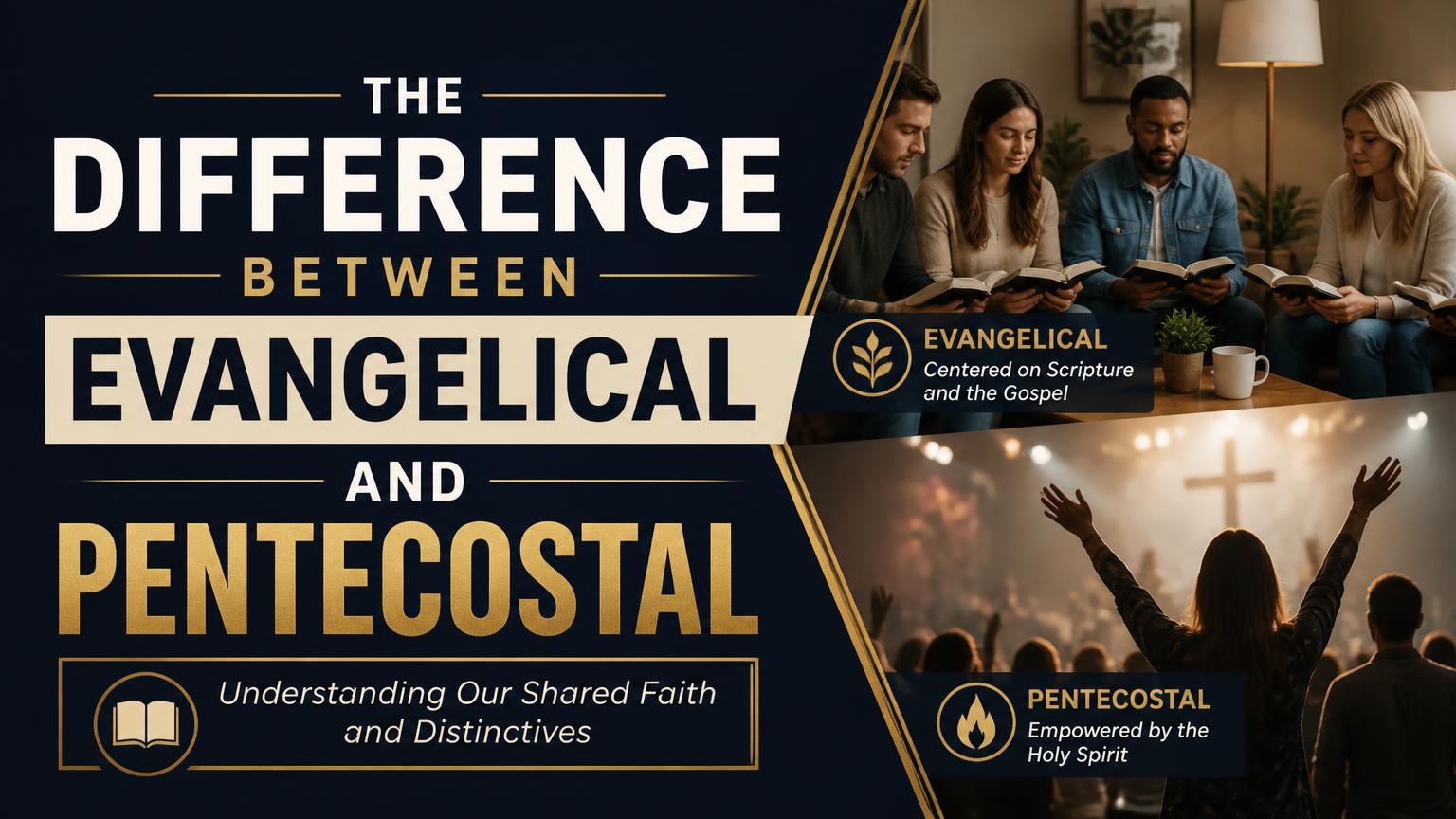
Evangelical and Pentecostal Christians share many central Christian beliefs, including the authority of Scripture, the deity of Jesus Christ, salvation through his death and resurrection, the need for personal faith, and the mission of evangelism. The main difference is emphasis: evangelical describes a broad Protestant movement centered on the gospel and biblical authority, while Pentecostal describes a more specific Christian tradition emphasizing the present work of the Holy Spirit, spiritual gifts, healing, prophecy, and often speaking in tongues.
The categories overlap. Many Pentecostals consider themselves evangelical, but not every evangelical is Pentecostal.
Difference Between Evangelical and Pentecostal
What “Evangelical” Means
“Evangelical” comes from a word meaning “gospel” or “good news.” In modern Christianity, it generally refers to Protestants who emphasize:
- The authority and trustworthiness of the Bible
- Salvation by God’s grace through personal faith in Jesus Christ
- The necessity of conversion or being “born again”
- The central importance of Jesus’ death and bodily resurrection
- Evangelism and the proclamation of the gospel
- The responsibility of Christians to live according to biblical teaching
Evangelicalism is not one denomination. It includes Baptists, many non-denominational churches, Reformed and Presbyterian churches, Methodists, Anglicans, Bible churches, and some Pentecostal and charismatic churches.
Because evangelicalism is a broad movement, evangelical beliefs can differ substantially. Some evangelicals believe certain spiritual gifts, such as prophecy and tongues, continue today. Others believe that some or all miraculous gifts were primarily given during the apostolic era. Some are Calvinist, while others are Arminian or hold positions between those systems.
What “Pentecostal” Means
“Pentecostal” refers to Christians who place particular emphasis on the events of Pentecost in Acts 2, when the Holy Spirit came upon Jesus’ disciples and they spoke in other languages.
Pentecostals generally teach that the Holy Spirit actively empowers believers today and that the spiritual gifts described in passages such as 1 Corinthians 12–14 remain available to the church. Commonly emphasized gifts include:
- Speaking in tongues
- Interpretation of tongues
- Prophecy
- Healing
- Words of knowledge
- Miraculous faith
Many classical Pentecostal denominations teach a distinct experience called the baptism in the Holy Spirit. They often understand this as empowerment for Christian witness, drawing on Acts 1:8. In many classical Pentecostal groups, speaking in tongues is regarded as the initial physical evidence of this experience. However, Pentecostal denominations do not all explain the experience in exactly the same way.
Pentecostal churches include Assemblies of God, Church of God in Christ, the International Pentecostal Holiness Church, the Foursquare Church, and many independent congregations. Pentecostalism is also a major global movement with considerable theological and cultural diversity.
Where Evangelicals and Pentecostals Overlap
The two traditions usually agree on the core Christian message. Both commonly affirm that:
- There is one God who exists as Father, Son, and Holy Spirit.
- Jesus Christ is fully divine and fully human.
- Jesus died for sin and rose bodily from the dead.
- People need reconciliation with God through Christ.
- The Bible is authoritative for Christian faith and practice.
- Christians are called to make disciples and proclaim the gospel.
- The church should worship God and serve others.
These shared convictions explain why Pentecostal churches are often included within the wider evangelical family. The difference is usually not whether Pentecostals believe the gospel, but how they understand the Holy Spirit’s work and the operation of spiritual gifts.
The Main Difference: The Holy Spirit and Spiritual Gifts
The clearest distinction concerns the Holy Spirit.
Evangelical churches vary. A continuationist evangelical believes that gifts such as prophecy, healing, and tongues continue today. A cessationist evangelical believes that some miraculous gifts served a foundational purpose in the early church and are not ordinarily given today. Other evangelicals avoid rigid categories and accept some forms of supernatural ministry while rejecting others.
Pentecostals typically expect the Holy Spirit to work through supernatural gifts in the contemporary church. They may include prayer for healing in regular services, invite prophetic ministry, or provide opportunities for tongues and interpretation according to their understanding of 1 Corinthians 12–14.
This difference reflects different interpretations of biblical passages. Pentecostals often point to Acts as a continuing pattern for Christian experience and to Paul’s teaching that believers should desire spiritual gifts. Evangelicals who reject Pentecostal practice may emphasize the unique role of the apostles, the sufficiency of Scripture, or the need to test claimed revelations carefully.
The disagreement is therefore not simply about whether the Holy Spirit exists. Both traditions affirm the Holy Spirit. It concerns how the Spirit gives guidance, empowers believers, and manifests gifts in the church today.
Salvation, Grace, and Christian Life
Evangelicals and Pentecostals generally agree that salvation is by God’s grace and is received through faith in Jesus Christ, not earned through good works. They commonly appeal to passages such as Ephesians 2:8–9 and Romans 3:23–26.
The traditions can differ in their broader theology of salvation. Many evangelical churches are Reformed or Calvinist, while many Pentecostal churches hold an Arminian or Wesleyan view that emphasizes human response, free will, and the possibility of turning away from faith. These are tendencies rather than universal rules. Evangelicals include both Calvinists and Arminians, and Pentecostal denominations also differ among themselves.
Pentecostals may place stronger practical emphasis on receiving the Holy Spirit’s power, spiritual warfare, divine healing, and victorious Christian living. Evangelicals may place greater emphasis on doctrinal teaching, biblical preaching, discipleship, and systematic study. In practice, many churches in both traditions emphasize all of these areas.
Worship Style and Church Experience
Pentecostal worship is often characterized by expressive participation. Services may include extended singing, raised hands, spontaneous prayer, healing ministry, testimonies, prophetic messages, or speaking in tongues with interpretation.
Evangelical worship ranges from highly formal services to contemporary gatherings with modern music and informal prayer. Some evangelical churches have worship that looks very similar to Pentecostal worship, especially in charismatic or non-denominational settings. Others use a more structured order of service with a strong focus on preaching and congregational singing.
Worship style alone cannot reliably identify a church’s theology. A church may use contemporary music without being Pentecostal, or it may worship quietly while affirming Pentecostal beliefs.
Key Differences in Belief and Practice
| Area | Evangelical Christianity | Pentecostal Christianity |
|---|---|---|
| Category | Broad Protestant movement or identity | Specific Christian tradition and movement |
| Central emphasis | Gospel, conversion, biblical authority, and evangelism | Holy Spirit empowerment and present spiritual gifts |
| Spiritual gifts | Views range from cessationist to continuationist | Usually affirms the ongoing operation of spiritual gifts |
| Tongues | Accepted by some, rejected or deemphasized by others | Commonly accepted; often significant in classical Pentecostal theology |
| Healing | May be practiced, cautiously affirmed, or viewed differently | Usually emphasizes prayer for divine healing |
| Worship | Wide range of styles | Often expressive, participatory, and open to spontaneous ministry |
| Salvation theology | Includes Calvinist, Arminian, and other positions | Often Arminian or Wesleyan, though not uniformly |
| Relationship between categories | May or may not be Pentecostal or charismatic | Often evangelical in its gospel commitments |
Are Pentecostals Evangelical?
Many Pentecostals are evangelical, especially when “evangelical” refers to commitment to the biblical gospel, personal conversion, and evangelism. Pentecostal denominations often operate seminaries, missions organizations, Bible colleges, and churches that fit comfortably within the broader evangelical world.
However, the two terms are not interchangeable. “Evangelical” identifies a broad theological and ecclesial family, while “Pentecostal” identifies a particular approach to the Holy Spirit and spiritual gifts. A Baptist church may be evangelical without being Pentecostal. A Pentecostal church may also be evangelical, but its Pentecostal identity adds beliefs and practices that are not shared by all evangelicals.
The term charismatic creates another point of overlap. Charismatic Christians affirm the continuation of spiritual gifts but may belong to historically non-Pentecostal denominations, such as Catholic, Anglican, Lutheran, or mainline Protestant churches. Classical Pentecostalism developed as a distinct movement, whereas the charismatic movement spread renewal theology within existing denominations.
Important Misconceptions
Pentecostal Does Not Mean Non-Evangelical
Pentecostals are not automatically outside evangelical Christianity. Their distinctive teachings about the Holy Spirit usually supplement, rather than replace, their belief in the gospel of Jesus Christ.
Evangelical Does Not Mean Anti-Supernatural
Some evangelicals reject contemporary tongues or prophecy, but others affirm them. Evangelicalism includes both cessationist and continuationist positions, so the label alone does not settle the question.
Spiritual Gifts Do Not Automatically Prove Spiritual Maturity
Paul’s teaching in 1 Corinthians shows that a church can exercise spiritual gifts while still struggling with division, pride, and disorder. Gifts must therefore be evaluated alongside love, holiness, sound doctrine, and the fruit of the Spirit. In 1 Corinthians 13, Paul places love above impressive spiritual experiences, and Galatians 5:22–23 describes character as evidence of the Spirit’s work.
Pentecostal Churches Are Not All Identical
Pentecostal denominations differ over baptism in the Holy Spirit, tongues, women in ministry, divine healing, prosperity teaching, church leadership, and the relationship between spiritual experience and formal doctrine. It is more accurate to speak of Pentecostal traditions than to assume every Pentecostal congregation holds identical beliefs.
How to Evaluate a Church in Either Tradition
The labels “evangelical” and “Pentecostal” provide useful orientation but do not tell the whole story. Someone comparing churches should examine:
- What the church teaches about Jesus’ identity and resurrection
- How it explains salvation and the authority of Scripture
- Whether claimed revelations are tested against biblical teaching
- How it understands spiritual gifts and healing
- Whether worship is orderly, Christ-centered, and edifying
- How leaders are chosen and held accountable
- Whether the church demonstrates love, integrity, service, and concern for the vulnerable
A Pentecostal church should not be judged solely by expressive worship, and an evangelical church should not be judged solely by its preaching style. The more important question is how faithfully the congregation teaches Scripture, follows Christ, and lives out its stated beliefs.
The difference between evangelical and Pentecostal is primarily one of scope and emphasis. Evangelicalism is a broad Protestant movement centered on the gospel, biblical authority, conversion, and evangelism. Pentecostalism is a more specific tradition within—or closely overlapping with—that wider world, distinguished by its emphasis on the present activity of the Holy Spirit and spiritual gifts. The categories overlap, but they should not be treated as synonyms.