
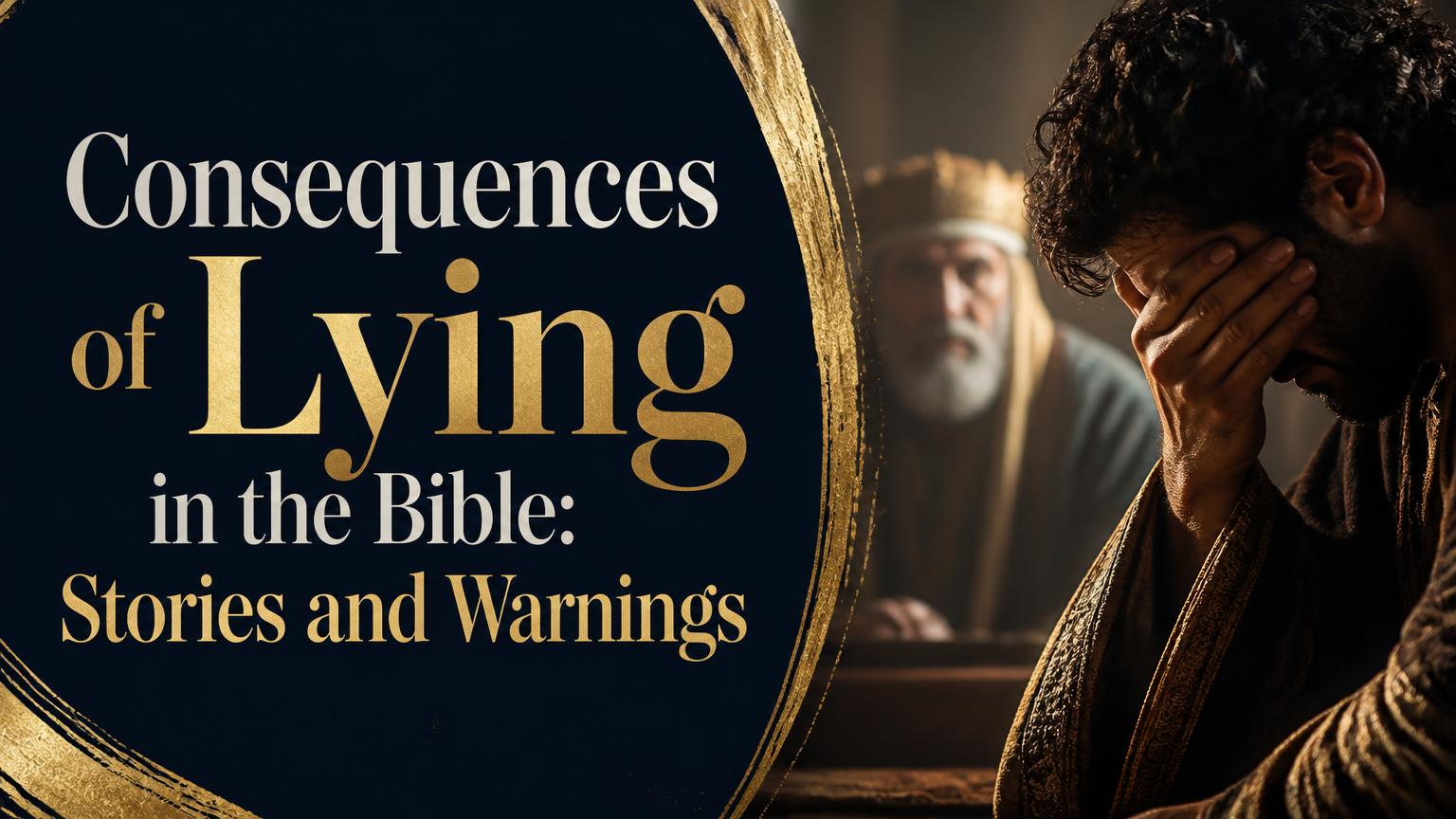
Lying in the Bible is treated as more than a minor breach of etiquette. Scripture connects falsehood with damaged relationships, injustice, spiritual corruption, divine judgment, and the loss of trust. Some biblical stories show immediate consequences, such as the deaths of Ananias and Sapphira, while others reveal slower effects: family division, guilt, fear, and the unraveling of communities. Yet the Bible also presents confession, repentance, forgiveness, and restored integrity as possible responses for those who turn away from deception.
Consequences of Lying in the Bible
Separation From God’s Truth
The Bible presents God as truthful and faithful, so lying opposes his character. Proverbs 12:22 says that “lying lips are an abomination to the LORD,” while Ephesians 4:25 instructs believers to put away falsehood and speak truthfully to one another. The issue is not merely that a lie contains inaccurate information. It represents a deliberate refusal to deal honestly with God, other people, or reality itself.
This spiritual consequence can become especially serious when a person uses religious language to hide deception. In Acts 5:1–11, Ananias and Sapphira sold property and gave part of the money to the church while pretending that they had given the entire amount. Peter made clear that they were not required to surrender all the proceeds; their sin was dishonest representation. Their lie was ultimately described as lying to the Holy Spirit and to God.
The account does not mean that every lie receives immediate physical judgment. It does show that God sees hidden motives and that deception within a worshiping community is spiritually serious. Lying can create an outward appearance of faithfulness while weakening genuine fellowship with God.
Broken Trust and Harm to Others
A lie commonly damages trust because it prevents another person from making decisions based on the truth. This harm becomes more severe when the lie concerns money, marriage, testimony in court, leadership, or another person’s reputation. The commandment against bearing false witness protects both individuals and the wider community from accusations that can destroy lives.
Joseph’s brothers provide a powerful example. They deceived Jacob by presenting Joseph’s bloodstained garment and allowing him to believe that his son had been killed (Genesis 37:31–35). Their lie caused years of grief for their father. The deception also burdened the brothers themselves with secrecy and guilt, which became evident when they later connected their suffering with what they had done to Joseph (Genesis 42:21–22).
Biblical law recognized that false testimony could produce concrete injustice. Deuteronomy 19:16–19 required a false witness to face the penalty intended for the accused. This principle shows why lying is not merely a private moral failure. Falsehood can manipulate judgment, transfer blame, deprive people of property, and expose the innocent to punishment.
Corruption That Spreads
Lying often creates a second problem that is larger than the original false statement: maintaining the lie requires additional concealment, excuses, or accusations. A person may begin by hiding one action and then distort several other facts to protect the first deception. Over time, this practice can shape character.
Colossians 3:9 tells Christians not to lie to one another because lying belongs to the “old self” that they are called to put off. The command concerns identity and conduct together. Repeated dishonesty trains a person to value self-protection over truth, making repentance more difficult. Jesus describes the devil in John 8:44 as a liar and the father of lies, identifying deception as part of a destructive spiritual pattern.
This does not mean that someone who tells a lie is permanently defined by it or becomes incapable of change. Scripture distinguishes between a sinful act and a hardened pattern of life. Nevertheless, persistent lying can dull the conscience, damage a person’s credibility, and make honest relationships increasingly difficult to sustain.
Public Justice and Divine Judgment
The Bible warns that lying may escape human detection for a time, but it does not escape God’s knowledge. Proverbs repeatedly contrasts truthful people, whose words bring stability, with deceitful people, whose speech causes trouble. These passages describe moral patterns rather than a mechanical promise that every liar will be exposed immediately.
Other passages speak more directly about final judgment. Revelation 21:8 lists “all liars” among those facing the lake of fire, and Revelation 22:15 places liars outside the holy city. These warnings should not be interpreted to mean that one confessed lie makes forgiveness impossible. The New Testament also teaches confession and cleansing from sin (1 John 1:9), and it calls people to put away falsehood. In Revelation, the emphasis is on people who remain characterized by rebellion and falsehood rather than turning to God in repentance.
Thus, biblical judgment includes both present consequences and ultimate accountability. A lie may result in immediate exposure, disciplinary action, or loss of trust, or its consequences may remain hidden for years. The delay does not make the deception harmless.
Biblical Stories Show Both Immediate and Long-Term Consequences
Several narratives illustrate different forms of consequence. Gehazi, the servant of Elisha, secretly pursued Naaman to obtain gifts after Elisha had refused them. Gehazi then lied about what he had done. In 2 Kings 5:20–27, Elisha confronted him, and Gehazi was struck with Naaman’s leprosy. The story links greed, deception, and judgment in a direct sequence.
Ananias and Sapphira experienced an even more immediate judgment in Acts 5. Their deaths underscored the seriousness of hypocrisy at a formative moment in the early church. The account is unusual precisely because such a dramatic judgment is not presented as the ordinary outcome of every dishonest act.
Other stories show consequences unfolding through relationships. Jacob deceived Isaac in order to receive Esau’s blessing (Genesis 27). Although God continued working through Jacob’s life, the deception contributed to family conflict and forced Jacob to leave home. Later, Jacob was himself deceived by Laban, who substituted Leah for Rachel (Genesis 29:23–25). The narrative does not present every later hardship as a simple mathematical punishment, but it does show how a culture of deception produces fear, suspicion, and fractured relationships.
What Counts as Lying in Biblical Teaching
Deliberate Falsehood and False Witness
Biblical teaching includes direct verbal lies, false testimony, fraudulent claims, and statements intended to mislead. Leviticus 19:11 commands, “You shall not steal; you shall not deal falsely; you shall not lie to one another.” The close connection between stealing, dishonest dealing, and lying shows that deception often involves taking something that does not rightly belong to the deceiver—money, reputation, authority, or another person’s freedom to make an informed decision.
False witness receives special attention because it uses speech as a weapon against another person. A false accusation can appear credible while placing the accused at a serious disadvantage. For that reason, biblical truthfulness involves more than avoiding technically false sentences. It requires honest testimony, accurate representation, and a refusal to manipulate facts for personal advantage.
Deception, Silence, and Half-Truths
Not every failure to disclose information is automatically a lie. Scripture recognizes differences between privacy, prudent silence, incomplete knowledge, and intentional deception. However, silence or a half-truth becomes morally deceptive when a person has a clear responsibility to provide relevant information and deliberately allows another person to form a false conclusion.
Abraham’s descriptions of Sarah as his sister illustrate the danger of technically accurate but misleading speech (Genesis 12:10–20; 20:1–18). Sarah was his half-sister, but Abraham used that fact to conceal their marriage because he feared for his life. The result placed others in morally dangerous situations and required God’s intervention. These accounts warn that literal accuracy does not automatically make communication honest; intention and foreseeable effect also matter.
Difficult Narratives Such as Rahab’s Lie
Rahab hid the Israelite spies and told the king of Jericho that they had already left, although they were concealed on her roof (Joshua 2:4–6). The New Testament commends Rahab for receiving the spies and sending them out safely (Hebrews 11:31; James 2:25), which has led to longstanding debate about how her lie should be evaluated.
The narrative clearly praises her faith, courage, and protection of the spies. It does not give a simple statement that every part of her conduct should be imitated, nor does it erase the moral difficulty of deceiving a hostile authority. This account should prevent simplistic conclusions. Biblical stories sometimes report a person’s action and commend one aspect of it without turning every detail into a universal command. The broader biblical teaching against falsehood remains clear.
Can a Person Be Forgiven for Lying?
Confession and Repentance Are the Biblical Response
The Bible does not portray lying as an unforgivable sin. Proverbs 28:13 says that the person who conceals wrongdoing will not prosper, but the one who confesses and forsakes it finds mercy. The two movements matter together: confession acknowledges the truth, while repentance turns away from the conduct that caused the harm.
For Christians, 1 John 1:9 connects confession with God’s faithfulness to forgive and cleanse. Forgiveness does not mean that the lie was insignificant or that every consequence disappears. It means that guilt before God need not remain permanent when a person genuinely turns from deception. Zacchaeus’s response to Jesus also illustrates that repentance may involve correcting financial wrongs and making restitution (Luke 19:1–10).
Forgiveness Does Not Remove the Need to Rebuild Trust
A person who has lied may receive forgiveness while still needing to repair damaged relationships. The injured person may require time, evidence of changed behavior, or appropriate boundaries before trust is restored. These responses are not necessarily vindictive; they recognize that trust depends on reliable conduct over time.
Practical repentance may include admitting the lie without minimizing it, correcting false information, returning what was wrongfully gained, accepting reasonable consequences, and practicing consistent honesty. In some circumstances, disclosure must be handled wisely, especially if revealing information could place someone in danger. Biblical repentance seeks both truth and love rather than using “honesty” as an excuse for unnecessary harm.
Conclusion
The consequences of lying in the Bible range from damaged trust and social injustice to spiritual hardening, divine discipline, and final judgment. Scripture’s stories show that deception can produce immediate consequences, as with Gehazi and Ananias and Sapphira, or prolonged grief and family division, as with Joseph’s brothers and Jacob. The Bible does not teach that every lie receives a visible punishment at once, but it consistently warns that falsehood is destructive and accountable before God.
At the same time, biblical warnings are joined to a message of mercy. A lie does not have to become a person’s permanent identity. Confession, repentance, restitution, and faithful conduct can begin the work of restoration. Truthfulness therefore involves more than avoiding false words; it means living transparently before God, treating others justly, and refusing to protect oneself through deception.