
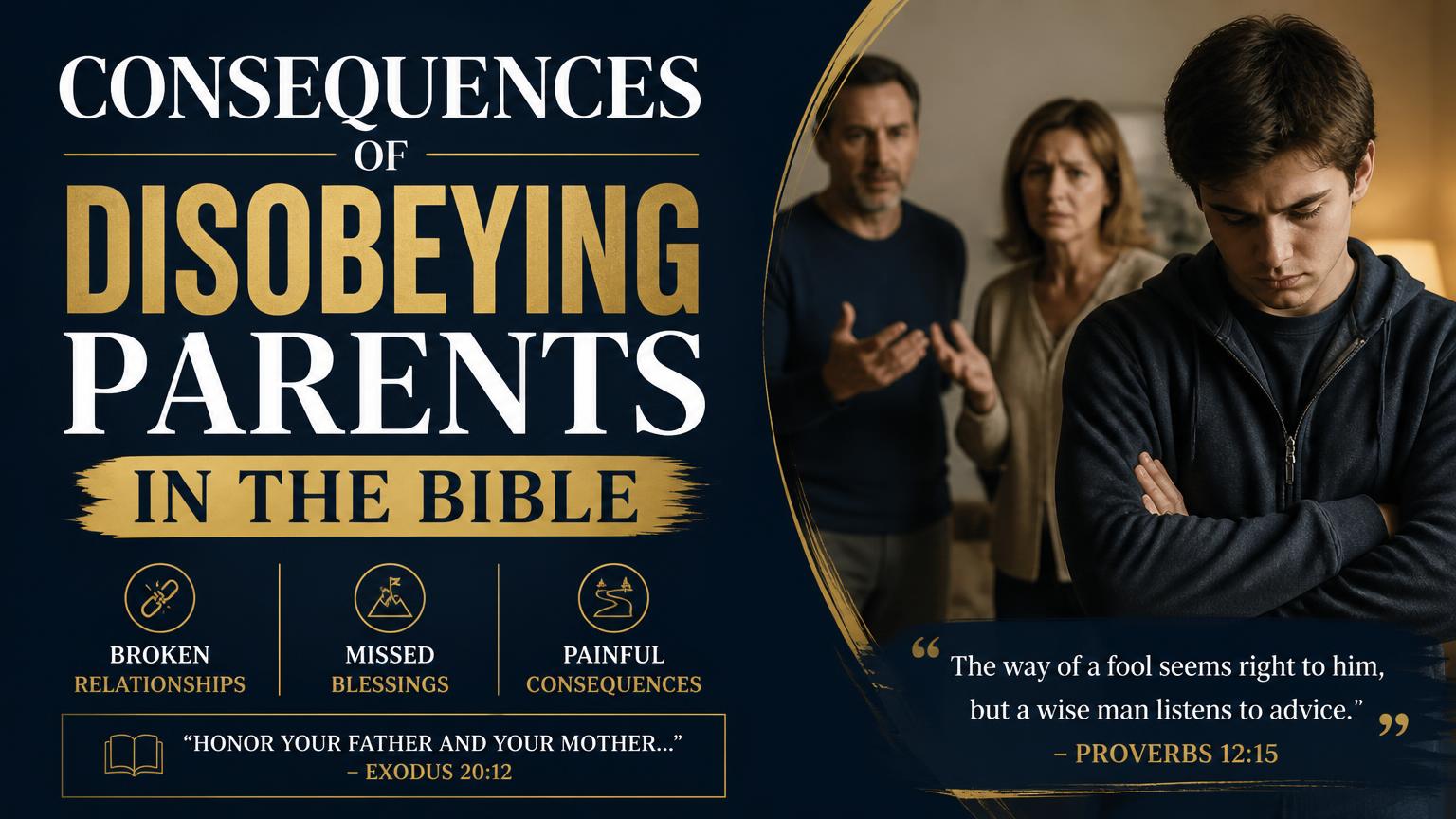
Disobeying parents in the Bible is treated as more than a family disagreement. Scripture connects a child’s response to parental authority with respect for God’s order, personal character, family relationships, and—under Israel’s covenant law—serious public consequences. At the same time, the Bible does not teach that every hardship is a direct punishment for disobeying parents, nor does it require obedience to commands that contradict God or enable abuse.
Consequences of Disobeying Parents in the Bible
The Bible describes several possible consequences of persistent, defiant disobedience: damaged trust, moral and spiritual harm, family conflict, corrective discipline, and in specific Old Testament circumstances, legal judgment. These consequences must be understood alongside the Bible’s command for parents to teach and discipline responsibly.
Broken Trust and Damaged Family Relationships
Disobedience can weaken the trust that makes family life possible. When children repeatedly reject reasonable instruction, parents may become less able to rely on them, and communication can become marked by suspicion, anger, or avoidance.
Proverbs repeatedly contrasts the wise child, who listens to correction, with the foolish child, who despises instruction. Proverbs 15:5 says that a fool rejects a father’s discipline, while a wise person accepts correction. The issue is not that parents are always right; it is that a refusal to receive wise correction can reveal an unwillingness to learn.
The practical consequence is often relational before it is dramatic. A child may lose privileges, freedom, or responsibility because disobedience has demonstrated poor judgment. Even when punishment is not imposed, dishonesty and defiance can create long-term distance within the family.
Spiritual Consequences of Rejecting God-Given Authority
The command to obey parents is connected to a broader biblical principle: God establishes legitimate authority for the protection and formation of human beings. Children are instructed, “Obey your parents in the Lord,” because this is right (Ephesians 6:1). Colossians 3:20 similarly says that children’s obedience pleases the Lord.
This does not mean parents are divine or incapable of error. It means that, in ordinary circumstances, rejecting parental instruction can become part of a larger pattern of resisting correction, humility, and responsibility. A child who learns to treat every authority with contempt may carry that attitude into school, work, marriage, church, and society.
The spiritual danger is therefore not merely breaking a household rule. Persistent rebellion can train the heart to prefer self-will over wisdom. Proverbs 1:7 teaches that reverence for the Lord is the beginning of knowledge, while fools despise wisdom and instruction. The connection is significant: learning to receive appropriate correction is one way a person develops the humility necessary to receive God’s instruction.
Discipline and Loss of Privileges
Biblical obedience includes consequences that are immediate and practical. Parents may appropriately restrict privileges, require restitution, assign reasonable consequences, or increase supervision after disobedience. These responses are intended to teach responsibility rather than satisfy parental anger.
Hebrews 12:11 describes discipline as painful in the moment but capable of producing “the peaceful fruit of righteousness” in those who are trained by it. Although the passage primarily discusses God’s fatherly discipline, it reflects a wider biblical understanding: correction should aim at restoration and maturity.
Ephesians 6:4 places an important limit on parental authority. Fathers are told not to provoke their children to anger but to bring them up in the discipline and instruction of the Lord. Parents therefore must not use discipline as revenge, humiliation, uncontrolled anger, or violence. Biblical correction is purposeful, proportionate, and directed toward wisdom.
Serious Judgment for Persistent Rebellion in the Old Testament
Deuteronomy 21:18–21 describes a “stubborn and rebellious son” who persistently refused to obey his parents, remained unresponsive to correction, and engaged in destructive behavior. The case was brought before the elders of the city, and judgment followed through the community’s legal process.
This passage is often misunderstood. It does not authorize parents to execute a disobedient child, and it does not describe an ordinary episode of childhood disobedience. The son is portrayed as persistently rebellious and uncontrollable, with the matter subject to public investigation by Israel’s civil authorities. The law addressed a serious threat to the covenant community, not a parent’s private anger.
The passage shows how seriously ancient Israel’s covenant law regarded entrenched rebellion, but it should not be transferred mechanically into modern family discipline. Christians must interpret it within its historical and legal setting. It provides evidence of the seriousness of defiant rebellion, not permission for abuse or vigilante punishment.
Shame, Loss, and Self-Destructive Consequences
Proverbs 30:17 warns about the eye that mocks a father and refuses to obey a mother, describing the result in vivid imagery. The proverb uses poetic language to communicate that contempt for parents is not harmless. Mockery, arrogance, and refusal to listen can bring disgrace and eventually self-inflicted harm.
The principle is also illustrated by Samson. His parents warned him against marrying a Philistine woman, but Judges 14:3 records that he insisted on pursuing the relationship. The immediate issue was not simply a household preference; it involved Israel’s covenant identity and Samson’s calling. Samson’s later life was marked by impulsive choices, compromised judgment, betrayal, and suffering. The text does not say that every later event was a direct punishment for that one decision, but his refusal to heed wise parental concern fits the larger pattern of self-will that damaged his life.
Biblical Examples of Disobedience and Its Results
Scripture does not present every family conflict as a simple story in which a child disobeys and receives immediate punishment. Its examples are more nuanced, showing different kinds of rebellion and different consequences.
Eli’s Sons: Disobedience Joined With Corruption
Hophni and Phinehas, the sons of Eli, abused their priestly position and treated the Lord’s offerings with contempt (1 Samuel 2:12–17, 22–25). Eli rebuked them, but they did not listen. Their conduct brought judgment on Eli’s household, and both men died on the same day during Israel’s defeat by the Philistines (1 Samuel 4:10–18).
Their story is not a simple example of children disobeying ordinary parental instructions. It concerns religious corruption and the failure of leaders to honor God. It does, however, show how persistent rebellion can become destructive when people reject correction and misuse authority. It also warns parents and leaders that tolerating serious wrongdoing can make them morally responsible for failing to restrain it.
Absalom: Rebellion Against His Father and Kingdom
Absalom’s revolt against David was far more than an argument between a son and his father. He attempted to seize Israel’s throne and caused civil war (2 Samuel 15–18). His rebellion ended in his death, despite David’s grief.
This account demonstrates the destructive reach of rebellion when personal resentment, ambition, and betrayal become public action. It should not be used to portray every disagreement with a parent as treason. Rather, it illustrates how refusal to respect rightful boundaries can harm an entire community.
Jesus: Obedience With Proper Priority
Luke 2:51 says that Jesus returned to Nazareth and was submissive to Mary and Joseph. His example confirms the goodness of ordinary obedience within a family. Yet Jesus also made clear that loyalty to God has ultimate priority. When human commands conflict with God’s will, “We must obey God rather than men” (Acts 5:29).
These principles belong together. Children should normally obey their parents, but parental authority is not unlimited. No parent has the right to command sin, conceal abuse, harm another person, or replace God’s authority.
Obedience and Honor Are Related but Not Identical
The Bible commands children to obey their parents, especially while they are under parental care. It also commands people to honor their father and mother, a duty expressed in the Fifth Commandment (Exodus 20:12; Deuteronomy 5:16).
Obedience generally means carrying out legitimate instructions. Honor is broader. It includes respect, truthful speech, gratitude, appropriate care, and refusal to treat parents with contempt. As children mature into adults, the form of obedience normally changes. An adult may no longer be required to follow a parent’s decisions about work, marriage, residence, or daily conduct, but may still owe parents respect and reasonable care.
Jesus condemned religious traditions that allowed people to avoid caring for their parents while claiming to dedicate their resources to God (Mark 7:9–13). This shows that honoring parents can include practical support, especially when parents are vulnerable. Honor does not require agreement with every parental decision or submission to controlling behavior.
When Should a Child Not Obey a Parent?
Biblical obedience is qualified by the phrase “in the Lord” in Ephesians 6:1. A parent’s authority is real but limited.
A child should seek help when a parent commands something clearly sinful, dangerous, or abusive. Examples may include sexual exploitation, serious violence, criminal activity, or instructions to conceal harm. In such situations, seeking protection from a trustworthy adult, church leader, counselor, teacher, medical professional, or appropriate authority is not dishonoring a parent. It may be an act of truth and wisdom.
The Bible also distinguishes disobedience from disagreement. A mature child may respectfully choose a different career, church, residence, or marriage partner without dishonoring parents. The question is whether the person is rejecting parental control or displaying contempt, deceit, and needless defiance. Respectful independence is not the same as rebellion.
What the Bible Requires of Parents
The consequences of disobeying parents cannot be considered apart from parental responsibility. Parents are instructed to teach God’s commands diligently (Deuteronomy 6:6–7), correct their children wisely, and avoid provoking or crushing them (Ephesians 6:4; Colossians 3:21).
This means parents should:
- give instructions that are clear, reasonable, and age-appropriate;
- model the character they expect from their children;
- correct consistently rather than impulsively;
- distinguish childish mistakes from deliberate defiance;
- listen to the child’s explanation before judging;
- discipline without humiliation or violence; and
- remain willing to admit their own mistakes.
A child’s disobedience is morally significant, but parental authority does not make every parental demand wise or righteous. Both children and parents remain accountable to God.
Disobeying parents in the Bible can lead to damaged trust, strained relationships, poor character formation, loss of responsibility, and—when rebellion becomes persistent and destructive—serious judgment. Yet Scripture does not teach automatic punishment for every act of disobedience. It calls children to obey and honor their parents, while requiring parents to exercise authority with justice, patience, and love. The proper biblical goal is not control for its own sake but the formation of wisdom, responsibility, and faithfulness to God.