
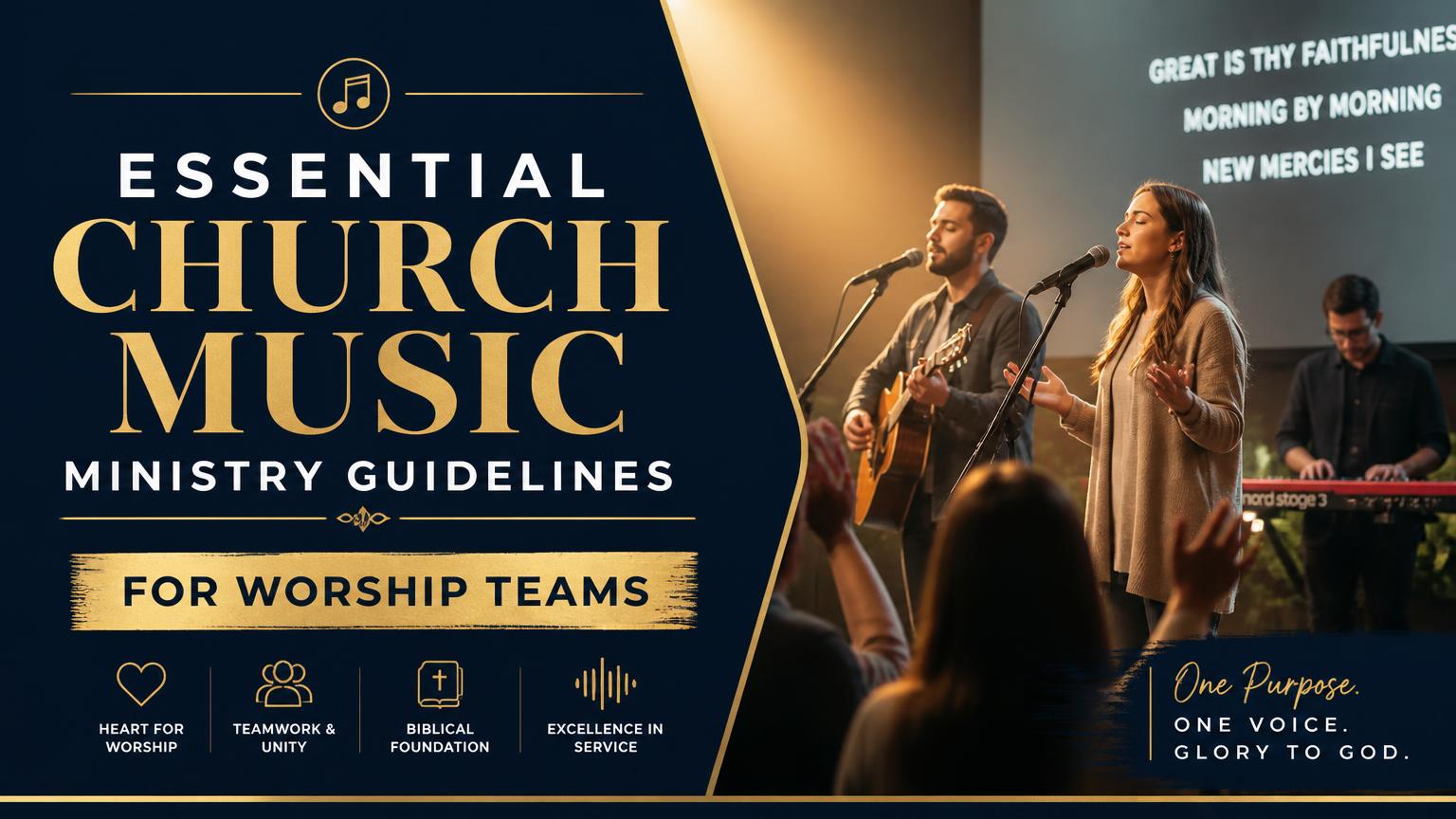
Church music ministry guidelines should help a worship team do more than produce polished services. They should shape a ministry that is biblically faithful, musically prepared, pastorally accountable, congregationally focused, and marked by humility. Music in gathered worship teaches, encourages, expresses prayer, and helps the church respond to God; therefore, both spiritual character and musical competence matter.
Church Music Ministry Guidelines
Define the Ministry’s Purpose Before Choosing Music
The primary purpose of church music is to glorify God and serve the gathered church—not to showcase performers. Colossians 3:16 describes believers teaching and encouraging one another through psalms, hymns, and spiritual songs. This means congregational music has a ministry function: it helps people remember the gospel, confess truth, express faith, and respond with gratitude.
Music is part of worship, but worship is broader than music. Romans 12:1 presents the whole life of a Christian as an offering to God. A music ministry should therefore support the church’s larger mission of discipleship, fellowship, evangelism, prayer, and faithful obedience.
A clear purpose helps answer practical questions:
- Does this song help the congregation sing truth?
- Does the arrangement serve the service’s pastoral purpose?
- Are musicians directing attention toward God or toward themselves?
- Does the music support the preaching, prayers, ordinances, and other elements of worship?
A team that understands its purpose is less likely to measure success only by volume, emotional intensity, technical difficulty, or audience response.
Establish Spiritual and Relational Qualifications
The New Testament does not provide a separate modern job description for worship musicians, but it consistently emphasizes character, humility, faithfulness, and service. A person leading publicly should demonstrate a credible Christian life, a teachable spirit, dependability, and respect for the church’s doctrine and leadership.
This does not mean musicians must be spiritually flawless. It does mean that visible ministry should not knowingly place people in positions that contradict their professed faith or create ongoing harm for the congregation.
Useful qualifications include:
- A sincere Christian confession and growing relationship with Christ
- Agreement with the church’s doctrine and ministry direction
- Dependability in attendance, preparation, and communication
- Humility when receiving correction
- The ability to work cooperatively rather than competitively
- A willingness to reconcile conflict instead of protecting personal status
- Respect for appropriate boundaries and pastoral authority
Galatians 5:22–23 identifies the fruit of the Spirit, including love, patience, gentleness, and self-control. These qualities are not less important than musical ability. Skill may make a person noticeable, but character determines whether that visibility strengthens or damages the ministry.
Choose Songs for Truth and Congregational Use
Song selection requires theological and pastoral judgment. A church should evaluate both what a song says and how effectively people can sing it.
Examine the lyrics for:
- Biblical accuracy
- A clear understanding of God’s character
- A faithful presentation of sin, grace, salvation, and Christian hope
- Appropriate emphasis on Christ and the gospel
- A balanced range of praise, confession, lament, petition, thanksgiving, and commitment
- Language that the congregation can understand without extensive explanation
A song may be musically attractive yet unsuitable if its theology is vague, misleading, or centered primarily on personal experience. Conversely, an older hymn, a contemporary song, a psalm setting, or a simple chorus may serve the church well when it communicates truth clearly.
Congregational suitability matters as much as artistic quality. Consider vocal range, tempo, repetition, lyrical density, melody, and whether the congregation can learn the song without the musicians carrying every line. The goal is not to choose the most impressive arrangement; it is to help the church participate meaningfully.
Prepare Musically and Spiritually
Biblical ministry does not oppose excellence. Psalm 33:3 calls worshipers to play skillfully, and 1 Chronicles 25 describes organized musicians who were trained and skilled. Excellence, however, means offering careful preparation to God and the church—not pursuing perfection or performance status.
Preparation should include:
- Reviewing the service theme and Scripture
- Selecting suitable keys and tempos
- Preparing transitions between songs and service elements
- Learning arrangements before rehearsal
- Checking lyrics, charts, instruments, microphones, and sound equipment
- Planning introductions, endings, instrumental sections, and spontaneous moments
- Rehearsing enough to reduce avoidable distraction
Spiritual preparation includes prayer, reflection on the songs’ meaning, repentance where necessary, and attention to the needs of the congregation. Prayer cannot replace rehearsal, and rehearsal cannot replace dependence on God. Healthy ministry requires both.
Leaders should also distinguish between genuine spontaneity and lack of preparation. Unplanned moments may sometimes serve the service, but confusion, extended talking, missed cues, and unnecessary repetition usually burden the congregation rather than help it.
Lead the Congregation Rather Than Perform for It
A worship team leads people in singing; it does not sing worship on their behalf. This distinction affects nearly every stage decision.
Leaders can encourage participation by:
- Choosing singable keys
- Keeping arrangements understandable
- Allowing the congregation to hear its own voice
- Avoiding excessive volume or instrumental density
- Using clear introductions and predictable song structures
- Giving brief, purposeful instructions when needed
- Modeling sincere engagement without theatrical imitation
- Leaving appropriate space for prayer, reflection, and congregational response
The team should be visible enough to lead but not so dominant that the congregation becomes an audience. 1 Corinthians 14:26–40 repeatedly connects gathered ministry with edification, order, and mutual benefit. In that context, a musically impressive moment is not automatically a spiritually fruitful one.
This principle also applies to technology. Lighting, screens, amplification, cameras, and visual effects should remove barriers to participation rather than turn worship into a production that people primarily watch.
Serve Under Pastoral and Church Leadership
Music ministry should operate within the church’s theological and pastoral oversight. Pastors and elders are responsible for the church’s doctrine and spiritual direction, while music leaders often contribute specialized musical knowledge. These responsibilities work best through cooperation rather than competition.
Healthy oversight includes:
- Agreement about the purpose and theology of worship
- Clear approval processes for songs and major arrangements
- Shared service planning between pastors and music leaders
- Defined responsibilities for musicians, vocalists, technicians, and coordinators
- Regular evaluation based on ministry fruit rather than personal preference
- A clear process for handling concerns, conflict, and correction
The music leader should not be expected to determine the entire theology of a service alone, and pastoral leaders should not treat music as a purely technical matter. Service planning is strongest when biblical content, pastoral care, congregational needs, and musical communication are considered together.
Build a Team Culture of Humility and Unity
A church music ministry can become unhealthy when talent creates hierarchy, favoritism, or competition. Philippians 2:3–4 calls believers to reject selfish ambition and consider others. That principle should shape auditions, scheduling, feedback, and platform decisions.
A healthy team culture:
- Values character alongside ability
- Gives people clear expectations
- Provides feedback privately and constructively
- Rotates opportunities when practical
- Mentors developing musicians
- Welcomes different musical backgrounds within theological boundaries
- Addresses resentment, gossip, and rivalry promptly
- Makes room for people who serve offstage
Rotation should not be used mechanically, especially when a role requires particular training. However, repeatedly concentrating all visible ministry in a small group can create dependence, discourage gifted members, and imply that only certain personalities or musical styles belong in the church.
Leaders should also establish a process for restoration when a team member experiences moral failure, personal crisis, or a season of instability. Immediate removal may sometimes be necessary for safety or credibility, but restoration and accountability should be handled pastorally rather than punitively.
Protect People and Handle Resources Responsibly
Church music ministry includes practical stewardship. Churches should provide a safe environment for children, students, volunteers, and vulnerable adults. Safeguarding policies, appropriate supervision, clear communication, and responsible boundaries are ministry responsibilities, not administrative distractions.
Financial and legal practices also require care. Churches should budget transparently for instruments, maintenance, training, software, and special events. They should use songs, recordings, arrangements, and projected lyrics in compliance with applicable copyright permissions and licenses. A ministry’s spiritual purpose does not exempt it from ordinary ethical and legal obligations.
Accessibility deserves attention as well. Depending on the congregation, this may involve readable lyrics, appropriate volume, assistive listening support, captioning, signed interpretation, seating considerations, or arrangements that allow people with different abilities to participate. Congregational worship should not unintentionally communicate that only the musically confident or physically able are full participants.
How to Plan an Effective Church Music Ministry
A sustainable ministry needs more than weekly song choices. Begin with an annual or seasonal direction that reflects the church’s teaching, calendar, and discipleship goals. From there, build repeatable weekly processes.
A practical planning cycle may include:
- Review the service purpose. Identify the main Scripture, sermon emphasis, pastoral need, and intended congregational response.
- Select appropriate songs. Choose music that reinforces the biblical message without merely repeating the sermon.
- Assign ministry roles. Confirm vocalists, instrumentalists, technicians, readers, and backups.
- Prepare materials. Distribute charts, recordings, keys, lyrics, and schedules early enough for meaningful preparation.
- Rehearse efficiently. Focus on difficult transitions, harmonies, dynamics, endings, and elements that affect congregational singing.
- Evaluate afterward. Ask whether the congregation could participate, whether the service flowed clearly, and what should change next time.
Evaluation should be specific. “That felt powerful” may describe an experience but does not explain whether the ministry achieved its purpose. Better questions include: Were the lyrics understood? Did the arrangement support singing? Did the team respond well to pastoral direction? Were technical problems minimized? Did the music help the church attend to God’s truth?
Common Tensions Church Music Leaders Must Hold Together
Excellence and Accessibility
Excellence improves clarity and reduces distraction, but excessive complexity can make the congregation passive. The best arrangement is not always the most technically advanced; it is the one that communicates truth and enables participation.
Contemporary Expression and Historic Faith
New music can express biblical truth in language familiar to the present congregation. Older hymns and songs preserve theological vocabulary and the testimony of previous generations. Churches need not treat these categories as enemies. The standard should be faithfulness, usefulness, and congregational participation rather than novelty or nostalgia.
Emotional Engagement and Biblical Substance
Music affects emotion, but emotional intensity does not prove spiritual depth. Scripture gives room for joy, sorrow, longing, celebration, lament, and reverence. Healthy worship joins sincere affection with truthful content rather than attempting to manufacture a particular mood.
Leadership and Shared Participation
A strong leader gives direction, yet the gathered church remains the primary singing body. Leaders should use their platform to make participation easier, not to create dependence on their personality, voice, or musical identity.
What Success Looks Like
A successful church music ministry cannot be measured only by attendance, applause, technical polish, or the number of songs learned. Its deeper outcomes include a congregation that understands what it sings, participates rather than watches, grows in biblical knowledge, expresses a range of faithful responses to God, and is strengthened in love and unity.
The team itself should also become more Christlike: more dependable, humble, teachable, prayerful, and willing to serve without recognition. Musical improvement matters, but it is most valuable when it supports those spiritual and congregational outcomes.
Church music ministry guidelines are therefore best understood as principles of faithful service. The team should pursue biblical truth, careful preparation, musical excellence, pastoral accountability, congregational participation, and relational health together. When those priorities remain aligned, music becomes more than an attractive part of a service—it becomes a means by which the church teaches, encourages, prays, and worships God together.