
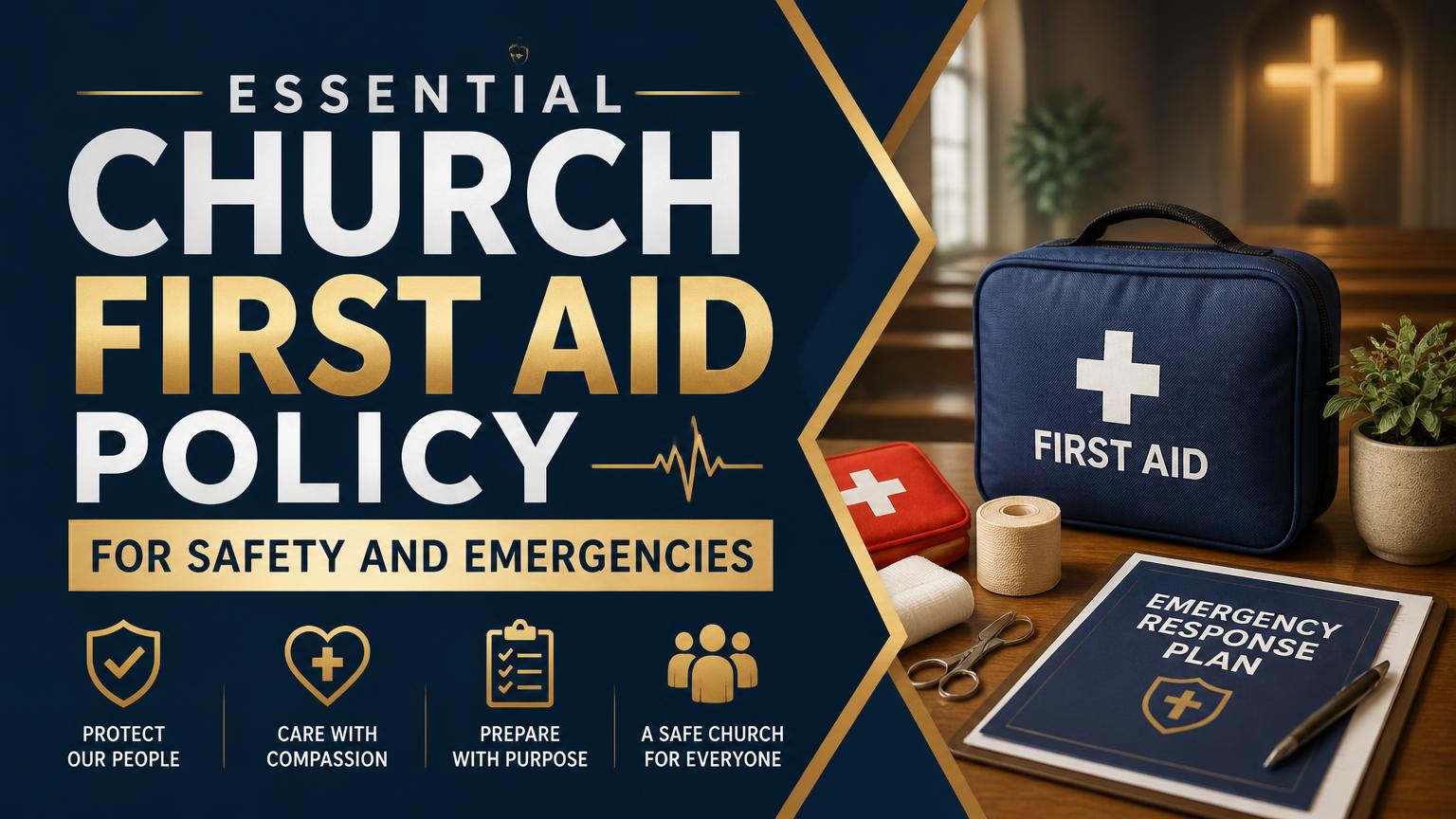
A church first aid policy establishes how the congregation will prevent injuries, respond to illness and emergencies, protect children and vulnerable people, and document incidents. It should be practical enough for volunteers to follow under pressure while making clear that first aid does not replace professional medical care. The policy should also reflect local health, employment, safeguarding, privacy, and reporting requirements.
Church First Aid Policy
A useful policy defines who responds, what they should do, when to call emergency services, how supplies are maintained, and how incidents are followed up. It should apply to worship services, children’s ministries, youth activities, meetings, outreach events, trips, camps, and church-run facilities.
Purpose and Scope
State the policy’s purpose in direct terms. For example:
The church will provide a reasonable and organized first-aid response for illness and injury occurring during church activities, while seeking emergency medical assistance whenever a condition may be serious or life-threatening.
The scope should identify:
- Church buildings, grounds, parking areas, and ministry spaces
- Regular services, classes, meetings, and rehearsals
- Children’s, youth, and senior ministries
- Off-site events, transportation, retreats, camps, and mission activities
- Employees, volunteers, members, visitors, contractors, and guests
The policy should not promise a level of medical care the church cannot provide. A congregation with no medically trained staff should not imply that it operates a clinic or guarantees continuous professional coverage.
Roles and Responsibilities
Assign responsibility before an incident occurs. A policy commonly identifies the following roles:
- Policy coordinator: Maintains the policy, training records, emergency contacts, and review schedule.
- First-aid responders: Provide care within their training and summon additional help.
- Ministry leaders: Supervise participants, maintain attendance information, and help control the scene.
- Safeguarding or child-protection lead: Handles incidents involving children or vulnerable adults according to safeguarding procedures.
- Facilities lead: Keeps access routes clear, maintains emergency equipment, and displays location signs.
- Incident reviewer: Ensures that reports are completed and that hazards or procedural weaknesses are addressed.
The policy should state who takes charge when more than one trained person is present. Clear leadership prevents several volunteers from giving conflicting instructions or leaving an injured person unattended.
First-Aid Response Procedure
A simple response procedure is more useful than a long list of medical instructions. The policy can require responders to:
- Assess immediate danger. Check for hazards such as fire, electrical danger, traffic, violence, structural damage, or exposed chemicals. Do not create another casualty.
- Check responsiveness and breathing. If the person is unresponsive, not breathing normally, or appears to have a life-threatening condition, call the local emergency number immediately and begin appropriate emergency care within the responder’s training.
- Send for help and equipment. Direct a specific person to retrieve the first-aid kit, automated external defibrillator if available, and other emergency equipment.
- Provide care within the responder’s competence. Use standard precautions, gloves, and other protective equipment. Do not attempt procedures for which the responder is not trained.
- Contact a parent, guardian, emergency contact, or responsible adult when appropriate. Follow safeguarding rules for children and vulnerable adults.
- Monitor the person until help arrives or responsibility is transferred. Record changes in condition and communicate clearly with emergency personnel.
- Secure the scene and preserve privacy. Move bystanders away when possible and avoid unnecessary discussion or photography.
- Complete an incident report after the immediate danger has passed.
The policy should emphasize that a responder must call emergency services when in doubt. Serious bleeding, breathing difficulty, chest pain, signs of stroke, severe allergic reaction, loss of consciousness, major burns, suspected spinal injury, poisoning, seizure-related danger, or a rapidly worsening condition require urgent professional assessment.
Consent, Capacity, and Confidentiality
Whenever possible, obtain the person’s consent before providing first aid. Explain what you intend to do and ask whether the person wants assistance. If an adult is unconscious or unable to make an informed decision and urgent care is necessary, responders generally act to preserve life and prevent serious harm, subject to applicable local law and training.
Children require additional safeguards. The church should obtain appropriate emergency-contact and medical information through its registration process, but staff and volunteers should not assume that a parent’s general consent authorizes every intervention in every circumstance. The policy should explain how leaders contact parents or guardians and what happens if they cannot be reached.
Treat medical information as confidential. Share it only with people who need it to provide care, manage safeguarding, meet a legal obligation, or respond to an emergency. Incident reports should be stored securely, with access limited to authorized personnel.
What the Policy Should Include
A complete policy connects emergency response with preparation, supervision, equipment, and review. These elements make the written procedure usable in real situations.
Training and Competence
The church should identify how many trained responders are needed for each activity. A small worship service may need a different arrangement from a children’s program, large conference, sports event, or overnight trip.
Training should be appropriate to the setting and may include:
- Basic first aid and cardiopulmonary resuscitation
- Automated external defibrillator use, where an AED is available
- Choking response
- Recognition of severe allergic reactions and other urgent conditions
- Infection prevention and use of personal protective equipment
- Safeguarding and working with children
- Emergency communication and evacuation procedures
- Activity-specific risks, such as water, hiking, transport, or sports
Training must be kept current under the requirements of the relevant training provider or local authority. Volunteers should understand the limits of their role: first aid stabilizes a person while professional help is obtained; it does not authorize diagnosis, prescribing medication, or treatment beyond training.
First-Aid Equipment and Locations
Place appropriately stocked kits where people can find them quickly. The policy should list their locations and identify who checks them. Depending on the activities, supplies may include:
- Disposable gloves and hand sanitizer
- Sterile dressings, adhesive bandages, and medical tape
- Antiseptic or wound-cleaning materials
- Scissors, tweezers, and cold packs
- Protective face shields for resuscitation
- Eye-wash supplies where relevant
- Blankets and disposable bags
- Flashlights and emergency contact information
A church may also maintain an AED, emergency oxygen, epinephrine, or other equipment, but only if it can manage training, maintenance, storage, and legal requirements. Prescription medication should not be administered casually by untrained volunteers. Any arrangement involving personal medicines, emergency inhalers, epinephrine, or medication storage should be written into the church’s health and safeguarding procedures.
Check kits on a regular schedule and after every use. Replace expired, damaged, contaminated, or depleted items. Equipment should be accessible without being exposed to unauthorized use by children.
Emergency Contacts and Site Information
Keep current information with each first-aid kit and at key reception points:
- Local emergency number
- Exact building address and entrance instructions
- Contact details for the church’s responsible leader
- Location of the nearest AED and first-aid kits
- Utility shutoff information where relevant
- Emergency contacts for children and participants
- Poison-control or equivalent medical advice contact where applicable
- Instructions for directing emergency responders to the correct room
For large or unfamiliar sites, include a simple floor plan. During an emergency, a volunteer should meet responders outside and guide them to the casualty rather than assuming they will find the right location.
Children, Vulnerable Adults, and Ministry Activities
Church first aid cannot be separated from safeguarding. Children and vulnerable adults may be unable to describe symptoms, consent clearly, or protect themselves from unsafe responses.
Ministry procedures should require appropriate supervision, accurate attendance records, emergency contacts, allergy information, and a reliable method of contacting parents or responsible caregivers. Leaders should avoid treating a child alone in a secluded area when another responsible adult can be present, unless immediate circumstances make that impossible.
For off-site activities, the leader should assess additional risks before departure. The group may need portable first-aid supplies, participant medical information, communication equipment, transport arrangements, and a plan for contacting emergency services in an unfamiliar location. Activities involving water, heights, vehicles, tools, animals, or strenuous exercise require activity-specific planning rather than reliance on a general building policy.
Incident Reporting and Follow-Up
An incident report should record facts, not speculation. It should normally include:
- Date, time, and location
- Name and contact details of the injured or ill person, where appropriate
- Description of what happened
- Observed signs or symptoms
- First aid provided and by whom
- Whether emergency services were called
- Witnesses and people notified
- Transfer of care to a parent, guardian, medical professional, or emergency responder
- Equipment used or contamination concerns
- Recommended follow-up
Do not include unnecessary diagnoses or judgmental comments. A report should not become a place for assigning blame.
Review incidents for prevention, not merely administration. A fall may reveal a wet floor, poor lighting, overcrowding, inadequate supervision, or a recurring trip hazard. Corrective actions might include repairing equipment, changing room layouts, improving signage, revising supervision ratios, or updating the risk assessment.
Serious incidents may trigger additional safeguarding, insurance, employment, regulatory, or legal reporting duties. Because these requirements vary by jurisdiction, the church should identify the responsible person and obtain qualified local advice where necessary.
Prevention and Risk Assessment
First aid is the final part of safety management, not the main method of preventing harm. Before activities begin, leaders should ask:
- What could reasonably go wrong?
- Who could be harmed?
- How likely and serious would the harm be?
- What controls can remove or reduce the risk?
- Who will supervise the controls?
- What emergency response is needed if prevention fails?
Practical controls may include securing rugs and cables, keeping exits clear, managing crowd movement, marking wet floors, storing chemicals safely, inspecting playground or sports equipment, using safe food practices, and planning for heat, cold, allergies, or severe weather.
A church should also distinguish between a first-aid policy and an emergency plan. First aid addresses illness and injury. An emergency plan may separately cover fire, evacuation, missing children, violence, severe weather, utility failure, and communication with families. The documents should cross-reference one another without becoming confusing or duplicative.
Review, Communication, and Policy Template
Give the policy an owner, approval date, review date, and version number. Review it at least annually and after:
- A serious incident or near miss
- A change in the building or ministry activities
- Introduction of new equipment
- Changes in legal or safeguarding requirements
- Loss or replacement of trained responders
- Feedback from volunteers, parents, or participants
Make the policy accessible to staff and ministry leaders. Volunteers do not need to memorize every paragraph, but they should know whom to contact, where equipment is located, how to summon emergency help, and how to report an incident. Short response cards posted near telephones and first-aid kits can support the full policy.
A practical policy usually contains:
- Purpose and scope
- Definitions and limitations
- Roles and responsibilities
- Emergency response procedure
- Consent, safeguarding, and confidentiality
- Training requirements
- Equipment and inspection schedule
- Children’s and off-site activity procedures
- Incident reporting and record retention
- Risk assessment and prevention
- Review and approval arrangements
A strong church first aid policy is clear, realistic, and regularly practiced. It does not attempt to turn volunteers into medical professionals. Instead, it helps them recognize danger, summon the right help quickly, provide safe care within their competence, protect those in their care, and learn from incidents so that future harm is less likely.