
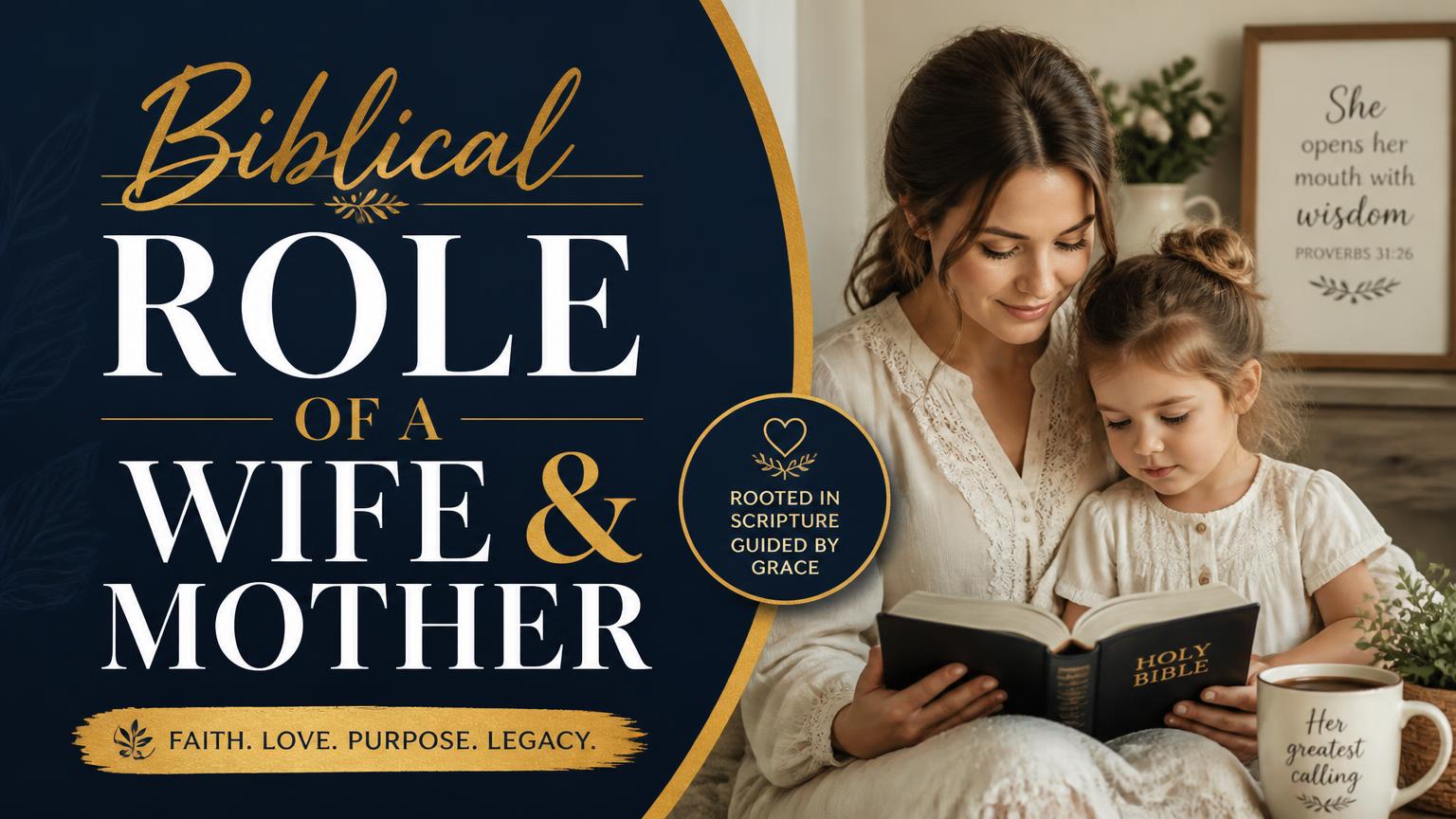
A biblical role of a wife and mother is best understood as a calling to love God, cultivate faithful relationships, nurture life, exercise wise stewardship, and serve others with strength and dignity. Scripture does not reduce women to domestic tasks or provide one rigid arrangement for every household. Instead, it gives principles for covenant marriage, parenthood, work, discipleship, and service.
Biblical Role of a Wife and Mother
The Bible presents marriage and motherhood as significant responsibilities, but neither role exhausts a woman’s identity. A wife and mother is first a person made in God’s image and called to follow Him. Her family responsibilities should express that identity rather than replace it.
Her Identity and Calling Before Her Roles
Genesis 1:27 teaches that both male and female are created in the image of God. A woman’s dignity therefore does not depend on her marital status, number of children, domestic productivity, or ability to meet other people’s expectations.
Marriage and motherhood are important biblical callings, but they are not the only forms of faithful Christian service. Scripture includes women who exercised courage, wisdom, hospitality, business skill, leadership, teaching, evangelistic influence, and material support for ministry. Deborah served as a judge, Priscilla helped instruct Apollos, Lydia used her home to support the early church, and Phoebe served the church at Cenchreae (Judges 4–5; Acts 18:24–26; Acts 16:14–15; Romans 16:1–2).
This broader picture prevents a common mistake: treating “wife and mother” as a woman’s entire spiritual identity. A biblical family role should equip a woman to love God and serve others, not isolate her from every other legitimate form of obedience.
Her Role as Wife: Covenant Partnership
Marriage in Scripture is a covenant partnership marked by loyalty, love, mutual responsibility, and shared service. Genesis 2 describes the woman as a “helper” suitable for the man. The Hebrew concept behind “helper” does not imply an inferior assistant; the same language is used elsewhere for God’s help. The passage presents the woman as a strong and corresponding partner, not as someone without value or agency.
A wife is called to cultivate faithfulness, respect, wisdom, and love within the marriage. Proverbs 31 portrays a woman who strengthens her household, makes commercial decisions, manages resources, plans for the future, and speaks with wisdom. Her activity extends beyond private domestic tasks, yet it benefits her family and community.
Ephesians 5 is sometimes reduced to the wife’s submission, but the passage begins with a call for believers to submit to one another in reverence for Christ (Ephesians 5:21). It then calls husbands to sacrificial love patterned after Christ’s love for the church. Whatever differences exist among Christian traditions concerning marital authority, the passage cannot rightly be used to justify domination, coercion, fear, or neglect.
Biblical respect does not require a wife to approve of sin or surrender moral judgment. Submission to a husband never means cooperating with abuse, criminal behavior, exploitation, or spiritual manipulation. Christian marriage involves accountability to God, and protecting oneself and children from harm is consistent with wisdom and righteousness.
Her Role as Mother: Nurture and Formation
The Bible treats parenting as more than providing food, education, and physical protection. Parents are responsible for shaping a child’s character, teaching God’s ways, correcting wisely, and demonstrating faith in daily life.
Deuteronomy 6:6–7 describes teaching children through ordinary routines—at home, during travel, at the beginning of the day, and at its close. This suggests that spiritual formation is not limited to formal lessons. Children learn through repeated conversations, family habits, discipline, prayer, forgiveness, and the way adults respond to pressure.
A mother’s influence may include:
- Providing affection, security, and patient presence
- Teaching children to know and honor God
- Correcting behavior without cruelty or humiliation
- Developing responsibility, compassion, honesty, and self-control
- Recognizing each child’s gifts and weaknesses
- Modeling repentance and dependence on God
- Protecting children while gradually preparing them for maturity
Paul’s description of Timothy’s faith highlights the influence of his mother Eunice and grandmother Lois (2 Timothy 1:5; 3:14–15). Their example shows that a mother’s spiritual influence often works through long-term consistency rather than dramatic public achievement.
At the same time, Scripture does not place the entire burden of parenting on mothers. Fathers are also commanded to teach, nurture, and avoid provoking their children to anger (Ephesians 6:4). Parenting is a shared responsibility, even when a family divides tasks according to its circumstances.
Her Stewardship of Home, Work, and Resources
Biblical household management includes much more than cleaning and cooking. It involves stewardship: using time, money, abilities, possessions, and relationships wisely for the good of the family and the wider community.
Proverbs 31 describes a woman who evaluates property, buys a field, plants a vineyard, produces goods, trades profitably, helps the poor, and prepares her household for the future. The passage does not present her as passive or intellectually limited. She is industrious, economically capable, generous, and trusted.
Titus 2:4–5 instructs older women to encourage younger women in love for their husbands and children, self-control, purity, kindness, and care for the home. This passage emphasizes the importance of household faithfulness, but it should not be interpreted as a universal prohibition against employment, education, leadership, or public service. The Bible’s own examples show women engaging in business and ministry.
The practical form of stewardship differs according to health, finances, children’s needs, cultural setting, and available support. Some mothers work outside the home; others devote most of their time to household and caregiving responsibilities; many do both. The biblical question is not whether every woman follows one arrangement, but whether her choices reflect wisdom, love, responsibility, and faithfulness.
Her Witness in the Church and Community
A wife and mother remains a disciple and member of the wider body of Christ. Her service is not limited to the private sphere. Scripture commends women who taught, prayed, prophesied, hosted churches, supported missionaries, cared for the vulnerable, and explained the faith.
Acts 2:17–18 applies Joel’s prophecy to both men and women, saying that God’s Spirit would be poured out on His servants and that both sons and daughters would speak prophetically. Galatians 3:28 affirms equal standing in Christ, even though Christians differ in how they interpret the implications for church offices and family roles.
A woman’s home can be a place of hospitality, discipleship, refuge, and ministry. But community service does not diminish the family, and family care does not make a woman spiritually insignificant. Healthy biblical service holds both responsibilities together without treating either one as automatically superior.
Biblical Principles for Balancing Marriage, Motherhood, and Other Callings
The Bible does not give a timetable that answers every modern question about employment, childcare, education, or household labor. It does provide principles that help families make wise decisions.
Practice Love Rather Than Role Performance
A woman can fulfill visible duties while becoming resentful, harsh, or spiritually exhausted. Biblical faithfulness concerns the character and purpose behind an action, not merely the appearance of completing tasks. First Corinthians 13 describes love as patient, kind, humble, and enduring. Those qualities matter in marriage and parenting as much as practical competence does.
This also means a mother should not measure her worth by perfection. Children need faithful love, correction, and stability—not an impossible performance of flawless motherhood.
Share Responsibility With Wisdom
Marriage should involve honest discussion about money, work, household tasks, parenting, rest, church involvement, and extended-family obligations. A husband’s leadership, where a couple understands marriage in that way, should resemble Christ’s self-giving care rather than unilateral control. A wife’s respect should coexist with wisdom, truthful counsel, and moral responsibility.
Both spouses should ask whether the household’s arrangement serves the family’s actual needs. Traditions, social media expectations, and cultural stereotypes are not equivalent to biblical commands.
Protect the Vulnerable
Biblical family life includes protection from injustice. A husband who uses Scripture to excuse intimidation or violence is contradicting the character of Christ. Likewise, a mother’s responsibility includes recognizing danger and seeking help when necessary.
Forgiveness and reconciliation do not require remaining in an unsafe situation without accountability or protection. Churches and families should support victims, confront wrongdoing, and involve appropriate civil authorities when abuse or criminal conduct is present.
Cultivate Intergenerational Discipleship
Titus 2 shows older and younger women helping one another develop practical holiness. This principle counters the isolation often experienced by mothers. Wise support may include mentoring, shared childcare, hospitality, prayer, financial assistance, and honest conversations about hardship.
A biblical view of motherhood therefore includes community. Parents remain responsible for their children, but they were never intended to carry every burden without help.
Common Misunderstandings About a Biblical Wife and Mother
One misunderstanding is that the Bible commands every woman to marry and have children. Scripture honors marriage and childbearing, but it also recognizes singleness as a legitimate condition for devoted service to God (1 Corinthians 7). Infertility, widowhood, singleness, and remaining childless do not make a woman less valuable or less faithful.
Another misunderstanding is that submission means silence or unquestioning obedience. Biblical women speak truth, offer counsel, act courageously, and make consequential decisions. Submission cannot erase a person’s responsibility before God.
A third misunderstanding is that domestic work is either the only biblical calling or spiritually unimportant. Caring for a household can be genuine service, but the Bible also values productive labor, generosity, public responsibility, hospitality, and ministry beyond the home. The issue is not whether an activity looks traditionally domestic; it is whether it is pursued faithfully and wisely.
What This Role Looks Like in Practice
A wife and mother living according to biblical principles may:
- Build a marriage characterized by loyalty, truth, affection, and mutual service
- Teach children Scripture through both instruction and example
- Manage household resources responsibly
- Correct children with consistency rather than anger
- Encourage her husband without becoming responsible for his obedience to God
- Seek wise counsel when facing difficult decisions
- Use professional, financial, creative, or organizational abilities for good
- Welcome others when hospitality is possible and appropriate
- Serve in the church without neglecting family responsibilities
- Ask for help instead of treating exhaustion as a badge of holiness
- Protect herself and her children from abuse or exploitation
These practices will look different across families. Biblical principles guide decisions; they do not require every household to have identical schedules, income arrangements, or divisions of labor.
Conclusion
The biblical role of a wife and mother is not passive submission or endless domestic performance. It is a life of covenant faithfulness, wise partnership, loving nurture, responsible stewardship, spiritual formation, and service to God and others. Scripture honors the home while also showing women exercising courage, wisdom, work, leadership, and ministry. The central standard is not conformity to one cultural model, but faithful love shaped by the character of Christ.