
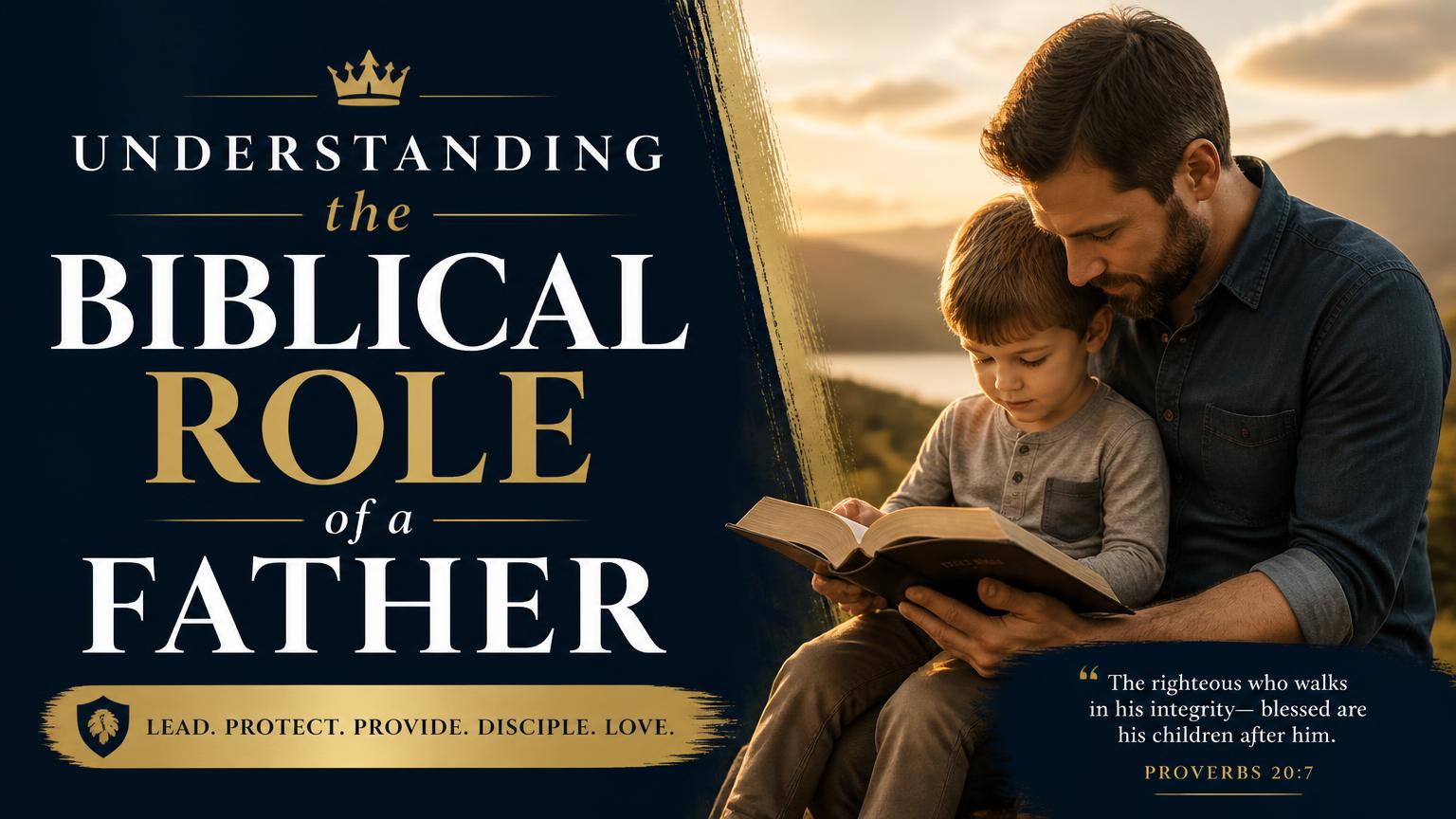
The biblical role of a father is more than earning income or exercising authority. Scripture presents fatherhood as a responsibility to love, teach, protect, provide for, discipline, and guide a family toward faithfulness to God. A father’s authority is meant to serve the good of those entrusted to him, not secure personal control.
Biblical fatherhood also requires humility. Fathers are imperfect people accountable to God, and the Bible measures their leadership by qualities such as compassion, self-control, faithfulness, justice, and sacrificial love.
The Biblical Role of a Father
The Bible does not reduce fatherhood to one task. It describes a father as a spiritual guide, teacher, provider, protector, disciplinarian, encourager, and example. These responsibilities work together: a father’s influence comes not merely from what he commands, but from the character he consistently displays.
Lead the Family Toward God
A father is called to help establish a home shaped by worship, righteousness, and obedience to God. God said of Abraham, “I have chosen him, so that he will direct his children and his household after him to keep the way of the Lord” (Genesis 18:19).
This leadership involved more than conducting religious activities. Abraham was expected to guide his household toward justice and faithful living. Biblical spiritual leadership therefore includes prayer, moral decision-making, repentance, service, and a willingness to place God’s commands above personal preference.
Deuteronomy 6:4–9 instructs parents to teach God’s words diligently to their children in the ordinary routines of life—at home, while walking, when lying down, and when rising. Although this command is given to God’s people generally rather than to fathers alone, fathers share a serious responsibility to ensure that faith is discussed and practiced within the home.
A father does not fulfill this role by forcing outward religious behavior while ignoring his own conduct. Children often learn what a father truly believes by observing how he treats his spouse, responds to failure, handles money, speaks about other people, and responds when he has done wrong.
Teach Faith Through Words and Example
Fathers are responsible for intentional instruction. Ephesians 6:4 tells fathers to bring their children up “in the training and instruction of the Lord.” This includes explaining biblical truth, answering questions, correcting error, and helping children apply faith to real decisions.
Instruction is most effective when it is connected to life. A father might discuss honesty when a child is tempted to lie, compassion when someone is suffering, or forgiveness after conflict. The goal is not merely to make children familiar with religious vocabulary but to help them understand why God’s ways are good and how those ways shape daily conduct.
Example gives instruction credibility. A father who asks his children to tell the truth but regularly deceives others teaches a contradiction. By contrast, a father who admits his mistakes and seeks forgiveness demonstrates that Christian faith includes repentance rather than a claim to moral perfection.
This does not mean a father must know every answer or possess exceptional theological expertise. He can model teachability by studying Scripture, seeking wise counsel, and acknowledging uncertainty honestly.
Provide, Protect, and Take Responsibility
Scripture treats the care of one’s household as a serious moral responsibility. First Timothy 5:8 warns that anyone who fails to care for relatives, especially members of the household, has denied the faith. In context, this concerns practical support for vulnerable family members. It establishes responsibility, not a simplistic formula that assigns every economic burden exclusively to men in every family arrangement.
Provision includes food, shelter, safety, education, medical care, and other genuine needs. It also includes emotional and spiritual presence. A father may earn an income yet remain neglectful if he is absent from family life, refuses responsibility, or leaves all guidance and care to someone else.
Protection likewise involves more than physical strength. A father should help create a home where children are protected from abuse, exploitation, manipulation, and unnecessary fear. Protection may require setting boundaries, confronting harmful behavior, seeking professional help, or removing a child from an unsafe environment. It is not the same as controlling every choice a child makes.
Biblical responsibility also means accepting the consequences of leadership. A father should not blame his spouse, children, or circumstances whenever problems arise. He should examine his own conduct, repair harm where possible, and act decisively when his family needs help.
Discipline with Love and Wisdom
Discipline in the Bible means training and correction, not venting anger. Ephesians 6:4 specifically warns fathers not to provoke their children to anger but to raise them with the discipline and instruction of the Lord. Colossians 3:21 similarly cautions fathers against discouraging their children.
These warnings place limits on paternal authority. A father who humiliates, threatens, intimidates, or disciplines unpredictably may produce fear or resentment rather than wisdom. Anger can make a father feel powerful while weakening trust and obscuring the lesson a child needs to learn.
Healthy discipline establishes clear expectations, explains consequences, corrects wrongdoing, and leaves room for restoration. It should be proportionate to the offense and appropriate to the child’s age and understanding. The purpose is to form character and teach responsibility, not to punish a child for inconveniencing an adult.
Hebrews 12:5–11 uses a father’s discipline as an analogy for God’s training of his children. The passage presents discipline as purposeful, loving, and directed toward righteousness. It does not justify cruelty or abuse. Any practice that causes serious physical or emotional harm contradicts the biblical command not to provoke or crush children.
Love, Encourage, and Remain Present
A father’s love should be expressed through dependable presence, affection, attention, and encouragement. Psalm 103:13 compares God’s compassion to that of a father who has compassion on his children. The comparison highlights tenderness, not merely authority.
Children need to know that their worth does not depend entirely on performance, athletic ability, academic success, obedience, or future income. A father can communicate this through listening carefully, showing affection, celebrating growth, and speaking words of affirmation. Correction is necessary, but children also need to hear what they are doing well and why they are valued.
Presence is more than occupying the same house. It means noticing a child’s fears, friendships, questions, and changes. Jesus’ ministry repeatedly demonstrated attention to people who could easily have been overlooked. A father who gives undistracted time communicates that his child is worthy of care.
The New Testament also uses fatherhood as a picture of patient relational guidance. Paul described his conduct among believers as resembling that of a father encouraging, comforting, and urging his children to live worthy of God (1 Thessalonians 2:11–12). This model combines affection with moral seriousness.
The Authority and Limits of Biblical Fatherhood
The Bible gives fathers meaningful authority, but it does not grant unlimited power. Authority exists for service, protection, and formation. It is not a license for domination.
Some Christian traditions describe a husband and father as the “head” of the household based on Ephesians 5:23. Whatever one’s interpretation of that passage, the surrounding instruction defines leadership through Christ’s self-giving love. Husbands are commanded to love their wives as Christ loved the church (Ephesians 5:25), and the section begins with a call to mutual submission among believers (Ephesians 5:21).
Biblical headship therefore cannot mean unilateral control, unquestioned decision-making, or exemption from accountability. Jesus rejected the model of leadership in which rulers “lord it over” others and instead taught greatness through service (Mark 10:42–45). A father who uses Scripture to excuse abuse, coercion, neglect, or financial exploitation is violating the purpose of biblical authority.
Fathers are also accountable to God for how they use influence. Their children’s obedience does not make every paternal decision righteous, and a father’s position does not make him incapable of error. Humility, listening, confession, and correction are essential parts of godly leadership.
What Biblical Fatherhood Does Not Mean
Biblical fatherhood does not mean that a father must be emotionally distant, authoritarian, or solely responsible for every aspect of family life. Scripture honors the contributions of mothers and other caregivers. Proverbs presents a mother as a teacher of wisdom, and Timothy’s faith was shaped by his mother Eunice and grandmother Lois (2 Timothy 1:5).
Nor does biblical fatherhood require a father to appear invulnerable. A father can acknowledge grief, ask for help, and admit when he is wrong without surrendering responsible leadership. Such honesty teaches children that strength includes dependence on God and willingness to grow.
Biblical fatherhood also does not guarantee that children will make faithful choices. A father can teach wisely and still have a child who rejects that instruction. Scripture holds children responsible for their own decisions; it does not place every later failure automatically on a parent.
Finally, fatherhood is not measured by biological connection alone. Biological fathers have a particular responsibility to their children, but faithful fathering is expressed through committed care, instruction, protection, and presence.
Fatherhood When Family Circumstances Are Difficult
The Bible recognizes the vulnerability of children without reliable parental care. God is called “a father to the fatherless” (Psalm 68:5), and believers are commanded to care for those who are vulnerable (James 1:27). These passages do not minimize the pain of an absent or abusive father, and they do not suggest that spiritual language removes the need for practical support.
Single fathers may need help balancing employment, caregiving, discipline, and spiritual instruction. Single mothers should not be treated as failures because a father is absent; Scripture gives parental responsibilities to both parents and calls the wider community to support families. Churches can help through mentoring, childcare, practical assistance, counseling, and safe relationships with trustworthy men.
Stepfathers also need wisdom and patience. They should pursue trust rather than demand instant emotional loyalty, respect appropriate boundaries, and provide consistent care. They must never use their role to erase a child’s history or excuse unsafe behavior. Where family relationships are complicated, the child’s safety and long-term wellbeing should guide decisions.
The Bible also recognizes spiritual fatherhood. Paul described himself as a spiritual father to some believers because he had helped lead them to faith and maturity (1 Corinthians 4:15). Mature Christian men can mentor younger people, but this role should strengthen—not replace—the responsibilities of parents and should operate with appropriate transparency and boundaries.
Practicing the Biblical Role of a Father
A father can translate these principles into ordinary habits:
- Pray for and with his children, rather than treating faith as someone else’s responsibility.
- Teach Scripture in ways connected to real decisions and relationships.
- Listen before correcting and seek to understand a child’s perspective.
- Establish clear, consistent boundaries without using fear or humiliation.
- Provide material care and take initiative in household responsibilities.
- Apologize when he has acted wrongly and pursue reconciliation.
- Show affection and verbal encouragement regularly.
- Protect children from genuine harm while allowing age-appropriate responsibility.
- Invite wise counsel from mature believers, counselors, or trusted family members.
- Model service by treating his spouse, children, and neighbors with dignity.
These habits do not produce a flawless family. They create a pattern in which authority is joined to love, correction to restoration, and instruction to example.
Conclusion
The biblical role of a father is to cultivate the wellbeing and faithfulness of his family through sacrificial love, responsible provision, wise protection, patient instruction, and consistent example. Scripture gives fathers real responsibility but rejects domination and neglect. A faithful father leads by serving, disciplines without provoking, accepts accountability, and points his children toward God through both his words and his life.