
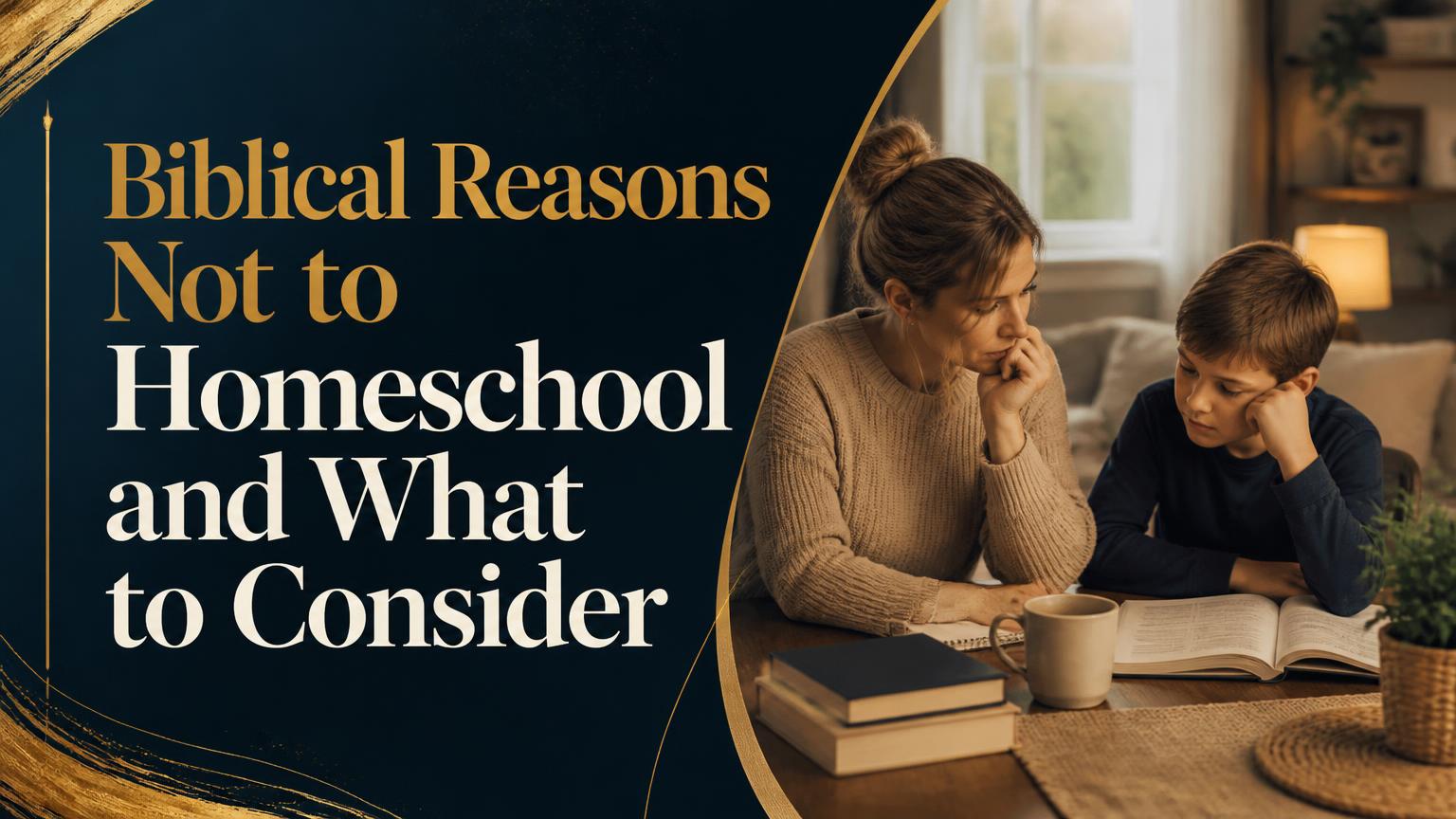
Homeschooling is not commanded or forbidden by Scripture. The Bible gives parents a serious responsibility to disciple and educate their children, but it does not prescribe one educational setting. As a result, there are biblical reasons some Christian families may wisely choose a private school, public school, co-op, or another arrangement rather than homeschooling.
The question is not which model appears most religious. It is which setting best enables a particular family to pursue faithfulness, wisdom, character, academic responsibility, healthy relationships, and love of neighbor.
Biblical Reasons Not to Homeschool
Parents Have Primary Responsibility, Not Exclusive Control
Scripture clearly assigns parents the responsibility to teach and form their children. Deuteronomy 6:6–7 describes parents speaking about God’s commands throughout ordinary life, and Ephesians 6:4 calls parents to bring up their children “in the discipline and instruction of the Lord.”
These passages establish parental responsibility, but they do not require parents to provide every lesson personally or control every part of their children’s education. Teaching faith at home is different from requiring the home to be the only educational environment.
A parent can remain deeply involved while receiving help from teachers, coaches, tutors, church members, or educational institutions. Delegating part of a child’s education does not automatically mean abandoning discipleship. Parents remain responsible for evaluating what their children are taught, discussing difficult ideas, correcting error, and modeling Christian obedience.
For some families, this distinction is important. A parent may faithfully disciple a child while recognizing that another qualified person can teach mathematics, science, languages, special education, or other subjects more effectively.
Children Need the Wider Body of Christ
Christian formation is personal, but it is not intended to be entirely private. The New Testament describes the church as a body with different members and gifts (1 Corinthians 12:12–27). Believers teach, encourage, serve, correct, and bear responsibility for one another. Older Christians are also called to instruct younger believers in practical godliness (Titus 2:3–5).
This does not mean every child must attend a church-run school. It does mean that a family should be cautious about making the home the complete center of a child’s intellectual, spiritual, and social life.
A homeschooling arrangement may provide rich community through a church, co-op, sports team, music program, extended family, or neighborhood. But if homeschooling consistently limits meaningful relationships, prevents children from learning alongside people who are different from them, or leaves the family without accountability, choosing another educational setting may be wiser.
The relevant biblical question is not simply, “Can we keep our children separate?” It is, “Are we helping them grow in truth, love, humility, courage, and responsible participation in the community?”
Wisdom Requires Humility About Capacity and Calling
The Bible repeatedly commends humility, wise counsel, and honest recognition of personal limits. “Without counsel plans fail, but with many advisers they succeed” (Proverbs 15:22). Christian service also depends on different people using different gifts rather than one person attempting every task alone.
Homeschooling demands substantial time, organization, patience, subject knowledge, and emotional energy. A parent may be devoted to the Lord and deeply committed to the children while still lacking the capacity to manage full-time education well.
That limitation may arise from:
- demanding employment or ministry responsibilities;
- health, disability, or chronic illness;
- caring for younger children or elderly relatives;
- financial pressures;
- a child’s specialized academic or developmental needs;
- severe family conflict or exhaustion;
- the parent’s lack of training in important subjects.
Acknowledging these limits is not spiritual failure. It can be an expression of humility and stewardship. A parent who continually teaches while angry, distracted, overwhelmed, or unable to meet a child’s needs may need to reconsider the method rather than simply try harder.
A different school setting can sometimes provide expertise and support that allows the parent to focus more effectively on discipleship, relationship, and wise oversight.
Protection Must Not Become Isolation
Parents should protect children from genuine harm. Christian freedom does not require exposing children to every influence without discernment. Parents may reasonably reject a school environment marked by violence, serious neglect, predatory behavior, or teaching they believe would undermine their responsibilities.
However, protection can become isolation when fear governs every decision. Jesus prayed that his followers would be protected from evil while remaining in the world, not removed from it (John 17:15). Christians are also called to be visible witnesses and to practice love beyond the boundaries of their own household (Matthew 5:14–16).
These passages do not directly prescribe public or private schooling. They do challenge the assumption that maximum separation is always the most faithful response. Children eventually must learn to think, speak, work, and act wisely among people who do not share their beliefs.
Homeschooling may prepare children for that responsibility, but it may also unintentionally shelter them from ordinary differences, disagreement, or service. A family should evaluate whether its educational choices are producing mature discernment or merely reducing exposure to anything unfamiliar.
Family Stewardship Includes Peace, Health, and Justice
A method that looks ideal in theory may be damaging in practice. Scripture treats anger, discouragement, neglect, and disorder as serious concerns within family life. Ephesians 6:4 warns parents not to provoke their children, and James 1:20 teaches that human anger does not produce the righteousness God desires.
If homeschooling produces constant conflict, emotional volatility, marital strain, neglected siblings, financial instability, or serious deterioration in a parent’s health, continuing solely because the method is considered more spiritual may be unwise.
This does not mean difficulty proves homeschooling is wrong. Every educational model involves sacrifice and adjustment. The issue is whether the family’s pattern of sacrifice is producing faithful care or sustained harm.
Stewardship may require changing curriculum, reducing activities, sharing instruction, using a co-op, hiring assistance, or enrolling a child elsewhere. Choosing an alternative can be a responsible way to protect family relationships and meet a child’s actual needs.
Christian Liberty Forbids Treating One Model as a Test of Faith
The Bible does not identify homeschooling, private schooling, or public schooling as a universal mark of Christian obedience. Romans 14:1–12 teaches Christians not to turn disputable practices into tests of righteousness, and 1 Corinthians 10:31 directs believers to honor God in whatever they do.
Applying those principles to education requires care. Schooling is not morally neutral in every detail, and parents must still reject genuine wrongdoing and fulfill their duties. But where Scripture gives no required educational format, Christians should be cautious about condemning families who make different decisions in good faith.
A family may homeschool for sound reasons. Another may choose a school because it provides needed expertise, community, safety, or support. Neither decision automatically demonstrates greater faithfulness. The moral question concerns the family’s motives, responsibilities, practices, and fruit—not the label attached to the educational model.
What the Bible Does—and Does Not—Say About Homeschooling
Deuteronomy 6 Commands Faithful Formation
Deuteronomy 6:6–7 tells God’s people to teach his commands diligently to their children—in the house, while walking, when lying down, and when rising. The emphasis is continual formation. Faith should shape ordinary life rather than being confined to a weekly religious activity.
The passage does not describe a modern homeschooling system. It predates public schools, private schools, and contemporary educational categories. Its central command is that parents must not surrender spiritual formation to an institution. Children should see the reality of faith in the home’s conversations, habits, priorities, repentance, worship, and treatment of others.
A child can receive formal instruction outside the home and still experience this kind of daily discipleship.
Proverbs 22:6 Is Not a Guaranteed Schooling Formula
Proverbs 22:6 urges adults to train a child in the way he should go. It supports intentional instruction, but it does not specify homeschooling, guarantee a particular outcome, or function as a mechanical promise that a correctly trained child can never depart from faith.
The verse should encourage diligence without producing false certainty or guilt. Parents are responsible for faithful teaching, but children are also moral persons who make real choices. No educational arrangement guarantees conversion, wisdom, or lifelong obedience.
The Bible Does Not Treat the Home as the Only Place of Learning
Scripture presents learning through parents, households, teachers, elders, congregations, apprenticeships, correction, and the gathered community. The precise institutions differ across biblical cultures, but the pattern is broader than one household acting alone.
This matters because some arguments against non-homeschool settings assume that any outside influence is inherently disobedient. Scripture does not support that conclusion. The concern is whether the influences shaping a child are truthful, wise, and consistent with the parents’ God-given responsibilities.
How to Discern Whether Homeschooling Is Wise for Your Family
A Christian family can evaluate educational options with several questions:
- What are our motives? Are we responding to a genuine need, or primarily to fear, social pressure, pride, or contempt for other families?
- Can we teach with consistency and patience? Good intentions do not replace time, preparation, emotional stability, or competence.
- What does this particular child need? Children differ in temperament, learning style, disability, maturity, interests, and social needs.
- Will the child have healthy community? Consider relationships with church members, extended family, peers, mentors, and people outside the immediate household.
- How will we maintain accountability? Trusted Christians, qualified educators, and other parents can identify weaknesses that a family may not see by itself.
- What kind of character is the arrangement producing? Academic success matters, but so do humility, responsibility, courage, compassion, honesty, and love.
- Can the family sustain the arrangement? A plan that repeatedly damages health, marriage, finances, or parent-child relationships requires serious reassessment.
Families should compare actual options rather than idealized stereotypes. Public schools vary widely. Private Christian schools vary in theology, quality, and culture. Homeschooling ranges from isolated parent-led instruction to highly collaborative networks. A decision should be based on the real setting available to the child, not on generalizations about an entire category.
The Central Biblical Principle
The Bible gives parents a duty to disciple their children, but it does not give them a mandatory schooling format. Biblical reasons not to homeschool therefore arise from principles of wisdom, community, stewardship, humility, protection, and Christian liberty—not from a verse that directly prohibits home education.
Homeschooling may be an excellent choice for one family and an unwise burden for another. The faithful decision is the one that enables parents to teach God’s truth, care for their children responsibly, seek wise help, and cultivate mature love of God and neighbor.